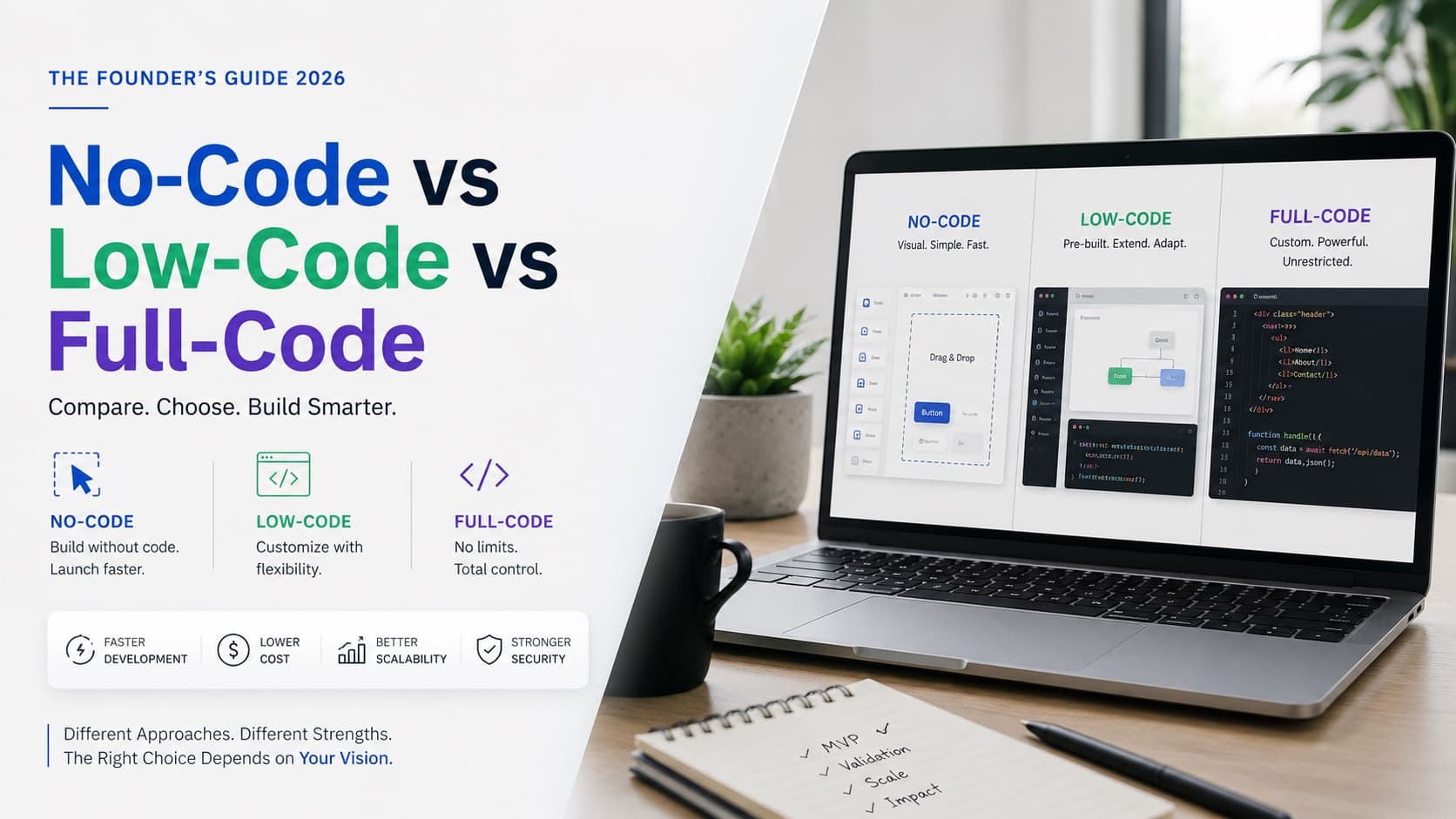

If you’re a founder, you’ve probably had this exact conversation with yourself at 11pm: “Do I hire a developer, learn to build this myself in a tool like Bubble, or just find someone who can write real code?”
I’ve spent years building software architecture and advising early-stage companies on exactly this decision, and here’s the uncomfortable truth: there is no universally “right” answer. There’s only the right answer for where your business is right now — your budget, your timeline, your technical risk tolerance, and how much of your product is actually your competitive advantage versus just plumbing.
This article breaks down no-code, low-code, and full-code the way I’d explain it to a founder sitting across from me, with real platforms, real trade-offs, and a framework you can actually use to make the call — without needing to write a line of code yourself.
The Three Approaches, in Plain English
| Approach | What it really means | Who should be looking at it |
|---|---|---|
| No-Code | You build your product by dragging, dropping, and configuring — no engineer required | Solo founders, non-technical co-founders, anyone testing an idea before spending real money |
| Low-Code | Visual building blocks for 80% of the work, with room for a developer to write custom logic for the other 20% | Small businesses with a technical hire (or contractor) who need speed without sacrificing flexibility |
| Full-Code | Custom-built software, written line by line by engineers | Businesses whose product is the technology, or who’ve outgrown what visual tools can handle |
Now let’s go deeper — because the difference between these three isn’t just “how technical is it,” it’s “how much future flexibility am I trading for speed today.”
No-Code: Your Fastest Path to Proof, Not Necessarily to Scale
No-code platforms let you build a working product — a database, a login system, payment processing, automated workflows — entirely through a visual interface. No syntax, no servers to manage, no developer on payroll.
Tools worth knowing:
- Bubble — the closest thing to a full application builder without code. Founders have used it to launch entire marketplaces and SaaS products, complete with user accounts, databases, and Stripe billing.
- Webflow — for marketing sites and content-heavy pages that need to look genuinely professional, not template-generic.
- Airtable + Zapier/Make — the go-to combination for internal operations: think a lightweight CRM, an order tracker, or an automated onboarding flow connecting your email, Slack, and payment tools.
- Glide — turns a spreadsheet into a functioning mobile app, popular with small businesses building simple booking or inventory tools without touching code.
Why this matters to you as a founder: If you’re validating a business idea, no-code is very likely your best first move. A solo founder can go from idea to a live, testable product — one real customers can sign up for and pay through — in a matter of weeks, for a few hundred dollars a month in platform fees instead of tens of thousands in development costs.
Where you need to be careful: No-code platforms are fantastic for proving demand, but they come with real constraints — performance limits as you scale, restricted customization, and a genuine risk of vendor lock-in (moving off Bubble later, once you’ve built a real business on top of it, is a well-documented headache in startup circles). Think of no-code as a rental, not a foundation. It’s the right call when speed and cost matter more than long-term control — which, for most early-stage ideas, they genuinely do.
Low-Code: The Smart Middle Ground for Growing Businesses
Low-code platforms give you the same visual, drag-and-drop speed as no-code, but with an escape hatch — a place for a developer to write actual code when the visual tools hit their ceiling.
Tools worth knowing:
- Retool — the standard choice for building internal dashboards and admin tools quickly. A single contractor can build you a customer-support panel, an inventory dashboard, or an approval workflow in days rather than weeks.
- Microsoft Power Apps — a natural fit if your business already runs on Microsoft 365; lets non-engineers build approval workflows and internal tools pulling from SharePoint or Excel data.
- OutSystems / Mendix — heavier-duty platforms suited for businesses with more complex operational needs (think logistics, healthcare admin, financial workflows) where a mix of visual building and custom code handles genuinely complicated processes.
- Supabase / Firebase — arguably low-code for your backend: instant database, authentication, and real-time features out of the box, with a developer writing custom logic only where your business actually needs it.
Why this matters to you as a founder: Once your business has real, repeatable operations — not just a product to validate, but internal processes to run — low-code is usually the most cost-efficient way to build the tools that keep your team functioning. You don’t need a full engineering team to get a properly customized internal system; you need one good contractor and the right platform.
Where you need to be careful: Low-code is a genuine sweet spot, but it can quietly become expensive if your custom logic requirements grow too large — you end up paying platform licensing fees and significant developer time, which sometimes ends up costing more than just building it properly from scratch. Ask any developer you hire: “At what point would this be cheaper to build full-code?” A good one will tell you honestly.
Full-Code: Where Your Core Product Should Eventually Live
Full-code means custom software, written by engineers, with no ceiling on what it can do. This is what companies like Netflix, Uber, and Airbnb run on — not because they’re showing off, but because their products, at their scale and with their specific requirements, have no visual-builder equivalent.
Why founders end up here:
- Your product IS the technology. If you’re building a fintech platform with a proprietary trading algorithm, or a healthtech app handling sensitive patient data under HIPAA, there is no drag-and-drop block for that. You need engineers who can write, test, and audit every line.
- You’ve outgrown your no-code/low-code platform. This is one of the most common (and expensive) transitions I help founders navigate: the product that got you to 10,000 users on Bubble genuinely cannot handle 100,000 users without a rebuild. Planning for this transition before it becomes an emergency is one of the highest-value conversations a founder can have with a technical advisor.
- You need real ownership. Full-code means you own every byte of your codebase. No platform can shut down, change pricing, or restrict an API in a way that breaks your business overnight.
Why you need to be careful here too: Full-code is slow and expensive to start. It requires hiring or contracting real engineers, setting up proper infrastructure, and committing to ongoing maintenance. Founders sometimes reach for full-code too early — building a custom backend for an idea that hasn’t even found its first ten customers yet — and burn through runway building infrastructure nobody’s using. Full-code is a serious, long-term investment. Make sure you’re investing it in something you’ve already proven people want.
Head-to-Head: What Actually Matters for Your Decision
| Factor | No-Code | Low-Code | Full-Code |
|---|---|---|---|
| Time to launch | Days to a few weeks | 1–4 weeks | Months |
| Upfront cost | Lowest (subscription only) | Moderate (subscription + contractor) | Highest (dev team or agency) |
| Technical skill needed from you | None | Some, or a part-time contractor | A real engineering hire or agency |
| Ceiling on customization | Low | Medium-to-high | None |
| Risk of outgrowing the tool | High, and soon | Medium | None — you control everything |
| Best for | Validating an idea, MVPs, marketing sites | Internal tools, growing operations, mid-complexity products | Your core product once it’s proven, regulated industries, anything at real scale |
A Framework You Can Actually Use
If you take nothing else from this article, take this: don’t ask “which tool is best,” ask “what am I actually trying to prove or protect right now?” Run your decision through three questions.
1. Am I still validating this idea, or do I know it works? If you don’t yet have paying customers or clear demand, no-code is almost always the right call — regardless of your technical comfort level. Spending real development money before you’ve proven people want the thing is one of the most common early-stage mistakes I see.
2. Is this core to what makes my business defensible, or is it internal plumbing? Your proprietary algorithm, your unique user experience, your core product mechanics — that deserves full-code, eventually. Your internal inventory tracker, your customer support dashboard, your approval workflow — that almost never does. Don’t spend engineering budget on things a $50/month tool already solves.
3. What happens to my business if this platform disappears or changes its pricing tomorrow? If the honest answer is “we’d be in real trouble,” you’ve outgrown that layer of the stack, regardless of how well it’s currently working. This is the question that should trigger the no-code-to-low-code or low-code-to-full-code conversation with a technical advisor — before it becomes a crisis, not after.
A simple rule I give every founder I work with: no-code to prove it, low-code to run it, full-code to own it. Most successful small businesses end up using all three at once — a no-code landing page, a low-code internal dashboard, and a full-code core product — rather than committing to one philosophy for everything.
One Trend Worth Watching
AI-assisted development (tools like GitHub Copilot, Cursor, and Claude Code) is quietly changing this entire calculation. Full-code development is getting dramatically faster because AI handles the repetitive boilerplate, which shrinks the traditional speed advantage no-code and low-code have relied on. At the same time, no-code platforms are adding AI-generated logic, pushing their customization ceiling higher than it’s ever been. If you’re making this decision for the first time in 2026, it’s worth asking any developer or agency you talk to how they’re using AI tooling — it directly affects your timeline and your budget.
The Bottom Line for Founders
No-code, low-code, and full-code aren’t a ladder you climb as your business gets “more serious” — they’re three different tools for three different jobs, and the businesses that scale efficiently tend to use all three, deliberately, at the right moments. The costliest mistake isn’t picking the “less impressive” option. It’s building full-code infrastructure for an idea nobody’s validated yet, or trying to force a no-code platform to do a full-code company’s job. Match the tool to what you’re actually trying to prove, protect, or scale — and you’ll spend your money and your time on the right things.