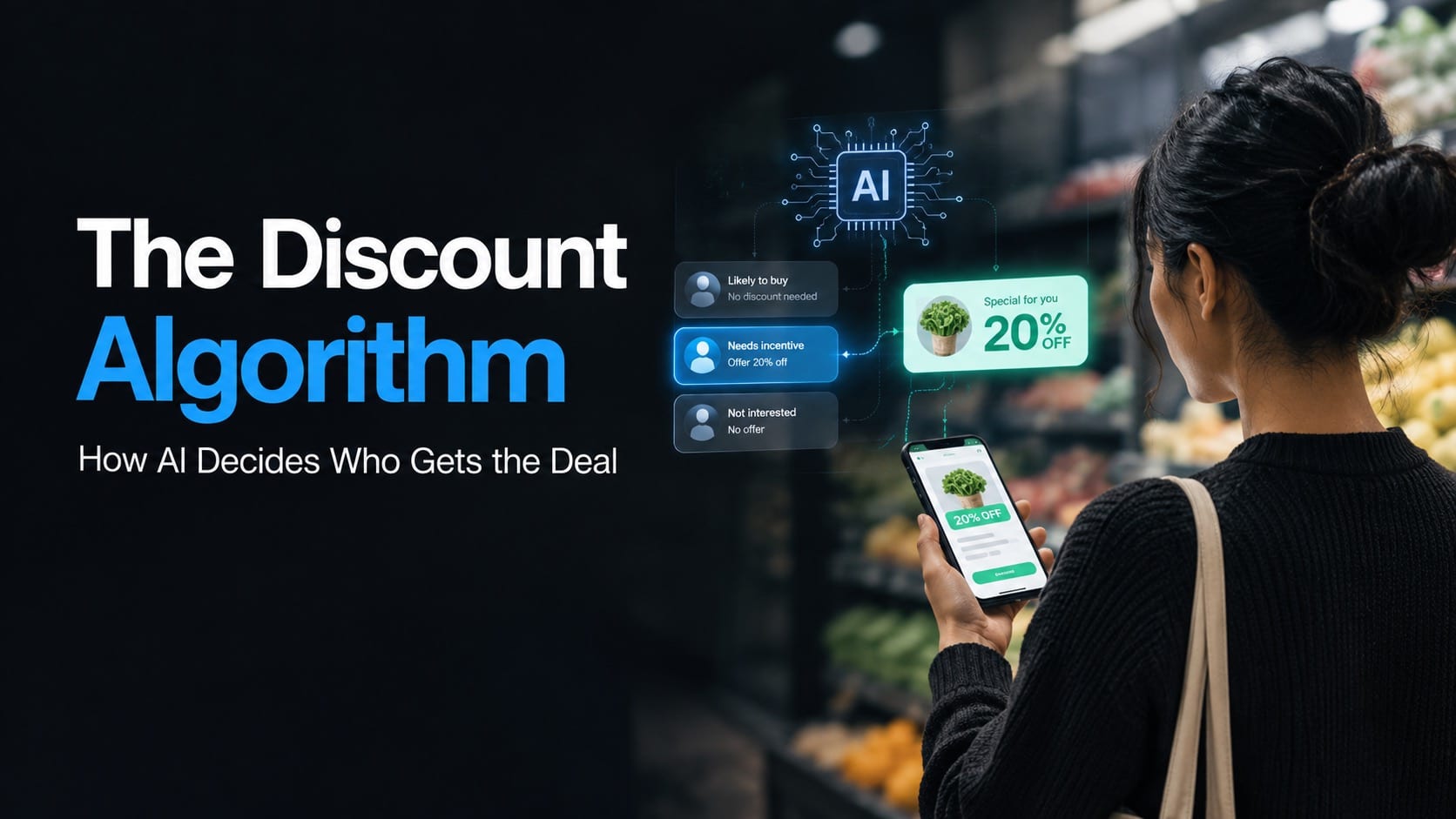

The Discount Algorithm: How AI Decides Who Gets the Deal
A $325 million acquisition, 60 billion machine-learning offers a year, and a grocery platform that says personalized discounts will continue. The software deciding who saves is already in place. The rules for proving the saving are not.
A coupon used to be a printed offer available to anyone who picked it up.
Today, the offer a shopper receives can be selected by software that predicts how that shopper will respond. The industry term is “AI decisioning.” Its purpose is to decide, customer by customer, which incentive to offer and whether to offer one at all.
Instacart has stated that it will continue offering personalized coupons and discounts. Grocery-industry data companies report generating billions of machine-learning offers a year. A customer-engagement platform paid hundreds of millions of dollars for an AI decisioning company in 2025.
The technology raises two questions for anyone on the receiving end of an offer. Who is selected to receive a saving? And discounted from what, compared with whom?
“The algorithm does not need to know what you can afford. It needs to predict what moves you.”
What the Technology Does
AI decisioning combines several kinds of prediction.
Purchase-propensity models estimate how likely a customer is to buy. Uplift models estimate something different: how much an offer changes that likelihood.
The distinction is the core of the system. A customer can be very likely to buy and need no incentive at all. Another customer may buy only after receiving one. Giving the first customer a discount spends money on a purchase that would have happened anyway.
A decisioning engine uses those predictions to select an action for each customer from a menu the business approves: which offer, which message, which channel and which moment. The business defines what counts as success, typically conversion, revenue or margin. The system optimizes for that objective. Maximizing the shopper’s savings is not automatically part of it.
Many systems also learn continuously. Using reinforcement learning, they test alternatives, record each customer’s response and adjust future decisions based on what produced results.
Who Builds It
The technology is commercially established.
Braze, a customer-engagement platform, completed its acquisition of the AI decisioning company OfferFit in June 2025 in a deal announced at $325 million. OfferFit describes its agents as making one-to-one decisions on the optimal way to market to each individual customer. Its co-founder said the system replaces manual A/B testing with reinforcement-learning agents that experiment and learn optimal actions on their own.
dunnhumby, the Tesco-owned customer-data company, reports creating around 60 billion personalized offers a year using machine learning. The company also states that it uses machine-learning techniques to identify which customers are more sensitive to price.
Instacart has owned Eversight, an AI pricing and promotions platform, since 2022.
Academic work documents the method. In 2020, Booking.com researchers published a technique for allocating promotions, such as room upgrades and free meals, to the customers most likely to be influenced by them while staying within return-on-investment limits. The approach was tested in randomized trials on the live platform.
How the Math Works
A simplified illustration shows why the system can give a smaller incentive, or none, to a reliable customer. Assume a product sells for $20 and costs the seller $12.
| Customer | Offer | Predicted purchase probability | Expected gross profit |
|---|---|---|---|
| A | No discount | 80% | $6.40 |
| A | $2 discount | 90% | $5.40 |
| B | No discount | 20% | $1.60 |
| B | $2 discount | 70% | $4.20 |
A system optimizing this model offers Customer B the discount and Customer A none.
Customer A is the more reliable buyer. Customer B is the more persuadable one. The system rewards responsiveness to an incentive, not loyalty. The figures are hypothetical, not observations about any retailer.
Where Grocery Fits
In a July 2026 statement on its pricing principles, Instacart said it ended randomized price tests on its platform in December 2025. It committed that customers shopping the same store location at the same time will see the same item prices, and that it will never use personal information to set item prices.
The same statement separates pricing from discounts. Instacart describes personalized coupons, targeted deals and loyalty rewards as fundamentally different from surveillance pricing, and states that it will keep offering personalized coupons and discounts.
During a 2025 study of its platform, Instacart told researchers that consumer-packaged-goods companies using its advertising products may use behavioral data to inform discounts or promotional offers.
Nothing in Instacart’s public statements discloses a system that calculates the smallest discount each customer needs. The documented point is narrower: personalized offers continue, and the industry sells software built to allocate them.
What the Shopper Sees
A personalized offer is visible to the person who receives it. The offers made to everyone else are not.
That makes the reference price, the number a discount is measured against, the shopper’s only point of comparison.
In December 2025, Groundwork Collaborative, Consumer Reports and More Perfect Union published a pricing experiment on Instacart. Participants added the same items from the same store to their carts at the same time and recorded the prices displayed. The main study stopped short of completing purchases.
In some cases, every participant saw the same sale price while different participants saw different “original” prices beside it. At a Washington, D.C., Safeway, all participants saw a 20-ounce bottle of Heinz ketchup for $4.99. The original price shown beside it varied among $5.29, $5.34, $5.39 and $5.59.
The amount paid was identical. The apparent saving was not.
Researchers said the reason was unclear. They found that shopper characteristics such as age, income and prior Instacart use did not meaningfully explain the price variation. Instacart said the tests were randomized, did not use personal information and ended in December 2025.
Two distinctions follow. Different prices do not establish unlawful profiling. And a discount label alone does not establish a genuine saving.
“A fair price requires a reference point the shopper can see.”
The Rules Are Catching Up to Prices, Not Offers
State law has begun to address personalized pricing. It has largely left offer allocation alone.
Maryland’s Protection From Predatory Pricing Act, in effect since October 1, 2026, restricts large grocery retailers and delivery services from using personal data to set a higher price for a shopper. It exempts specified promotional, loyalty, subscription and consent-based pricing. A system that withholds a discount from a customer predicted to buy anyway does not raise that customer’s price.
New Jersey’s Fair Price Protection Act, scheduled to take effect August 1, 2027, goes further on the reference price. It permits personalized discounts only if they are genuine reductions from the price offered to the public in the seller’s recent, regular course of business, and it requires loyalty programs to disclose their pricing benefits and data practices.
At the federal level, the Federal Trade Commission proposed an enforcement policy statement in August 2026 stating that undisclosed use of personal data to set prices could violate the FTC Act. The statement has not been finalized.
Two Open Questions
AI decisioning is legal, commercially mature and expanding. It changes what a discount is: no longer a public offer, but an individual decision based on a prediction about the person receiving it.
That leaves two questions the shopper cannot answer from a single screen. Who else was offered a saving? And what genuine price was the saving measured against?
Related Articles on IMFounder
- Your Mirror Is About to Start Diagnosing You.
- 15 Explosive AI Updates October 2026: ChatGPT Builds Apps Inside Answers, and more.
- AGI Timeline 2026: 7 Shocking Truths About How Close We Really Are to Human-Level AI
- 15 Explosive AI Updates: OpenAI’s Shock IPO U-Turn, Nvidia’s $13B Power Grab & more..
- The Massive Anthropic IPO May Signal a Dangerous Peak in the AI Bubble
- Your Mirror Is About to Start Diagnosing You
- 5 Powerful Startups You Can Launch With Only $1,000
Sources
- Braze — Braze Completes Acquisition of OfferFit
- dunnhumby — Personalisation, Products, and Price: Some of the Ways dunnhumby Is Using AI
- arXiv — Retrospective Uplift Modeling for Dynamic Promotions Recommendation Within ROI Constraints (Booking.com)
- Instacart — Pricing Principles
- Groundwork Collaborative — Same Cart, Different Price
- Maryland General Assembly — HB 895 Enrolled, Protection From Predatory Pricing Act
- New Jersey Legislature — Fair Price Protection Act, ACS for A4085/A4523 (Third Reprint)
- Federal Trade Commission — Comment Period Extension, Personalized Pricing Policy Statement