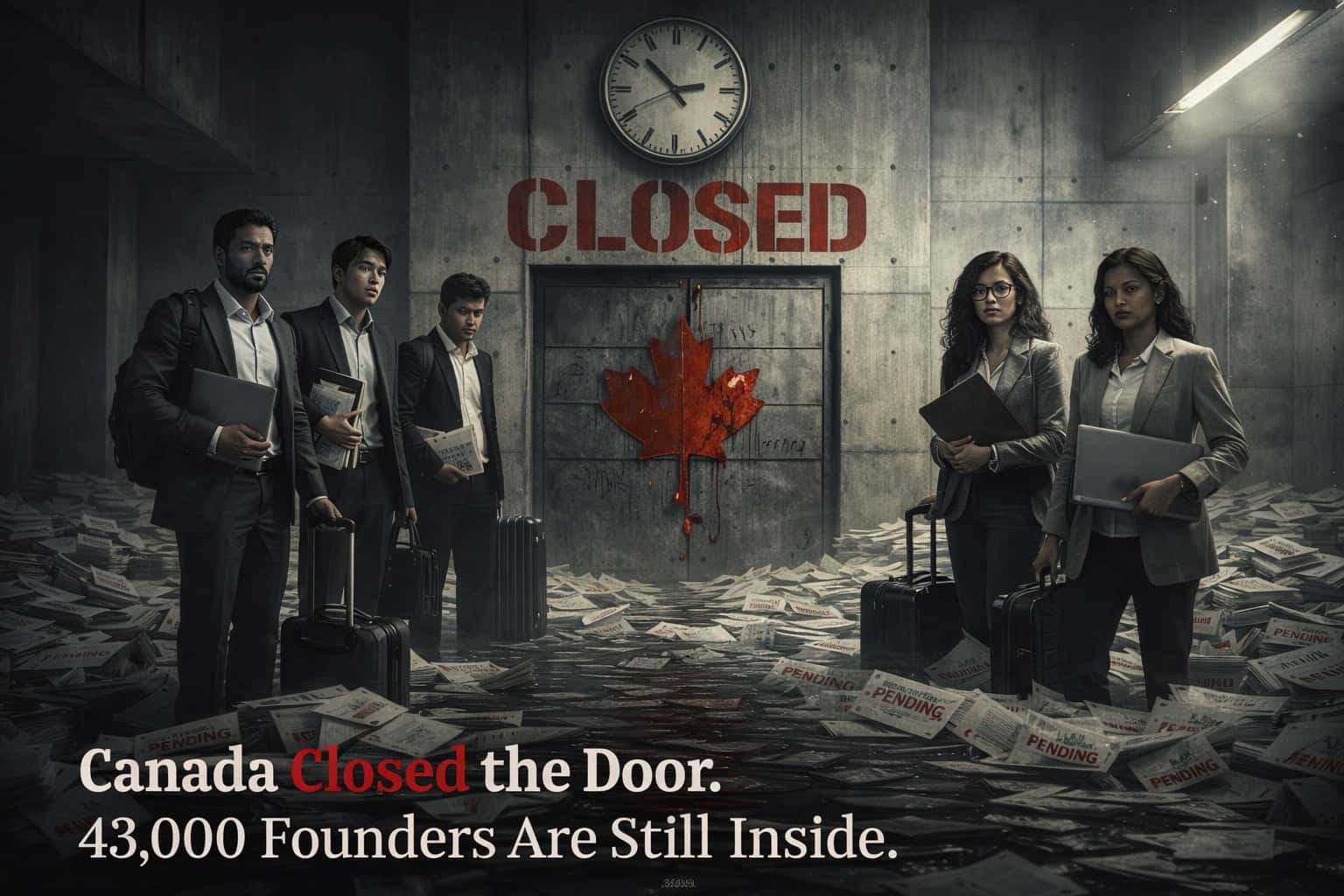

Canada Startup Visa 2026 marks the end of an era — and the beginning of a crisis for over 43,000 founders stuck waiting years for permanent residence in a program that promised to deliver it in six months. The federal government officially closed the Startup Visa (SUV) to new applicants on January 1, 2026. But the real story is not the closure. It is the tens of thousands of entrepreneurs and their families — many split across two countries — who are trapped inside a broken queue with no clear exit, no reliable timeline, and now a new law that gives Ottawa the power to delete their application entirely.
This article breaks down exactly what happened, who is affected, what five real founders experienced, what Bill C-12 actually means for pending files, and what your options look like right now in 2026.
Canada Startup Visa 2026: The Promise vs. The Collapse
The Canada Startup Visa was launched in 2013 with one bold guarantee: if you built something worth backing, Canada would grant you permanent residency within six months. Entrepreneurs from South Asia, Southeast Asia, the Middle East, and across the world lined up. Incubators collected fees. Commitment certificates were issued by the thousands. Then the system collapsed under its own weight.
The program did not fail because of bad founders. It failed because of a structural design flaw that Ottawa ignored for years. The SUV outsourced vetting to designated organizations — venture capital funds, angel investor networks, and business incubators. These organizations were supposed to be gatekeepers. Instead, many became intake machines.
An internal IRCC report from 2023 found that incubators were responsible for four-fifths of all SUV submissions, and that most of the problematic applications came through them. The same report flagged immigration lawyers and consultants who were selling pre-packaged startup concepts designed not to build companies, but to secure immigration status. Despite these findings, not a single designated organization had its status revoked for integrity concerns at the time of that report.
The result was catastrophic. Applications exploded from manageable to uncontrollable. By late 2025, the backlog had reached 43,200 pending files — more than double the 20,000 cases that first triggered government intervention 18 months earlier. The IRCC processing time calculator listed estimated waits for new applicants at more than 10 years. A government transition binder leaked to BetaKit reportedly estimated some cases could take as long as 35 years to process.
On December 19, 2025, Immigration Minister Lena Diab hit the reset button. The Canada Startup Visa 2026 intake closed permanently for new applicants.
Where Every Applicant Stands Right Now
Processing timelines vary dramatically depending on when you applied. Here is the real picture based on IRCC data as of late 2025:
| Application Year | Estimated Remaining Wait | Applicants in Queue |
|---|---|---|
| 2020 | ~1 month — nearly done | ~100 |
| 2021 | ~37 months remaining | ~1,700 |
| 2022 | 10+ years | ~41,400 (combined 2022+) |
| 2023 onward | 10+ years (Bill C-12 risk) | Included above |
Out of 43,200 total pending files, an estimated 41,400 were submitted in 2022 or later. That is the true scale of the crisis facing the Canada Startup Visa 2026 cohort.
5 Real Cases: Founders Reported Online
These are documented, real cases drawn from publicly available forums and major Canadian news coverage — not hypotheticals.
Case 1 — The Family With a Pre-Arrival Letter and 10 Months of Silence
(CanadaVisa Immigration Forum, January 2026)
A family applied for SUV permanent residence in July 2021. Official filing began July 2022. They completed their first medical in December 2023, a second medical in December 2024, and received a Pre-Arrival Letter (PAL) in March 2025. Then — complete silence for over 10 months.
Forum members confirmed that hundreds of applicants in this exact situation had been waiting since early 2024 with PALs in hand but no Confirmation of Permanent Residence (COPR). The community warning was clear: a Pre-Arrival Letter is not a PR approval. IRCC can still request updated business documentation or further information from your designated organization, even this late in the process.
Case 2 — The 2022 Applicant Doing Repeat Medicals With No End in Sight
(CanadaVisa Immigration Forum, February 2026)
A founder submitted their SUV application in August 2022 and completed upfront medicals at the time of filing. In April and May 2024, they were called for re-medicals, submitted biometrics, Schedule A forms, and Police Clearance Certificates for both Canada and their home country. As of February 2026 — over three and a half years after application — they requested their GCMS notes in October 2025 and were still waiting for any final decision.
The repeat medical requests suggest IRCC is actively reviewing the file, which is encouraging. But the timeline shows how far the processing queue extends even for applicants who are clearly being engaged.
Case 3 — Ryo Wu and Allison Le, COOCO Founders
(CBC News, October 2025)
COOCO co-founders Ryo Wu and Allison Le applied for the SUV in October 2022 after the IRCC website showed an 18-month processing window. That window came and went. As reported by CBC News, the delays reshuffled everything — business plans, financial forecasts, and team stability. Wu described the impact plainly: being a temporary resident blocked access to Canadian bank loans and credit entirely. Investors told the team they would not commit capital without founders holding permanent status. Their case represents one of the clearest examples of how SUV delays do not just affect immigration — they directly strangle the business being built.
Case 4 — The Founder With Signed City Contracts and Still No PR
(CBC News, October 2025)
An entrepreneur named Mathew applied for the SUV in August 2021. Despite building a real, operational business — one with signed city government contracts — his temporary resident status blocked access to both venture capital and Canadian banking credit. When IRCC introduced priority processing in April 2024, favouring startups backed by Canadian capital or Canada’s Tech Network incubators, Mathew saw it as a policy that actively moved newer applicants ahead of founders like him who had been in the system for years through other designated organizations. His case illustrates a two-tiered injustice: founders who happened to choose the right incubator moved up the queue; everyone else fell further behind.
Case 5 — The Priority Angel Investor Applicant Waiting in Abu Dhabi
(CanadaVisa Immigration Forum, 2026)
This founder had their PR application received in June 2023, completed biometrics in November 2023, received their first medical clearance in March 2024, got a PAL in April 2024, completed a second medical in January 2026, and applied for an Open Work Permit from Abu Dhabi in March 2025 — which remained pending as of early 2026. Their category is listed as Priority Angel Investor, which theoretically qualifies for faster processing. Yet even in a prioritized category, the applicant is in a multi-year holding pattern, unable to enter Canada on a work permit while their PR is processed abroad.
Split Families: Half in Canada, Half at Home — Who Gets Priority?
This situation affects thousands of SUV applicant families, particularly from India, Pakistan, Iran, and Southeast Asia, where one co-founder or spouse entered Canada on an open work permit while remaining family members stayed abroad waiting for PR approval.
What IRCC’s policy actually says: The 2026–2028 Immigration Levels Plan explicitly states that priority processing will be given to SUV applicants who are already in Canada on valid work permits. This is a formal policy commitment.
What this means in practice:
If the primary applicant is physically in Canada on an active SUV open work permit, their file is significantly more likely to receive active review. Family members abroad are not independently prioritized but are processed as part of the same application file once the primary file moves.
Being in Canada does not guarantee faster processing, but it materially improves the odds of being in the active review queue rather than dormant inventory.
The hard truth for split families:
If the primary applicant is abroad and no work permit was ever obtained or extended, that file faces the highest risk of sitting untouched for years — and under Bill C-12, that risk is now measurably higher. Families in this position should consult an immigration lawyer immediately to explore whether the primary applicant can enter Canada under a different category — such as a C-11 Entrepreneur Work Permit or a Visitor Record — to establish physical presence while the SUV PR application is processed.
Why the Canada Startup Visa 2026 Was Hit This Hard — Other Programs Were Not
This is a critical question. Why did the SUV collapse while other entrepreneur immigration pathways kept moving?
1. Delegated gatekeeping with zero accountability The SUV gave private organizations — incubators, angel networks, VC funds — the power to issue commitment certificates that triggered government PR processing. Unlike PNP entrepreneur streams, where provinces retain direct evaluation responsibility, the SUV created an intermediary layer that was exploited at scale. Nobody was watching the gatekeepers.
2. Volume without vetting By 2024, IRCC’s own data showed that incubators had flooded the system with applications from entrepreneurs who, in many cases, had no genuine business operating or planned in Canada. PNP entrepreneur streams avoided this because they require net worth verification, in-person interviews, business plan assessments, and performance agreements directly with provincial governments.
3. PR before proof The SUV was structurally unusual in offering permanent residency before a founder proved their business works in Canada. Most other entrepreneur pathways require you to operate a business for 12 to 24 months, create jobs, and meet investment thresholds before nomination. The SUV’s PR-first model attracted many applicants who valued the immigration outcome more than the entrepreneurial one — and the system had no mechanism to filter them out early.
4. One federal queue for the entire country Federal programs run through a single national processing queue managed by IRCC. When the federal queue collapsed, every SUV applicant from Vancouver to Halifax was in the same broken line. PNP applicants processed through independent provincial pipelines with different intake caps and timelines — which is why those programs kept moving while the SUV ground to a halt.
For founders researching Canada’s broader immigration ecosystem for startups, our guide to Canada’s AI investment plan and its gaps explains why federal innovation programs consistently overpromise and underdeliver.
Bill C-12: The Biggest Risk to Pending SUV Applications

Bill C-12, formally the Strengthening Canada’s Immigration System and Borders Act, received Royal Assent on March 26, 2026. It is now law. For Canada Startup Visa 2026 applicants still in the pipeline, this legislation introduces a risk that did not exist before.
What Bill C-12 gives the government:
The law grants Cabinet the authority to cancel, suspend, or modify large groups of immigration documents — including work permits and permanent resident visas — and to cancel or suspend the processing of entire categories of applications. These powers are triggered on “public interest” grounds: fraud, administrative errors, public health, safety, or national security. Any order must be approved by Cabinet and published in the Canada Gazette. There is no requirement for IRCC to notify individual applicants directly.
For full details on the legislation, see the official Government of Canada Bill C-12 announcement.
Why this specifically threatens incubator-backed SUV applicants:
Nearly 80% of designated business incubators reportedly fail to meet the April 2024 Ministerial Instructions (MI72). These instructions define what qualifies as a compliant, priority-eligible designated organization under the SUV program. Thousands of SUV PR applications — particularly from Southeast Asia, China, and Iran — were submitted through incubators that do not meet this standard.
Under Bill C-12, IRCC now has the legal architecture to issue a single Cabinet order cancelling all pending PR applications linked to non-compliant incubators simultaneously. Industry insiders and immigration lawyers have identified this as the single highest structural risk for post-2022 applicants.
What Bill C-12 does NOT do:
It cannot revoke PR status once you have already landed and received confirmation of permanent residence. It does not automatically cancel your application simply because it exists — a Cabinet-level order is required, and that order must be published in the Canada Gazette. Express Entry, PNP streams, and other economic PR pathways are completely unaffected.
The legal counter-move — Mandamus:
A 2025 Federal Court ruling in Tousi v. Canada established that prolonged SUV delays can be challenged through a legal tool called Mandamus — a court order compelling IRCC to act on a file. Applicants who have been waiting over 40 months, have met all program requirements, and have documented their follow-up communications with IRCC have a viable path to force their file into active review. For 2021 and early 2022 applicants in particular, consulting an immigration lawyer about Mandamus eligibility may be the most direct action available right now. You can check current IRCC processing times here to assess where your application year stands.
Should You Pursue Other PR Options in Parallel? Yes — Here Is What Is Open
Waiting passively on an SUV application that has not moved in two or more years is not a strategy. Pursuing a parallel pathway does not cancel your SUV application — it builds optionality while keeping you moving.
Provincial Nominee Program (PNP) Entrepreneur Streams Currently the most active route for business immigrants in 2026. British Columbia, Nova Scotia, Saskatchewan, Manitoba, Prince Edward Island, and New Brunswick all have operating streams. Requirements typically include net worth of CAD $300,000–$600,000, a minimum business investment, job creation commitments, and a performance agreement period before provincial nomination. Ontario’s stream remains suspended pending a full redesign.
C-11 Entrepreneur Work Permit The most underused option in 2026. The C-11 allows entry to Canada to establish or acquire a business without requiring designated organization backing. The applicant must demonstrate the venture will create meaningful economic benefit for Canada. Once operating, a PR application through a provincial program or the forthcoming federal pilot becomes available. Immigration lawyers consistently describe this as the most flexible current entry point for founders who are still abroad.
Quebec Entrepreneur Program Operates entirely independently of IRCC’s federal programs. Requires a net worth of CAD $900,000 and a business investment of CAD $300,000. French language proficiency provides a significant processing advantage.
Intra-Company Transfer (ICT) Work Permit If you already operate a business outside Canada, transferring yourself to a Canadian subsidiary or branch as an executive, manager, or specialized knowledge worker qualifies under the ICT stream. This can be a faster entry route while a longer-term PR pathway is developed.
New Federal Entrepreneur Pilot (Expected Mid-to-Late 2026) IRCC has confirmed a redesigned pilot program is coming. Early signals from government sources indicate it will prioritize founders already operating in Canada, focus on AI, cleantech, and life sciences sectors, target 12-month processing timelines instead of the previous 37-plus months, and require proof of active Canadian operations before application.
For founders currently setting up operations while waiting, our guide to the best coworking spaces for startups in Toronto, Vancouver, and Calgary covers where to work and build while your status is resolved.
Practical Action Plan: What to Do Right Now
If you are in Canada on an active SUV work permit:
- Extend your work permit immediately — do not let it lapse under any circumstances
- Document all business activities, revenues, employees, and milestones in writing with dated records
- Confirm your designated organization’s compliance status with MI72 — ask them directly and get it in writing
- Consult an immigration lawyer about whether your incubator qualifies for priority processing
- Explore a parallel PNP application if your net worth meets the threshold
If you are outside Canada waiting for PR:
- Get legal advice on whether you can enter Canada on a C-11 or Visitor Record — physical presence in Canada is now a formal IRCC prioritization factor
- If you have been waiting 40 or more months, ask a lawyer whether a Mandamus application is viable for your file
- Do not assume your file is moving — request GCMS notes to check its actual current status
If your incubator does not meet MI72:
- This is the highest-risk situation under Bill C-12 — treat it as urgent
- Consult an immigration lawyer immediately to assess whether your application can be restructured or whether switching to an angel investor or VC-backed commitment certificate is possible
- Monitor the Canada Gazette weekly for any group cancellation orders targeting non-compliant incubator applications
What Comes Next
The era of volume-first entrepreneur immigration in Canada is finished. The Canada Startup Visa 2026 closure is not a pause from which the same program returns — it is a reset toward a smaller, stricter, performance-driven replacement.
IRCC’s direction is unambiguous: founders who are already in Canada, already operating a business, already creating Canadian jobs will be the priority. The new pilot, when it arrives, will reward execution over planning and results over promises.
For the 43,000 founders currently in the pipeline, the most important truth is this: your application is not dead, but your strategy cannot remain the same. The rules changed in December 2025, changed again in March 2026 with Bill C-12, and will change again when the new pilot launches. Staying passive is the highest-risk position you can hold.
If you are building a startup and need an honest assessment of your idea, market, and immigration strategy before making a major move, IMFounder’s Founder Review service is designed exactly for that moment.

Frequently Asked Questions
Q: Is Canada’s Startup Visa completely closed in 2026? Yes. The Canada Startup Visa 2026 is closed to new applicants as of January 1, 2026. Only founders with a valid 2025 commitment certificate have until June 30, 2026 to submit their PR application. No new commitment certificates are being issued.
Q: What happens to my SUV PR application that is already submitted? Your application continues to be processed. Priority is given to applicants who are physically in Canada on valid SUV work permits and those backed by designated organizations that meet the April 2024 MI72 ministerial instructions. If neither applies to you, your file is in the general inventory queue.
Q: Does Bill C-12 automatically cancel my startup visa application? No. Bill C-12 gives the government authority to issue group cancellation orders through a Cabinet approval process published in the Canada Gazette. No such order targeting SUV applications has been issued yet. However, applicants backed by non-MI72-compliant incubators face elevated risk and should seek legal advice now.
Q: If half my family is in Canada and half abroad, do we get prioritized? IRCC prioritizes applicants who are physically in Canada on valid work permits. Family members abroad are not independently prioritized but are processed as dependents on the same file once the primary applicant’s file moves into active review.
Q: Can I apply for a PNP or other PR pathway while my SUV application is pending? Yes. Pursuing a PNP entrepreneur stream, C-11 work permit, or other pathway does not cancel or negatively affect your SUV application. For most 2022-plus applicants, exploring parallel pathways is not optional — it is essential.
Q: What is Mandamus and can I use it? Mandamus is a Federal Court order compelling a government body to act on a decision it has unreasonably delayed. Following the 2025 Tousi v. Canada ruling, it is a recognized and viable route for SUV applicants who have waited more than 40 months, met all program requirements, and can document their follow-up efforts with IRCC. Consult an immigration lawyer to assess whether your file qualifies.
Related Articles on IMFounder
- Canada’s AI Investment Plan: Bold Numbers, Familiar Gaps — Why federal tech ambition keeps outpacing delivery
- Best Coworking Spaces for Founders in Toronto, Vancouver, and Calgary in 2026 — Where to build while immigration resolves itself
- SaaS Tools Every Canadian Startup Needs in 2026 — Build lean while you wait
- Founder Review: Validate Your Startup Before You Move — IMFounder’s advisory service for pre-immigration founders
IMFounder covers tech, AI, entrepreneurship, and immigration for founders building across Canada, the USA, and Asia. Have a startup visa story to share? Write to us at admin@imfounder.com