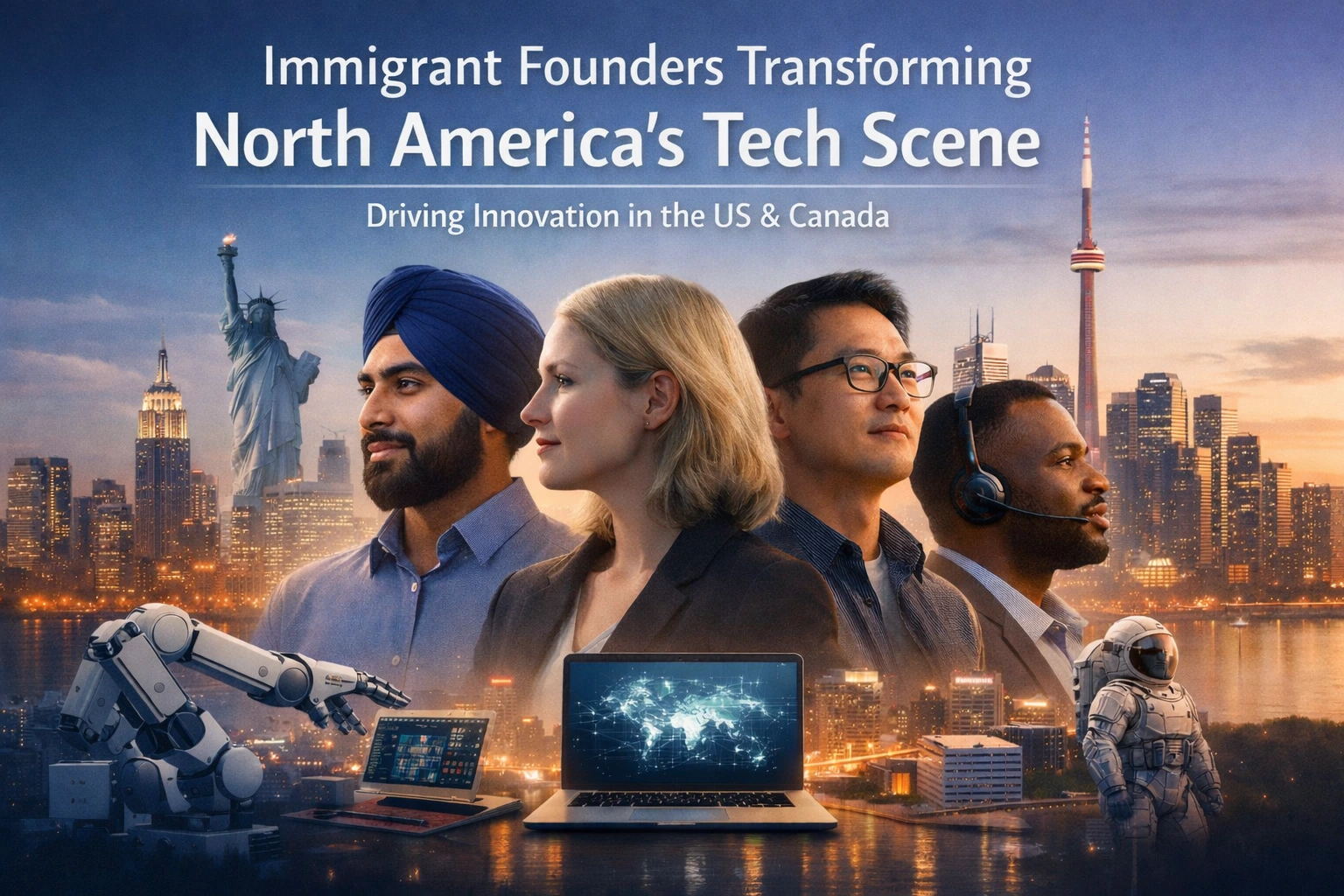

In the past three decades, North America’s technology landscape has been profoundly shaped by immigrant founders — entrepreneurs born outside the United States and Canada who are now leading some of the world’s most influential startups and tech giants. Far from being a side note in the innovation story, immigrant founders are at the heart of North America’s competitive edge in artificial intelligence, software, semiconductors, and platform-based business models.
From the early days of Silicon Valley to the emerging startup hubs of Toronto and Montreal, foreign-born founders are building companies that create jobs, attract capital, and push the boundaries of what technology can do. Their rise reflects both a global talent pipeline and structural dynamics unique to North American markets — including access to top universities, deep capital pools, and a culture that rewards risk.
A Quantitative Lens: The Immigrant Contribution by the Numbers
To understand the scale of impact, consider these broad metrics:
- A significant portion of U.S. startups valued over $1 billion (unicorns) have at least one immigrant founder.
- In Canada, immigrants represent a disproportionately high share of tech entrepreneurs relative to their share of the population.
- Immigrant-founded startups in both countries employ tens of thousands and contribute billions to GDP.
These figures underline a pattern: immigration and technological innovation are deeply connected economic drivers, not coincidental phenomena.
Why Immigrant Founders Are Overrepresented in Tech
Several structural and psychological factors help explain this overrepresentation:
1. Self-Selection and Risk Tolerance
People who choose to move countries — especially across continents — exhibit higher risk tolerance, adaptability, and resilience. These traits translate directly into entrepreneurial success, where uncertainty and pivoting are constant.
2. Global Perspective
Immigrant founders often bring a global mindset from day one. Their lived experience navigating multiple cultures and markets gives them an intuitive advantage in designing products and platforms with international appeal.
3. Talent Magnetism of North American Institutions
World-class research universities — including MIT, Stanford, UBC, and the University of Toronto — attract top global talent. Many founders begin their journeys as students or researchers before transitioning into entrepreneurship, bringing deep technical expertise alongside entrepreneurial ambition.
4. Network Effects and Community Clusters
Ecosystems like Silicon Valley, New York, Boston, and Canada’s “Tech Triangle” (Toronto–Waterloo–Montreal) benefit from dense networks of investors, mentors, and talent, which immigrant founders often tap into successfully.
Profiles of Influence: Immigrant Founders Who Transformed Tech
Rather than traditional biographical sketches, what stands out is how these founders leveraged North America’s ecosystem to scale globally.
United States
- Sergey Brin — Co-founder of Google, Brin fled the Soviet Union and helped build one of the most transformative tech platforms in history.
- Elon Musk — Born in South Africa, Musk’s ventures — including SpaceX and Tesla — have reshaped aerospace and the automotive industry.
- Jensen Huang — Taiwanese-born founder of NVIDIA, a cornerstone company powering modern AI and graphics computing.
Canada
- Tobias Lütke — German immigrant and founder of Shopify turned Canada into a global ecommerce tech hub.
- Stewart Butterfield — While Canadian-born, Butterfield’s path in global tech highlights the international flows of talent that define Canada’s startup identity.
These founders illustrate a broader narrative: immigration status did not limit ambition — it amplified it within North America’s innovation ecosystem.
Sectoral Dynamics: Where Immigrants Drive Innovation
Immigrant entrepreneurship is not evenly distributed across industries. Certain high-growth verticals show particularly strong representation:
Artificial Intelligence
AI stands as one of the most globally competitive tech sectors. Many startups in robotics, machine learning, and autonomous systems are led by founders with backgrounds from Asia, Europe, and the Middle East — combining rigorous technical training with market access in North America.
Software as a Service (SaaS)
Platforms designed for global businesses — from messaging to logistics — often originate from immigrant founders who think beyond local markets from day one.
Semiconductors & Hardware
With rising global competition, companies at the intersection of silicon and software have become economically and strategically vital — and immigrant leadership has been a defining feature in this realm.
Biotech & Health Tech
The diversity of scientific training and funding approaches brought in by immigrant founders enriches innovation in therapeutics, diagnostics, and computational biology.
Ecosystem Challenges and Policy Implications
Despite their contributions, immigrant founders face structural headwinds:
- Visa bottlenecks and policy uncertainty in the U.S. can slow founder mobility.
- Funding biases may skew investment toward founders who fit certain cultural norms or networks.
- Uneven access to resources persists between major hubs and smaller cities.
Canada’s Startup Visa and prioritized immigration pathways partially mitigate arrival barriers, allowing many founders to integrate into innovation clusters more rapidly. Nevertheless, both countries grapple with balancing national labor priorities with the need to maintain global competitiveness in tech leadership.
The Future: AI, Remote Work, and the Next Generation of Founders
As remote and hybrid work reshape talent flows, the future may feature even more fluid founder movements across borders. Immigrant founders are increasingly building startups that:
- Operate globally from inception.
- Leverage diasporic networks for fundraising and talent.
- Target emerging markets with tailored solutions.
Simultaneously, second-generation immigrant entrepreneurs — raised and educated within North America — are beginning to launch their own ventures, blending multicultural insights with local market expertise.
Conclusion: Immigration as Innovation Infrastructure
Immigrant founders are not simply contributors to North America’s tech scene — they are architects of its evolution. Their stories illustrate how global talent, when coupled with access to capital and supportive ecosystems, can produce outsized economic and technological impact.
As North America competes with other regions for leadership in AI, biotech, and digital platforms, supporting immigrant innovation — through policy reform, capital access, and inclusive networks — will be crucial to sustaining growth and global relevance.