
Walk into any café, college campus, or co-working space today and ask a Gen Z founder what they do—you probably won’t get a single answer.
“I’m a designer… and I run a small Instagram page… and I freelance on weekends.”
That “and” is the story.
For Gen Z, work isn’t one lane anymore. It’s a stack.
The New Career Isn’t a Job. It’s a System.
There was a time when having multiple jobs meant instability. Today, for Gen Z, it signals control.
A full-time job is no longer the end goal—it’s just one layer of income. Around it, young professionals are building side streams that range from freelance gigs to content channels to digital products.
Not because it’s trendy. Because relying on one paycheck feels risky.
You can see the logic. One company can lay you off. One skill can become outdated. One platform can disappear.
But five income streams? That’s harder to wipe out.
This Isn’t Hustle Culture. It’s Risk Management.
There’s a tendency to frame this as “hustle culture 2.0”—Gen Z grinding harder than everyone else.
That misses the point.
Most aren’t chasing Lamborghinis or viral success. They’re building safety nets.
A part-time freelance client covers rent if a job goes sideways. A small YouTube channel pays for groceries. A digital product generates passive income in the background.
Individually, these streams might look small. Together, they change the equation.
Freedom, in this context, isn’t quitting your job overnight.
It’s knowing you could, if you had to.
The Internet Turned Skills Into Income
None of this works without the infrastructure.
Ten years ago, monetizing a skill required connections, credentials, or capital. Now, it requires distribution.
- Designers sell templates globally
- Writers land clients through Twitter or LinkedIn
- Developers ship micro-tools and monetize them instantly
- Creators build audiences first, then layer revenue on top
Platforms did something subtle but powerful: they removed the gatekeepers.
And Gen Z walked right through.
Where Attention Meets Income
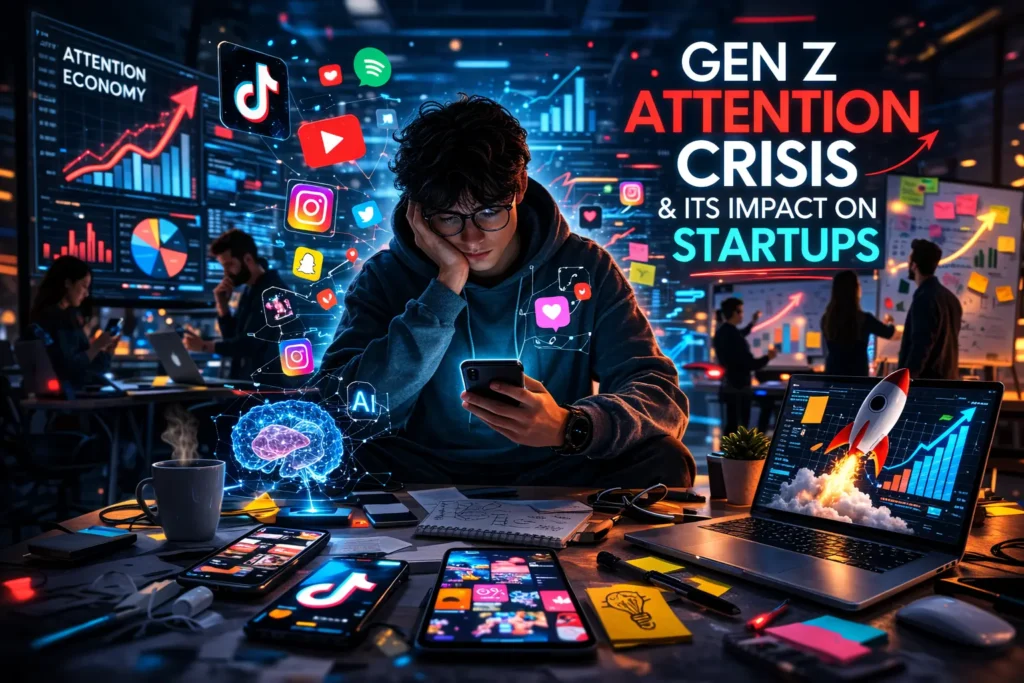
This is where our earlier IMFounder coverage becomes relevant.
In “Gen Z Attention Span Crisis & Startups” and “Attention Economy vs Skill Economy,” we explored how attention—not just skill—is becoming the new currency online.
That shift is now directly shaping income.
Because today, what you know matters—but what you can distribute matters more.
A great designer with no audience competes on price.
A decent designer with 50,000 followers sells at a premium.
That’s not a bug. That’s the system.
Gen Z understands this intuitively. They don’t just build skills—they build visibility alongside them.
And once you have attention, monetization becomes modular:
- Ads
- Sponsorships
- Digital products
- Paid communities
Income streams start to layer naturally.
The Rise of “Micro-Entrepreneurship”
Not everyone is building the next big startup.
In fact, most aren’t.
What Gen Z is really building is something quieter: micro-businesses.
Small, focused, often solo-run operations that generate consistent income without massive scale.
Think:
- A niche newsletter with 2,000 loyal readers
- A Notion template store making a few hundred dollars a month
- A faceless YouTube channel generating ad revenue
- A freelance pipeline that never fully dries up
None of these sound like headlines.
But together, they can replace—or outperform—a traditional salary.
AI Is Accelerating Everything
If this trend had a turbocharger, it’s AI.
Tasks that used to take hours—editing videos, writing drafts, designing assets—now take minutes. That changes the math.
A single person can now run what used to require a small team.
And that’s critical for side hustles, because time is the biggest constraint.
With AI:
- Content gets produced faster
- Ideas get tested quicker
- Systems get automated earlier
It doesn’t just make work easier.
It makes multiple streams feasible.
The Trade-Off No One Talks About
There’s a polished version of this story on social media: multiple incomes, flexible life, working from anywhere.
The reality is messier.
Managing multiple streams isn’t passive. It’s fragmented.
You’re switching contexts constantly—client work, content, admin, growth. There’s always something to optimize, something to improve.
And the line between “free time” and “productive time” starts to blur.
That’s where burnout creeps in.
Gen Z is aware of it. You can see the conversation shifting from “hustle harder” to “build smarter.”
Because stacking income only works long-term if it’s sustainable.
What Freedom Actually Looks Like
The biggest misconception is that multiple income streams are about making more money.
They’re not.
They’re about removing dependency.
When one stream dips, another holds.
When one opportunity disappears, another fills the gap.
That’s a different kind of security—one that doesn’t rely on a single employer, industry, or platform.
And that’s why this shift matters.
Gen Z isn’t rejecting work.
They’re redesigning it.
The Bottom Line
The old model was simple: one job, one path, one paycheck.
Gen Z replaced it with something more complex—but more resilient.
Multiple streams. Flexible identity. Distributed risk.
It’s not as clean. It’s not always easier.
But it gives them something previous generations rarely had:
Options.