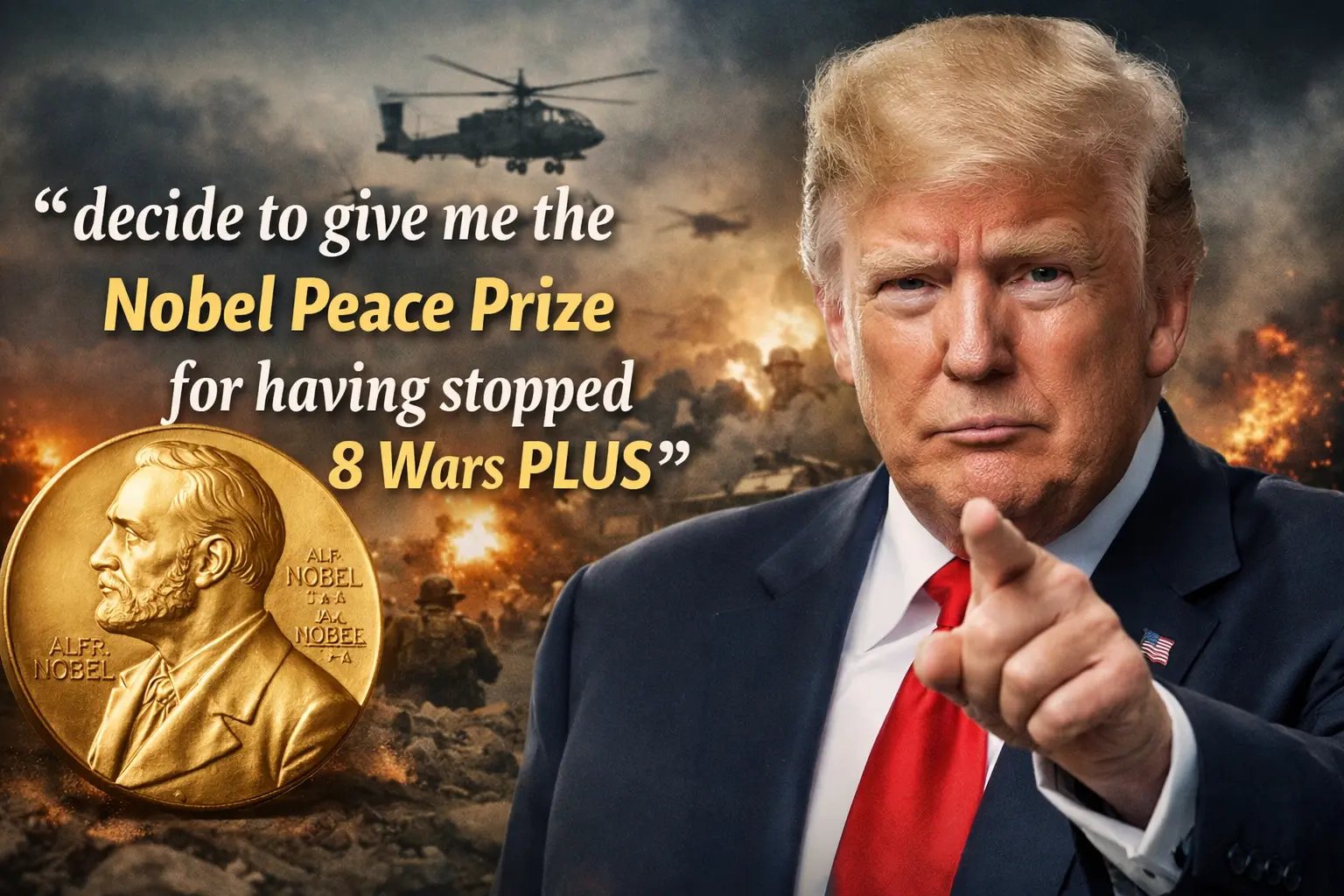

In early 2026, a diplomatic firestorm erupted after U.S. President Donald Trump sent a blunt message to Norwegian Prime Minister Jonas Gahr Støre, in which he controversially tied his push for American control of Greenland to his frustration over not receiving the 2025 Nobel Peace Prize. Trump wrote that because he hadn’t been awarded the prize, he “no longer feels an obligation to think purely of peace,” and went on to justify a forceful campaign for Greenland — a territory of the Kingdom of Denmark — on strategic security grounds.
This message was reportedly forwarded by Norway to several European ambassadors in Washington, escalating the diplomatic fallout.
Trump’s Nobel Prize Grievance
Trump’s text from January 18, 2026, claimed the Nobel committee’s choice not to honor him — he stated it did not “decide to give me the Nobel Peace Prize for having stopped 8 Wars PLUS” — was a key reason he felt freed from prioritizing peace in policy. Trump suggested that Greenland is vital to global and American security and argued Denmark could not defend the island against Russia or China.
It’s important to note that the Nobel Peace Prize is awarded by an independent Norwegian Nobel Committee, and not by the government of Norway or its prime minister. Norway’s leaders have repeatedly clarified this point to Trump’s administration.
Why Greenland Matters
Greenland is geographically strategic, located between North America and Europe, directly adjacent to the Arctic. It hosts valuable mineral resources and plays a role in Arctic defense infrastructure, including early-warning radar and NATO-linked operations. Trump argued that without U.S. control, Greenland could fall under Russian or Chinese influence — claims that European officials challenge as exaggerated.
Trump’s message, and subsequent social media posts on Truth Social, also threatened tariffs on European nationsopposing U.S. aims, a move that risks transatlantic economic friction.
Denmark and Greenland’s Response
Denmark and Greenlandic authorities have condemned any notion of U.S. annexation or coercive acquisition. Danish leaders reaffirm that Greenland’s future and sovereignty are matters for Denmark and Greenland alone, based on international law. Greenland’s prime minister declared that the island “chooses Denmark… NATO… and the EU,” explicitly rejecting U.S. takeover efforts.
Thousands of Greenlanders have protested Trump’s rhetoric and perceived threats. Meanwhile, Denmark and Greenland have engaged in diplomatic talks with U.S. envoys, seeking to calm relations.
NATO Allies and European Union Reaction
Trump’s push has strained relations within NATO. Many alliance members oppose using tariffs or aggressive postures to pressure sovereign allies like Denmark. Some Western European leaders have stressed that Arctic security should be managed cooperatively through NATO and international law, rather than through unilateral demands.
At an emergency style session at NATO headquarters in Brussels, Nordic and European officials emphasized diplomatic de-escalation and reaffirmed Denmark’s rights over Greenland.
The European Union has discussed potential retaliatory tariffs and economic measures in response to U.S. threats. Such trade pressure could have significant economic consequences for U.S.–EU relations.
China and Russia in the Background
Although Trump frequently frames his strategy in terms of competition with China and Russia, neither nation has formally sought control of Greenland. However, both have shown interest in Arctic shipping routes and mineral exploration, which fuels debate about future geopolitical competition in the region. European officials argue that including China and Russia in the conversation should not justify unilateral U.S. actions that violate alliance norms.
National Security or Personal Grievance?
Analysts are divided over interpreting Trump’s actions. Some U.S. officials defend his stance as a legitimate national security concern regarding Arctic defense and supply lines. Others, both domestically and internationally, see an element of personal grievance playing into foreign policy — especially involving the Nobel Peace Prize, an award not tied to American governance or Norway’s executive branch.
Conclusion
The ongoing crisis highlights how personal political narratives can intersect with global diplomacy, affecting alliance cohesion, trade relationships, and Arctic geopolitics. As NATO allies, Denmark, Norway, and European partners seek to maintain unity and uphold international law, Trump’s controversial linkage of national security goals to a Nobel Prize disappointment underscores the complex blend of personality, power, and policy in modern geopolitics.