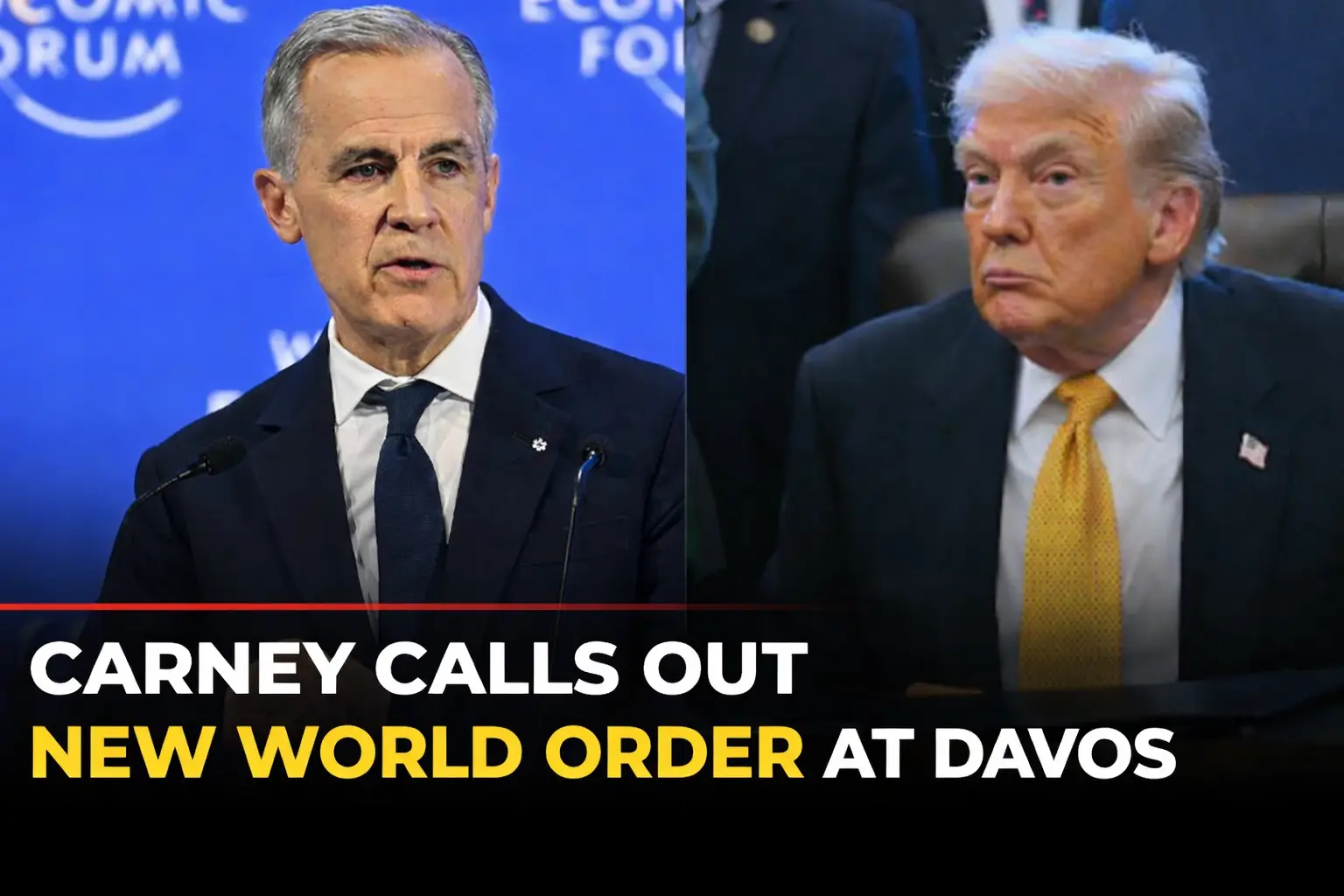

In a headline-grabbing address at the World Economic Forum (WEF) in Davos, Switzerland, Canadian Prime Minister Mark Carney articulated a bold vision for a shifting global order, challenging long-standing assumptions about international economic leadership and alliances. His speech framed what he described as a rupture in the old rules-based system, urged middle powers to act together, and highlighted deeper engagement with China as part of Canada’s strategic economic diversification. The implications of Carney’s address stretch beyond diplomacy — touching on Canada’s economic growth prospects and the United States’ geopolitical and economic standing.
1. The Core Message: “The Old Order Is Not Coming Back”
Carney’s speech stressed that the post-World War II, U.S.-led rules-based international order is undergoing a fundamental transformation. He argued that great powers no longer operate under predictable frameworks, and instead use economic integration as leverage or coercion. This, he said, has eroded the stability countries once relied upon.
According to Carney:
- The familiar global system, shaped by multilateral institutions and anchored by American economic leadership, no longer reliably guarantees stability.
- Canada and similarly positioned middle powers must adapt — not by building isolationist walls, but by building new coalitions and diversified partnerships.
- Simply complying with dominant powers will not secure safety or prosperity.
His message resonated with leaders from Europe and Asia at Davos, where tensions over tariffs, security interests in the Arctic, and shifting alliances dominated discussions.
2. Strategic Pivot: Canada’s Engagement With China
A key element of Canada’s new strategy, as highlighted by Carney’s wider diplomatic efforts, is intensified economic engagement with China. In January 2026, Carney concluded a strategic partnership and tariff restructuring with Beijing — a meaningful reset after years of strained ties.
Highlights of this evolving China-Canada economic relationship include:
- Reduced tariffs on Chinese electric vehicles into Canada, reversing punitive levies.
- Lowered Chinese duties on Canadian agricultural exports, such as canola seeds — potentially unlocking billions in trade.
- Increased cooperation in energy exports, tourism, and finance.
Carney has described this partnership as pragmatic, emphasizing that Canada will “take the world as it is — not as we wish it to be.”
This shift does not mean abandoning Canadian values, he says, but rather balancing strategic autonomy with diversified economic ties — a theme echoed in his Davos remarks about middle powers building strength together. PM of Canada
3. Economic Significance for Canada
Diversification and Resilience
Carney’s approach aims to reduce Canada’s economic dependence on its largest trading partner — the United States. At present, nearly 70 % of Canadian exports go to the U.S. market. By broadening markets — especially through China and other nations — Canada increases its trade resilience and access to global supply chains.
Boost to Key Sectors
Deeper ties with China can stimulate growth in:
- Agriculture: Expanded access to Asia’s largest market for canola and other commodities.
- Manufacturing and EV supply chains: Lower EV import duties could spur competition, consumer choice, and industry growth.
- Energy and critical minerals: China is a major player in global energy markets and renewable technologies — sectors where Canada holds natural advantages.
Geopolitical Leverage
By building diversified partnerships — including with the European Union and emerging markets — Canada may gain greater diplomatic leverage, even as global power dynamics evolve.
Moreover, Carney’s call for coalition-based action rather than strict reliance on traditional institutions signals a new Canadian role as a convening middle power — able to navigate between Western alliances and growing Asian markets.
4. Impact on the United States
Shift in Economic Influence
Carney’s framing implies a relative decline in U.S. economic dominance. As Canada and other nations pursue diversified partnerships, U.S. influence over global trade patterns may decrease. Every major trading partner developed outside the traditional U.S. umbrella chips away at American economic exclusivity.
Global Leadership and Trust
Carney’s remarks suggest that allies may be recalibrating their trust in the United States as the sole economic anchor — particularly when geopolitical competition intensifies. If countries like Canada build robust ties with China and others, the U.S. risks losing not just market share, but diplomatic influence.
Supply Chain and Currency Dynamics
Changes in trade networks could eventually influence:
- Supply chain redundancies: Firms may diversify away from reliance on U.S. markets.
- Reserve currency roles: Wider use of alternative currencies in trade settlement could affect the global dominance of the U.S. dollar, though this remains a long-term and complex trend.
5. A New World Order? Not a U.S. Exit, But a Shared Multipolar Future
Carney stopped short of claiming the U.S. will be entirely marginalized. Instead, he painted a picture of a multipolar global order where middle powers like Canada, along with the EU, ASEAN nations, and others, shape issue-specific coalitions based on shared interests and values. Yahoo News
This emerging order would not eradicate U.S. leadership, but dissipate its unilateral control. In such a world, no single nation dictates terms — instead, interdependence and cooperation become more distributed.
Conclusion: An Evolving Economic and Diplomatic Landscape
Mark Carney’s Davos speech marks a significant pivot in international economic discourse. By acknowledging the limits of the old rules-based order and embracing diversified diplomacy — including renewed engagement with China — Canada signals a strategic evolution likely to reshape trade, influence, and growth.
For Canada, this approach could mean enhanced resilience, new markets, and amplified international relevance.
For the United States, the shifting dynamics present both challenges and opportunities: the challenge of maintaining economic influence in an increasingly multipolar world, and the opportunity to lead through renewed cooperation rather than dominance.
In either outcome, Carney’s articulate call for adaptive cooperation — not isolation — underscores a pivotal moment in global economic policy. PM of Canada