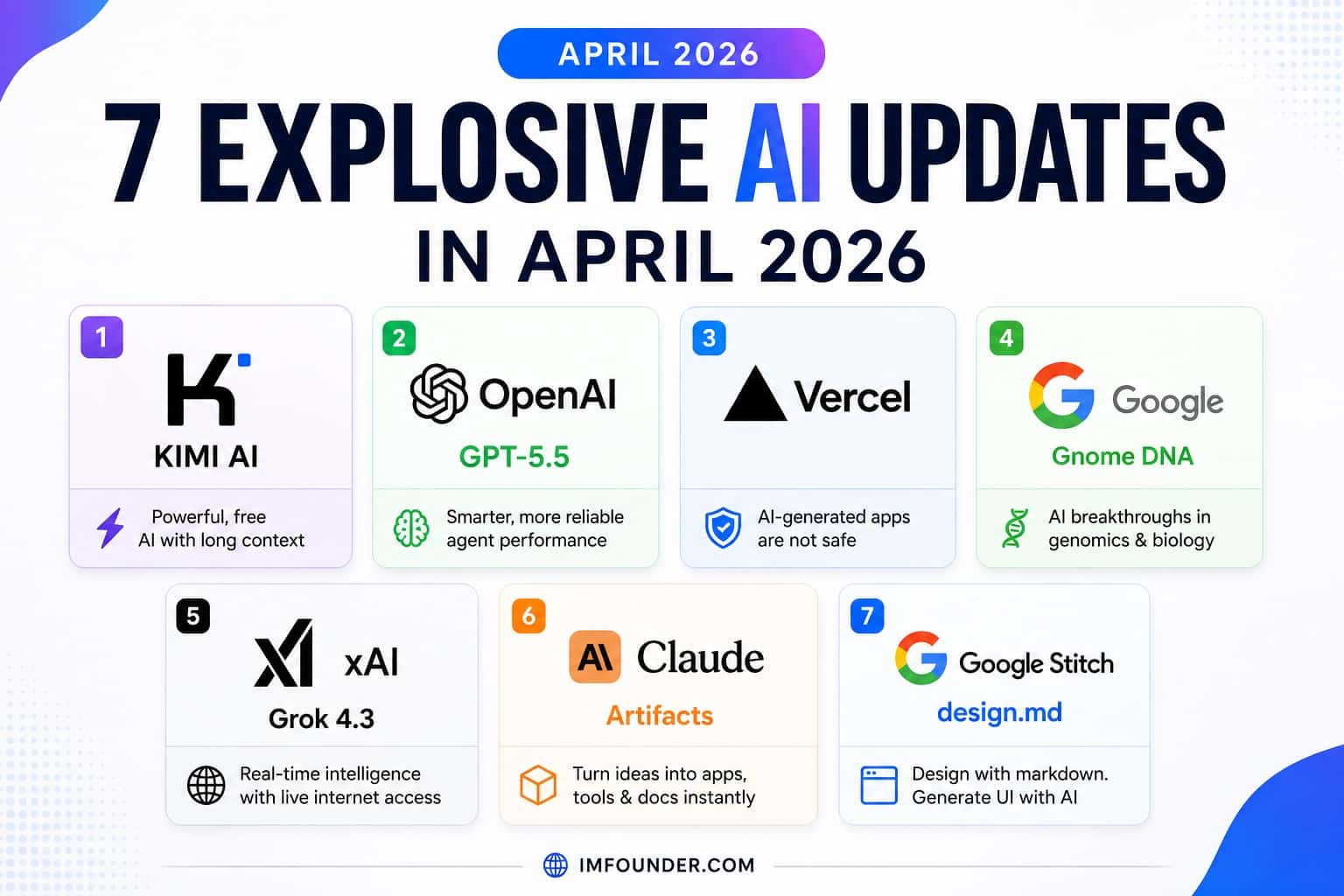

AI Updates April 2026: The Seven Biggest Breakthroughs Founders Must Watch
AI Updates April 2026 are not incremental improvements — they represent a platform shift. This month alone introduced new models, new security concerns, AI-native developer workflows, and even AI pushing into biology.
These updates affect founders, product teams, developers, and investors differently — but one thing is clear:
The AI stack is moving faster than startup roadmaps.
Here are the 7 most important AI updates from April 2026 that every founder should understand.
1. Kimi AI Is Becoming the Most Dangerous Free AI Model
Chinese AI lab Moonshot AI released major upgrades to Kimi AI, and the positioning is aggressive: high-performance, free, and long-context.
Kimi’s improvements include:
- Massive context window (millions of tokens class)
- Strong coding and reasoning benchmarks
- Free-tier access competing with paid models
- Faster inference compared to many premium tools
This matters because pricing pressure is now real. Founders building AI SaaS must prepare for zero-cost competitorspowered by models like Kimi.
The biggest strategic takeaway:
Distribution and product UX now matter more than model access.
2. OpenAI GPT-5.5 Quietly Expands Capabilities
OpenAI continues its rapid release cycle with GPT-5.5, a mid-generation upgrade focused on:
- Improved agent behavior
- Better tool usage
- More consistent reasoning
- Reduced hallucinations
- Faster multi-step execution
GPT-5.5 isn’t just smarter — it’s more reliable in production, which is what startups actually need.
The shift here is subtle but important:
AI is moving from chat tool → execution engine
That changes product architecture. Instead of building logic in code, founders can now delegate workflow logic to AI agents.
3. Vercel Warns: AI-Generated Apps Are Not Safe
Deployment platform Vercel raised a serious concern:
AI-generated apps are increasingly vulnerable to hackers.
The issue stems from:
- AI writing insecure authentication logic
- Weak API protection
- Exposed environment variables
- No rate limiting
- Improper database rules
Many founders are shipping AI-generated MVPs directly to production.
That’s dangerous.
This update signals a new startup requirement:
AI Security Layer
Founders now need:
- AI code audits
- automated security scanning
- runtime monitoring
- AI-safe templates
AI makes building faster — but also makes shipping vulnerabilities faster.
4. Google Gnome DNA Pushes AI Into Biology
Google introduced Gnome DNA, an AI system focused on genomic understanding and biological modeling.
This marks a major expansion:
AI is moving beyond software into science-first industries
Potential impact:
- drug discovery
- disease prediction
- protein modeling
- synthetic biology startups
- biotech automation
For founders, this means something important:
AI opportunities are no longer limited to SaaS.
The next wave may come from AI-powered biology startups.
5. Grok 4.3 Improves Real-Time Internet Intelligence
xAI released Grok 4.3, improving:
- Real-time data access
- reasoning quality
- coding performance
- multimodal understanding
Grok’s advantage is live internet awareness, which many models still limit.
That opens new startup use cases:
- real-time market research
- live news summarization
- trading intelligence
- social monitoring tools
- trend detection platforms
Grok is becoming the real-time brain layer.
6. Claude Artifacts Is Changing How Apps Are Built
Anthropic expanded Claude Artifacts, turning chat output into:
- working apps
- dashboards
- mini tools
- UI components
- interactive documents
Artifacts removes the gap between:
Idea → prototype → usable product
This is huge for founders.
Instead of writing specs, you can build working software directly in chat.
Artifacts signals a new category:
AI-native product builders
Startups can now:
- build internal tools instantly
- test product ideas quickly
- create demos in minutes
- launch micro SaaS faster
This dramatically reduces time-to-market.
7. Google Stitch + design.md Changes Design Workflow
Google also introduced Stitch with design.md, a new AI-first design workflow.
The idea is simple but powerful:
Write product UI in markdown → AI generates design system.
Example flow:
design.md
- dashboard
- sidebar navigation
- analytics cards
- user table
AI converts this into:
- UI layout
- components
- styling
- responsive design
This removes the need for:
- Figma first
- manual wireframes
- design handoff
Founders can now describe UI → generate product.
This is a major productivity leap.
What These AI Updates Mean for Founders
The AI Updates April 2026 reveal three major trends:
1. AI Is Becoming Free
Kimi and others are pushing model costs toward zero.
2. AI Is Becoming the Product
Claude Artifacts and Stitch turn AI into builders.
3. AI Introduces New Risks
Vercel’s warning shows AI security is now critical.
Founders who adapt early gain:
- faster MVPs
- cheaper development
- smaller teams
- faster iteration
Those who ignore this shift will compete against AI-native startups.
Final Thoughts
April 2026 may be remembered as the moment AI stopped being a tool and started becoming the entire startup stack.
From Kimi AI’s free power to GPT-5.5’s reliability, from Grok’s live intelligence to Claude Artifacts building apps — the pace is accelerating.
The founders who win won’t just use AI.
They will build companies designed around it.
Related Articles on IMFounder
- 7 Explosive AI Updates in April 2026 That Will Shock Every Founder
- ChatGPT Agent vs Claude — The Explosive New AI Leader
- ChatGPT Image Generation Update — New ChatGPT Image Generation update brings improved realism, editing, and workflow advantages
- Claude Design is quietly becoming one of the most talked-about AI features — The New AI Interface Builder
- Are You Using the Wrong AI Tool? — A Practical Guide to Choosing the Right AI for the Right Task
- Powerful AI Tools for Founders in 2026 — You Must Know About Now
- A.I. Social Media Accounts Are Growing Faster Than Humans — And It’s Changing Everything
- 5 Powerful Claude AI for Sales Prompts — That Will Close More Deals
- The Emerging Titan in AI and Its Impact — DeepSeek