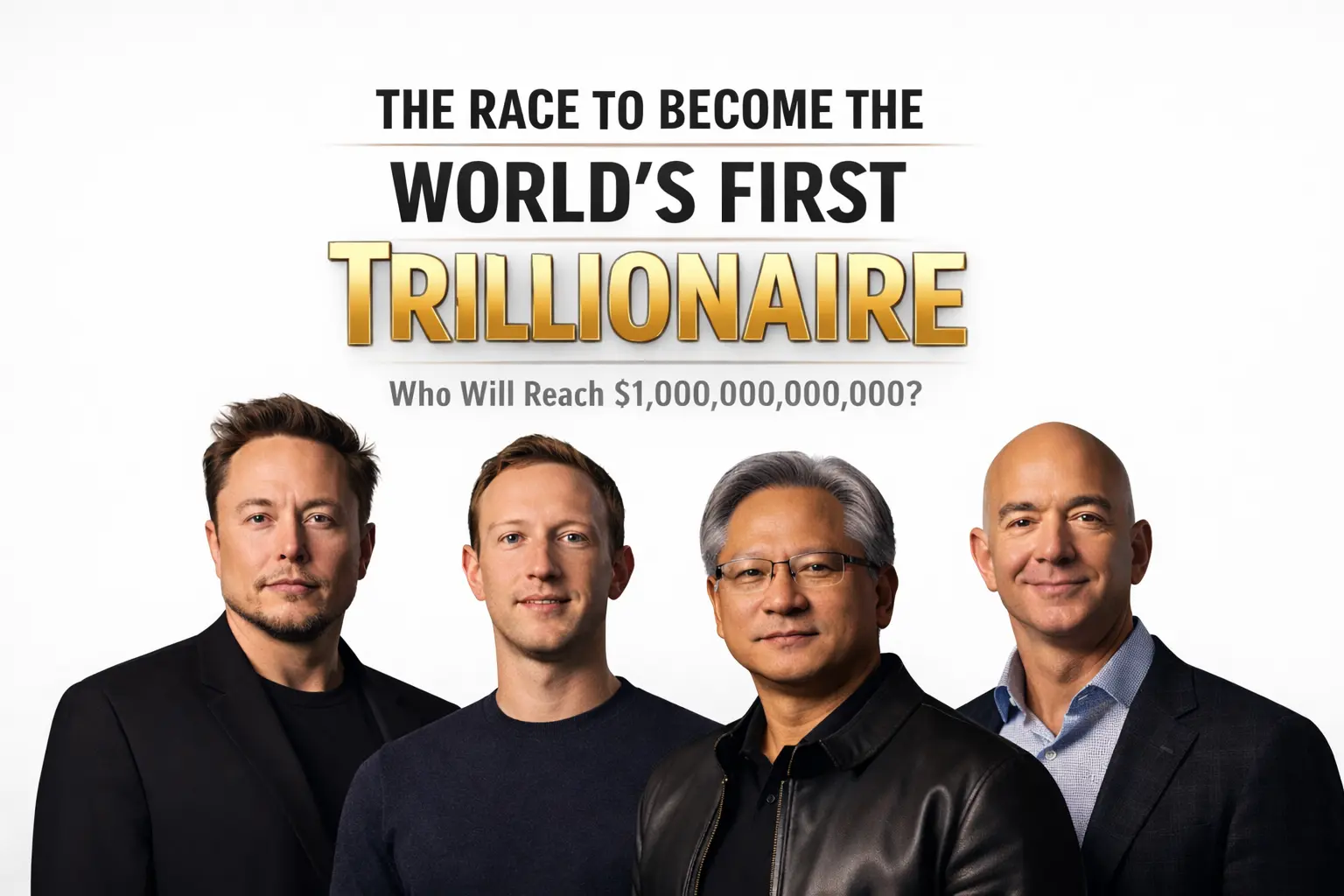

The world has never had a trillionaire — an individual whose personal net worth reaches $1 trillion USD. Yet, as global markets, technology sectors, and capital valuations expand, experts increasingly view this milestone as inevitable. In this article, we explore who is in the race today, how they could reach $1 trillion, and the economic forces behind the wealth escalation.
Current Contenders in the Trillionaire Race
Here are the most likely individuals whose net worth trajectories could plausibly lead to the first trillionaire:
| Name | Estimated Net Worth | Major Wealth Sources |
|---|---|---|
| Elon Musk | ~$720–750B | Tesla, SpaceX, AI platforms |
| Jensen Huang | ~$160–180B | NVIDIA (AI semiconductors) |
| Jeff Bezos | ~$240–260B | Amazon, AWS, Blue Origin |
| Mark Zuckerberg | ~$210–230B | Meta Platforms (AI, social) |
| Bernard Arnault | ~$180–200B | Luxury brand conglomerate |
| Other Emerging Figures | Variable | Tech, AI, green energy sectors |
Estimates reflect public equity valuations and known asset holdings.
What It Takes to Become a Trillionaire
Reaching $1 trillion in personal net worth is not just about accumulating money. It involves structural valuation shifts in global markets and ownership of assets that become fundamental to global economic systems.
1️⃣ Major Company Revaluations
Founders owning large equity shares benefit when their companies receive sudden valuation boosts — for example, an IPO of a highly valued private company, or re-rating due to new markets.
2️⃣ Control of Strategic Economic Infrastructure
Technology platforms that countries and large industries depend on — like cloud computing, AI infrastructure, and next-generation semiconductors — can drive outsized wealth accumulation.
3️⃣ Expansion of New Economic Sectors
Sectors such as artificial intelligence, space exploration, semiconductor manufacturing, and digital ecosystems are creating value at exponential rates.
4️⃣ Non-Linear Wealth Jumps
Unlike normal income growth, ultra-wealth at the billionaire level often increases via step changes:
- New products or technology breakthroughs.
- Business spin-offs or IPO unlocks.
- Global regulatory shifts favoring digital assets or cloud licensing.
How the Top Candidates Could Cross $1 Trillion
🔹 Elon Musk
Growth Engines:
- Tesla’s leadership in electric vehicles and autonomy.
- SpaceX’s private valuation (future IPO potential).
- AI platform development (Tesla AI, Dojo compute).
Trigger Events:
- SpaceX public listing with high valuation.
- Tesla AI licensing revenue surpassing expectations.
These combined could push Musk’s net worth into the trillion range within the next 3–6 years.
🔹 Jensen Huang (NVIDIA)
Growth Engines:
- Dominance in AI-accelerated compute chips.
- Broad industry integration (data centers, cloud, enterprise AI).
Trigger Events:
- Continued global AI infrastructure expansion.
- New partnerships with sovereign cloud providers.
🔹 Jeff Bezos
Growth Engines:
- Amazon e-commerce and AWS cloud services.
- Blue Origin’s increasing contracts in space infrastructure.
Trigger Events:
- AWS business unit spin-off or valuation reset.
- Major space/government contracts scaling revenue.
🔹 Mark Zuckerberg
Growth Engines:
- Meta Platform’s strategic shift to AI and virtual platforms.
- Advertising and engagement monetization.
Trigger Events:
- New generative AI platform adoption.
- Strong consumer OS integrations.
🔹 Bernard Arnault
Growth Engines:
- Global luxury goods demand — resilient across economic cycles.
- Expansion into high net worth consumer segments.
Trigger Events:
- Luxury brands achieving financialization status.
- New asset classes emerging from luxury ecosystem.
Because It’s Not a Linear Race
The Critical Difference:
Trillionaire wealth is created through valuation inflection points, not slow compound growth.
Key valuation mechanisms:
- IPO unlocks for privately held companies.
- AI and cloud licensing revenue dominance.
- Cross-industry adoption of proprietary tech stacks.
- Strategic control of foundational economic infrastructure.
These mechanisms explain why some contenders could jump hundreds of billions in wealth in a single cycle, while others grow more gradually.
The Wealth Acceleration Framework
---------------------------------------------------------
|            HOW ULTRA-WEALTH ACCELERATION WORKS         |
---------------------------------------------------------
| 1. Foundations: Large Equity Holdings                  |
|   — Ownership in scalable tech platforms               |
|   — Founders, early-stage holders                      |
|                                                       |
| 2. Inflection Events: Valuation Shock Points           |
|   → IPO of private high-growth company                 |
|   → Spin-off or re-rating of business unit             |
|   → Global adoption of technology                      |
|                                                       |
| 3. Strategic Control: Economic Infrastructure         |
|   → AI compute layers (semiconductors, data centers)   |
|   → Cloud platform dominance                           |
|   → Defense + sovereign tech contracts                |
|                                                       |
| 4. Non-Linear Wealth Steps                             |
|   → +$200B+ in a year from a trigger event             |
|                                                       |
| Result: First trillionaire likely emerges from         |
|         AI + cloud + strategic equity growth           |
---------------------------------------------------------
Why This Matters for Global Wealth Trends
The first trillionaire will mark more than a record — it represents how ownership of next-generation economic infrastructure drives global value.
What Investors and Analysts Should Monitor
- High-growth private assets approaching IPO readiness
- AI infrastructure revenue acceleration metrics
- Cloud platform contracts with governments and enterprises
- Semiconductor capacity and long-term supply agreements
Each of these signals may indicate the next trillion-dollar valuation jump.
Conclusion
As of 2026, no individual has reached $1 trillion in personal wealth, but several high-profile billionaires are positioned within striking distance. The race isn’t simply about who is richest today, it’s about who owns the systems that power the next era of global value creation.