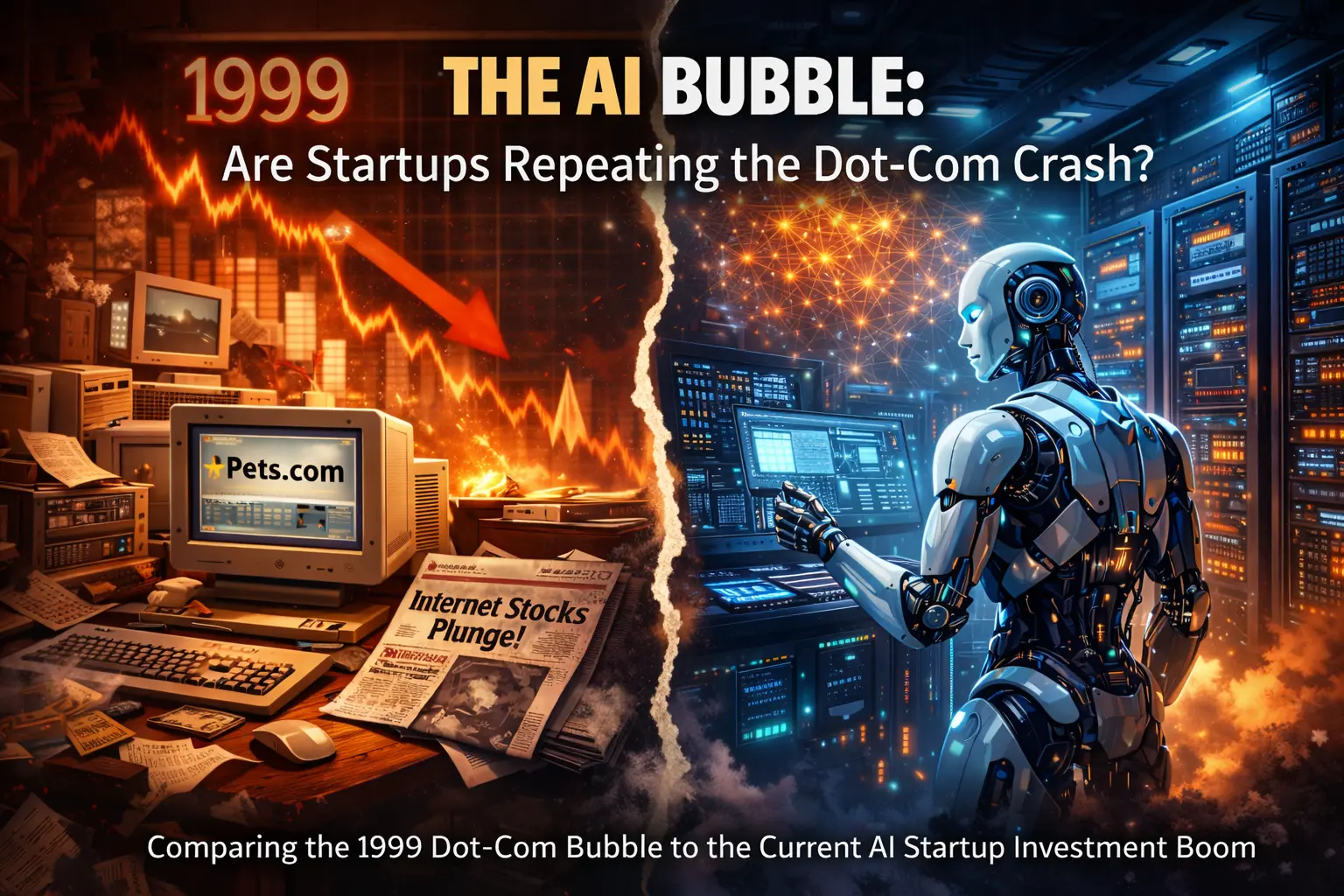

Silicon Valley is pouring billions into artificial intelligence. But history suggests tech hype cycles rarely end quietly.
For the past two years, artificial intelligence has been the most powerful magnet for venture capital in the technology industry.
Startups promising to “revolutionize everything with AI” are raising hundreds of millions of dollars before shipping a product. Investors are racing to fund anything with the letters A and I in its pitch deck.
The numbers are staggering.
According to multiple venture capital reports, global AI investment surpassed $200 billion in 2025, with companies like OpenAI, Anthropic, and xAI attracting massive valuations.
The race to build AI infrastructure is already triggering historic spending. Earlier this year, IMFOUNDER reported on Elon Musk’s $20 billion xAI data center expansion, a sign of how intense the AI infrastructure race has become.
But beneath the excitement lies an uncomfortable question circulating through Silicon Valley boardrooms:
Are we watching the early stages of the next dot-com crash?
The Ghost of the Dot-Com Bubble
To understand today’s AI boom, it helps to revisit the late 1990s.
During the Dot‑Com Bubble, investors poured money into any company connected to the internet.
It didn’t matter whether the startup had revenue.
Or even customers.
Companies like Pets.com and Webvan raised enormous funding rounds based on little more than the promise that the internet would change everything.
And to be fair, it did.
But most early companies failed.
When the bubble burst in 2000, the NASDAQ Composite lost nearly 78% of its value, wiping out trillions of dollars in market capitalization.
Thousands of startups disappeared overnight.
Yet the underlying technology—the internet itself—went on to reshape the world.
Amazon survived.
Google was born.
The crash didn’t kill the internet.
It simply killed the hype.
The AI Gold Rush
Today’s artificial intelligence boom feels strikingly similar.
Startups are raising massive valuations while building products on top of existing AI infrastructure provided by companies like Microsoft, Google, and NVIDIA.
Many of these companies are not actually building their own AI models. Instead, they rely on existing platforms and APIs — a trend we previously explored in Why Most AI Startups Don’t Actually Build AI.
In many cases, these startups are not building fundamental AI models themselves. Instead, they are layering interfaces, tools, and automation systems on top of large language models.
Some venture capitalists privately call this phenomenon “AI wrappers.”
The pattern is becoming familiar:
- A startup integrates an AI API.
- Adds a sleek interface.
- Raises $50 million.
- Promises to transform an industry.
The problem?
Many of these companies have no durable technological advantage.
If the underlying model provider launches the same feature, the startup disappears overnight.
Valuations That Defy Gravity
The biggest warning sign of a potential bubble is often valuation.
Consider this:
- OpenAI has been valued at over $80 billion.
- Anthropic has raised billions from Amazon and Google.
- AI startups with less than $5 million in annual revenue are raising funding at $500 million valuations.
For venture investors, the logic is simple:
If AI truly transforms industries—from healthcare to finance to software—then the winners could become trillion-dollar companies.
But that same logic fueled the internet bubble in 1999.
And most of those companies vanished.
The Infrastructure Layer Is Real
Here’s where the comparison with the dot-com era becomes more nuanced.
During the internet boom, companies that built infrastructure survived.
Think of firms like:
- Cisco Systems
- Amazon
In the AI era, the infrastructure layer appears to be forming around:
- AI chips from NVIDIA
- Cloud computing from Microsoft and Amazon
- Foundation models from OpenAI, Anthropic, and Google DeepMind
These companies control the expensive layers of the AI stack:
- data
- compute
- training infrastructure
And that gives them enormous defensive power.
Behind the scenes, the AI boom is powered by massive data centers consuming enormous energy and water resources — something IMFOUNDER previously investigated in AI’s Growing Data-Center Footprint.
The Coming Shakeout
If the dot-com era is any guide, a correction is almost inevitable.
Thousands of AI startups currently exist.
But history suggests only a fraction will survive.
The likely sequence looks familiar:
- Overfunding phase – Venture capital floods the market.
- Hype peak – AI becomes the center of every tech narrative.
- Reality check – Many companies fail to generate sustainable revenue.
- Market correction – Investors pull back.
- Survivor era – A small number of dominant platforms emerge.
In other words, the bubble bursting doesn’t mean AI itself fails.
It means weak business models fail.
Why This Time Might Be Different
Despite the bubble concerns, there is one major difference between AI and the dot-com era.
Artificial intelligence is already producing real productivity gains.
Software engineers are using tools like:
- GitHub Copilot
- ChatGPT
AI tools are also reshaping entrepreneurship itself. IMFOUNDER recently explored how AI is enabling a new generation of solopreneurs to build companies without large teams.
Companies are automating customer service, writing software faster, and analyzing data in ways that were impossible just a few years ago.
The economic impact is already measurable.
That suggests AI is not simply hype—it is a foundational technology shift.
But foundational technologies still go through investment bubbles.
The internet did.
Railroads did.
Even electricity did.
The Real Lesson From the Dot-Com Crash
The biggest takeaway from the dot-com bubble is simple:
Technological revolutions are real.
But market hype always overshoots reality.
In 1999, investors believed every internet startup would change the world.
In reality, only a handful did.
The same may prove true for artificial intelligence.
Ten years from now, the AI giants dominating the global economy may already exist today.
But they probably won’t be the hundreds of startups currently pitching investors with “AI-powered everything.”
Just like the dot-com era, the real winners may emerge after the bubble bursts.