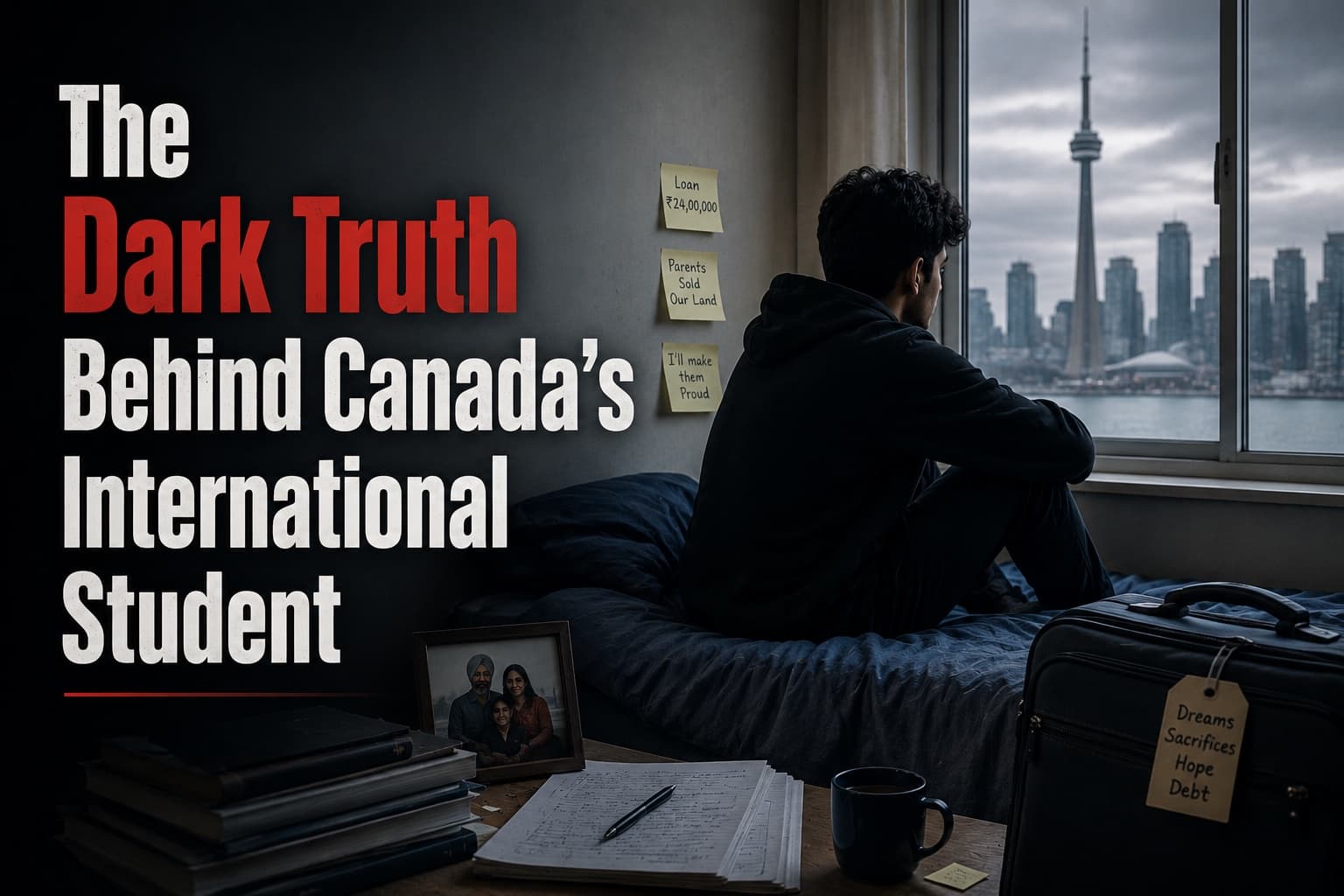

In thousands of villages across India, there is one dream that almost every family understands.
Canada.
Not just as a country.
But as hope.
Hope that a son will not spend his life struggling in debt.
Hope that a daughter will finally have opportunities her parents never had.
Hope that one child studying abroad could change the future of an entire family.
For years, families across Haryana, Gujarat, Andhra Pradesh, Kerala, Punjab and many other regions borrowed money, mortgaged homes, sold ancestral land, and emptied savings accounts to send their children overseas.
When the visa arrived, celebrations began.
Relatives came over with sweets.
Neighbors congratulated the family.
Parents proudly said:
“Our child is going to Canada.”
But behind thousands of smiling airport photos was a reality few people were prepared for.
A reality of crushing debt.
Overcrowded basements.
Loneliness.
Mental exhaustion.
Online hate.
Broken promises.
And a system that many students now believe treated them less like learners and more like revenue.
The Canadian Dream That Was Sold Worldwide
For over a decade, Canada built a reputation as one of the most welcoming destinations for international students.
Compared to the United States, it appeared safer, friendlier, and more immigration-friendly. Study permits often came with pathways to work permits and eventually permanent residency.
Education agents across India aggressively marketed this dream.
Social media was filled with videos promising:
- easy settlement,
- high-paying jobs,
- permanent residency pathways,
- and a “better life.”
For middle-class Indian families, this was not just education.
It was survival planning.
Parents who had spent their entire lives struggling believed their children could finally escape financial instability.
Some sold farmland that had belonged to their families for generations.
Some took education loans worth thousands of dollars.
Some borrowed money from relatives while hiding the true scale of their debt.
Many believed the suffering would be temporary because Canada would eventually reward hard work.
But what many students encountered after landing was very different from the dream they had been sold.
When Education Became a Billion-Dollar Business
For years, Canada’s international education industry was presented to the world as a success story.
But behind the glossy marketing campaigns, smiling graduation photos, and immigration seminars was a system that quietly transformed education into one of the country’s most profitable economic engines.
And eventually, many students began asking a painful question:
“Were we students first — or customers?”
According to Global Affairs Canada, international students contributed an estimated $37.3 billion CAD to the Canadian economy in 2022 alone through tuition, housing, food, transportation, and spending. (Global Affairs Canada)
That number is larger than several major Canadian export industries.
The international student system did not just support colleges and universities.
It supported:
- landlords,
- private housing markets,
- transportation systems,
- retail businesses,
- restaurants,
- gig economy jobs,
- cellphone companies,
- banks,
- and entire local economies.
For many institutions, international tuition became financial oxygen.
And that is where the system slowly began to change.
The Financial Addiction No One Wanted to Admit
Domestic tuition in Canada is regulated and relatively limited.
International students, however, often paid two, three, or even four times more than domestic students for similar programs.
As public funding pressures increased, many colleges and universities became increasingly dependent on foreign tuition revenue to survive. (The Times of India)
Critics, auditors, educators, and even some Canadians began warning that parts of the system were becoming financially addicted to international student money.
In Ontario’s college sector, reports suggested that international students accounted for the majority of tuition revenue in some institutions. (Reddit)
This changed incentives.
Instead of asking:
“How many students can we realistically support?”
Some institutions appeared focused on:
“How many more students can we recruit?”
Campuses expanded rapidly.
New programs appeared constantly.
Overseas recruitment exploded.
Partnerships with private agencies grew aggressively.
And thousands of students in India were told:
- Canada needs workers,
- jobs are everywhere,
- permanent residency is achievable,
- and life abroad is waiting.
For many families, these promises sounded like destiny.
For some institutions, they became business strategy.
A Global Industry Built on Hope
In cities across India, education consultancies turned foreign education into a pipeline industry.
Billboards promised settlement opportunities.
Social media influencers posted luxury lifestyles across Canada.
Agents earned commissions for student placements.
Seminars filled hotel halls with parents desperate to secure their children’s futures.
The message was emotionally powerful:
“Send your child abroad now — or they will fall behind forever.”
And families believed it.
Because they wanted to believe it.
Very few parents were shown:
- overcrowded student housing,
- rising unemployment,
- brutal living costs,
- mental health struggles,
- or how competitive survival in Canada had become.
The dream was marketed aggressively.
The risks often were not.
The Housing Crisis Everyone Saw Coming
As student numbers surged, infrastructure failed to keep up.
In several cities, housing shortages intensified dramatically.
Students struggled to find affordable places to live.
Basements became overcrowded.
In some cases, multiple students reportedly shared tiny rooms simply to survive rising rent costs.

Critics argued that governments and institutions expanded enrollment far faster than housing capacity.
And yet recruitment continued.
Students kept arriving.
Because the money kept flowing.
“Diploma Mill” Became a National Conversation
As public frustration grew, terms like “diploma mill” entered mainstream Canadian debate.
Not every institution deserved that label.
Many universities and colleges continued providing high-quality education and strong student support.
But public trust began collapsing around institutions accused of prioritizing quantity over quality.
Critics questioned:
- whether some programs truly improved career outcomes,
- whether infrastructure matched enrollment growth,
- and whether education had become too closely tied to immigration marketing.
The controversy surrounding Conestoga College became symbolic of a much larger national issue.
Suddenly, international students were no longer seen only as learners.
They became political ammunition.
Students Became the Face of Problems They Did Not Create
This is where the tragedy becomes deeply unfair.
Governments benefited.
Colleges benefited.
Landlords benefited.
Businesses benefited.
Entire local economies benefited from international student spending. (Global Affairs Canada)
But when housing prices exploded and jobs became harder to find, many ordinary students became the public face of national frustration.
The same students who had paid enormous tuition fees were suddenly blamed for:
- housing shortages,
- wage pressure,
- overcrowding,
- inflation,
- and lack of jobs.
Online hostility intensified rapidly.
Students who arrived legally and followed rules often became targets of anger they had no power to control.
Then the System Started Cracking
When Canada tightened immigration and study permit rules, the financial fragility of the entire system became visible almost immediately.
International student arrivals dropped sharply. (The Economic Times)
Some institutions faced hiring freezes, budget cuts, and layoffs. (The Times of India)
Reports indicated thousands of jobs across the education sector were affected as enrollment declined. (The Times of India)
That exposed a difficult truth:
Many institutions had become so financially dependent on international students that the system itself struggled when the flow slowed down.
Which raises a painful question:
If reducing student intake threatens the survival of institutions, were students truly being treated as learners —
or had they become the economic foundation holding entire systems together?
The Human Cost Was Never Included in the Revenue Numbers
Government reports proudly measured billions in economic contribution. (Global Affairs Canada)
But there is no statistic measuring:
- the father who sold farmland,
- the mother who mortgaged jewelry,
- the student crying alone after a 12-hour shift,
- or the guilt of telling parents everything is “fine” while drowning in debt.
No economic report measures emotional collapse.
No tuition graph shows loneliness.
No enrollment chart captures humiliation.
Because behind every billion-dollar revenue figure was a real person trying to build a future.
And many now feel that somewhere along the way, the system stopped seeing them as human beings — and started seeing them as income streams.
The Sacrifices Families Never Talk About Publicly
In many Indian households, parents rarely tell outsiders how much they suffered financially to send their children abroad.
A father may spend 25 years saving money only to watch it disappear in one tuition payment.
A mother may quietly sell her jewelry without telling relatives.
Families often take enormous risks because they believe foreign education is an investment that will eventually rescue everyone financially.
In villages across India, “going to Canada” became more than migration.
It became status.
And with that came pressure.
Students carried not only luggage at the airport — but the expectations of entire families.
Many could not afford to fail.
That pressure became devastating once reality hit.
The Reality Waiting in Canada
Some students arrived expecting modern apartments and opportunity.
Instead, many found:
- overcrowded basements,
- mattresses lined side by side,
- rising rent,
- intense competition for minimum wage jobs,
- and long working hours combined with studies.
Some students reportedly worked overnight warehouse shifts and attended morning classes with almost no sleep.
Others struggled to find any work at all.
Food insecurity became increasingly common.
Students who posted smiling Instagram photos often hid completely different realities from their parents.
Some avoided video calls because they did not want their families to see where they lived.
Some lied about their situation because they knew their parents had already sacrificed too much.
One student described online:
“Back home, everyone thinks we made it. Here, we are just surviving.”
The Mental Health Crisis Nobody Prepared Them For
Loneliness hit many students harder than expected.
For the first time in their lives, they were completely alone:
- no family,
- no emotional support,
- no financial safety net,
- and no certainty about the future.
Some students struggled silently with anxiety and depression while continuing to pretend everything was fine.
Parents back home proudly told neighbors:
“My son is in Canada.”
Meanwhile, that same son could be skipping meals to save money.
This emotional disconnect became one of the cruelest parts of the international student experience.
The family believed the dream was working.
The student often felt trapped inside it.
When the Internet Turned Against International Students
As Canada’s housing crisis, inflation, and job market pressures worsened, international students increasingly became targets online.
Across social media platforms, anger exploded.
Many Canadians blamed immigrants and international students for:
- housing shortages,
- rising rent,
- job scarcity,
- overcrowding,
- and economic pressure.
Some criticism focused on legitimate policy concerns.
But much of the online discourse crossed into hostility and stereotyping.
Students began encountering racist comments online and in public spaces.
Suddenly, many who had arrived believing Canada was welcoming felt unwanted.
This created a painful contradiction.
Most international students had followed legal pathways, paid enormous tuition fees, obeyed immigration rules, and contributed billions to the economy.
Yet many became symbols of national frustration.
Yes, There Were Problems — But Blaming Every Student Is Wrong
There were real problems inside the system.
Investigations and reports revealed:
- fraudulent admission cases,
- unethical recruitment practices,
- immigration loophole abuse,
- and institutions expanding too aggressively in some cases.
Ignoring these issues would be dishonest.
But blaming millions of international students collectively is equally dangerous.
Most students were not scammers.
Most were simply young people trying to build a better future.
Many themselves became victims:
- of dishonest agents,
- misleading marketing,
- changing immigration rules,
- and systems that treated them like numbers.
A few bad actors should never define an entire community.
Because behind every study permit was a real human being.
Not a statistic.
Not a political talking point.
A person.
The Sudden Collapse of the Dream
When Canada later tightened immigration rules and capped international student permits, panic spread across many communities.
Students who had built entire life plans around earlier policies suddenly faced uncertainty.
Some families had already taken massive loans assuming permanent residency opportunities would remain accessible.
Now many students felt stranded:
- too deep in debt to return home,
- but increasingly uncertain about staying.
For some colleges heavily dependent on international tuition, the slowdown also exposed how financially fragile the system had become.
The cracks were no longer hidden.
A Generation Caught Between Two Worlds
Perhaps the saddest part of this story is that many students no longer feel fully accepted anywhere.
In Canada, they are sometimes blamed for national problems far bigger than themselves.
Back home, families still expect success stories.
Many students live emotionally trapped between:
- guilt,
- fear,
- debt,
- and responsibility.
Some cannot tell their parents they are struggling because the emotional cost would destroy them.
Imagine calling home after your parents sold their house or spent their life savings for your education — only to admit that you’re barely surviving.
That silence is becoming the hidden pain of thousands of international students.
The Bigger Question Canada Must Ask
Canada benefited enormously from international students.
They supported colleges financially, filled labor shortages, paid taxes, rented homes, worked difficult jobs, and contributed to local economies.
But the system also raised difficult ethical questions.
Should education ever become so deeply tied to immigration marketing?
Should institutions aggressively recruit students without ensuring housing and support systems exist?
Should families abroad be sold dreams without fully understanding the realities waiting for them?
And when things go wrong — who carries the consequences?
Usually not the institutions.
Usually not the consultants.
Usually not the policymakers.
It is the students.
And their families.
Behind Every Visa Was a Family’s Entire Future
The international student crisis is not just an immigration story.
It is a human story.
A story about parents who believed education could change destiny.
A story about students who crossed oceans carrying their families’ hopes.
A story about institutions, policies, economics, and social tensions colliding all at once.
And somewhere between political debates and internet outrage, many people forgot something simple:
International students are human beings.
Behind every visa approval was:
- a mother’s prayers,
- a father’s sacrifices,
- years of savings,
- family debt,
- and the belief that life could finally become easier.
For many families, Canada was never just another country.
It was hope itself.
And when hope breaks, the damage reaches far beyond borders.
Related Articles on IMFounder
- The Global Wave of Anti-Immigration Protests: Why the West is Pushing Back
- What’s Driving the Anti-Immigration Wave in Canada, the U.S., the U.K. and Europe?
- A heartbreaking story of an international student on the verge of giving up — and the life-changing financial support in Canada that helped her stay, graduate
- Canada Startup Visa 2026: Shocking Truth for 43,000 Trapped Founders