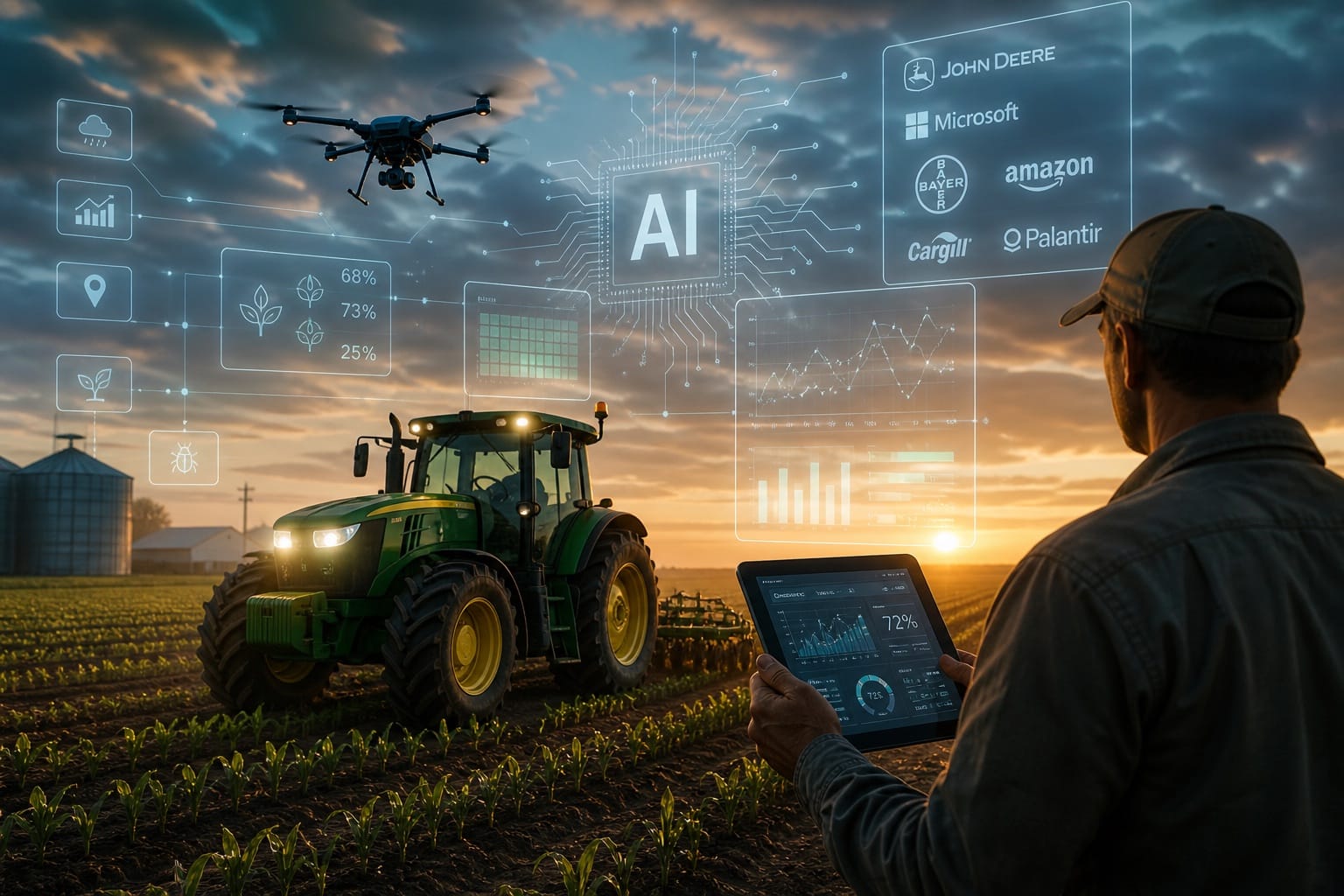

You have been farming the same land for three generations. You know when to plant by the feel of the soil and the look of the sky. You made decisions that kept the operation alive through drought years, market crashes, and input price spikes that would have broken someone working from a spreadsheet.
Now a $750,000 tractor is running your fields without you in it. A platform you agreed to in a click-through contract is collecting data on every acre, every yield, every chemical application. And a $300 million government contract has created a single digital file with your name on it.
The pitch is efficiency. The question is: efficient for whom?
The Machines Are Already in the Fields
The agricultural robotics market is not a forecast. It is an active deployment layer.
Industry estimates widely place the global agricultural robotics market at $15.2 billion in 2025, projected to exceed $40 billion by 2031 at sustained double-digit growth rates.
John Deere is already selling autonomy-ready tractors capable of operating with minimal human input, monitored remotely through its Operations Center platform. Autonomous systems now assist with planting, spraying, and harvest timing—tasks that previously depended on operator judgment built over years in the field.
The labor case for automation is straightforward. U.S. farm employment has declined modestly in recent years while the farmer population continues to age. Estimates indicate that more than one-third of U.S. farmers are over 65.
The workforce gap is real. The industry is filling it with hardware.
According to McKinsey & Company, AI adoption could generate approximately $100 billion in on-farm value and an additional $150 billion at the enterprise level.
That split matters. Enterprise-level value flows to the companies building and managing the infrastructure—not necessarily to the grower operating within it.
Who Is Actually Being Displaced
The first workers affected are not farm owners. They are seasonal and migrant laborers.
Estimates vary, but multiple projections suggest that a significant share of agricultural labor could be automated over the coming decade.
In the United States, a large portion of hired farm labor is composed of immigrant workers, with tens of thousands of agricultural positions remaining unfilled annually.
Reporting from Reuters has indicated that a substantial share of U.S. agricultural labor may be undocumented—making it both economically essential and politically vulnerable.
The machine does not need an H-2A visa. It does not age out. It does not require housing.
And unlike the worker in the field, it generates data—data that someone else owns.
The Data Is the Crop
Every autonomous tractor, drone, and precision agriculture platform is collecting data: soil composition, yield per acre, planting windows, chemical application rates, and environmental response.
That data has economic value.
Companies including Bayer, Corteva Agriscience, Syngenta, and Cargill collect and utilize agricultural data across their platforms.
Bayer, through its Climate FieldView platform, is widely reported to control a significant share of global agricultural data infrastructure, though exact figures are not publicly disclosed.
Contract language is critical. While platforms often state that farmers “own” their data, terms typically grant companies broad rights to use, aggregate, and build derivative models from that information.
Legal analysts have noted that this allows integration into machine learning systems and predictive analytics platforms with downstream commercial value.
The farmer generates the data. The platform captures the value.
One Farmer, One File
On April 22, 2026, the USDA entered into a $300 million agreement with Palantir Technologies to support the National Farm Security Action Plan and the “One Farmer, One File” initiative.
The stated goal is administrative efficiency: a unified digital profile for each farm, consolidating acreage reporting, subsidy programs, and disaster relief.
The efficiency argument is valid. Farmers should not have to leave the field to complete paperwork.
But Palantir’s core capabilities were developed in large-scale data integration for defense and intelligence environments.
The USDA has stated the system will improve fraud detection and program oversight. What it also creates is a centralized, real-time data layer across American agriculture—linking production, financial dependency, and land use into a single platform.
The Control Layer
The shift is not isolated to one company or one system.
Research cited by The Guardian and IPES-Food indicates that major technology firms—including Google, Microsoft, Amazon, IBM, and Alibaba—are building positions across digital agriculture: crop monitoring, logistics, input systems, and market forecasting.
At the same time, partnerships are deepening:
- John Deere with Cargill
- Microsoft with Trimble
- Bayer operating on Amazon Web Services
The farmer operates the land. The infrastructure—and increasingly, the decision-making framework—belongs to interconnected systems.
The economic pressure favors standardized, high-volume crops that align with algorithmic optimization and global commodity markets.
What Is at Stake
The global agricultural commodity market is measured in the trillions and projected to expand significantly over the next decade.
The infrastructure being deployed today—autonomous machinery, precision platforms, and centralized data systems—will shape how that market is controlled.
This is not a single transfer of ownership. It is an incremental shift.
Each platform adoption, each data agreement, each automation layer moves a portion of operational control away from the farmer and into systems the farmer does not build and cannot fully audit.
Technology providers argue that these systems are necessary to address labor shortages, improve efficiency, and stabilize production in a volatile environment. They position AI as a necessary evolution to maintain global food supply stability under increasing environmental and economic pressure.
Those benefits are real.
So are the trade-offs.
Conclusion
Artificial intelligence is not removing farming. It is restructuring it.
The question is not whether AI makes agriculture more efficient. It does—on the metrics the systems are designed to measure.
The question is who defines those metrics, who owns the output, and who retains decision-making authority when the algorithm and the farmer disagree.
Three generations of knowledge about that land are not in the database.
They are walking the rows at dawn, reading what no sensor has been built to read yet.
Related Articles on IMFounder
- The Restaurant Industry: The Fastest Way Into the Economy Is Closing
- How Sysco Corporation Consolidated the Middle Layer of Food Distribution
- Trees Are the Rarest Resource on Earth
- Influencer-Founded Brands: The New Million-Dollar Empires
- How Netflix, Paramount, and Comcast Are Competing to Buy Warner Bros
Sources & References
- McKinsey & Company — Gen AI in Agriculture Report
- Reuters — Agricultural labor & automation insights
- United States Department of Agriculture — Policy and program data
- Civil Eats — Farm data ownership analysis
- FedScoop — USDA–Palantir coverage