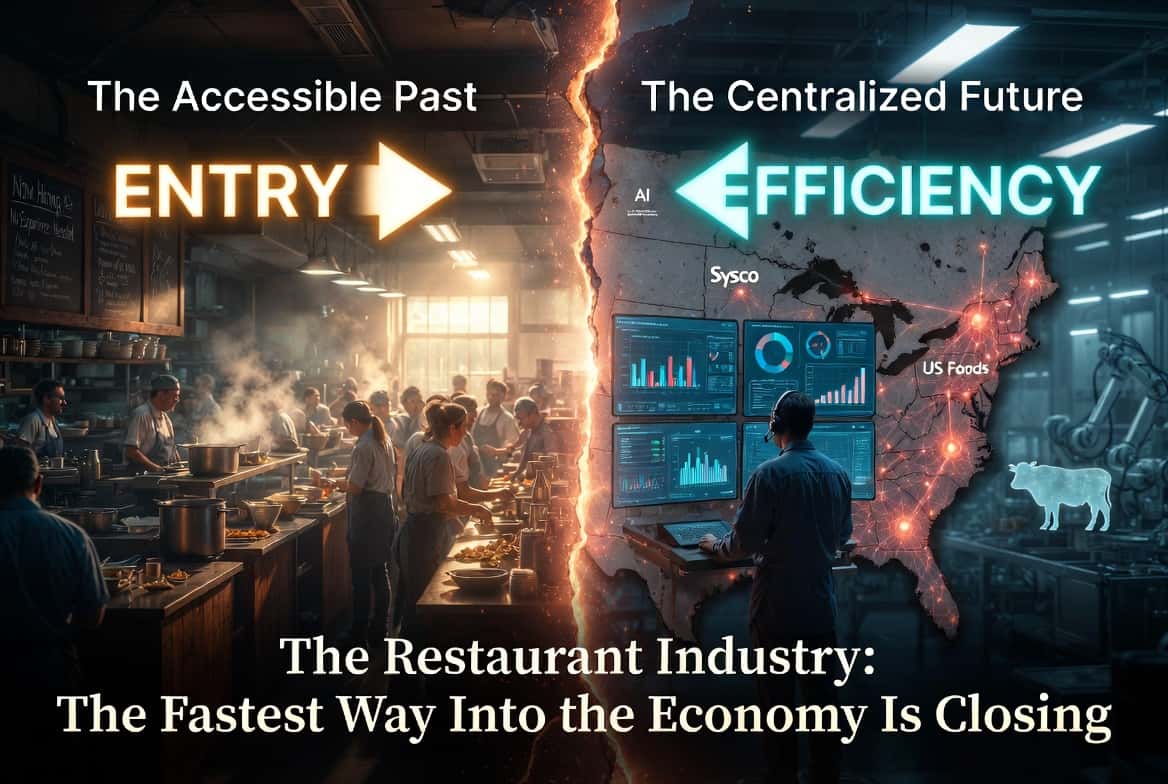

How supply chain concentration, input volatility, and operational centralization are eliminating one of the most accessible pathways into income — and why founders should be paying attention.
The Economic Function Nobody Is Talking About
When analysts map the global economy, they focus on technology, finance, and manufacturing. These sectors attract capital, dominate policy conversations, and generate headlines.
What they don’t cover is the system quietly absorbing millions of workers every year — one that requires no degree, no credential, and no extended hiring process.
The restaurant industry.
Its visibility has made it easy to dismiss. Restaurants exist in every city, every income bracket, and every economic climate. That familiarity creates a false sense of permanence. In reality, the industry functions as one of the most critical economic infrastructures in the world — not because of what it produces, but because of how fast it puts people to work.
In the United States alone, approximately 15 million people are employed in restaurant and foodservice roles. What distinguishes the sector is not only its scale, but its accessibility. Hiring cycles are short. Credential requirements are limited. Onboarding can occur within days. For individuals seeking immediate income — whether due to job displacement, financial disruption, or transitional circumstances — the restaurant industry has historically provided a reliable pathway into economic participation.
That function is now under structural pressure.
This Is Not a Downturn. It’s a Structural Shift.
The current wave of independent restaurant closures is widely attributed to inflation, labor shortages, and post-pandemic normalization. Those factors influence operating conditions. They do not fully explain the persistence and pattern of closures across the independent segment.
A more consequential shift is occurring at the distribution level.
Companies like Sysco have expanded beyond logistics into integrated supply networks — absorbing regional distributors, expanding protein sourcing, and building out operational infrastructure. With annual revenues exceeding $70 billion and an estimated 16–18% share of the U.S. foodservice distribution market, Sysco occupies a central position in how food moves from producers to operators. Combined with US Foods and Performance Food Group, a concentrated distribution environment has formed around the entire sector.
This is not a traditional monopoly. It is a consolidation of access.
Independent restaurants rely on sourcing flexibility — multiple suppliers, variable purchasing volumes, and the ability to adapt to cash flow constraints. As distribution consolidates, that flexibility disappears. Operators face fewer sourcing options, tighter purchasing terms, and diminished negotiating leverage. This shift disproportionately affects smaller businesses.
The Protein Problem Founders Should Be Watching
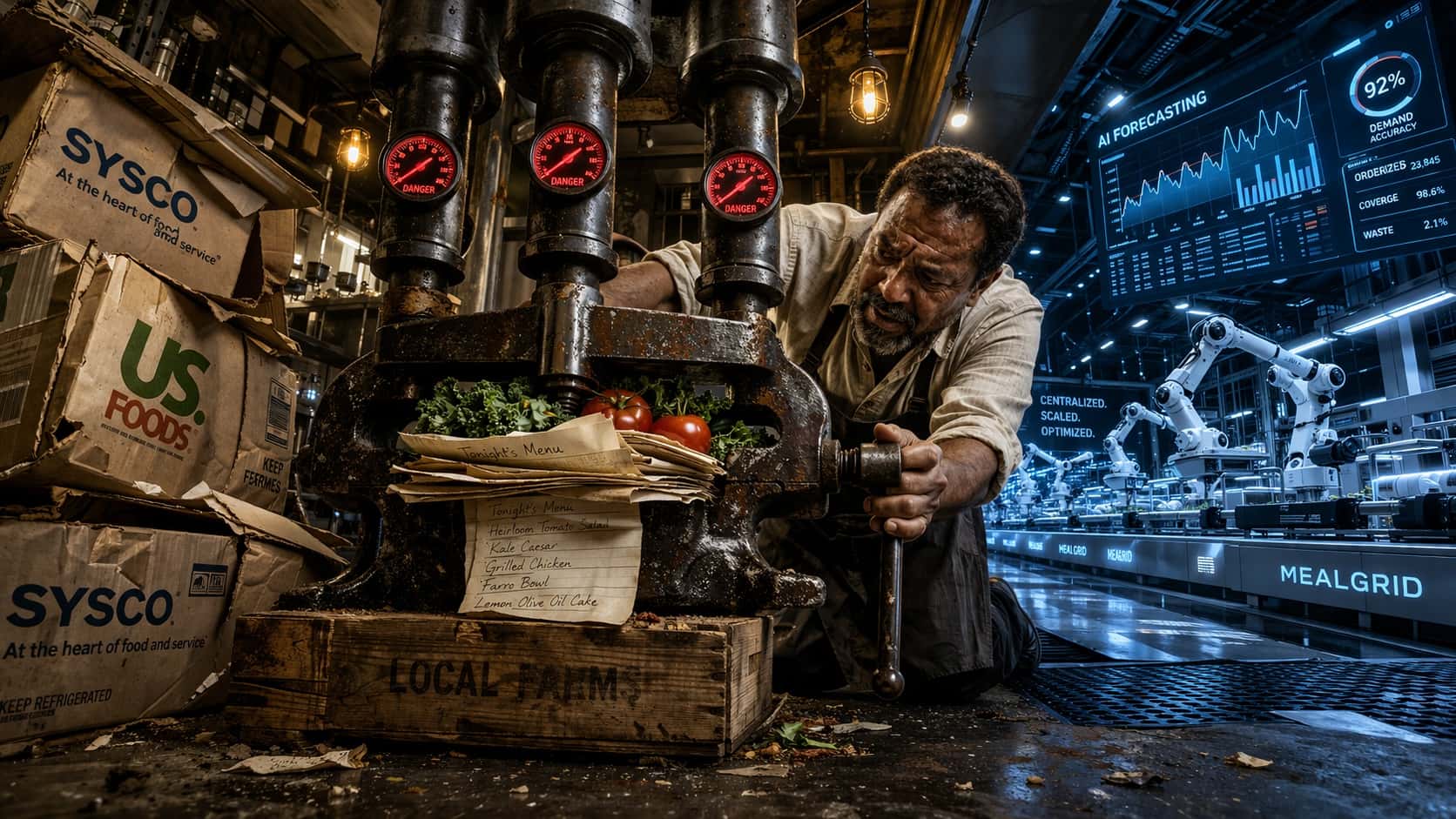
Beef has become a central pressure point in the system — and it is not recovering anytime soon.
The U.S. cattle inventory has declined to levels not seen since the mid-20th century, driven by drought conditions, rising feed costs, and long-term herd contraction. Supply is tight. Prices remain elevated. And when constrained supply intersects with concentrated distribution channels, pricing power shifts upstream fast.
Large, capital-backed operators can absorb this. They lock in long-term procurement contracts and negotiate at scale. Independent restaurants cannot. They purchase closer to spot pricing and operate on margins that typically fall between 3% and 6%.
Within that margin structure, sustained increases in input costs — whether protein, dairy, or dry goods — rapidly erode profitability. Under these conditions, closures are not isolated events. They are a predictable outcome of prolonged margin compression.
Every Closure Removes a Point of Entry Into the Economy
Here is where this moves beyond business performance.
Each independent restaurant that exits the market removes a point of entry into the workforce. At scale, this reduces the industry’s capacity to absorb labor quickly. The effect is cumulative: fewer independent establishments mean fewer immediate hiring opportunities, longer workforce re-entry timelines, and slower income recovery.
This impact is not evenly distributed. Tourism-driven economies, rural markets, and service-based communities are hit hardest. In these areas, restaurants are not just businesses. They are economic anchors.
As independent operators exit, the industry does not contract uniformly. It reorganizes around larger, more capitalized entities — and what replaces independent restaurants changes the equation entirely.
Efficiency Is Replacing Accessibility — and That’s a Tradeoff Most Founders Haven’t Priced In
Corporate-backed groups, vertically integrated brands, and standardized service platforms are expanding their share of the market. From an operational standpoint, this improves predictability and capital efficiency. From a labor standpoint, it shrinks the door.
Technologies such as Toast enable real-time inventory management, dynamic pricing, and labor optimization. AI-driven forecasting tools reduce waste and align procurement with demand. Scheduling systems align staffing levels tightly with projected revenue.
These systems improve margins. They also reduce elasticity.
As operations become more optimized, fewer employees are required per unit of revenue. Hiring processes become more structured. Workforce entry becomes less immediate. The informal pathway into the workforce — walking into a restaurant and starting within the week — begins to disappear.
The industry becomes more efficient. And less accessible.
The Misclassification That’s Costing the Economy
The restaurant industry is frequently categorized as a low-margin, high-risk business sector. That classification reflects financial realities. It does not capture the industry’s structural function.
Unlike sectors that require formal education, extended hiring processes, or specialized training, restaurants provide immediate access to income. This has historically enabled individuals to enter or re-enter the workforce without delay — regardless of background, prior experience, or credential.
Despite this role, the industry is not formally recognized as economic infrastructure. It is regulated and evaluated as a consumer-facing service sector.
That misalignment has consequences. As distribution consolidates, input costs remain elevated, and independent operators exit the market, there is no framework in place to preserve the industry’s function as an accessible entry point. When those access points disappear, they are not replaced — and they are not easily rebuilt.
Why Founders Should Care About This
The cumulative effect of these changes is a structural shift in how individuals participate in the economy.
As independent restaurants decline and centralized operators expand, the number of immediate entry points into the workforce contracts. The system becomes more predictable and efficient — and less capable of absorbing labor at speed.
This is not a collapse of the industry. It is a reconfiguration of its underlying structure. But structure determines access.What distinguishes the restaurant industry is the breadth of that access. It does not rely on formal credentials, extended hiring processes, or narrowly defined qualifications. Participation is not limited by background, prior experience, or traditional pathways into employment. It remains one of the few sectors where entry into the workforce can occur quickly and at scale.
That is what makes it uniquely important.
It functions not only as a source of employment, but as an open access point into economic participation.
As that access point contracts, the implications extend beyond the industry itself.
Because the issue is not simply the loss of restaurants.
It is the reduction of one of the only systems that allows broad, immediate entry into the economy.
The restaurant industry is not just part of the economy—it is one of the primary ways into it, and one of the few that has historically remained open to almost anyone.
An economy optimized entirely for efficiency reduces redundancy, limits pathways, and concentrates risk within fewer systems. The restaurant industry has historically counterbalanced that dynamic by providing decentralized, high-speed access to employment. That function is not being replaced. And the broader implications extend well beyond the food sector.
The issue is no longer just who controls the supply chain.
It is who retains access to the economy itself.
Related Articles on IMFounder
- How Sysco Corporation Consolidated the Middle Layer of Food Distribution
- 7 Shocking Reasons Trees Are the Rarest Resource on Earth — And We’re Erasing Them Fast
- Hair Fall & Shower Water: Causes, Prevention, and Technology — Hard Water, Hair Loss, Prevention Tips & Best Shower Filters Explained
- Most Popular Holiday Drinks in North America — including hot chocolate, mulled wine, peppermint mocha, and eggnog
- Best Places for Stunning Fall Foliage — Top Road Trips & Hidden Gems for Peak Fall Colors in North America
- The Rise of Streetwear in North America: From Subculture to Mainstream — Culture, Brands & Future