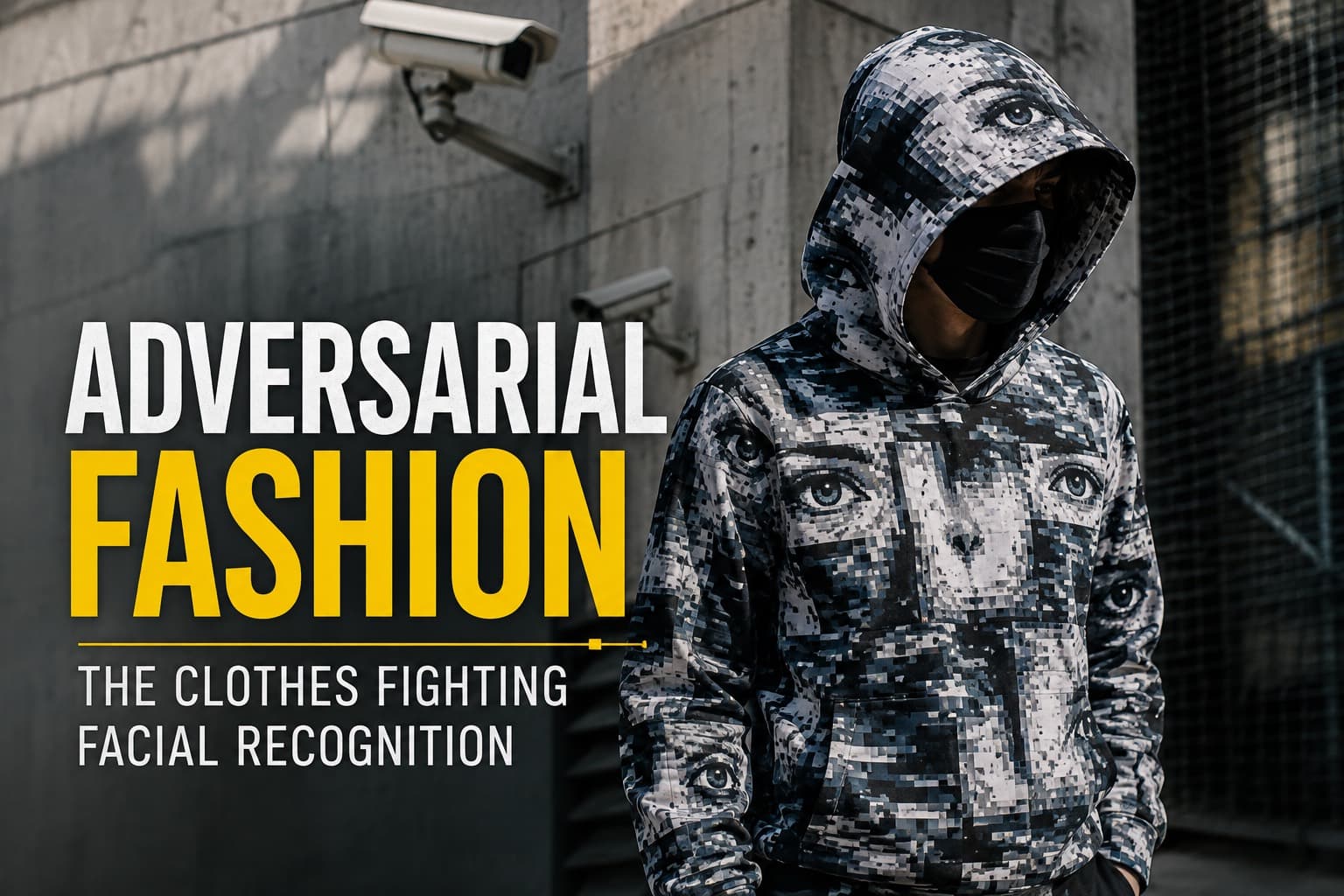

Introducing adversarial fashion—the engineered clothing confusing facial-recognition cameras and turning privacy into the next luxury status symbol.
The next revolutionary garment may not make the person wearing it look more attractive.
It may make them disappear.
Not from the people standing beside them. Not from conventional cameras. From the artificial intelligence quietly watching through those cameras, converting faces, bodies, movements and clothing into searchable data.
A new category known as adversarial fashion is attempting to disrupt that process. Designers are producing jackets, sweaters, scarves and accessories embedded with engineered patterns intended to confuse computer-vision systems. Some garments overwhelm facial-detection software with false visual signals. Others use reflective materials or infrared light to obscure the wearer from night-vision cameras. Specialized bags block the wireless signals used to track smartphones.
This is fashion designed for an audience that is not human.
The customer sees a boldly patterned sweater. The algorithm may see several faces, no person at all or an object that does not belong in its database.
The technology remains experimental, its effectiveness varies, and no garment can guarantee digital invisibility. But the existence of adversarial fashion reveals something bigger than a design trend.
Surveillance has become sufficiently normal that people are beginning to dress for it.
The defining accessory of the AI era may not help people get noticed. It may help them escape being recognized.
Every public space is becoming machine-readable
A conventional surveillance camera records a scene. An AI-enabled camera interprets it.
Computer-vision systems can detect faces, follow people across locations, read license plates, estimate age, categorize behavior and compare biometric information against databases. The camera no longer needs a person staring at a monitor. Software can watch thousands of feeds simultaneously and generate alerts whenever a predefined condition appears.
Facial recognition is now used across airports, retail stores, apartment buildings, offices, schools, stadiums and public streets. Law-enforcement agencies increasingly combine public cameras with privately operated networks, creating surveillance systems that can reconstruct where a person traveled and when.
The global facial-recognition market is estimated at approximately $8.2 billion in 2026, with some projections placing it above $25 billion by 2033. AI-powered video surveillance is expanding alongside it.
Meanwhile, the cameras themselves are becoming wearable.
Meta has worked to reposition camera-equipped smart glasses as fashionable consumer products rather than conspicuous recording devices. Less expensive competitors are now following. In August 2026, an $89 pair of camera glasses sold out through Kmart in Australia, prompting warnings that discreet recording technology was moving into ordinary retail faster than privacy law could respond.
The result is a fundamental change in public life. People are no longer photographed only when another person deliberately lifts a phone. They can be captured by street cameras, doorbells, vehicles, retail systems and eyewear without ever realizing a recording occurred.
Digital platforms are required to offer some version of privacy controls, however inadequate. The physical world does not contain a “reject all cameras” button.
Adversarial fashion is attempting to manufacture one.
The sweater is attacking the algorithm
Computer vision does not see a shirt, face or body in the human sense. It processes pixels and searches for statistical features that correspond with patterns learned during training.
That creates weaknesses.
An adversarial pattern is engineered to exploit the difference between machine perception and human vision. The image looks ordinary—or at least artistically unusual—to a person while triggering a significantly different interpretation inside an AI system.
Small manipulations can sometimes cause image classifiers to make absurd mistakes. A model may identify an object correctly until a strategically designed patch is introduced, then classify it as something entirely unrelated.
Adversarial clothing moves that attack from a computer screen onto the body.
Italian fashion-technology company Cap_able translates AI-interfering images into knitted textiles. Its designs feature distorted faces, eyes and animal-like forms arranged across brightly colored garments. The company says these patterns can influence selected recognition systems by introducing multiple false features into the image.
Instead of detecting the wearer’s face, a vulnerable model may focus on the faces woven into the sweater.
German label Urban Privacy takes a broader counter-surveillance approach. Its FACEPTION garments use face-like patterns to interfere with recognition, while its URBAN GHOST coat places infrared LEDs around the hood. The lights are invisible to the naked eye but can appear as an intense glare through certain night-vision cameras.
The company also sells signal-blocking smartphone bags and anti-paparazzi accessories, turning privacy protection into a coordinated wardrobe.
These garments do not produce Harry Potter invisibility. A person standing nearby can still see the wearer. A conventional camera can still record them. A determined investigator may use other identifying details, including gait, body shape, location, phone data or earlier photographs.
The objective is narrower: reduce the confidence of specific automated systems and make passive biometric tracking more difficult.
The clothing is not hiding the body.
It is poisoning the data.
The science is becoming more sophisticated
Early adversarial fashion often depended on static, conspicuous graphics optimized against a specific computer-vision model. That created a major problem: a pattern that fooled one algorithm under laboratory lighting might fail against another camera, angle or detection system.
Clothing also moves. Fabric folds, stretches and rotates. Lighting changes. People turn sideways, cover parts of a design or wear a jacket differently than researchers anticipated.
The latest experiments are attempting to address those weaknesses.
A paper presented at CVPR 2026 describes thermally activated, dual-modal adversarial clothing designed to interfere with both visible-light and infrared surveillance. The experimental garment appears as an ordinary black shirt until an embedded heating system activates thermochromic dyes, revealing a hidden adversarial pattern.
The researchers reported that the pattern could activate within approximately 50 seconds and achieved an adversarial success rate above 80% across the environments they tested.
Other researchers are using physical simulations to account for motion, fabric deformation, changing viewpoints and real-world illumination. Instead of optimizing an image against a single photograph, they design printable patterns intended to remain disruptive throughout a moving video sequence.
This represents a shift from novelty camouflage toward adaptive privacy technology.
But every successful adversarial attack becomes training material for the next defensive model. Surveillance companies can retrain their systems to recognize the patterns, combine several identification methods or flag adversarial clothing as suspicious.
The contest may become continuous: fashion attacks the model, the model adapts, and designers produce the next pattern.
Privacy becomes a software update.
Adversarial fashion is not an invisibility cloak. It is the opening move in an arms race between the body and the machine watching it.
Fashion has always encoded resistance
Clothing has never been merely decorative.
It communicates class, gender, profession, wealth, religion, allegiance and dissent before the wearer says a word. Governments have regulated what people may wear. Protest movements have turned colors, masks and uniforms into political symbols. Marginalized communities have repeatedly used fashion to reclaim identities that institutions attempted to control.
Adversarial clothing continues that history, but its message has two audiences.
To a human, the garment can signal opposition to biometric surveillance. To a machine, it delivers corrupted information.
That dual function makes the category unusually powerful. The design is both statement and instrument.
Fashion is also better positioned than conventional privacy tools to make resistance culturally desirable. Encryption software rarely appears on a runway. Data-protection law does not become a streetwear drop. A technically effective privacy garment, however, can operate as design, protest and status object simultaneously.
That could move anti-surveillance behavior from cybersecurity subcultures into mainstream lifestyle.
The moment a musician, athlete or fashion celebrity is photographed wearing an algorithm-confusing jacket, digital disappearance becomes aspirational.
Not hiding because there is something to conceal.
Hiding because unrestricted visibility is no longer chic.
Privacy could become the ultimate luxury product
There is an uncomfortable contradiction inside the movement.
Several adversarial garments are expensive. Cap_able has listed sweaters and hoodies for hundreds of euros. The cost reflects specialized development and low-volume production, but it also previews a future in which protection from surveillance is sold as premium fashion.
Wealthy people already purchase privacy through gated homes, private transportation, exclusive resorts, security teams and legal representation. They can avoid public infrastructure in ways ordinary people cannot.
Adversarial luxury could extend that inequality into biometric space.
The people most exposed to facial recognition are often those with the least power to avoid it: workers entering monitored workplaces, tenants inside camera-heavy housing, travelers passing through borders and residents of heavily policed neighborhoods.
If a €600 sweater provides even partial resistance while an inexpensive uniform does not, the right to become less visible has been converted into a consumer tier.
The wealthy become difficult to track.
Everyone else becomes high-resolution data.
There is also the possibility that effective garments could be restricted. Governments already regulate face coverings in certain public settings, protests and security zones. If adversarial clothing significantly interferes with police systems, lawmakers may characterize it as obstruction rather than privacy protection.
A garment designed to defend civil liberties could itself become probable cause.
That tension exposes the political heart of the technology: surveillance works best when opting out is treated as suspicious.
Who is the real adversary?
Supporters of facial recognition argue that it can locate missing people, accelerate criminal investigations, prevent fraud and improve security. Those benefits are real in some applications.
So are the risks.
Biometric data is not a password that can be reset after a breach. A person cannot replace their face. Misidentification can carry consequences ranging from public humiliation to arrest, while systems deployed in the name of safety can migrate into workplace control, political monitoring or commercial profiling.
In several countries, AI surveillance has expanded faster than legal oversight. Investigations have documented governments using smart-city infrastructure to monitor activists and journalists. Retailers are deploying facial recognition to identify suspected shoplifters. Police networks can search enormous quantities of privately collected footage.
The European Union’s AI Act restricts certain uses of real-time biometric identification, bans untargeted scraping of images to build facial databases and prohibits some forms of biometric categorization. But regulation remains fragmented globally, and technological capability continues moving faster than public consent.
Adversarial fashion emerges inside that gap.
It is a private response to a system-level problem. A jacket may confuse one camera, but it cannot establish enforceable limits on data retention, prevent authorities from combining databases or give communities meaningful control over surveillance infrastructure.
The wardrobe is being asked to perform the work of legislation.
The future may dress defensively
The first generation of privacy fashion is loud because resistance needs to be seen. Future versions may become nearly invisible.
Thermochromic designs could activate only when required. Infrared materials could be incorporated into ordinary fabrics. Accessories might detect nearby cameras and dynamically change their optical properties. Smart textiles could generate adversarial patterns in real time based on the surveillance system observing them.
A person might wear a perfectly conventional black coat that appears radically different to every machine.
That future will not eliminate surveillance. It will make perception unstable.
Cameras will become more intelligent. Clothing will become more deceptive. Identification systems will combine faces with movement, voice, devices and location. The body will become a contested platform surrounded by technologies attempting either to extract information from it or defend it from extraction.
Fashion will no longer be designed only around weather, beauty, modesty or social identity.
It will be designed around machine vision.
The industry has always promised transformation: wear this dress and become more confident, more powerful, more desirable. Adversarial fashion offers a darker transformation.
Wear this and become less knowable.
The garments available today cannot guarantee anonymity, and anyone selling absolute invisibility is selling fiction. But their importance does not depend on perfect technical performance.
They make the surveillance system visible.
Every distorted face knitted into a sweater asks why strangers, corporations and governments should be permitted to identify people automatically simply because they entered public space. Every infrared hood challenges the assumption that the camera has a greater right to observe than the individual has to refuse.
Privacy used to mean closing a door.
In the AI era, there may be no door left to close.
So fashion is learning how to make the algorithm look away.