
Google’s crackdown on “site reputation abuse” didn’t start in June 2026 — it started two years earlier. Here’s the real timeline, what actually changed this year, and how to keep your business off Google’s next hit list.
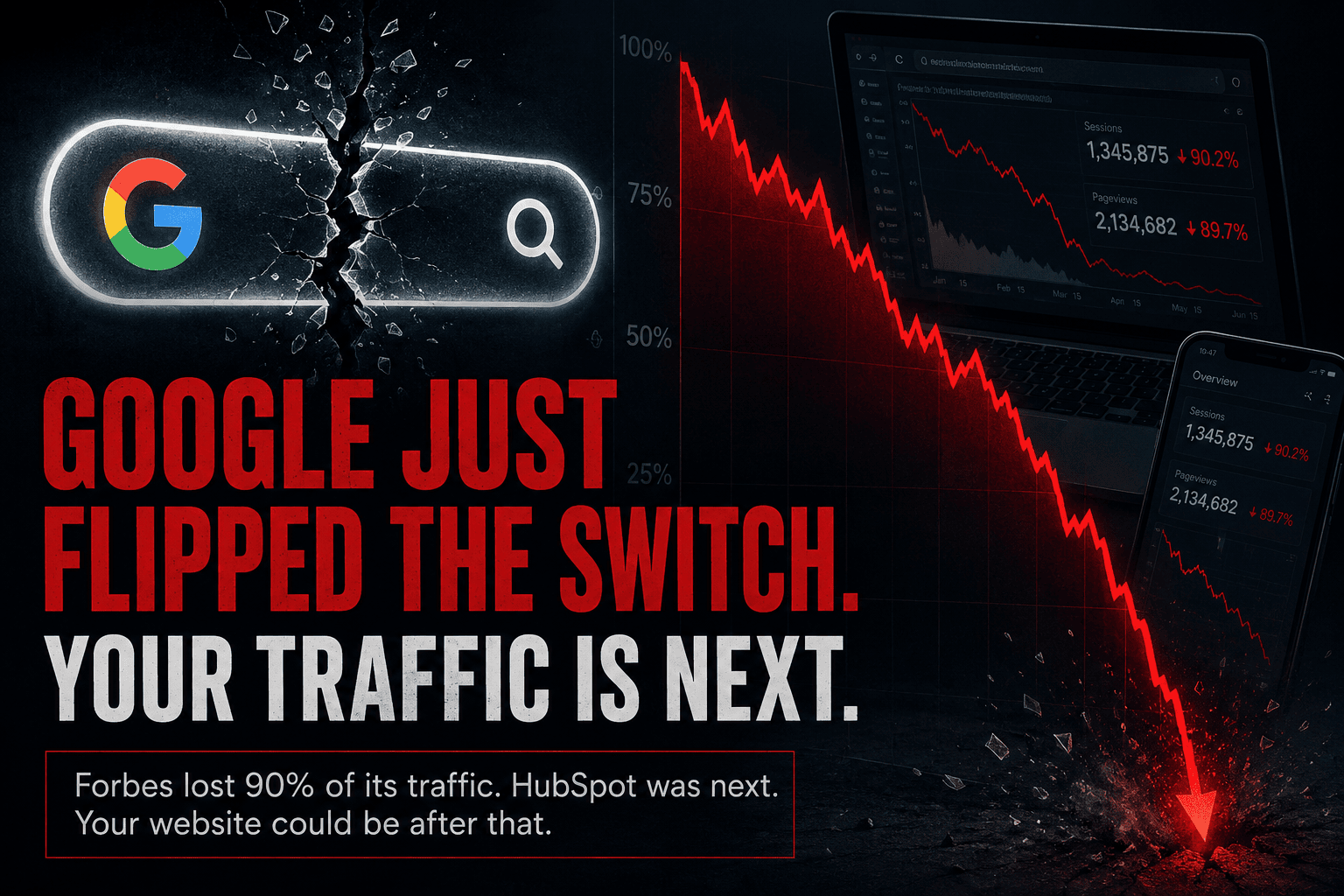
If you run a website, you’ve probably heard some version of this story: Google flipped a switch, Forbes lost almost all its search traffic overnight, HubSpot got dragged down with it, and now every business is scrambling to survive the next update. The Google June 2026 Update is real, and it is reshaping how content ranks. But the headline-grabbing Forbes collapse people are talking about didn’t happen this June — it happened nearly two years earlier, and the June 2026 update is best understood as the latest chapter in that story, not the opening one.
Getting the timeline right matters, because it changes what you should actually do about it. This article walks through what genuinely happened, what changed with the Google June 2026 Update specifically, why it hit Forbes and HubSpot the way it did, and what smaller businesses need to do differently in a search landscape that now punishes brand-borrowing and rewards genuine authority.
What Is the Google June 2026 Update?
The Google June 2026 Update was a global spam-fighting rollout that ran from roughly June 24 to June 26, 2026. Unlike a broad “core update,” which re-evaluates content quality across the entire web, this was a targeted enforcement pass. It went after known spam categories that Google has been formally policing since 2024: scaled, low-value content produced primarily to capture search traffic; expired domains repurposed to inherit old ranking authority; manipulative link schemes; and, critically, the “site reputation abuse” policy that first made headlines when it hit Forbes Advisor.
The Google June 2026 Update did not introduce a brand-new rulebook. It re-applied existing rules more aggressively, at global scale, catching sites that had drifted back into risky practices or that Google’s systems simply hadn’t caught yet. That distinction is the single most important thing to understand if you’re trying to protect your own rankings: this wasn’t a new law. It was a new wave of enforcement of a law that’s been on the books since 2024.
The Real Timeline: From Forbes’s 2024 Collapse To The 2026 Enforcement Wave
To understand the Google June 2026 Update, you have to rewind to March 2024, when Google formally introduced its site reputation abuse policy. The policy targets a specific practice: a well-known, high-authority website renting out sections of its domain to third-party content producers — often affiliate marketers — who publish commercial content designed to exploit the host site’s trust and ranking power with Google, rather than to genuinely serve readers.
How Forbes Advisor Lost Up To 90% Of Its Traffic
Forbes Advisor, the personal-finance and product-review arm of Forbes.com, became the poster child for this policy. In September 2024, following public criticism of its business model from SEO analysts, Forbes Advisor’s search visibility began falling sharply. Independent tracking tools such as Ahrefs later showed the section’s estimated organic traffic sliding toward near zero by early 2025 — a decline that, measured against its 2024 peak, works out to somewhere around 90 percent. Google never issued a public statement confirming the exact cause or size of the drop, which is normal; Google rarely comments on individual sites. But the timing, the scale, and the specific pages affected (currency converters, insurance comparisons, credit card reviews — all high-commercial-intent content) lined up closely with the site reputation abuse policy Google had just finished expanding.
Forbes Advisor did eventually claw back a portion of that traffic starting in early 2025, largely by tightening editorial oversight and rebuilding topical authority rather than through any quick technical fix — a pattern that recurs throughout this story and matters for anyone hoping a Google June 2026 Update penalty can be reversed overnight. It generally can’t.
HubSpot’s Quieter, Slower-Burning Reckoning
HubSpot’s situation unfolded on a similar timeline but told a different story. As enforcement of the site reputation abuse policy tightened through late 2024, certain HubSpot blog content — pieces built primarily to capture broad, high-volume search terms rather than to serve HubSpot’s actual product audience — began losing rankings. Some independent analyses put HubSpot’s organic traffic decline at roughly 80 percent across affected content categories.
What makes HubSpot’s case genuinely instructive, and worth remembering before you panic about a Google June 2026 Update hit, is what happened to the business underneath the traffic chart: HubSpot’s revenue kept growing through the same period. That’s because a software company selling enterprise subscriptions doesn’t depend on blog traffic the way a media company selling ad impressions does. Direct visits, branded search, and existing customer relationships carried the business while the top-of-funnel blog traffic fell. It’s a useful reminder that a scary-looking Search Console graph and a scary-looking revenue graph aren’t automatically the same graph.
What Actually Changed In The Google June 2026 Update
So if the big Forbes and HubSpot drops predate it, what did the Google June 2026 Update actually do? Four things stand out.
Renewed Enforcement On Scaled Content Abuse
The update took aim at sites publishing large volumes of thin, templated, or AI-assisted content whose primary purpose is ranking rather than helping the reader. This isn’t a ban on using AI tools to write — it’s a penalty on content that reads as interchangeable, generic, and optimized purely for keyword coverage rather than genuine expertise.
Expired Domain Abuse, Closed Further
The Google June 2026 Update continued closing a loophole where marketers buy expired domains that once belonged to legitimate, authoritative sites and repopulate them with unrelated commercial content, hoping to inherit the old domain’s trust signals. Google’s systems got noticeably better at detecting this pattern this year.
Site Reputation Abuse, Still Very Much Active
This is the same policy that hit Forbes Advisor in 2024. It remained a manual, human-reviewed action rather than a fully automated one heading into mid-2026, according to SEO analysts who track enforcement patterns closely. That matters: it means Google is still selectively reviewing and penalizing specific sites rather than running this check algorithmically across the whole web, which is part of why enforcement can feel sudden and uneven.
Two New Enforcement Deadlines Layered On Top
In the weeks leading up to the June rollout, Google quietly set two additional deadlines: a policy change addressing AI-generated-answer manipulation that took effect in mid-May 2026, and enforcement against certain deceptive UX patterns — including back-button hijacking, where a site traps a visitor who tries to leave — that began in mid-June 2026. Much of the traffic volatility site owners reported in late June was likely the combined, delayed effect of both of these plus the spam update itself, rather than any single cause.
Why The Google June 2026 Update Hits Big Brands Harder Than It Looks
It might seem counterintuitive that Forbes and HubSpot — sites with enormous authority, huge budgets, and full-time SEO teams — would be more exposed than a small independent blog. But the mechanics of site reputation abuse enforcement actually make big, trusted domains more attractive targets for exactly the kind of abuse the Google June 2026 Update polices.
A brand-new website has to earn Google’s trust page by page. A legacy domain like Forbes.com already has decades of backlinks, citations, and reader trust baked in. That trust is valuable — valuable enough that renting out a slice of it to third-party commercial publishers became a business model in itself. Google’s site reputation abuse policy exists precisely because that arbitrage was working: content that had no business ranking was ranking, simply because it lived on a trusted domain. Once Google closed that loophole, the sites that had leaned into it hardest had the furthest to fall.
Smaller, single-owner websites are less likely to have this specific problem, but they’re not off the hook. The scaled-content and low-value-content provisions in the Google June 2026 Update apply just as much to a five-person marketing agency’s blog as they do to a Fortune 500 media brand.
What This Means For Small And Mid-Sized Businesses
If you’re not Forbes or HubSpot, here’s the version of this that actually applies to you.
Your content needs a clear, identifiable point of view. Google’s systems are increasingly good at distinguishing genuinely useful, experience-backed writing from generic content assembled to cover a keyword. The Google June 2026 Update leaned further into this distinction, not away from it.
Third-party or outsourced content on your domain carries real risk. If you host guest posts, sponsored content, or an outsourced content mill under your main domain, review it against Google’s site reputation abuse guidance. This is the exact mechanism that hit Forbes, and it scales down to any domain that mixes first-party expertise with rented-out commercial content.
A traffic drop is not automatically a penalty. Before assuming you’ve been hit by anything related to the Google June 2026 Update, check Google Search Console’s Manual Actions report. If it’s empty, you’re most likely looking at a broader algorithmic reassessment, a technical issue, or the ongoing shift toward AI Overviews absorbing clicks that used to go to websites — a separate but very real trend reshaping search traffic across nearly every industry in 2026.
Recovery is slow by design. Neither Forbes nor HubSpot bounced back with a quick fix. Recovery from this category of penalty tends to take months of consistent, demonstrable quality improvement — not a single round of edits.
How To Protect Your Site From The Next Google June 2026 Update-Style Penalty
A practical checklist, based on what actually correlated with recovery for sites that got hit:
- Audit any third-party or syndicated content on your domain. If someone else is publishing under your brand primarily to exploit your domain’s authority, that’s the single highest-risk pattern Google is currently policing.
- Cut genuinely thin, templated pages rather than trying to defend them. Consolidating or removing low-value pages has consistently outperformed trying to “optimize” them further.
- Strengthen visible author expertise. Real bylines, real credentials, and a clear editorial process are quality signals Google’s systems weight more heavily than they used to.
- Keep a close eye on Search Console, not just Google Analytics. Clicks and impressions falling together points to an algorithmic issue; a divergence between the two usually points to a technical or tracking problem instead.
- Don’t panic-edit everything at once. Sweeping changes during an active rollout make it harder to diagnose what actually helped or hurt, and can compound a temporary dip into a longer one.
- Build authority the slow way. Genuine backlinks, citations, and reader trust are exactly what the site reputation abuse policy is designed to protect — which means they’re also exactly what protects you from it.
The Bigger Picture: Search Is Changing Faster Than Most SEO Playbooks
The Google June 2026 Update is a symptom of something larger than one company’s spam policy. Search itself is being restructured around AI-generated answers, and a shrinking share of searches result in a click to any website at all. Against that backdrop, Google has strong incentive to keep the remaining organic results as trustworthy as possible — which means less tolerance for exactly the kind of brand-borrowing and content-scaling that built Forbes Advisor’s old traffic numbers in the first place.
For businesses that depend on organic search, the lesson of Forbes and HubSpot isn’t “big brands are untouchable” or “small sites are safe.” It’s that ranking power built on borrowed trust or content volume is fragile, while ranking power built on genuine expertise and a real audience relationship is far more durable — through this update, and whatever Google calls the next one.
Frequently Asked Questions
Did the Google June 2026 Update specifically target Forbes and HubSpot?
No. Forbes Advisor’s traffic decline began in September 2024 and HubSpot’s began around December 2024, both tied to Google’s site reputation abuse policy. The Google June 2026 Update was a separate, later enforcement wave targeting spam more broadly across the web.
How much traffic did Forbes actually lose?
Independent tools like Ahrefs estimated Forbes Advisor’s organic traffic fell to near zero by early 2025 compared with its 2024 peak — a drop of roughly 90 percent by some estimates. Google has not publicly confirmed an exact figure.
Is the Google June 2026 Update a core update or a spam update?
It was a spam update, meaning it targeted specific violations of Google’s spam policies rather than reassessing overall content quality the way a core update does.
Can a site fully recover after a site reputation abuse penalty?
Partially, and slowly. Forbes Advisor regained some traffic starting in 2025 after tightening editorial oversight, but recovery took months and was tied to genuine quality changes, not a quick technical fix.
How do I know if my traffic drop is related to the Google June 2026 Update?
Check the Manual Actions report in Google Search Console first. If it’s empty, compare the exact date your traffic dropped against known update rollout windows, and check whether clicks and impressions fell together — that pattern points to an algorithmic cause rather than a technical one.