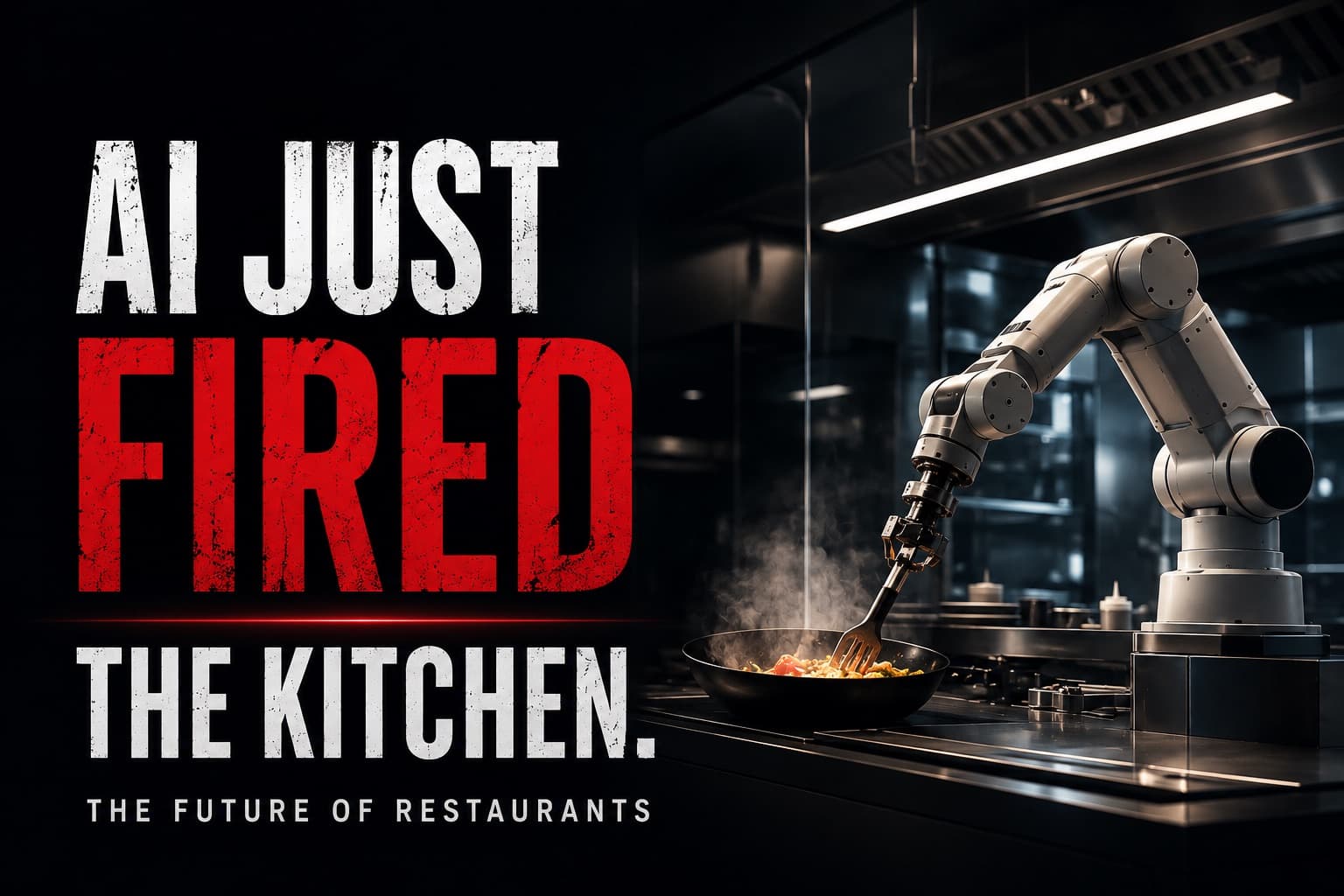

There is a robot cooking dinner inside a German supermarket, and it does not want a break, a promotion, a creative outlet or Sunday night off.
It does not arrive late because the train stalled. It does not call out sick during brunch. It does not burn out after six consecutive doubles or disappear halfway through service after realizing that another industry will pay more for fewer scars.
Its name is the CA-1, short for Circus Autonomy One, and it may be the clearest preview yet of what happens when artificial intelligence stops writing emails and starts taking control of physical labor.
Built by German robotics company Circus SE, the CA-1 is not a humanoid chef theatrically waving a spatula for social media. It is something potentially more disruptive: an autonomous food-production system compressed into seven square meters.
The machine stores ingredients, accepts orders, dispenses precise portions, cooks with induction, plates meals, manages pickup compartments and cleans its own equipment. It contains 36 ingredient silos, four cooking stations, eight pickup slots and an integrated dishwasher. According to Circus, one unit can hold enough ingredients for more than 500 dishes, operate continuously and produce approximately 800 meals per day with less than one hour of human interaction.
This is not a robot helping a cook.
This is the kitchen becoming a machine.
The most dangerous restaurant robot will not look like a chef. It will look like infrastructure.
The restaurant has been reduced to seven square meters
The first public CA-1 began serving customers at a REWE supermarket in Düsseldorf in October 2025. Customers place an order through a digital terminal and watch the system prepare dishes behind glass. Meals initially included familiar, automation-friendly selections such as lentil curry and penne arrabbiata, with main dishes promoted from approximately €6.
The setting matters.
Circus did not introduce its robot inside an avant-garde tasting room where diners expect technology to perform tricks. It placed the machine inside a supermarket, where convenience, cost and consistency matter more than culinary theater.
That is the actual target.
The CA-1 is not coming first for the chef shaving truffles over handmade pasta in a twenty-seat restaurant. It is coming for the invisible industrial kitchen: supermarkets, hospitals, airports, universities, hotels, corporate cafeterias, train stations and fast-casual chains.
These environments do not need culinary spontaneity. They need hundreds of consistent meals produced safely, quickly and cheaply. They need kitchens that can remain open when workers cannot be found. They need exact portions, predictable costs and fewer human variables.
The CA-1 turns those needs into software.
A company can theoretically update menus across multiple locations, monitor inventory remotely, analyze demand and optimize production through the Circus operating system. Recipes no longer live primarily in the instincts of cooks. They become programmable assets distributed across a robotic fleet.
That is where this becomes bigger than another story about automation.
Circus is not simply selling cooking equipment. It is attempting to build an operating system for food production.
AI has finally found the line cook
Restaurant automation has been approaching the kitchen in pieces for years.
Self-ordering kiosks replaced cashiers. QR codes replaced menus. Algorithms adjusted delivery prices. Robotic arms flipped burgers, fried chicken wings and assembled bowls. Software handled scheduling, inventory, reservations and purchasing.
But most systems automated one task while leaving the conventional kitchen intact.
The CA-1 attacks the kitchen as a complete production unit.
Its robotic arms, ingredient silos, induction vessels, sensors and cleaning equipment combine tasks previously divided among prep cooks, line cooks, expediters and dishwashers. AI-supported forecasting can also predict demand, control inventory and reduce waste.
The sales pitch is efficiency. The labor consequence is obvious.
In the United States, full-service restaurant employment remained approximately 174,000 jobs below its pre-pandemic level in May 2026, according to the National Restaurant Association. Operators have spent years describing labor shortages as an existential crisis.
Technology companies listened.
The restaurant industry told investors it could not find enough workers. Investors responded by funding machines that may ensure it never needs as many workers again.
The labor shortage did not save restaurant workers. It created the business case for deleting them.
No, it cannot replace a real chef—yet
The claim that CA-1 can operate “without staff” requires an industrial-sized pinch of salt.
Ingredients still need to be sourced, received, inspected, prepared and loaded in forms the machine can process. The system requires maintenance, sanitation verification and technical support. Someone must develop the recipes, manage allergens and ensure that the food leaving the machine is safe.
And the CA-1 does not taste.
It cannot walk through a market, find exceptional tomatoes and change the menu because the fruit is perfect. It cannot rescue a broken sauce through instinct, read a dining room or understand why one plate feels emotionally flat. It cannot negotiate with a fishmonger, calm a client, mentor an apprentice or create a dining experience around a family’s history.
But that argument can become a comforting distraction.
Most meals sold globally are not culinary art. They are standardized products created within strict cost, time and portion constraints. The cook in a hospital cafeteria is rarely being paid for creative authorship. The airport employee assembling grain bowls is executing a system designed elsewhere.
The CA-1 does not need to replace every chef to transform food service. It only needs to outperform the economics of repetitive kitchen labor.
That is a considerably lower bar.
The robot revolution is having scaling problems
The future, however, has encountered an inconvenient obstacle: the physical world.
In July 2026, Circus reduced its projected annual revenue from a previously announced range of €44 million to €55 million down to approximately €5.2 million. The company said system onboarding, integration and continuing service had not yet scaled according to its planned economics. Some deployments were pushed into 2027, while projected EBITDA fell to approximately negative €17 million.
That is an extraordinary correction.
The machine may automate a kitchen, but installing, operating and supporting fleets of food-safe robots is not the same as uploading software. Real kitchens contain grease, steam, bacteria, inconsistent ingredients, damaged packaging, changing temperatures and customers who press the wrong button.
Dinner is a hostile computing environment.
Circus has continued expanding production and reported cutting its CA-1 manufacturing cycle from roughly eight weeks to four. But its financial reset reveals the enormous distance between an impressive demonstration and a profitable global network.
The CA-1 can remove friction from restaurant labor only by transferring complexity somewhere else—to engineers, technicians, supply chains, software teams and centralized food-preparation systems.
The kitchen does not disappear. It is reorganized beyond the customer’s view.
The chef becomes intellectual property
If autonomous kitchens scale, the most valuable culinary worker may no longer be the person standing over the stove.
It may be the person who designs the recipe system.
Chefs could become licensors of taste: developing menus, flavor profiles and branded culinary programs that robotic fleets reproduce across thousands of locations. A recognizable chef would not need to operate every kitchen. Their formulas could travel as software.
That creates a new hierarchy.
At the top will be culinary creators who own brands, recipes, data and distribution. Beneath them will be technicians who maintain the systems. The traditional middle—the working cooks who translate knowledge into meals—could become dangerously thin.
The future chef may be less employee than intellectual property.
For elite chefs, consultants and media personalities, that could create extraordinary leverage. For millions of workers who learned the profession through repetition on the line, it could destroy the very entry-level jobs through which expertise is built.
A machine can reproduce a recipe. It cannot explain where the next generation of chefs will learn to create one after the training ground has been automated away.
The kitchen is not dead. It is becoming code.
The CA-1 is not proof that chefs are obsolete. It is proof that the food industry has identified which parts of their labor it considers disposable.
Creativity will survive. Luxury hospitality will survive. Restaurants built around human personality, cultural authority and live experience will survive.
Standardized production will be attacked relentlessly.
That leaves the industry with a brutal question. If machines perform the repetitive work, will human cooks finally be elevated into better-paid creative and hospitality roles? Or will corporations capture the savings while eliminating the ladder that allowed cooks to become chefs?
The CA-1 is currently preparing inexpensive meals inside a supermarket in Düsseldorf. Its manufacturer is still losing money, its expansion plans have slowed and its promise of frictionless autonomy remains unfinished.
But the direction is unmistakable.
AI is no longer asking chefs for recipes.
It is learning how to run the kitchen without them.
Related Articles on IMFounder
- How Sysco Corporation Consolidated the Middle Layer of Food Distribution
- Why Starbucks’ TikTok Creator Program Changes the Future of Work
- GLP-1 Is Eating the Food Industry From the Inside Out
- The Restaurant Industry: The Fastest Way Into the Economy Is Closing
- 7 Shocking Reasons Trees Are the Rarest Resource on Earth
- The Stadium Economy Was Rewritten Without Labor: How AI Is Automating Stadium Jobs Away