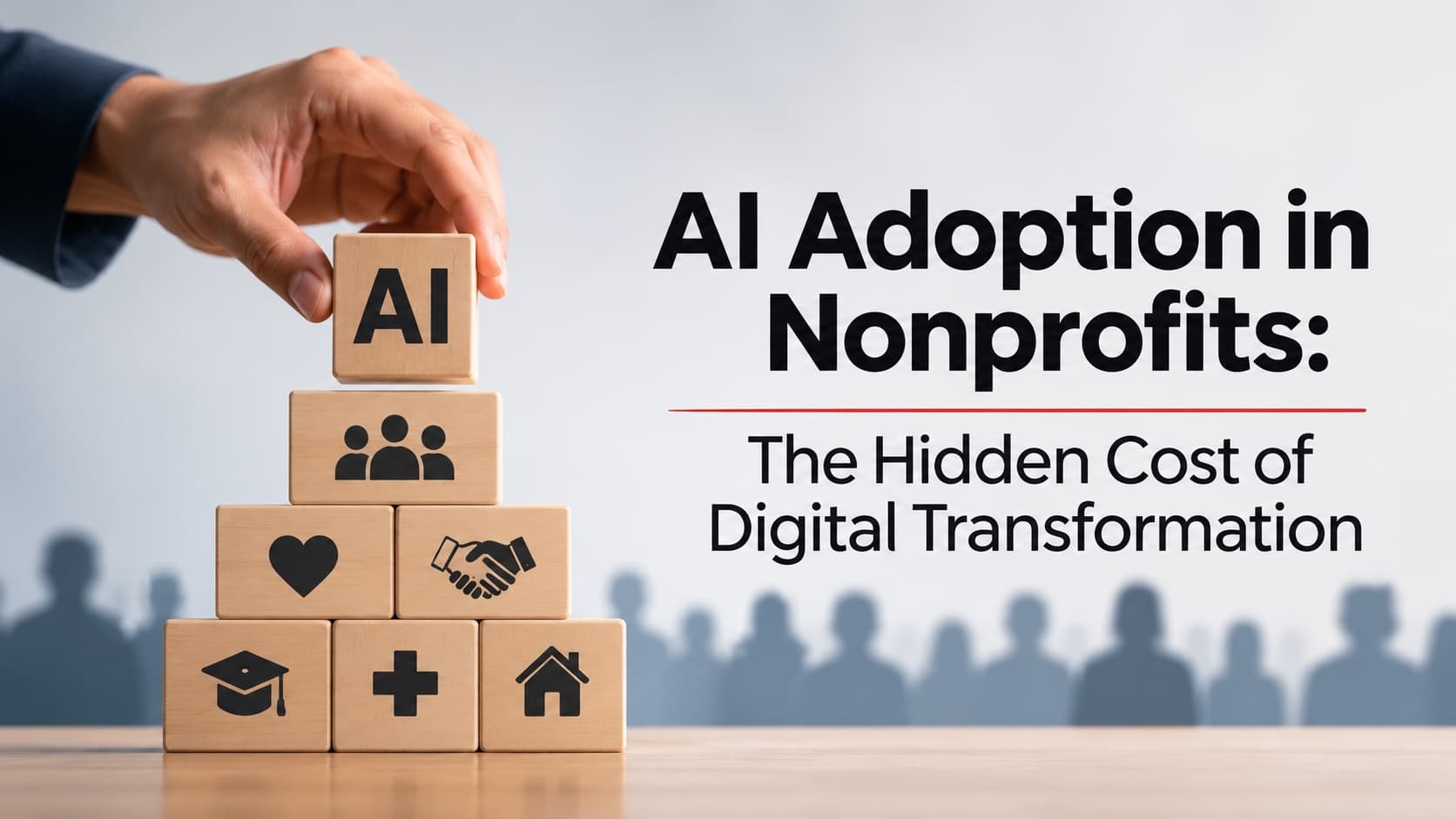

AI adoption is accelerating across America’s nonprofit economy. But behind the productivity gains is a harder question: Who controls the technology keeping essential services running?
While America argued about artificial intelligence, the nonprofit sector got to work. No billion-dollar launch parties, no venture capital victory laps, and no breathless declarations about changing civilization before lunch. Just organizations trying to keep their doors open, employees paid, donors engaged, and communities served. Increasingly, they are doing it with artificial intelligence.
The technology is getting cheaper to access. Keeping an organization alive is another matter.
America’s Other Economic Engine
The word nonprofit still conjures images of donation jars, volunteer bake sales, and charitable organizations operating on goodwill. The actual economy looks considerably different. According to the Bureau of Labor Statistics, nonprofit establishments employed approximately 12.8 million Americans in 2022, representing 9.9% of private-sector employment. Candid’s U.S. Social Sector Dashboard identifies approximately 1.94 million registered nonprofit organizations in its 2023-based dataset.
The sector encompasses hospitals, universities, community organizations, research institutions, museums, housing programs, workforce development agencies, food assistance networks, foundations, and independent journalism. These are not peripheral institutions. They provide services that households, businesses, and governments depend on, and their financial instability does not remain neatly contained within nonprofit balance sheets. It moves outward into employment, health care access, housing assistance, food security, and local economies.
That makes their rapid adoption of artificial intelligence an infrastructure story, not merely a technology story.
The Funding Crisis Arrived First
Before AI became a daily productivity tool, nonprofit organizations were already navigating years of workforce disruption. The pandemic eliminated approximately 580,000 nonprofit jobs between 2019 and 2020, according to research from George Mason University. Employment subsequently recovered, but more slowly than in the for-profit sector. Then 2025 brought another shock, one that exposed just how vulnerable organizations had become to government funding decisions.
An October 2025 Urban Institute study found that one-third of surveyed service nonprofits experienced government funding disruptions during the first four to six months of the year. Twenty-one percent lost at least some government funding, 27% experienced delays, pauses, or freezes, and 6% received stop-work orders. Those categories overlap, but the combined picture is unmistakable: funding instability had become an operational emergency.
A subsequent Urban Institute report published in October 2026 examined the consequences across the full year. Among staffed nonprofits experiencing government funding disruptions, 30% reduced employment, compared with 20% of staffed nonprofits overall. Hiring expectations deteriorated and did not recover. As of late 2024, 57% of staffed nonprofits planned to hire new employees. By early 2025, that figure had fallen to 41%, and by early 2026 it stood at 38%.
The consequences extended beyond payroll. Only 45% of nonprofits experiencing government funding disruptions reported meeting demand for their services in 2025, compared with 52% overall. Meanwhile, 71% of disrupted organizations expected demand to increase during the following year. Communities needed more assistance precisely when the organizations providing it were losing financial flexibility.
Artificial intelligence entered that environment as a potential efficiency tool. The available research does not establish that funding cuts directly caused AI adoption, but it demonstrates that both developments are occurring across a sector under considerable operational strain. Organizations are being asked to deliver more services with fewer predictable resources, creating an environment in which productivity technology becomes increasingly attractive.
The demand for nonprofit services is growing. The money supporting those services is becoming less predictable. AI has entered the gap.
Everyone Is Using AI. Almost Nobody Has Rebuilt Around It.
The Virtuous benchmark exposes the difference between using technology and transforming an organization. Although 92% of surveyed nonprofits had adopted AI, only 7% reported major improvements in organizational capability. Researchers describe this disconnect as an efficiency plateau, a condition in which employees become faster at completing individual assignments without producing corresponding changes in institutional performance.
An employee might use AI to draft a fundraising email, summarize a board meeting, generate social media captions, research grants, or organize a report. Each task becomes easier, but the underlying operating model remains largely unchanged. Organizations still contend with fragmented processes, inconsistent documentation, inadequate training, and limited capacity to measure whether the technology is improving outcomes. Faster administrative work does not automatically translate into better programs, stronger financial performance, or improved community services.
The governance gap compounds the problem. Virtuous reported that 47% of surveyed organizations had no AI policy, a consequential finding for institutions handling information involving donors, employees, clients, beneficiaries, and vulnerable populations. An organization may gain several hours of productivity while introducing questions about confidentiality, accuracy, vendor access, and institutional accountability. Those questions become more serious when AI moves beyond drafting newsletters into financial analysis, case management, and service delivery.
The Funders Are Using AI, Too
The Center for Effective Philanthropy identified another disconnect between nonprofit organizations and the institutions financing their work. Its research found that just 17% of nonprofit leaders reported that their foundation funders had engaged them in conversations about using AI. Foundations and grantees are exploring similar technologies, but communication about implementation remains limited, creating another challenge for organizations already struggling to secure predictable funding.
An organization may need staff training, secure software, professional development, and governance procedures to deploy AI responsibly. Yet the foundation evaluating its grant application may never have discussed those requirements with the organization. This disconnect matters because technological efficiency has financial costs of its own, particularly when institutions need to establish appropriate safeguards for sensitive information and maintain human oversight.
AI can reduce the cost of producing a grant proposal, but it cannot manufacture the funding that proposal requests. Nor can it guarantee that an organization has the capacity to deliver the programs described in increasingly polished applications. A better-written proposal is not the same thing as a better-funded institution, and a more efficient fundraising department does not necessarily translate into a stronger funding environment.
Where the Technology Is Taking Hold
Across nonprofit operations, artificial intelligence offers a growing collection of practical applications. Education organizations can develop instructional materials, translate communications, and support individualized learning activities. Workforce development programs can assist participants with résumés, career research, interview preparation, and skills documentation. Community organizations can streamline volunteer coordination, administrative reporting, scheduling, and donor outreach, while foundations can use AI-assisted research to examine grant applications, summarize program information, and organize evaluation materials.
These applications illustrate the technology’s potential rather than verified adoption rates for individual nonprofit subsectors. The available research does not establish that education, workforce development, community services, and philanthropy are implementing AI at the same pace or achieving comparable results. That distinction matters because access to technology is not proof of effectiveness, particularly when organizations serve people facing digital access limitations, language barriers, or sensitive personal circumstances.
A chatbot may help someone navigate an application, but it may also produce an incorrect answer, misunderstand eligibility requirements, or mishandle information. For organizations providing essential services, these failures can carry consequences beyond administrative inconvenience. The operational question is not simply whether AI can perform a task. It is whether the organization can verify the result, protect the people involved, and remain accountable when something goes wrong.
Nonprofit Journalism Offers a Clearer Picture
One of the strongest measurable examples of nonprofit AI adoption comes from independent newsrooms. The Institute for Nonprofit News reported that AI use among its members rose from 34% in 2023 to 63% in 2024 and 81% in 2025, an increase of 47 percentage points in just two years. Common applications included meeting transcription, summarization, and data analysis rather than autonomous reporting or story production. The adoption curve demonstrates how quickly technology can become embedded in a profession built around verification, editorial judgment, and public trust.
Meanwhile, the sector’s financial picture remains complicated. INN’s 2026 Index reported more than $750 million in combined 2025 revenue across its network, representing a 14% increase over the previous year. But median annual revenue per outlet slipped slightly to $525,000, indicating that aggregate growth did not translate into equivalent gains for the typical newsroom. Approximately three-quarters of nonprofit news publishers also reported negative effects from the political climate.
These pressures matter because nonprofit journalism increasingly serves communities where commercial news operations have contracted. The same AI systems that accelerate transcription, document analysis, and administrative work introduce questions about source confidentiality, factual reliability, and editorial independence. Newsrooms may gain valuable operational capacity without increasing the resources available for original reporting, legal review, or investigative work.
AI can accelerate the production of information. It cannot assume responsibility for whether that information is true.
The Commercial Stack Beneath the Mission
Much of the nonprofit AI transition relies on tools developed and controlled by commercial technology companies. ChatGPT, Claude, Gemini, Microsoft Copilot, Canva’s AI features, and Grammarly provide capabilities ranging from research assistance and writing to design and administrative productivity. For organizations operating with limited staff, the attraction is obvious. A small team can access functions that previously required specialized employees, outside contractors, or expensive software.
But accessibility creates another economic relationship. A nonprofit may own its mission, donor relationships, and program expertise while depending on outside vendors for increasingly important operational functions. Those vendors control product features, pricing structures, service availability, and contractual terms. If subscription prices rise, a feature disappears, or data policies change, the nonprofit must adapt, regardless of whether the decision aligns with its mission or financial capacity.
For a well-funded institution with a dedicated technology department, managing those changes may be routine. For a community organization operating with a handful of employees, the same disruption can become a significant operational problem. The nonprofit sector is not simply purchasing software; it is incorporating commercial technology into the infrastructure through which public-benefit services are delivered. When nearly half of surveyed organizations lack formal AI policies, the question of institutional control becomes difficult to ignore.
The underlying contradiction is striking. Organizations created to serve the public interest are increasingly relying on privately controlled systems to fulfill that responsibility. The technology may improve productivity, but it also transfers a portion of operational control to companies whose commercial priorities are not necessarily aligned with nonprofit missions.
The Stack Economy Has Reached Philanthropy
The nonprofit transition reflects a broader restructuring of American economic life. Workers increasingly combine income sources, while entrepreneurs assemble revenue from services, digital products, consulting, and independent platforms. Organizations are pursuing a parallel strategy, diversifying their funding while adopting technology intended to stretch limited resources further.
The Institute for Nonprofit News found that 49% of its members drew on at least four revenue streams in 2025, up from 38% in 2022. Individual giving represented 33% of aggregate member revenue in 2025, compared with 29% in 2023. The movement toward diversified funding is measurable within nonprofit journalism, where organizations increasingly combine individual contributions, institutional grants, earned revenue, and other forms of financial support.
But diversification is not the same as security. Four unreliable revenue streams do not automatically produce a stable organization, just as six AI subscriptions do not automatically create a coherent operating system. Both strategies require management, oversight, and a clear understanding of where vulnerabilities remain. This is the economic connection between the independent worker and the modern nonprofit: both are trying to build resilience through multiple systems while retaining control over their work.
The New Barrier to Entry
Artificial intelligence may make starting a mission-driven organization easier. A founder can research a problem, develop a business plan, design public-facing materials, organize fundraising campaigns, and prepare operational documents using widely available technology. Functions that once required significant outside assistance can now be completed with fewer resources, potentially lowering the initial cost of organizational development.
That does not eliminate the legal, financial, and operational requirements of sustaining a nonprofit. Tax-exempt status, regulatory compliance, responsible governance, financial reporting, program delivery, and long-term funding remain separate obligations. An organization can produce professional-looking materials, sophisticated grant applications, and comprehensive strategic plans without possessing the financial or operational capacity to execute them.
The competitive advantage will not necessarily belong to the organization with the largest collection of AI tools. It may belong to the institution capable of integrating those tools into documented, auditable workflows while maintaining independent judgment and control over sensitive information. For founders, that distinction is more consequential than mastering the latest prompt-writing technique.
The Next Infrastructure Question
Industrialization helped reshape American charitable institutions, while economic crises expanded demand for organized social support. Artificial intelligence is now entering a nonprofit sector confronting its own structural pressures. The technology can reduce administrative burdens, expand access to specialized capabilities, and help small teams operate more efficiently, but it cannot independently replace government contracts, philanthropic support, trained employees, or community trust.
More significantly, AI introduces a new form of dependency at the same time organizations are trying to reduce their financial vulnerability. Commercial technology providers increasingly influence the cost, accessibility, and functionality of tools used to deliver public-benefit services. That creates an infrastructure problem extending beyond subscription fees and software selection into questions of governance, institutional independence, and accountability.
The central question is no longer whether nonprofits will use artificial intelligence. Many already do, and the adoption figures suggest that the technology has moved beyond experimentation. The question is whether these organizations will build the governance, financial resilience, and operational independence necessary to control how they use it.
America’s nonprofit sector is learning to operate with artificial intelligence. Whether that makes it more resilient or simply more dependent on another set of powerful institutions remains the defining question of this quiet boom.
Sources
- Bureau of Labor Statistics. Nonprofits Accounted for 12.8 Million Jobs in 2022.
https://www.bls.gov/opub/ted/2024/nonprofits-accounted-for-12-8-million-jobs-9-9-percent-of-private-sector-employment-in-2022.htm - Candid. U.S. Social Sector Dashboard: Organizations.
https://candid.org/explore-issues/us-social-sector/organizations - Virtuous and Fundraising.AI. 2026 Nonprofit AI Adoption Report.
https://virtuous.org/resource/the-2026-nonprofit-ai-adoption-report-download/ - George Mason University. 2024 Nonprofit Employment Report.
https://nonprofitcenter.schar.gmu.edu/wp-content/uploads/2024/12/Nonprofit-Employment-Report-12.24-Full-Text-2.pdf - Urban Institute. How Government Funding Disruptions Affected Nonprofits in Early 2025.
https://www.urban.org/sites/default/files/2025-10/How_Government_Funding_Disruptions_Affected_Nonprofits_in_Early_2025.pdf - Urban Institute. Workforce and Community Consequences of Government Funding Disruptions in 2025. October 2026.
https://www.urban.org/research/publication/workforce-and-community-consequences-government-funding-disruptions - Urban Institute. The Prevalence, Persistence, and Financial Implications of Government Funding Disruptions for Nonprofits in 2025. October 2026.
https://www.urban.org/research/publication/prevalence-persistence-and-financial-implications-government-funding - Center for Effective Philanthropy. AI With Purpose: How Foundations and Nonprofits Are Thinking About and Using Artificial Intelligence.
https://cep.org/report-backpacks/ai-with-purpose-how-foundations-and-nonprofits-are-thinking-about-and-using-artificial-intelligence/ - Institute for Nonprofit News. 2026 INN Index.
https://inn.org/our-work/index-about/inn-index-report/ - Institute for Nonprofit News. 2026 Index: Revenue and Expenses.
https://inn.org/inn_reports_pages/2026-index/revenue-expenses/