
Employee-generated content is not new. Workers have been making brands visible online for years, often without permission, protection, or pay. The change now is that companies are beginning to formalize what employees were already doing. Starbucks’ TikTok creator pilot is the latest proof point, and it signals a much larger shift:
The workplace is becoming the next creator fund.
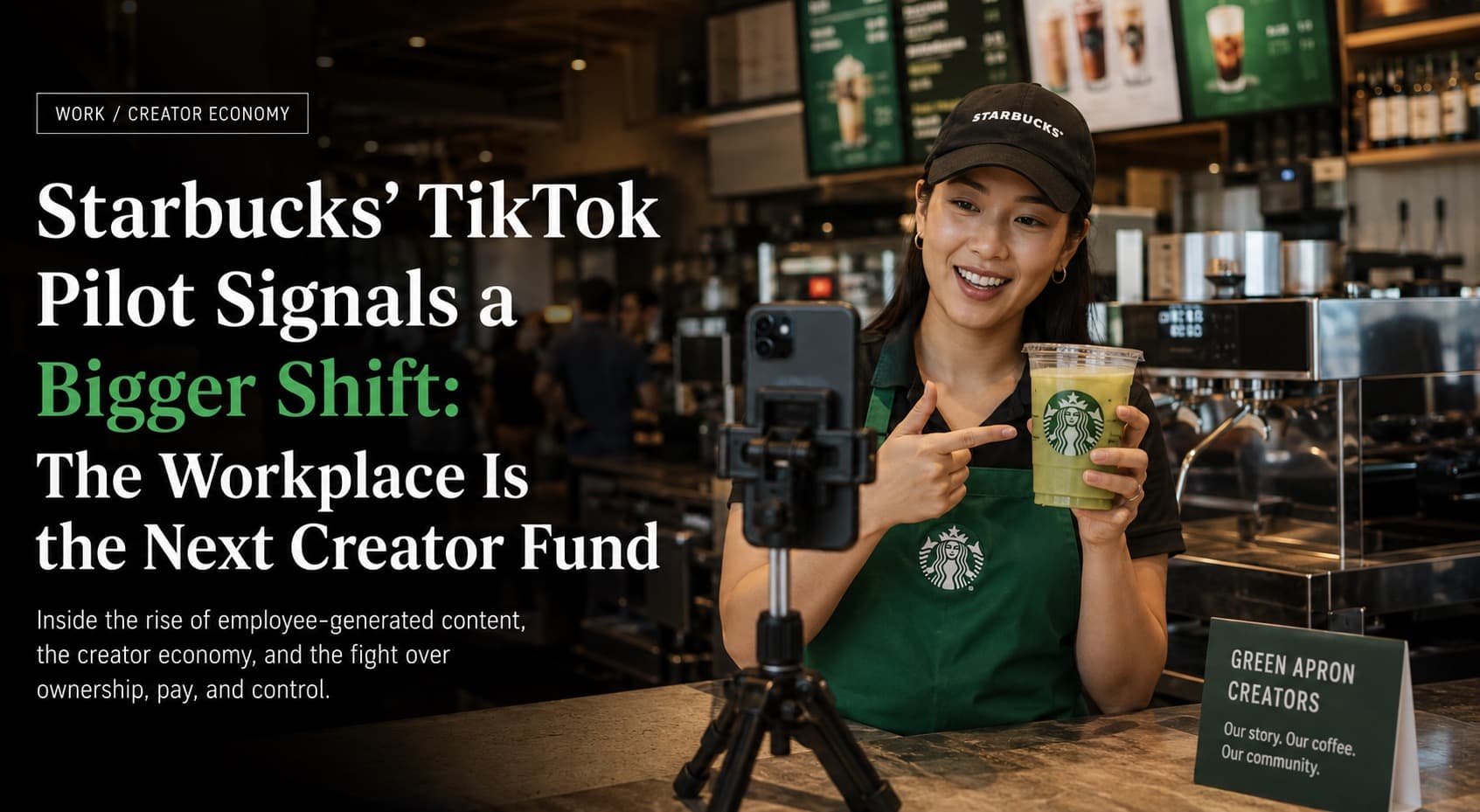
Starbucks is piloting a custom Creator Network inside TikTok’s Content Suite, building on its Green Apron Creators program. According to Marketing Dive, the pilot allows Starbucks to share creative briefs with selected employee-creators and compensate them through ad revenue sharing, with expansion dependent on what the company learns from its summer 2026 test.
That detail matters because this is not just employees posting cute videos from work. It is a major consumer brand turning workplace content into paid creator infrastructure.
The story is not that Starbucks invented employee-generated content. It did not.
The story is that one of the most visible food and beverage companies in the world is helping move employee content from informal posting into a structured system: briefs, platform tools, amplification, brand strategy, and revenue sharing.
That is the shift.
For years, workers gave brands free visibility through their own personality, humor, skill, access, and daily proximity to the product. Now companies are realizing that the people inside the operation may be more valuable than the influencers hired outside of it.
The Workplace Creator Economy Has Arrived
This is the workplace creator economy, and it is coming fast.
The old influencer model was built around external personalities selling products from the outside.
The new model is different.
It turns the employee into the trusted narrator of the brand.
The barista making the drink, the server walking the floor, the line cook firing plates, the retail associate unpacking the drop, the flight attendant filming a travel routine, the nurse explaining a shift, the warehouse worker showing the real process — these people already have something most ads lack:
Proof.
Gen Z understands this instinctively.
They grew up reading polished ads as fiction and behind-the-scenes content as signal.
Sprout Social’s 2026 State of Social Media report found that 40% of consumers frequently discover products or services through employee-generated content, rising to 61% for Gen Z.
The same report found that 61% of consumers believe employees creating content on behalf of, or to promote, a brand should be compensated accordingly.
That is the entire argument in two data points: employee content drives discovery, and consumers already understand that workers should be paid when their content helps brands sell.
By the Numbers
• 40% discover products through employee-generated content
• 61% of Gen Z does the same
• 61% believe employee creators deserve compensation
• Creator economy projected to reach $480 billion
This is where the creator economy stops being just an influencer economy.
Goldman Sachs Research projected in 2023 that the creator economy could grow from about $250 billion to $480 billion by 2027.
That estimate is not just about YouTubers, TikTok celebrities, podcasters, and lifestyle influencers.
It points to a broader monetization stack forming around attention, content tools, affiliate commerce, short-form video, brand partnerships, platform payouts, and creator-led business models.
The workplace is now being pulled into that stack.
Every Business Is Sitting on a Content Engine
The reason is simple:
Every business is sitting on a content engine.
Most companies used to think of content as something produced by marketing teams after the work was done.
Now the work itself is the content.
The process is the proof.
The person closest to the product becomes the most credible media asset in the room.
In food, this is especially obvious.
A finished latte is content. But the worker making 200 drinks under pressure is better content. A plated entrée is content.
But the prep, the fire, the handoff, the recovery, the chef calling the room, the server saving the guest experience, the baker pulling bread from the oven — that is the content people believe.
It is real, fast, human, messy, specific, and hard to fake.
That is why brands want it.
That is also why workers need to understand the value of what they are creating.
AI Makes Human Workers More Valuable
AI makes this even more important. As synthetic content floods social platforms, real human labor becomes a premium signal.
A brand can generate a fake food image in seconds.
It can use AI to write captions, test hooks, create scripts, edit clips, translate posts, summarize comments, and optimize posting schedules.
But the raw material people trust still comes from reality:
The hands. The voice. The movement. The access. The mistake. The recovery. The proof that someone is actually inside the work.
This is the next layer of creator infrastructure.
AI will not eliminate workplace creators. It will make them more valuable by turning their raw footage into scalable media.
A worker captures the real moment; AI helps package it. A brand sends the brief; the employee gives it credibility.
The platform distributes it; the ad system monetizes it. The company gets reach, culture, recruitment value, product discovery, and brand trust. The worker may get visibility, maybe payment, maybe a path into the creator economy — if the structure is fair.
The Real Question Is Ownership
That “if” is the entire labor question.
As IMFounder has reported in its coverage of automation pressure across stadium labor, visibility alone does not protect workers when companies control the infrastructure.
Because once companies start building internal creator programs, the next fight will be over ownership.
Who owns the account?
Who owns the footage?
Who owns the style?
Who owns the face, voice, catchphrases, recipes, routines, training language, editing format, audience relationship, and creative identity?
What happens when the employee leaves?
Can the company keep using the content?
Can it run ads with the worker’s likeness?
Can it edit the worker into a campaign they did not approve?
Can it claim the account if the employee built it while working there?
Those questions are not theoretical. Social media account ownership has already become a legal issue.
In JLM Couture, Inc. v. Gutman, the Second Circuit examined a dispute involving social media accounts managed during employment by designer Hayley Paige Gutman. The court rejected a special test for social media accounts and said they should be treated like property, beginning with the question of original ownership. Dechert’s analysis of the case emphasized that ownership turns on who originally owned the account and whether that ownership was validly transferred.
That case should be a warning shot for every company rushing to build employee-creator programs. If businesses want workers to create content on behalf of the brand, they need clear contracts.
Not vague social media policies.
Not “we’ll figure it out later.”
Actual written terms covering compensation, content ownership, account control, likeness rights, usage windows, paid amplification, editing rights, post-employment access, revenue sharing, and what happens if the creator leaves the company.
It should also be a warning for workers.
Visibility is not the same thing as ownership.
A worker can be the face of the video and still lose control of the asset if the terms are unclear.
They can build the style and still watch the company absorb it. They can become the reason people care about the brand and still be treated as replaceable labor once the format becomes profitable.
What Starbucks’ Pilot Really Means
That is why Starbucks’ pilot matters beyond Starbucks.
It marks a cultural and business pivot. Instead of punishing employees for creating content about their work, brands are beginning to build systems around them.
That could create opportunity.
It could create paid pathways for workers who already understand the product better than any outside influencer. It could give employees new income streams, new visibility, and a real stake in the media value they help create.
But it could also become the next extraction machine if companies treat employee-creators as cheap authenticity while keeping control of the upside.
The difference between opportunity and exploitation will come down to terms.
Who gets paid.
Who owns the content.
Who controls the account.
Who can reuse the footage.
Who benefits when the post converts.
Who keeps the audience when the job ends.
The Bottom Line
The workplace creator economy has arrived. The companies that get it right will not just ask employees to post. They will build fair creator systems with compensation, consent, rights, and ownership clearly defined. The companies that get it wrong will create the next wave of labor disputes dressed up as innovation.
The future of work is not just remote, automated, or AI-assisted.
It is visible.
It is filmed.
It is monetized.
It is distributed.
And increasingly, it is creator-led.
Your workplace is the next creator fund. The only question is whether workers will own a piece of it.
FAQ
What is employee-generated content?
Employee-generated content is social media content created by employees that showcases their workplace, products, or day-to-day experiences, often helping brands build authenticity and trust.
Why is Starbucks’ TikTok creator program significant?
It formalizes employee content creation through structured creator programs, compensation, and platform support, signaling a broader shift toward workplace creators.
How does AI affect employee-generated content?
AI can help edit, optimize, translate, and distribute content, but authentic workplace experiences remain the foundation of trusted creator content.
Who owns employee-created social media content?
Ownership depends on employment agreements, platform policies, and intellectual property laws. Clear contracts are essential to define rights, compensation, and post-employment usage.
Related Articles on IMFounder
- How Sysco Corporation Consolidated the Middle Layer of Food Distribution
- 7 Shocking Reasons Trees Are the Rarest Resource on Earth
- GLP-1 Is Eating the Food Industry From the Inside Out
- The Restaurant Industry: The Fastest Way Into the Economy Is Closing
- Why the AP × Swatch Collaboration Could Become One of the Smartest Luxury Business Moves
- Gen Z’s Attention Span Crisis Is Reshaping How Startups Build Products