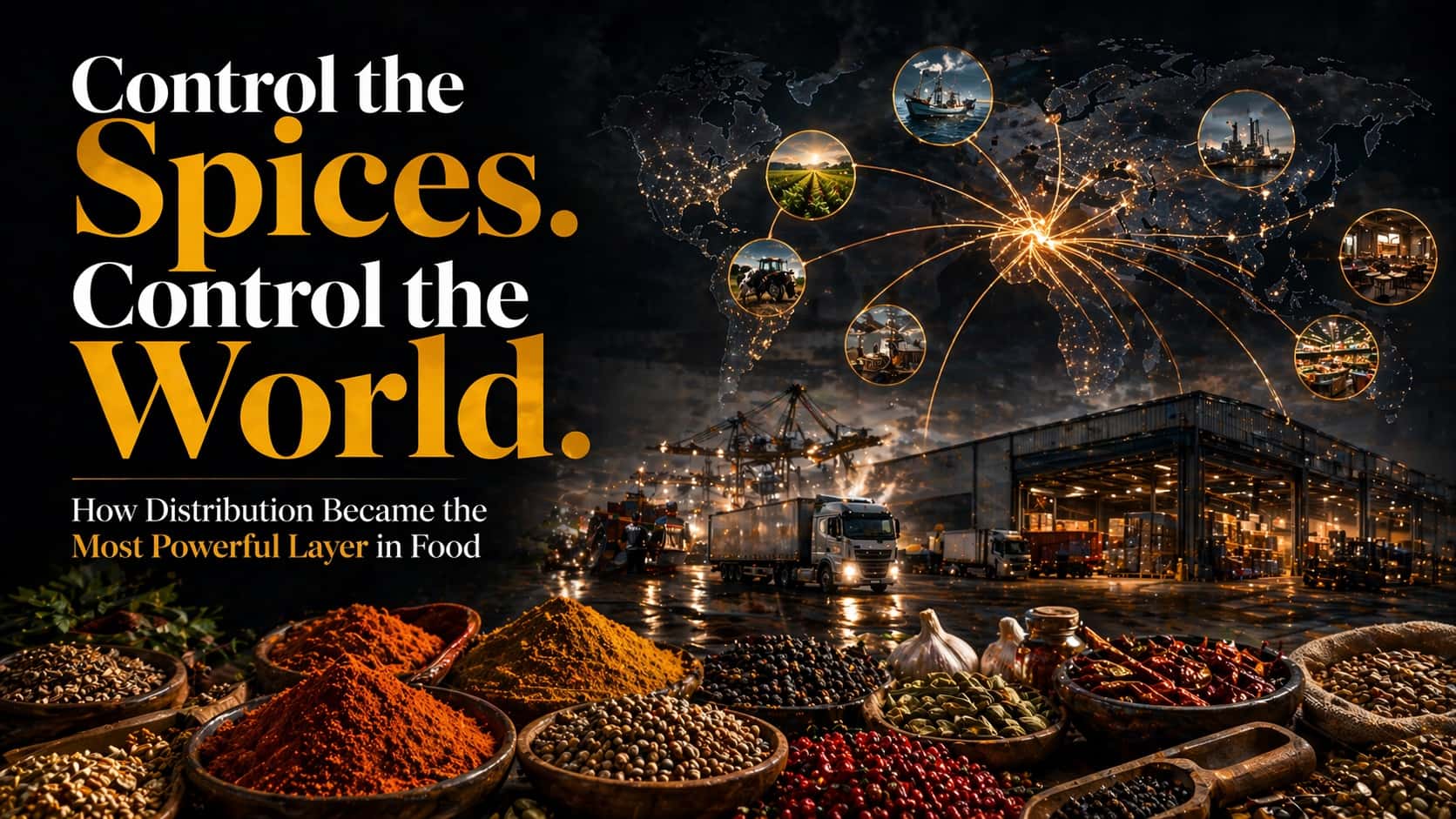

In Dune, whoever controls the spice controls the universe. In the modern food economy, distribution is the spice.
Distribution—not production—is where power consolidates.
For decades, the food industry has been analyzed through the lens of production: agriculture, commodities, manufacturing, and labor. Operators focus on menu costs, staffing volatility, and guest demand. Investors track commodity cycles and consumer spending patterns. Policymakers debate subsidies and supply constraints.
But this framing misses where leverage actually compounds.
Power in modern food systems does not sit at the point of origin. It sits in the layer that connects origin to consumption—the infrastructure that determines how product moves, how it is priced, and who has access to it.
That layer is distribution.
Over the past decade, and with increasing acceleration between 2023 and 2026, Sysco Corporation has systematically expanded its control over that layer. Not through a single transformative move, but through a sequence of targeted acquisitions and operational integrations that, in aggregate, reshape how the foodservice economy functions.
This is not a story about scale alone. It is a story about positioning.
Sysco Is No Longer Just a Distributor
Historically, distributors occupied a transactional role. They aggregated supply, managed logistics, and delivered goods to operators. Their value proposition was efficiency—moving product from point A to point B at scale.
What Sysco has built is materially different.
Today, the company operates across multiple interdependent layers: sourcing, procurement, logistics, credit extension, equipment supply, and increasingly, data-driven demand forecasting. This transforms the distributor from a vendor into an embedded system.
Once embedded, the economics change.
Operators no longer engage with distribution as a simple purchasing function. They build operational workflows around it—ordering systems, delivery schedules, credit terms, and inventory cycles. Over time, this creates friction against switching. Not because alternatives do not exist, but because replacing the system requires unwinding multiple dependencies simultaneously.
That is where leverage accumulates.
The Accumulation Strategy
The transformation did not occur overnight. It unfolded through incremental moves that expanded coverage across the value chain.
In 2016, Sysco acquired Brakes Group, extending its reach into European markets and significantly expanding its global sourcing capabilities. This move increased purchasing volume at scale, strengthening negotiating power with suppliers and enabling more centralized procurement strategies.
In 2023, the company completed its acquisition of Edward Don & Company. This was not simply a diversification play. It represented a shift into non-food operational inputs—equipment, disposables, and back-of-house essentials. By consolidating these categories under one supplier relationship, Sysco deepened its integration into daily restaurant operations.
In 2025, Sysco’s UK division acquired Fairfax Meadow, strengthening its position in protein sourcing. Protein is among the most volatile inputs in restaurant economics, subject to fluctuations in feed costs, weather, global demand, and supply chain disruptions. Control at this level provides not only supply stability but pricing influence at a critical margin point.
That same year, Sysco acquired Ginsberg’s Foods, a northeastern U.S. distributor. On its own, the acquisition is incremental. In context, it contributes to a broader pattern: the steady absorption of regional players, reducing the number of independent procurement pathways available to operators.
In 2026, Sysco announced an agreement to acquire Jetro Holdings, including Restaurant Depot. This represents a different kind of strategic move. Restaurant Depot has historically functioned as an alternative channel for independent operators—offering cash-and-carry purchasing without long-term contracts. Integrating this model into Sysco’s system internalizes a key source of optionality.
Individually, each acquisition expands capability. Collectively, they expand control.
This is not expansion. This is coverage.
Market Share vs. System Influence
Sysco controls an estimated 17%–20% of the U.S. foodservice distribution market, making it the largest single distributor in the country. On paper, that figure suggests a fragmented market with room for competition.
In practice, the company’s influence extends beyond its share of volume.
Because Sysco operates at the intersection of sourcing, logistics, financing, and delivery, it shapes how transactions occur across the system. Suppliers compete for placement within its network. Operators rely on it for consistency, credit, and fulfillment. Pricing signals propagate through its channels.
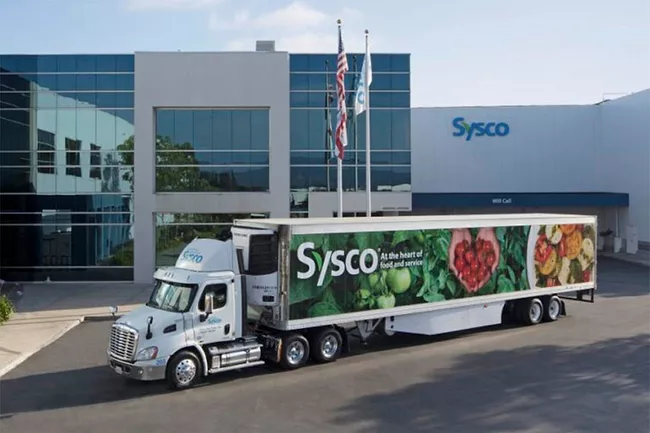
This creates a form of structural influence that is not captured by traditional market share metrics.
The most powerful company in a supply chain is not the one that makes the product—it’s the one that decides how it moves.
The company that controls the middle layer does not just participate in the market—it helps define its parameters.
The Economics of Dependence
For operators, the effects of this shift are rarely explicit.
There is no single moment where dependency becomes visible. Instead, it emerges through accumulated friction.
Costs increase without a clear cause.
Alternative suppliers begin to mirror primary ones in pricing and availability.
Negotiations lose effectiveness as leverage shifts upstream.
Margins compress, but the source of compression is difficult to isolate.
This is how consolidation manifests operationally.
The system does not need to eliminate competition. It only needs to reduce meaningful differentiation between options.
Over time, switching costs rise—not only in financial terms, but in operational disruption. Changing distributors affects ordering systems, delivery schedules, product specifications, and credit arrangements. For many operators, particularly small and mid-sized businesses, the cost of transition outweighs the potential savings.
This creates a form of soft lock-in.
Capital Efficiency and Strategic Positioning
From a capital allocation perspective, Sysco’s model offers a distinct advantage.
Production is asset-intensive. It requires land, equipment, labor, and exposure to environmental and commodity risks. Margins are often constrained by input volatility and global pricing pressures.
Distribution, by contrast, operates with a different risk profile.
By controlling the movement of goods rather than their production, Sysco captures value across transactions without assuming the full burden of production risk. It leverages scale in procurement, optimizes logistics networks, and extends credit to operators, generating multiple revenue streams from a single position in the value chain.
This is a structurally efficient model.
It allows for expansion without proportional increases in asset intensity, while maintaining influence over pricing and access across the system.
Implications for Founders and Operators
For founders building within the food ecosystem—whether in restaurants, hospitality tech, or supply chain innovation—the implications are immediate.
First, procurement strategy becomes a strategic function, not a back-office task. Diversification of supply chains is no longer optional. It is a hedge against systemic dependence.
Second, direct relationships with producers gain importance. Local sourcing, cooperative purchasing models, and vertically integrated supply chains offer potential pathways to reduce reliance on centralized distribution networks. These approaches introduce complexity, but also restore a degree of control.
Third, data becomes a competitive lever. As large distributors integrate demand forecasting and purchasing analytics, independent operators must develop their own capabilities to manage inventory, pricing, and menu engineering with precision.
Finally, credit relationships require scrutiny. Distributor financing can provide short-term liquidity, but it also reinforces dependency. Founders must evaluate the trade-offs between convenience and control.
None of these strategies eliminate the influence of large distributors. But they shift the balance.
The Structural Risk
The risk is not the existence of a dominant distributor.
The risk is a system where alternatives exist, but behave similarly.
When multiple suppliers rely on the same sourcing networks, logistics infrastructure, and pricing frameworks, differentiation erodes. Competition becomes nominal rather than functional.
In that environment, operators face constrained choice without explicit restriction.
This is a structural condition, not a temporary market cycle.
It does not reverse quickly, because it is built into the architecture of the system.
Control Without Ownership
Sysco does not need to own farms, fisheries, or manufacturing facilities to exert influence over the food economy.
Ownership is not the primary lever.
Control over movement is.
Control over how food flows from supplier to operator.
Control over how it is priced at each stage of the journey.
Control over who receives access—and under what terms.
When enough layers consolidate under a single system, the distinction between ownership and control becomes less relevant.
The system does not need to own the market to shape it.
It only needs to route it.
Conclusion
In the end, this was never just about food.
It was about infrastructure.
It was about the systems that determine how goods move, how capital flows, and how access is structured within an industry that underpins daily economic activity.
Restaurants are often described as the front line of the economy—the visible layer where transactions occur. But the forces that shape their viability operate further upstream, in the networks that supply them.
Those networks are consolidating.
And as they do, the balance of power shifts—not toward those who produce food, but toward those who control its movement.
Control the supply. Control the outcome.
In modern food systems, distribution is the spice.
Control the spices. Control the world.
Related Articles on IMFounder
- 7 Shocking Reasons Trees Are the Rarest Resource on Earth — And We’re Erasing Them Fast
- Hair Fall & Shower Water: Causes, Prevention, and Technology — Hard Water, Hair Loss, Prevention Tips & Best Shower Filters Explained
- Most Popular Holiday Drinks in North America — including hot chocolate, mulled wine, peppermint mocha, and eggnog
- Best Places for Stunning Fall Foliage — Top Road Trips & Hidden Gems for Peak Fall Colors in North America
- The Rise of Streetwear in North America: From Subculture to Mainstream — Culture, Brands & Future