
Let me tell you something about kitchens. Real ones. The kind that run at 2 AM on a Formula 1 circuit when half your crew just walked because the staffing agency shorted their check. You learn fast who built something real — and who was just borrowing time from a system that was never going to pay them back.
Gen Z learned that lesson without ever stepping foot in a professional kitchen. They looked at the deal on the table — same time every day, annual review, maybe a 3% bump — and said no. Not loudly. They just quietly built something else. Something that pays on their terms, with offers coming directly to them through a phone they already had.
“They didn’t burn the system down. They walked around it. Which, if you think about it, is so much more insulting.”
83 million Americans are freelancing in 2026 — 36% of the entire U.S. workforce, contributing $1.5 trillion to this economy. The global gig economy is headed for a $674 billion valuation by end of 2026. This is not a pandemic hangover. This is what happens when a generation decides the old contract was a bad deal and the technology to write a new one is already in their pocket. As we covered in ‘Overqualified’ Has Become the Most Polite Rejection in Corporate America, the traditional hiring model is not just slow — it is actively pushing skilled workers out the door.
The money — honestly
People talk about gig work like it is loose change and desperation. That narrative is comfortable for the people it protects. It is also completely wrong. Here is what a worker running three platforms — strategically, thirty hours a week — actually makes:
| Platform | Hours/Week | Avg Rate | Est. Annual |
|---|---|---|---|
| Qwick / Gigpro | 10 hrs | $22/hr | ~$11,400 |
| Rover / TaskRabbit | 10 hrs | $24/hr | ~$12,480 |
| DoorDash / Instacart | 10 hrs | $20/hr | ~$10,400 |
| 30 hrs/week, 3 apps | 30 hrs | $22 avg | ~$34,320/yr |
Forty hours clears $45,000 — without a boss, a commute, or a single job application. The workers treating this like a real business are doing considerably better.
$108K
Average annual U.S. freelancer income (2025)
5.6M
Workers now earning $100K+ independently
63%
Of freelancers breaking six figures — up from 12.5% in 2011
The platform stack
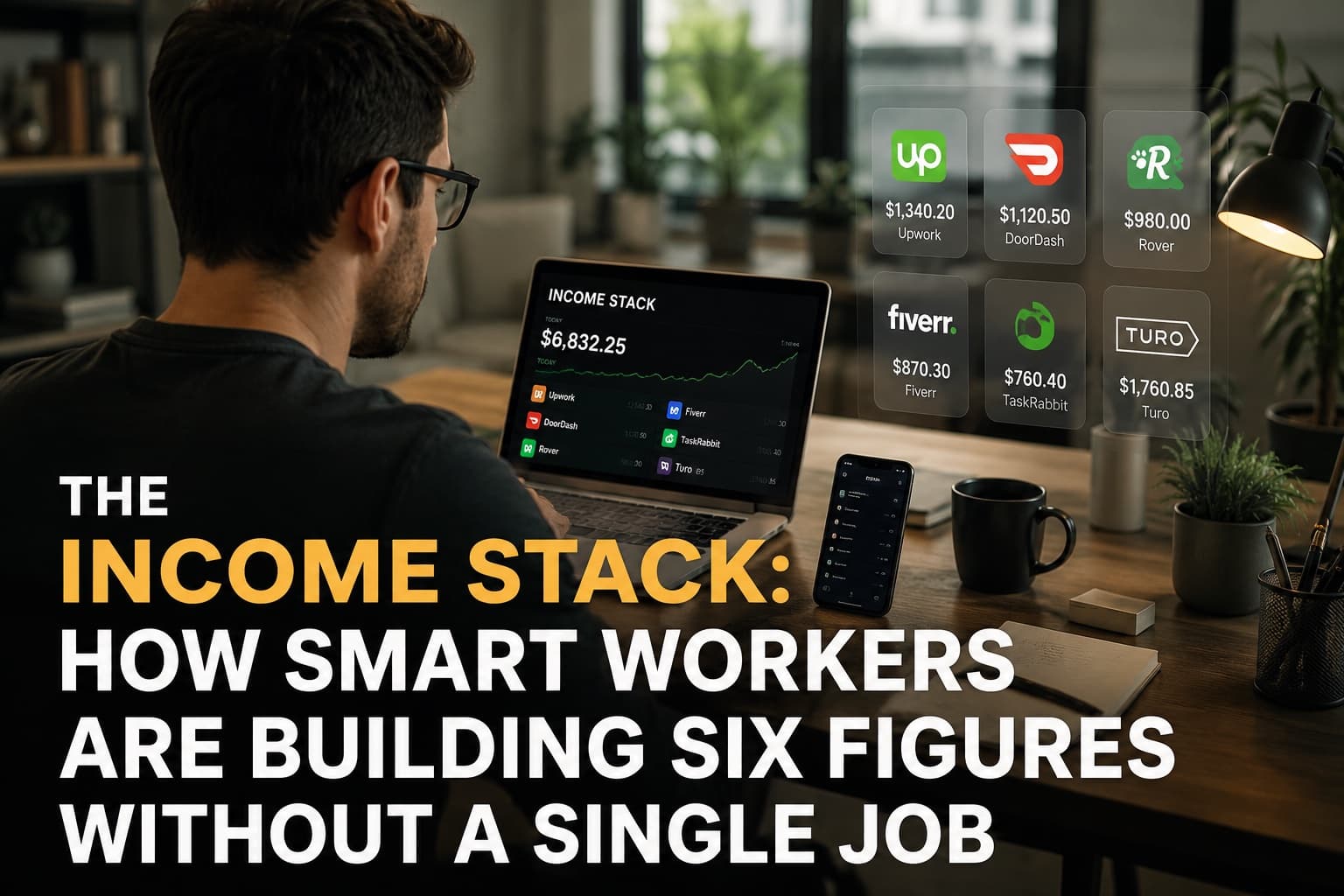
Nobody picks one. That is amateur hour. The play is a portfolio — each platform a different revenue channel, demand curve, and surge window. And if you think you need capital to launch a business, this stack proves otherwise:
| Qwick / Gigpro | Real-time hospitality shifts. Confirm or pass. Stack certs, unlock better shifts. $18–$28/hr. |
| DoorDash / Instacart / Spark | Run two or three simultaneously on surge windows. Peak evenings and weekends are where the margin lives. $17–$25/hr. |
| Rover / Wag | Build your Rover book right — $1,000+/month from clients who tip and refer. Wag fills gaps only. $16–$32/hr. |
| TaskRabbit / Thumbtack | Assembly, moving, handyman, errands. Specialized skills hit $100+/hr. Top Taskers clear $1,000+/month. $20–$100+/hr. |
| Airbnb co-hosting | Turnover work or full co-hosting for a revenue share. No Airbnb listing required. $25–$60/hr. |
| Turo | Your car earns while you sleep. Multi-vehicle operators near airports clear $2,000–$5,000+/month from a parking lot. |
| Fiverr / Upwork / Contra | Highest ceiling in the stack. AI, content, design, development. Contra runs zero commission. $75–$150/hr. |
| Care.com / Clipboard Health | Childcare, elder care, credentialed nursing shifts — no agency taking a cut. Fastest-growing tier by volume. $15–$28/hr. |
Every industry now has an app
Think about what it used to take to run a laundry service. Storefront. Equipment. License. Staff. Capital. Years. Now you need a washer, a dryer, and a Poplin account. Pick up laundry, wash it at home, deliver it back. Poplin operates in 500+ cities and markets earnings up to $6,000/month. Hampr raised $1.08M in May 2025. Zeel dispatches licensed massage therapists on demand and pays 75% of every booking. Dolly moves furniture with truck owners earning $35–$50/hr.
The global gig tech platforms market goes from $485 billion in 2025 to $1.39 trillion by 2035. Every service that used to require a storefront and a payroll has been reduced to an app and a background check. And as we reported in Data Is the New Crop, the infrastructure layer being built across service industries is no accident — it is a deliberate consolidation of how labor, logistics, and consumers connect.
“The worker who understands that is not an employee waiting for a shift. They are an operator with inventory.”
The risk — because it is real
None of this is frictionless. Platform dependency is real. Algorithms change. Markets saturate. Workers absorb volatility employers used to carry — no sick days, no unemployment insurance, no HR department. The benefits gap remains the most significant structural weakness in the model.
But here is the shift: workers are choosing volatility they can see and route around over stability they were promised and never actually had. The sous chef who worked sixty-hour weeks for a decade and got laid off when the restaurant group sold — that was not stability. It was the illusion of it. As we documented in The Restaurant Industry: The Fastest Way Into the Economy Is Closing, the traditional service labor model has been structurally compromised for years. The income stack worker who loses one platform still has four others. Managed risk versus hidden risk — and one of those the worker controls.
The tax advantage nobody explains
A W-2 employee pays tax on every dollar earned. A self-employed gig worker pays tax on profit — income minus every documented business expense. Key deductions: 72.5 cents per business mile ($21,750 on 30,000 miles), home office, phone, equipment at full cost via Section 179, 100% of health insurance premiums, SEP-IRA contributions up to $66,000, and a new 2026 deduction of up to $12,500 on reported tip income.
Worker earning $45,000 gross. After mileage and standard deductions, taxable income drops to roughly $22,500 before retirement contributions. A salaried worker has one lever. A gig worker running their income like a business has eleven.
What the industry will not admit
The labor shortage in hospitality, healthcare, and logistics is not a mystery. Workers repriced their availability. The traditional offer did not move. So they moved. And as AI continues automating the jobs that used to sit beneath them, the urgency to build an independent income architecture is not slowing down — it is accelerating. The platforms they chose are doing something employers stopped doing twenty years ago: competing for their time. Qwick posts a shift. Workers confirm or pass. No interview. No probation. The market clears in real time.
LinkedIn pull quote
“Gen Z didn’t reject work. They rejected the deal.”
Traditional employment is not dying. But it is competing — for the first time in a long time — against a model that is operationally mature, financially viable, tax-advantaged, and culturally normalized for an entire generation raised to question every deal put in front of them.
The workforce did not disappear. It decentralized. The companies that figure that out first will own the next decade of labor. The ones that don’t will keep wondering why their Indeed posts get twelve views and zero applications.
Related Articles on IMFounder
- Why Every Startup Suddenly Wants to Become an “AI Company”
- Women Entrepreneurship in North America: Grants, Funding, and Support for Women
- Influencer-Founded Brands: The New Million-Dollar Empires Built From Followers
- Gen Z’s Attention Span Crisis Is Reshaping How Startups Build Products
- 10 Bootstrapped Startups That Raised Zero
- Medvi: The Explosive Startup Built With ChatGPT That Hit $401M
- The Founder’s Complete Guide to Visas, Grants & Funding in Canada and the USA
- The New American Dream: 5 Powerful Startups You Can Launch With Only $1,000