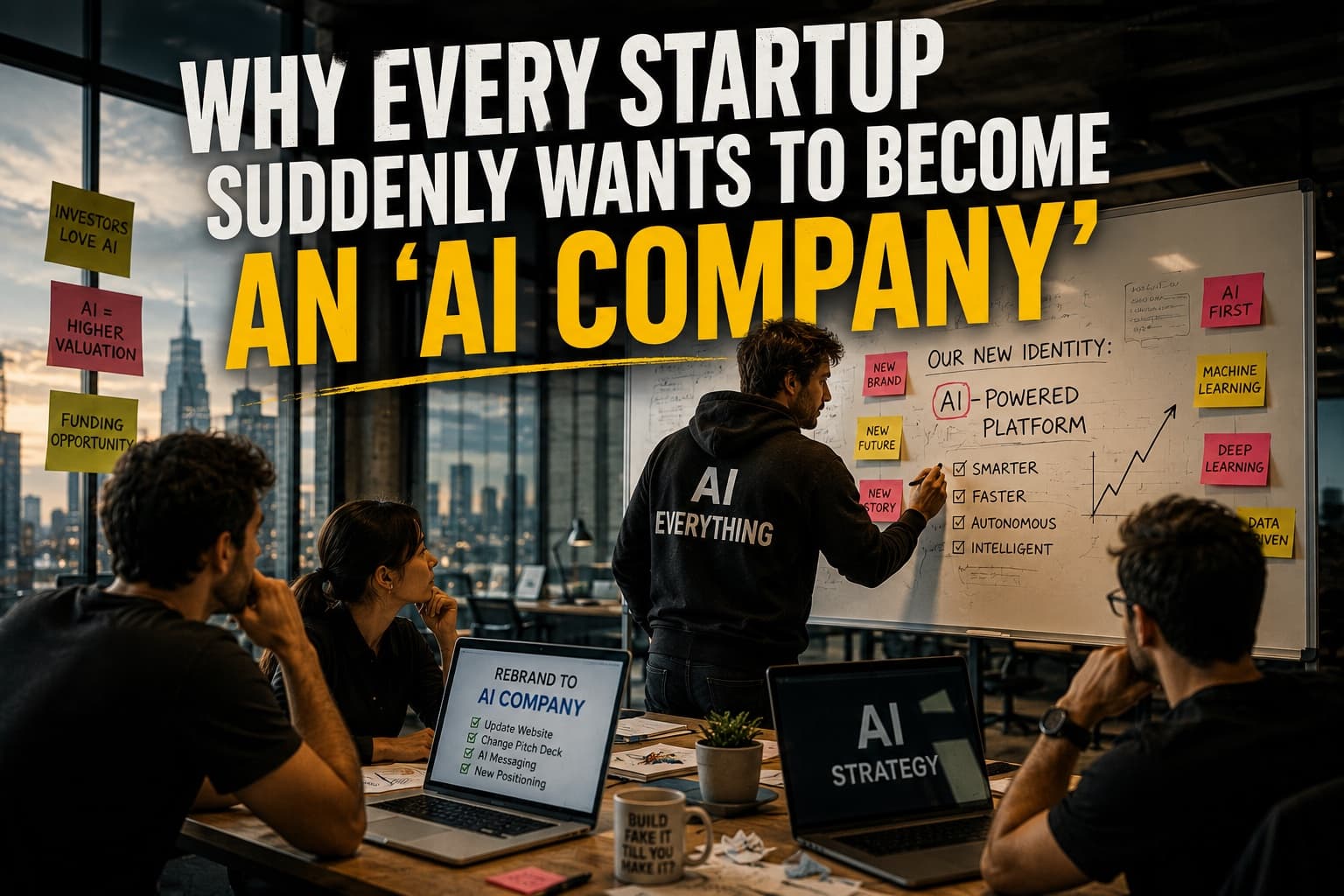

For years, startups proudly called themselves SaaS companies, fintech platforms, productivity apps, or marketplaces.
Now almost every founder pitch sounds the same:
“We are an AI-powered platform transforming the future of…”
Even companies that barely used automation six months ago are suddenly rebranding themselves as artificial intelligence businesses.
Some are building genuinely impressive AI products.
Others are simply adding a chatbot to an existing app and rewriting their homepage.
The result is a strange new startup economy where “AI” has become both a real technological breakthrough and a marketing label companies feel pressured to adopt just to stay relevant.
And investors, founders, employees, and users are all starting to notice the difference.
The Great AI Rebranding Wave
The shift happened fast.
After the explosive rise of OpenAI and tools like ChatGPT, startups everywhere realized something important:
Investors were paying attention to AI companies differently.
Suddenly:
- AI startups received larger valuations
- Venture capital moved aggressively into the sector
- AI announcements dominated headlines
- Founders without an AI angle started looking outdated
Almost overnight, businesses began updating:
- Pitch decks
- Websites
- App descriptions
- LinkedIn bios
- Investor presentations
A scheduling app became an “AI productivity ecosystem.”
A customer support tool became an “AI-powered engagement platform.”
A basic analytics dashboard became an “intelligent decision engine.”
In many cases, the actual product barely changed.
The branding did.
The Fear of Being Left Behind
Part of this trend is understandable.
Every major technology shift creates panic inside the startup world.
During previous cycles:
- Everything became “crypto”
- Then “metaverse”
- Then “Web3”
- Now it is AI
Founders are constantly worried about appearing irrelevant.
If competitors mention AI while your company does not, investors may assume:
- your product is outdated
- your team lacks innovation
- your growth potential is weaker
That pressure becomes even stronger when funding markets tighten.
Many startups today are struggling to raise capital. Revenue expectations are higher. Growth is slower. Investors are more selective.
Adding AI to the story can sometimes reopen conversations that otherwise would never happen.
That does not mean founders are dishonest.
But it does create incentives for exaggeration.
The Rise of “Fake AI”
One of the biggest problems in today’s startup ecosystem is the rise of superficial AI integration.
This usually looks like:
- adding a simple chatbot to an existing app
- connecting an API from another AI provider
- generating automated summaries
- rebranding old automation features as “AI”
In some products, the AI component is genuinely useful.
In others, it feels forced.
Users are beginning to notice when “AI-powered” really means:
“We connected a third-party language model to one feature.”
This creates confusion in the market because not every AI claim represents meaningful innovation.
A food delivery app suggesting restaurants is not necessarily revolutionary AI.
An email app auto-generating subject lines does not automatically make the entire company an AI startup.
The problem is not that these features exist.
The problem is when marketing promises far more intelligence than the product actually delivers.
Real AI Innovation Still Exists
At the same time, dismissing all AI companies as hype would be a mistake.
Some startups are building products that genuinely change workflows, industries, and productivity.
Companies like:
are building systems that fundamentally change how people:
- search for information
- write content
- generate images
- create videos
- code software
- analyze data
The difference is visible.
Real AI companies usually solve difficult technical problems and create entirely new workflows.
Fake AI branding often adds cosmetic features without changing the product’s core value.
Users can eventually tell the difference.
Investors Created Part of the Problem
The startup ecosystem often follows investor behavior.
Right now, venture capital firms are aggressively competing for AI exposure.
Many funds fear missing the next major technology platform shift.
That creates pressure throughout the market:
- Founders want AI narratives
- Accelerators prioritize AI startups
- Media outlets amplify AI stories
- Recruiters search for AI talent
- Public companies mention AI during earnings calls
Even large corporations have started inserting “AI” into presentations repeatedly because markets reward the narrative.
In some cases, stock prices move simply because executives mention artificial intelligence frequently during investor discussions.
That environment naturally encourages startups to reposition themselves around AI whether or not the technology is central to the business.
The Real Risk for Startups
Ironically, blindly chasing AI branding can actually hurt startups long-term.
Why?
Because hype creates expectations.
If users try an “AI-powered” product and discover:
- inaccurate results
- generic automation
- weak functionality
- unnecessary AI features
trust disappears quickly.
Consumers are becoming more skeptical.
People increasingly ask:
- Is this feature genuinely useful?
- Does AI improve the experience?
- Or is this just marketing?
Startups that rely too heavily on AI buzzwords without strong execution may struggle once the hype cycle cools down.
History has shown this repeatedly in tech.
The companies that survive are usually the ones solving real problems — not the ones using the trendiest vocabulary.
AI Is Becoming a Business Requirement
At the same time, ignoring AI completely may also become risky.
Artificial intelligence is no longer just an experiment.
It is rapidly becoming infrastructure.
Just as companies eventually adopted:
- cloud computing
- smartphones
- analytics
- online payments
many businesses will eventually integrate AI in practical ways.
The key difference is whether AI improves the product meaningfully.
The best startups are treating AI as:
- a tool
- an accelerator
- a workflow enhancer
—not as their entire identity.
That distinction matters.
Marketing vs Innovation
The current startup landscape has created two very different categories of companies:
1. AI-Labeled Companies
These companies primarily use AI as branding.
Their messaging is stronger than their actual innovation.
2. AI-Native Companies
These businesses are built around AI capabilities from day one.
Their products would not exist without modern machine learning systems.
Over time, the market will likely separate the two.
Because eventually, users care less about whether something is called AI and more about whether it actually works.
Final Thoughts
Artificial intelligence is real.
The technological shift is real.
The opportunities are massive.
But so is the hype.
Right now, many startups are racing to attach themselves to the AI movement because investors, media attention, and market perception reward it.
Some companies are building the future.
Others are simply updating their homepage copy.
The challenge for founders is understanding the difference between using AI strategically and using AI as decoration.
Because long-term success rarely comes from chasing trends alone.
It comes from solving real problems people genuinely care about.
And in the middle of all the AI noise, that part of building a startup has not changed at all.
Related Articles on IMFounder
- ByteDance’s DeerFlow and the Rise of AI Employees
- ChatGPT Agent vs Claude: The Explosive New AI Leader
- AI Isn’t Coming for Factory Jobs — It’s Coming for Office Jobs
- The Stadium Economy Was Rewritten Without Labor: How AI Is Automating Stadium Jobs Away
- 7 Explosive AI Updates in May 2026 That Will Shock Every Founder
- ChatGPT Agent vs Claude — The Explosive New AI Leader
- ChatGPT Image Generation Update — New ChatGPT Image Generation update brings improved realism, editing, and workflow advantages
- Claude Design is quietly becoming one of the most talked-about AI features — The New AI Interface Builder