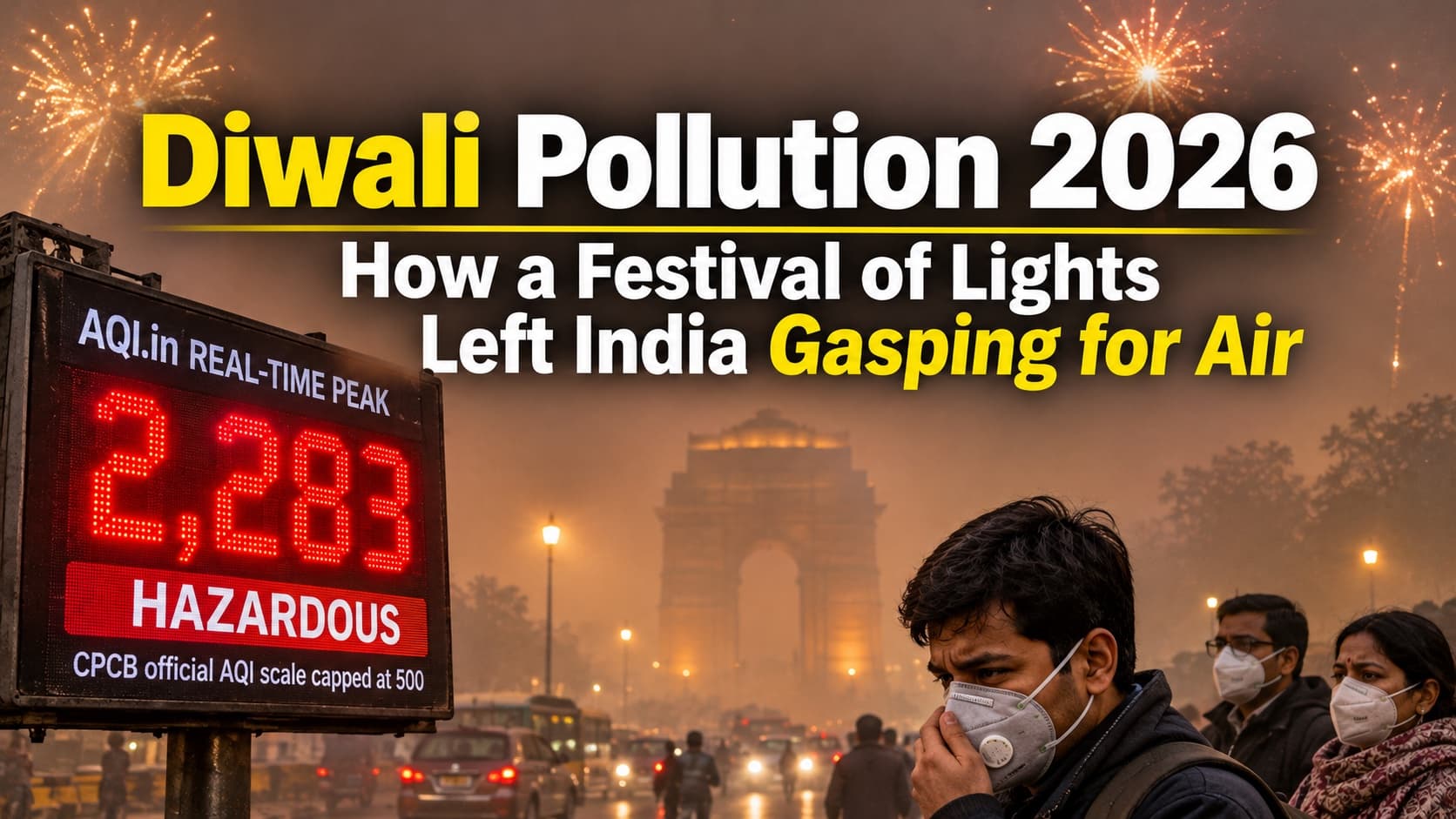

Diwali pollution did exactly what experts warned it would on the night of 8 November 2026. Delhi recorded its worst Diwali-night air quality in five years, and by morning the capital was wrapped in a thick grey haze. siasat
Behind the numbers is a simple story: a festival of lights, a city already breathing air far above safe limits, and thousands of households deciding that a few minutes of sparks and noise mattered more than the next day’s air. This article sets out what happened, what firecrackers do to air, water, soil and bodies, and why Diwali pollution keeps repeating despite bans and court orders. It is also a fair account. Millions of families celebrated with lamps and sweets only. The problem is behaviour and weak enforcement, not a faith.
Diwali Pollution 2026: What Happened on the Night of 8 November
The official numbers are alarming even before you account for gaps in the data. According to analysis by the think tank Envirocatalysts, the CPCB’s citywide PM2.5 average peaked at 592 µg/m³ at 1 am, nearly ten times the 24-hour standard. PM2.5 refers to fine particles small enough to enter the lungs and bloodstream. siasat
The true peak was likely higher. Many monitors went silent after readings near 1,000 µg/m³, the most they can record, and analysts estimate the city peaked near 800 µg/m³. Reports said 45 of the capital’s 59 stations had missing hourly readings for at least one pollutant, which risks understating the damage. siasatsiasat
The same analysis found that sulphur dioxide nearly quadrupled, most of the rise came after the 10 pm deadline, and PM2.5 was still close to 350 µg/m³ at 8 am on Monday. The shared airshed offered no escape: Delhi was already breathing more than twice the safe limit before a single cracker was burst. siasatsiasat
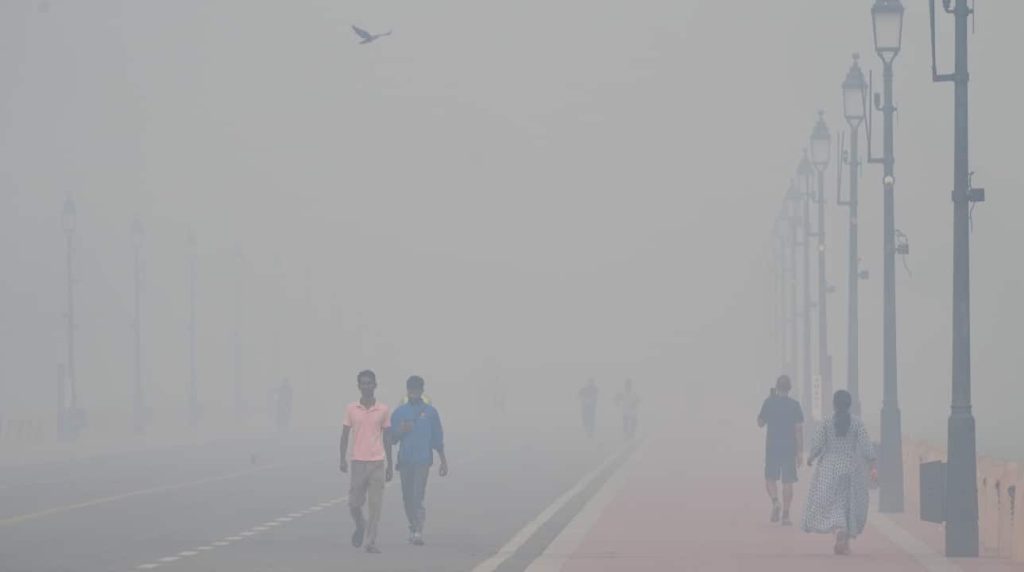
The official AQI told a similar story. It stood at 368 on 9 November, with 15 stations in the severe category, and Burari touched 441. By 10 November it had eased to 307, still “very poor”. Delhi AQI Today: Delhi’s post-Diwali air remains ‘very poor’; 15 locations record severe AQI +2
This happened even though firecrackers remained prohibited in Delhi ahead of Diwali 2026. Reporting after the festival was blunt: the firecracker ban was flouted, adding a significant pollution burden. business-standardbusiness-standard
The “3,000 AQI” Screenshots: What Is Real?
Every Diwali, posts claim Delhi hit an AQI of 2,000 or 3,000. Private monitors in places like Rohini showed readings above 2,000. These are not official figures. The CPCB scale stops at 500 and does not report beyond it, while the US method extends the calculation past 500 into four digits. Low-cost sensors can also read high. The honest takeaway: don’t quote “3,000” as an official AQI, but understand that official “severe” can understate how dangerous the air was near heavy bursting. Diwali pollution clouds Delhi as 45 monitors miss readings +2
Beyond Delhi: Where Else Diwali Pollution Struck
Diwali pollution was not a Delhi-only event.
- Chennai. Smoke was bad enough that the Chennai Open final was delayed, and Tamil Nadu Pollution Control Board readings put Manali at 277 and Arumbakkam at 264. openthemagazine
- Tamil Nadu injuries. The state’s fire and rescue department said 1,116 people were treated in hospitals for firecracker-related injuries, and 430 were admitted as burn inpatients between 7 and 9 November. etvbharatetvbharat
- Deaths and fires. A Special Sub-Inspector of Police died after being assaulted while intervening against youths bursting firecrackers on a public road, according to Tamil Nadu Police. National roundups reported blasts that killed two boys in Delhi and Odisha, and a separate roundup counted 13 dead in Madhya Pradesh and six more in fire accidents across Rajasthan, Tamil Nadu, Delhi and Odisha. Diwali Violence Claims Lives Of Police Officer, Techie In Tamil Nadu; 1,116 Injured +2
- Farm fires too. Fairness matters: Punjab recorded 1,152 farm fires on Diwali, its biggest daily spike this season. Crackers were not the only source that night. openthemagazine
How Diwali Pollution Damages the Environment
Air: Particles, Gases and Metals
Firecrackers burn chemical mixtures to produce light, colour and bang. The colours come from metal salts such as barium, strontium and copper, which end up in the air you breathe. One analysis of Diwali-night readings reported an 875% spike in pollution in states like Delhi, Uttar Pradesh and Haryana in 2024. In 2025, Delhi’s PM2.5 reached as high as 675 after Diwali. business-standardindia
Noise: The Forgotten Pollutant
In 2025, 23 of Delhi’s 26 noise monitoring stations recorded levels above permissible limits, up from 22 in 2024 and 13 in 2023. A 2022 National Green Tribunal order told authorities to treat noise pollution at par with air pollution, but implementation remains poor. Loud bangs disturb sleep, stress hearts and frighten newborns, the elderly and animals. millenniumpostmillenniumpost
Water, Soil and Waste
Burst crackers leave paper, plastic and chemical residue that washes into drains and soils. Environmental rules note that cracker use causes excessive air and noise pollution and solid waste problems. Evidence on how much firecrackers specifically contribute to river pollution is thinner than for air, so be wary of dramatic percentages. Rivers like the Yamuna are overwhelmed mainly by untreated sewage and industrial effluent, and festival waste adds to a load they can’t absorb. business-standard
Animals and Fire Risk
Stray dogs, cattle and birds suffer disorientation and injury from blasts and smoke. Fires from rockets and sparks add to the toll, as the multi-state casualty reports above show.
The Health Cost of Diwali Pollution
After Diwali 2025, doctors across Delhi-NCR reported a sharp rise in respiratory and pregnancy-related cases, linked to air and noise pollution from late-night firecrackers. The elderly, children and pregnant women are most affected. In Delhi that year, more than 250 people were injured in firecracker-related accidents, and Safdarjung Hospital treated the most, 129 cases. post diwali pollution spikes respiratory and pregnancy related cases in delhi ncr +2
Diwali pollution sits on top of a chronic crisis. The State of Global Air 2025 report attributed two million deaths in India to air pollution in 2023, up from 1.4 million in 2000. The Lancet Countdown estimates around 1.72 million deaths a year in India from human-made PM2.5, a 38% rise since 2010. A Lancet Planetary Health study found air pollution caused nearly 15% of all deaths in the capital in the period studied. Air pollution damaging brain health; worsening disease burden in India: SoGA 2025 +2
One caution: these are modelled estimates, and no study can give an exact “Diwali death toll”. What the evidence supports is that a few hours of heavy bursting adds a dangerous acute spike to air that is already damaging people’s health all year.
Diwali Pollution and the Most Polluted Cities in the World
Diwali does not create the most polluted cities in the world, but it can push already stressed ones over the edge. In IQAir’s 2025 report, 66 of the world’s 100 most polluted cities were in India. Loni in Uttar Pradesh topped the list with an annual PM2.5 average of 112.5 µg/m³, and Delhi ranked fourth. The rest of the list is mostly in Pakistan, China, Bangladesh and Central Asia, so this is a regional crisis, not an exclusively Indian one. drishtiiasbusinesstoday
The baseline comes from everyday sources. CSE finds that vehicles, industries, open waste burning, solid fuels, construction and dust have offset earlier gains, and stubble burning’s share of Delhi’s PM2.5 was only 3.5% in 2025, down from 13% in 2020. Diwali is the loudest spike on a curve that stays too high all year. cseindiatribuneindia
Why Do People Still Burst Crackers? It Is Not About One Community
Diwali pollution is a behaviour problem with understandable roots.
- Tradition and joy. For many families, crackers are tied to childhood memories.
- The “my few crackers don’t matter” trap. Each household’s contribution feels tiny, but millions together create the spike.
- Weak enforcement. Rules differ across cities and are poorly policed, so illegal supply is easy to find.
- Livelihoods. Tamil Nadu’s Sivakasi cluster supports a large workforce, and bans without transition support breed resentment.
- Mixed political messaging. After Diwali, parties trade blame, which confuses the rules.
Hindus are roughly 80% of India’s population (Census 2011), so any national festival involving crackers will involve many of them. But firecrackers are also burst at weddings, on New Year’s Eve, and after cricket wins across communities. Many scholars note that “Deepavali” means a row of lamps, and that firecrackers are a later custom, not a scriptural requirement. Many Hindu families and spiritual leaders already celebrate cracker-free. Blaming a whole community is inaccurate and tends to harden resistance.
Officials argue the picture is mixed too. After Diwali 2025, Delhi’s Home Minister said those bursting firecrackers after 10 pm “behaved irresponsibly” but that firecrackers were not the sole reason for the spike. That is fair, and it is also why both enforcement and year-round source control matter. millenniumpost
How to Stop Diwali Pollution: What Actually Works
For governments and regulators
- Enforce at the supply end: manufacturing, warehouses and online sales, not just street bursting.
- Fix monitoring. With 45 of 59 stations missing data on the worst night, the public can’t trust the picture.
- Set consistent rules across the airshed, because smoke ignores city borders. Activist Vimlendu Jha argues that heavy reliance on bans, restrictions and GRAP does not address the underlying sources of emissions. openthemagazine
- Support cracker-industry workers with transition programmes, and fund community light and laser shows.
For citizens
- Celebrate with diyas, string lights, rangoli and community shows.
- If crackers are legal where you live, use certified green crackers only. They reduce emissions but do not eliminate them.
- Stay within the permitted hours, and report illegal sales to local authorities.
- Protect yourself: check PM2.5 on the CPCB dashboard, wear a well-fitted N95, keep windows closed and use a HEPA purifier on bad nights.
FAQs About Diwali Pollution
How bad was Diwali pollution in Delhi in 2026?
The CPCB citywide PM2.5 average peaked at 592 µg/m³ at 1 am, nearly ten times the 24-hour standard. Analysts believe the real peak was near 800 µg/m³ because many monitors stopped reporting.
Did Delhi’s AQI really hit 3,000?
Not on the official scale, which stops at 500. Some private monitors and social posts showed four-digit values using the US formula or low-cost sensors.
Are green crackers safe?
They are designed to emit less, but they still release particles and gases. They are less harmful, not harmless.
Does Diwali cause most of India’s air pollution?
No. It adds a severe short-term spike. The year-round baseline comes from vehicles, industry, dust, waste burning and fuels.
Final Thoughts: Let the Festival of Light Stay Light
Diwali pollution in 2026 was not a surprise. It was a forecast that came true. The warning was clear, the ban was in place, and the smoke still rolled over Delhi, Chennai and a dozen other cities. Diwali’s message is the victory of light over darkness, and a lamp-lit Diwali loses none of that.
The fix is neither shame nor blame. It is enforceable rules, honest data, support for workers who depend on the industry, and families choosing, one home at a time, to keep the night bright without making the morning toxic. Share this with someone who still thinks “my few crackers won’t matter.”
Sources and further reading
- Siasat: Diwali pollution clouds Delhi as 45 monitors miss readings
- Business Standard: Delhi’s post-Diwali air, 9 November 2026
- Open Magazine: Delhi’s post-Diwali “public health emergency”
- ETV Bharat: Tamil Nadu Diwali injuries
- IQAir: 2025 World Air Quality Report
- Down To Earth: State of Global Air 2025
- Business Today: Why CPCB and private AQI readings differ
- WHO: Ambient (outdoor) air quality and health
Related Articles on IMFounder
- India’s Air Pollution Crisis: How Government Failure Turned Breathing Into a Privilege
- India Paper Leak Scandal: 70+ Shattered Dreams, Student Suicides & Modi Govt 10-Year Shameful Failure
- The Unyielding Fury of India’s Youth: CJP Protests Expose Education Crisis Under Modi Government
- Ontario Wildfire July 2026: Shocking Fire Emergency Pushes Northern Communities to the Edge
- The World on Fire: Why Global Instability Has Surged Since 2020 — And Who’s Profiting