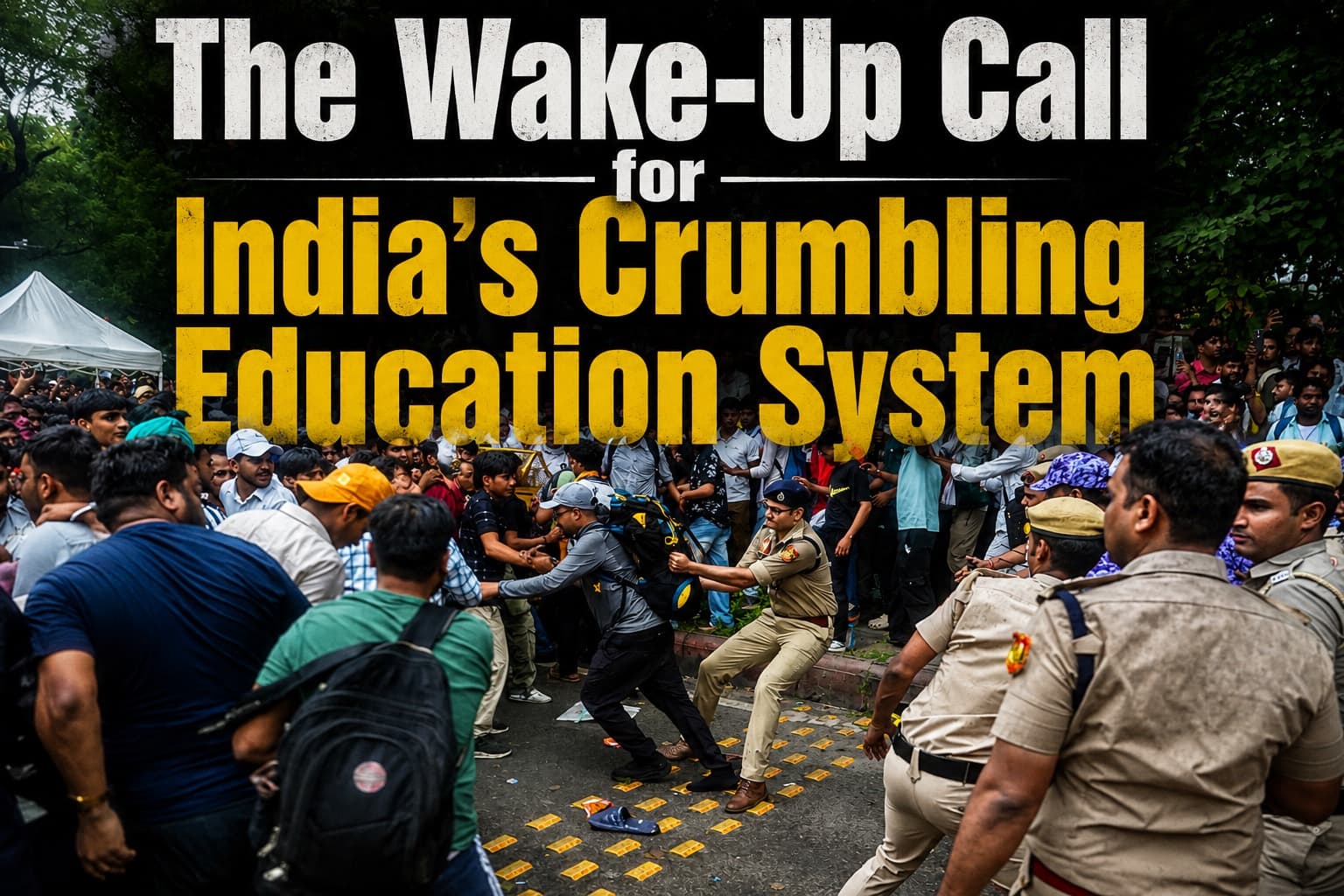

CJP Protest has erupted as one of the most significant youth uprisings in contemporary Indian history. At its core lies a simple truth: youth and students constitute the backbone of any nation. When Prime Ministers and Presidents from Canada, Australia, the United States, New Zealand, and broader G7 alliances extend support to India while advancing specific geopolitical and ideological interests, domestic policymakers must rigorously counter policies that erode national strengths. Strategic international partnerships should not blind us to internal decay. The education system—meant to forge capable citizens—now stands accused of systemic betrayal. The CJP Protest, driven by the Cockroach Janta Party, lays bare this uncomfortable reality with unflinching intensity. Reuters
This movement transcends typical political agitation. It represents a generation robbed of merit, hope, and opportunity by repeated examination scandals, commercialization of learning, and governmental indifference. As Parliament convened its Monsoon Session on July 20, 2026, thousands took to the streets, only to face barricades, batons, and tear gas. This is not mere protest; it is a reckoning.
What is the Cockroach Janta Party (CJP) and How Was It Formed?
The Cockroach Janta Party (CJP) originated as a sharp, satirical response to entrenched failures in India’s competitive examination ecosystem. Emerging prominently in 2026 amid fresh NEET-UG controversies, the group channels the resilience of ordinary citizens—likened to cockroaches surviving every attempt to crush them—against a system that repeatedly fails its brightest minds.

Founded by frustrated students and young activists, CJP gained traction through social media campaigns highlighting coaching mafia nexuses, exorbitant fees, and mental health crises culminating in suicides. What began as online mockery of bureaucratic excuses evolved into sustained physical protests at Delhi’s Jantar Mantar. The movement unites diverse groups: engineering aspirants, medical hopefuls, parents burdened by loans, and educators disillusioned by the status quo. Its demands are straightforward yet revolutionary: complete overhaul of the National Testing Agency (NTA), accountability for leaks, and a student-centric education model insulated from political interference. Instagram
Unlike traditional political outfits, CJP rejects hierarchical leadership, emphasizing collective youth anger. This decentralized structure has allowed rapid mobilization but also invited allegations of being “foreign-funded” or “anti-national”—a recurring government refrain that the article will dissect later.
Sonam Wangchuk: National Icon Turned Hunger Striker
No figure embodies the CJP Protest more poignantly than Sonam Wangchuk. The Ladakhi education reformer and climate activist rose to prominence through innovative solutions tailored to Himalayan challenges. He pioneered the Ice Stupa project, creating artificial glaciers to combat water scarcity, and established alternative schools emphasizing practical, eco-friendly learning over rote memorization. His efforts have preserved Ladakhi culture while addressing climate change impacts on vulnerable mountain communities. Wangchuk’s work earned international recognition, including features in global documentaries, positioning him as a beacon of indigenous ingenuity and environmental stewardship.
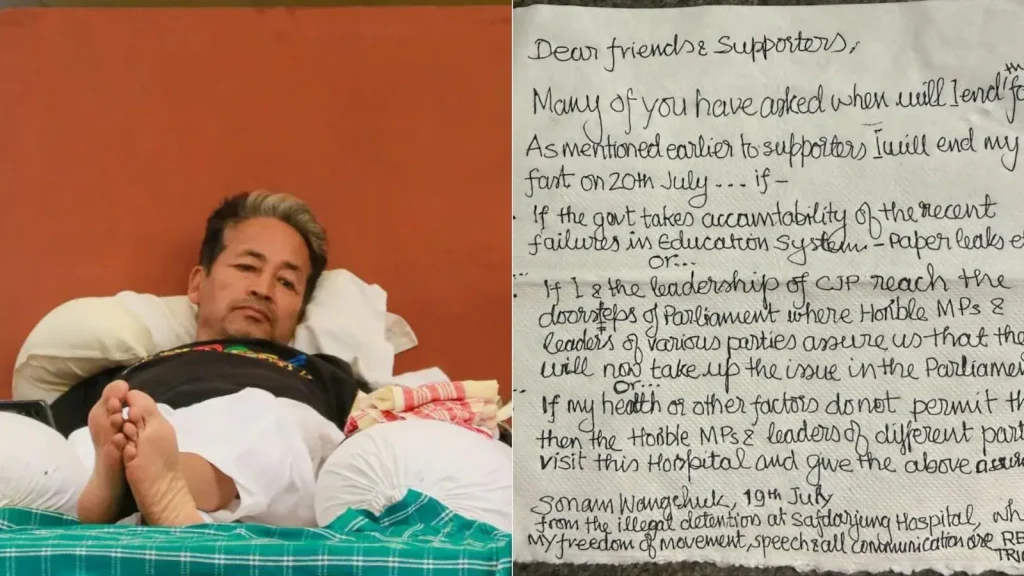
In late June 2026, Wangchuk joined the CJP sit-in at Jantar Mantar, launching an indefinite hunger strike. By July 14, he had completed 17 days; by the historic July 20 march, reports placed him on day 23 or more. His demands align with CJP’s: resignation of Union Education Minister Dharmendra Pradhan, systemic reforms to prevent paper leaks, support for affected students, and national dialogue on education privatization’s ills. X.com
Government response proved controversial. Delhi Police removed the weakening activist to Safdarjung Hospital citing medical concerns and a court order. His wife, Gitanjali Angmo, rushed to the facility, insisting on family consent for treatments and highlighting restricted access. Opposition leaders, including Rahul Gandhi and Arvind Kejriwal, decried the action as coercive. From his hospital bed, Wangchuk issued notes offering to end the fast only if parliamentarians visited and committed to raising these issues in session. His resolve, despite frailty, underscores the protest’s moral urgency. Reports suggest he refuses IV fluids, prioritizing principle over personal health. Reuters
Wangchuk’s participation elevates the CJP Protest beyond Delhi-centric grievances, linking it to broader struggles for environmental justice, regional autonomy, and equitable development.
The Historic July 20 Protest March: Unprecedented in Scale and Significance
July 20, 2026, will be etched in Indian history as the day student power confronted parliamentary privilege directly. As the Monsoon Session commenced, thousands of protesters—students, parents, activists from groups like AISA, and CJP supporters—attempted a march toward Parliament House. Police enforced restrictions, confining protests to Jantar Mantar, leading to barricades, scuffles, lathi charges, and tear gas deployment.
Eyewitness accounts and videos depict chaotic scenes: young faces contorted in pain and defiance, clouds of gas dispersing crowds, and alleged plainclothes assailants joining uniformed officers. This event’s importance lies in its novelty. Previous agitations—farmers’ protests, CAA demonstrations, or anti-corruption movements—differed in demographics. Here, the core participants are India’s aspirational middle and lower-middle class youth, whose futures hinge on competitive exams. Never before has such a broad, sustained, technology-amplified student uprising targeted the education ministry with this singular focus on examination integrity.
The march symbolized rejection of “business as usual.” Metro shutdowns, internet curbs in protest zones, and heavy security underscored the state’s nervousness. Supporters included cultural figures like Shabana Azmi and Prakash Raj, broadening appeal.
Government Labeling: Anti-National, Khalistani, Maoist, Terrorist Sympathizers
A disturbing pattern emerges in official rhetoric. During CJP Protest, participants face branding as anti-national elements or foreign agents. This mirrors past tactics: farmers labeled Khalistani, northeastern or left-leaning protesters Maoists, and now students as terrorist-adjacent. Such labels serve dual purposes—discrediting genuine demands and justifying surveillance or force.
Critics argue this reflects insecurity. When peaceful students highlight verifiable failures, deflection through nationalism rhetoric avoids addressing root causes like governance lapses in NTA oversight. Why equate demanding functional exams with sedition? This strategy risks alienating an entire generation already skeptical of institutional promises. uniindia.com
Brutality in Uniform: Lathi Charges, Hidden Identities, and Alleged Goons

Reports from July 20 paint a grim picture of law enforcement response. Police allegedly wielded stainless steel rods during lathi charges, causing injuries among students protesting peacefully. Multiple videos show officers with missing name tags—removed intentionally, per eyewitnesses. Furthermore, unidentified men in civilian clothes reportedly beat protesters while police stood by or actively facilitated access.
Such tactics erode public trust. Hiding identities suggests accountability fears. Government-organized “goons” (if verified) point to outsourced violence, a tactic condemned in democratic societies. Delhi Police maintains actions were proportionate to maintain order near sensitive areas. Independent verification remains crucial, yet the visual evidence circulating widely amplifies outrage. x.com
Paper Leaks Epidemic: Quantifying the Crisis from 2014 to 2026
The CJP Protest stems from accumulated betrayal. Comprehensive analyses reveal a sharp post-2015 surge in exam fraud. Between 2005-2026, over 220 incidents spanned 21 states. Pre-2015 averaged roughly 7 cases yearly; post-2015, this nearly doubled to 12 annually, with 148 cases documented. Paper leaks now constitute about 70% of incidents, up from 32%.
NEET-UG alone suffered major blows in 2015 (AIPMT cancellation), 2024, and dramatically in 2026. The 2026 scandal involved “guess papers” circulated via WhatsApp and coaching hubs in Rajasthan and elsewhere, with overlaps exceeding 100 questions in key subjects. The exam, held May 3 for over 22 lakh candidates, was cancelled, triggering nationwide despair. Similar irregularities plague UPSC, SSC, and state exams. Student suicides linked to these pressures exceed 20 in recent counts.
This isn’t isolated incompetence but a pattern implicating coaching cartels, corrupt officials, and weak digital security. From 2014 onward, under the current dispensation, the frequency intensified despite technological promises. thewire
CJP’s Core Demands and Ministerial Inaction

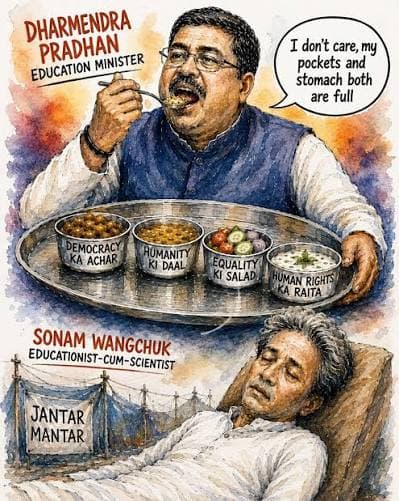
Central demands of the CJP Protest include immediate resignation of Dharmendra Pradhan, NTA dissolution or radical reform, leak-proof technology (biometrics, AI monitoring), compensation for victims, mental health support, and curbs on coaching industry excesses. Protesters seek a flexible, student-centric system prioritizing learning over high-stakes single exams.Despite mounting pressure, Pradhan has not resigned. Prime Minister Narendra Modi, vocal on international stages and during election rallies, has offered limited direct engagement domestically. This silence contrasts sharply with proactive responses to other crises, fueling perceptions of disconnect. Opposition calls for consensus (e.g., Rahul Gandhi’s student rallies) highlight the need for bipartisan reform, yet progress stalls. thehindu
Why Is This Happening? Systemic Rot and Political Priorities
Several factors converge. Education’s privatization created a lucrative industry vulnerable to manipulation. Political patronage in appointments, under-resourced regulatory bodies, and electoral reliance on coaching hubs in states like Rajasthan and Bihar exacerbate vulnerabilities. Demographic pressure—millions chasing limited seats—intensifies desperation.
Broader governance critiques point to centralized control without matching execution capacity. International G7/5 Eyes engagement focuses on geopolitics (trade, defense, countering China), sidelining soft issues like education quality that determine long-term national power.
The CJP Protest exposes how short-term political calculations undermine the youth dividend. Suppressing protests may restore superficial order but deepens cynicism. Sustainable solutions require transparency, judicial oversight, and depoliticization of examinations.
Prioritizing Temples Over Textbooks: Is the Modi Government Anti-Education?

A stinging question reverberates through the CJP Protest corridors: Why does the Modi government appear fundamentally against robust, accessible public education? While top 10 economies invest heavily in human capital—leading nations like Japan (around 7.4% of GDP), China (6.1%), the United States (6%), UK, and others allocating 5-7.5% or more toward education—India languishes below global benchmarks. Public spending hovers around 4-4.6% of GDP and roughly 2.4-2.6% of the central budget in recent years, far short of the 6% recommended by international frameworks. This underinvestment manifests brutally on the ground: thousands of government schools have been closed or merged across states since 2014 due to low enrollment, teacher shortages, and fund diversion, with estimates suggesting over one lakh rural and small schools shuttered or rationalized in various reports.
Simultaneously, significant public resources flow into temple redevelopment, pilgrimage infrastructure (e.g., Ayodhya’s multi-billion dollar makeover, Char Dham projects, and dozens of spiritual sites under schemes like PRASHAD), cultural diplomacy restoring Hindu mandirs abroad, and high-profile religious tourism initiatives. Critics argue this reflects a deliberate tilt toward majoritarian cultural assertion—coupled with electoral strategies centered on caste calculations and religious polarization—over universal education access. When votes are sought in the name of faith and identity while classrooms crumble and students face rigged exams, the CJP Protest exposes a dangerous inversion of priorities. A nation investing in mandirs but starving schools risks mortgaging its demographic dividend for short-term political gains, leaving millions of aspiring youth as collateral damage in the pursuit of a “Viksit Bharat” that sidelines its foundational classrooms. This mismatch fuels the rage on Delhi streets: education is not a religious or caste issue—it is a national survival imperative ignored at peril.
A Nation at Crossroads
As Sonam Wangchuk weakens and students nurse wounds from July 20, India faces a choice. Will it heed the CJP Protest and rebuild its education edifice, or double down on denial? History favors the former. Youth resilience, symbolized by the “cockroach” moniker, suggests they will not fade quietly.
The coming weeks—marked by hospital updates, parliamentary debates, and potential further mobilizations—will test India’s democratic maturity. For a nation aspiring to global leadership, securing its students’ futures is non-negotiable. The CJP Protest is not the problem; it is the symptom of deeper ailments demanding urgent surgery.
Related Articles on IMFounder
- India Paper Leak Scandal: 70+ Shattered Dreams, Student Suicides & Modi Govt 10-Year Shameful Failure
- Google’s $15 Billion AI Data Centre Raises Water Concerns in a Country Where over 600 Millions Already Face Water Stress
- India’s Air Pollution Crisis: How Government Failure Turned Breathing Into a Privilege
- Bill C-9 Canada: The Truth Behind the New Hate Crime Law
- Strait of Hormuz Crisis: Why Founders and Businesses Are in Serious Danger