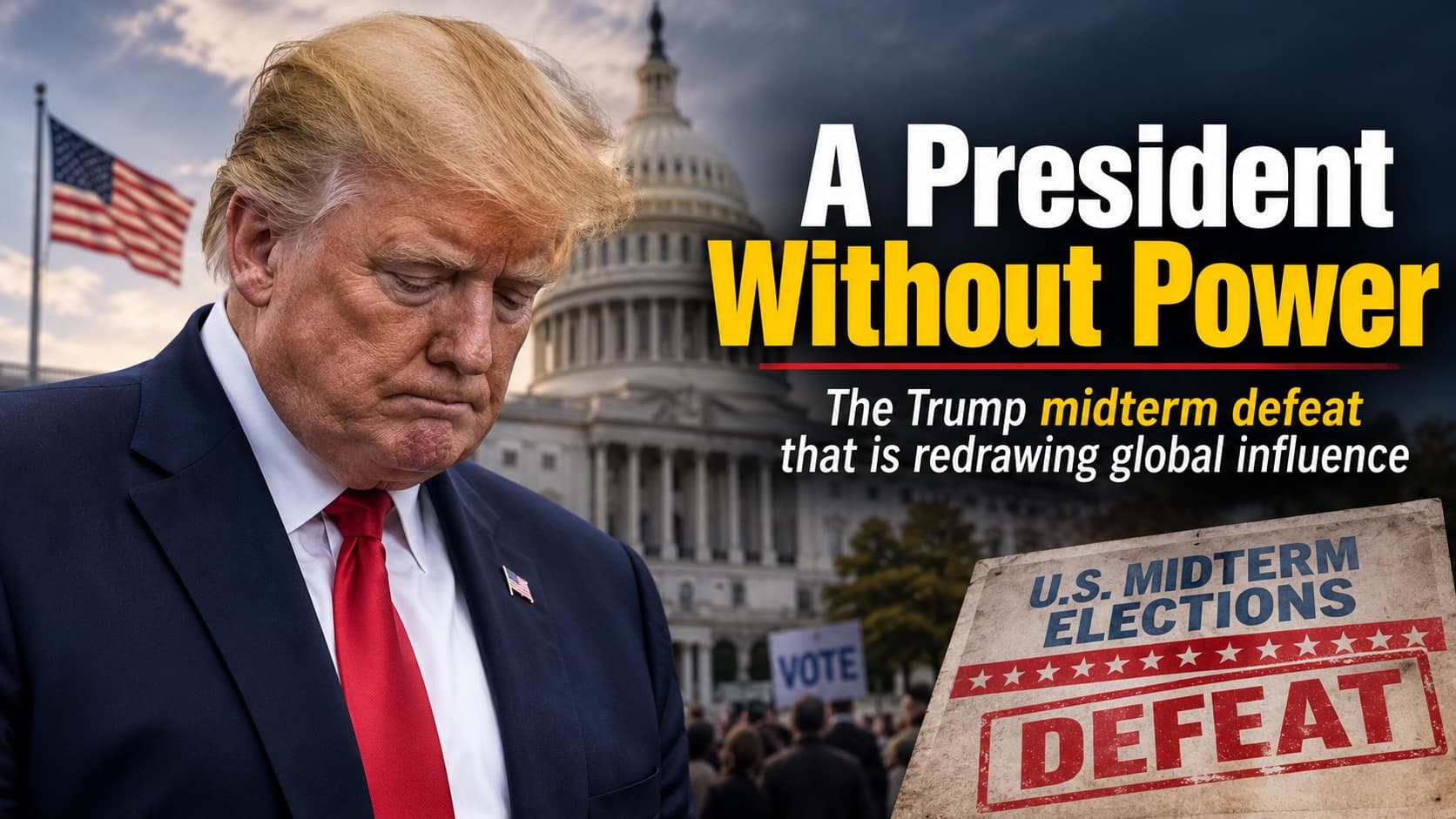

Trump midterm defeat is no longer a forecast. It is the new reality of American politics. On Tuesday, November 3, 2026, voters handed Democrats control of both the House and the Senate, ending two years of unified Republican power in Washington. The question echoing from Berlin to Beijing is blunt: is Donald Trump now a president without power?
The honest answer is more interesting than the headline. His domestic agenda just lost its legislative engine. Yet the same Trump still holds the veto pen, commands the armed forces and controls most levers of foreign policy. This analysis explains what happened, what the Trump midterm defeat means for the rest of the world, and what to watch next. Figures reflect reporting as of November 5, 2026, and a number of races were still being counted.
What Happened: Inside the Trump Midterm Defeat
The scale of the Trump midterm defeat is hard to overstate. NBC News projected that Democrats flipped seven Senate seats: Iowa, Kansas, Ohio, Maine, North Carolina, South Carolina and Texas. They also held battleground seats in Georgia and Michigan. In the House, NBC reported Democrats passed the 218-seat threshold, and Minority Leader Hakeem Jeffries is expected to become speaker when the new Congress convenes in January.
CBS News estimated Democrats will hold between 251 and 268 House seats and at least 54 Senate seats. Those ranges matter because the count is not final. Northeastern Global News noted that dozens of House races, plus Senate contests in Alaska and Mississippi, were still being decided at last check. Treat every seat total, including the ones in this article, as provisional until certification.
Why voters delivered the Trump midterm defeat
Analysts quoted by Northeastern pointed to voter anger over the Iran war, higher gasoline prices and wider economic anxiety. Vice President JD Vance reached a similar conclusion, writing on X that the Republican losses came down to the war. Trump himself accepted the outcome and congratulated Democrats, but warned he would veto legislation he considers unreasonable once the new Congress takes office.
Is Trump a President Without Power? The Reality Check
“President without power” makes a viral headline, but it is only half true. The Trump midterm defeat splits his presidency into two very different halves.
At home, he is clearly weaker. Democrats will control the federal purse strings, chair committees and decide which nominees get confirmed to key national security and diplomatic posts, according to the Council on Foreign Relations. Expect subpoenas, hearings and a legislative push on health costs. NBC reported that Democrats see leverage to restore enhanced Affordable Care Act subsidies and reverse Medicaid cuts.
Abroad, the picture is different. A president can veto any bill limiting military action, and Congress needs a two-thirds majority in both chambers to override. As Chatham House’s Laurel Rapp told CNBC, Trump retains “a lot of latitude” on foreign policy even while facing more oversight. Dawn’s analysis made the same point: the midterms clip his wings at home, not abroad, because his powers over sanctions, trade and military operations remain wide.
That is why the best description of the Trump midterm defeat is not “powerless.” It is a weakened president with fewer domestic tools and unchanged global reach. The seven shifts below show how that tension is playing out.
Shift 1: Unified Washington Is Over
For two years Republicans controlled the White House, the House and the Senate. That era ended on November 3. The practical changes arrive in January, but the political effect started immediately: Jim Jordan announced a bid for House minority leader, and Senate Minority Leader Chuck Schumer told Americans that “relief is on the way.”
Oversight is the biggest change. The Carnegie Endowment’s analysis of how Congress could constrain Trump points to impoundment, rescissions and revenue-raising techniques that bypass Congress as areas where the administration has pushed past traditional boundaries. Investigations could pressure the White House, though Carnegie cautions it is unclear whether hearings can be converted into binding limits.
For the world, the lesson is simple: Washington is no longer a single decision-maker. Every foreign government now has two power centers to lobby.
Shift 2: The Iran War Becomes the Test of the Trump Midterm Defeat
No issue will define the Trump midterm defeat more than Iran. Carnegie notes the Senate has already voted fourteen times on the war, yet only one nonbinding measure ever passed both chambers. With Democrats in charge, war powers resolutions and funding conditions become realistic tools. Quincy Institute’s Trita Parsi argued in Dawn that Congress ended the Vietnam war by cutting off money, and Democrats could try the same lever.
But a veto stands in the way. A CNN analysis published before the vote argued that Trump would still control the wareven if Congress changed hands, and that his decision to keep the blockade despite political costs made a sudden retreat unlikely. Slate reported that Trump has said he might resume bombing after the midterms, and Trump has said the war was necessary because Iran cannot be allowed a nuclear weapon.
Markets are betting on de-escalation anyway. Yahoo Finance reported that oil fell below $90 as traders wagered on the war ending. That bet could prove wrong if Trump decides the political risk is now behind him. For Gulf states, Europe and Asia, Iran is the clearest example of a president constrained in the Capitol but not in the Situation Room.
Shift 3: Tariffs and Trade Get a New Political Referee
Trade partners are watching the Trump midterm defeat for one reason: tariffs. The Council on Foreign Relations says many Asian business and political leaders hope Democrats can rein in Trump’s use of tariffs, and that Congress can at least use oversight to expose their costs. Slate’s analysis went further, arguing that high prices tied to tariffs and the Iran war swelled the size of the Democratic wave.
The caution is that trade policy is largely an executive tool. Dawn noted that Trump keeps substantial authority over sanctions and trade, and that Democrats may seek to reclaim some oversight rather than strip it away overnight. South African President Cyril Ramaphosa, whose country faces rising trade tensions with Washington, said the results could “introduce a new era in world relations,” according to Axios. Hope is not policy, but it explains why exporters from Johannesburg to Jakarta are paying attention.
Shift 4: Ukraine and NATO Get a Cautious Lifeline
Europe reacted with relief, but also with care. European Parliament Vice President Christel Schaldemose said she was “cautiously optimistic on Europe’s behalf,” arguing the result could help support for Ukraine and the green transition. German Defense Minister Boris Pistorius congratulated Democrats on a historic victory, and Spain’s Pedro Sanchez said voters had rejected hatred and climate denial, according to TRT World’s roundup.
The Kyiv Independent’s headline captured Ukraine’s mood: the result is a blow to Trump and a potential boost for Kyiv. Yet French politician Raphael Glucksmann warned that Trump still holds significant influence over international affairs. Some commentary even warns that frustration after the Trump midterm defeat could turn toward European allies and NATO. Berlin, notably, said it will talk to both Democrats and Republicans.
The lesson for Europe is to engage Congress more deeply while preparing for a White House that has fewer domestic distractions to hide behind and more time to focus abroad.
Shift 5: China and Russia Recalibrate
Beijing’s response was measured. China’s Foreign Ministry called the election an internal U.S. affair, while saying China wants to keep communicating, manage differences and build a constructive, strategically stable relationship. That is classic Chinese diplomacy: do not celebrate, do not criticize, and keep trade channels open.
Moscow was less diplomatic. Deputy Foreign Minister Sergei Ryabkov said the Democrats’ approach to Russia is extremely negative. For Russia, a Democratic Congress means possible new pressure through sanctions, oversight and Ukraine funding, even if the president resists.
Iran is watching too. CNN’s analysis noted Iranian state television has tracked Trump’s approval ratings and speculated that Republican losses would force concessions. That is a dangerous assumption if it leads Tehran to underestimate what a president with unchecked military authority might do.
Shift 6: Markets React to the Trump Midterm Defeat
Financial markets delivered an immediate verdict. Al Jazeera reported that the Nasdaq, Dow and S&P 500 opened higher after the sweep and after Trump accepted the results. Other market reports described a weaker dollar, lower Treasury yields, rising gold and a sharp drop in oil prices. A Reuters headline carried by Express Tribune said oil dipped 9 percent.
The mood was not uniformly bullish. A separate Reuters market wrap said the sweep also sparked gridlock fears that hit AI shares and Treasuries. In other words, investors like falling oil and lower political risk, but they also know divided government can stall budgets, debt-ceiling talks and tech policy. This is market reporting, not investment advice, and prices move fast.
Shift 7: Allies Start Hedging Against 2028
The deepest global impact of the Trump midterm defeat may be psychological. Dawn’s analysis argues that international partners must now ask whether commitments made by this administration can survive a change of political direction in Washington in 2028. If the answer is “maybe not,” allies will diversify trade, defense and diplomacy.
Pew Research Center data cited by Axios already shows many countries increasingly view Washington as unreliable and self-interested. A midterm loss that exposes how quickly American voters can reverse course adds fuel to that perception. Meanwhile, as the CFR notes, presidential hopefuls will study these results when crafting their own foreign policy platforms. The 2028 race has effectively begun.
What Comes Next After the Trump Midterm Defeat
Nobody can predict how Trump will respond, but analysts outline three broad scenarios.
Scenario 1: A pivot to foreign policy
The CFR argues the final two years could be more heavily focused on foreign policy than the first two, and that Trump might become even more adventurist abroad given constraints at home. This is the scenario that worries diplomats most.
Scenario 2: Selective deals with Democrats
Trump has signaled willingness to work with the new majorities. Health costs, prices and some trade measures could create overlap. Deals would be transactional and fragile, but possible.
Scenario 3: Confrontation and vetoes
Trump warned he will veto bills he considers unreasonable. If Democrats pass war powers limits or tariff restrictions, a veto showdown is likely. Overriding requires two-thirds of both chambers, which means significant Republican defections.
Key Takeaways: What the Trump Midterm Defeat Means for the World
- Trump is weaker at home, not powerless abroad. His veto, military command and trade authority remain.
- Iran is the first major test of the Trump midterm defeat. Watch for war powers votes and any resumption of strikes.
- Allies are cautiously relieved, but they are hedging for a post-Trump Washington.
- Markets are pricing lower oil and lower political risk, while still fearing gridlock.
- China is staying calm, Russia is bracing for pressure and Europe is lobbying Congress.
Frequently Asked Questions About the Trump Midterm Defeat
Did Democrats really win both the House and Senate?
Yes. NBC News, CBS News and CNBC projected that Democrats won control of both chambers on November 3, 2026. Some races remained uncalled as of November 5, so final totals may change.
Is Trump a lame duck after the midterm defeat?
Politically, he is weaker on domestic legislation. Constitutionally, he remains commander in chief with veto power, so his foreign policy authority is largely intact.
How does the Trump midterm defeat affect oil and the global economy?
Oil prices fell and the dollar weakened right after the results, partly on hopes of de-escalation with Iran. Those hopes depend on decisions the president, not Congress, ultimately controls.
Conclusion: Weakened, Not Powerless
The Trump midterm defeat is a political earthquake, but earthquakes do not erase buildings; they change what can stand. Trump lost his congressional majority, his unchecked agenda and much of his domestic momentum. He did not lose the veto, the military or the ability to surprise the world.
For readers, the smartest way to follow the story is to watch three signals: whether war powers resolutions advance, whether tariffs are softened, and whether Trump negotiates or escalates. Those answers will show whether the Trump midterm defeat produced a more cautious America or a more unpredictable one.
Related Articles on IMFounder
- Global Protests Explode: 5 Shocking Truths Behind France’s Riots and India’s Delhi Crackdown
- The Vote highjack Controversy: The world’s biggest democracy becomes a joke under Modi.
- Trump Is Changing How American Beef Is Sold—and AI Is Moving Into the Slaughterhouse
- Canada Luring American Scientists: A Bold $541-Million Coup
- The Unyielding Fury of India’s Youth: CJP Protests Expose Education Crisis Under Modi Government
- Bill C-9 Canada: The Truth Behind the New Hate Crime Law
- India Paper Leak Scandal: 70+ Shattered Dreams, Student Suicides & Modi Govt 10-Year Shameful Failure