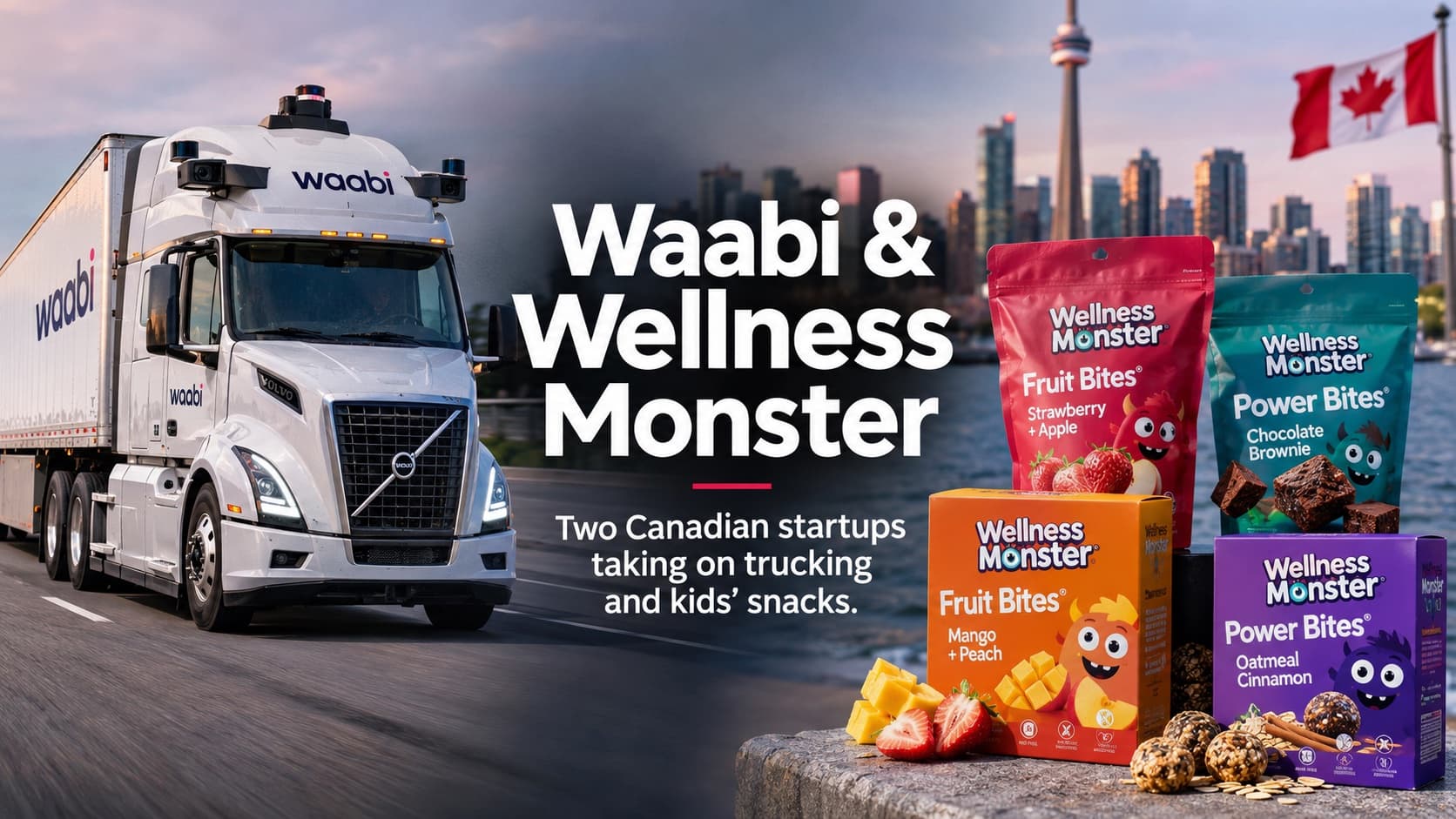

Waabi and Wellness Monster operate in industries that could hardly be more different. One is developing artificial intelligence capable of driving massive commercial trucks without human intervention. The other is trying to change what children eat by challenging the conventional snack aisle. Yet both companies represent an important shift in Canadian entrepreneurship: building businesses around problems that affect millions of people, rather than simply introducing another product into an already crowded market.
Toronto-based Waabi has attracted up to US$1 billion in new financing commitments in 2026 and is developing autonomous transportation technology with Volvo and Uber. Wellness Monster, also based in Toronto, has secured its first seed investment and expanded its children’s snack products into approximately 180 Canadian retail locations. The differences in their scale are enormous. So are the challenges they face. But their stories raise a common question: Can Canada become a place where ambitious companies are not only created, but successfully commercialized, scaled, and sustained? The answer depends on what happens after the investment announcements.
Waabi and Wellness Monster: Two Canadian Startups, Two Different Problems
Canada’s startup ecosystem is often associated with artificial intelligence, financial technology, clean energy, and advanced research. Consumer packaged goods receive less attention, even though they are an important part of the country’s manufacturing and retail economy. Waabi and Wellness Monster demonstrate that innovation does not require every business to use the same technology or pursue the same market.
Waabi is attempting to solve a technological and operational challenge: moving freight more efficiently through vehicles capable of navigating roads autonomously. Wellness Monster is addressing a consumer problem: the gap between the snacks children enjoy and the ingredients and nutritional qualities many parents want. Their approaches are different, but both need to achieve the same commercial result. They must convince customers that their alternatives deliver enough value to justify changing established behaviour. For Waabi, that means gaining the trust of logistics operators, vehicle manufacturers, insurers, and regulators. For Wellness Monster, it means convincing retailers to allocate shelf space and persuading families to buy its products repeatedly. Neither challenge can be solved by funding alone.
Waabi: The Canadian AI Company Trying to Reinvent Transportation
Founded in 2021, Waabi is a Toronto-headquartered autonomous driving technology company developing artificial intelligence for commercial trucks and, increasingly, robotaxis. Its central product, the Waabi Driver, is designed to operate vehicles by interpreting their surroundings, predicting the behaviour of road users, and making driving decisions. Unlike conventional driver-assistance systems, which help a human operate a vehicle, Waabi is pursuing technology capable of performing the driving task within defined operational conditions.
The ambition is substantial. Long-haul trucking forms an essential part of modern supply chains, transporting everything from groceries and pharmaceuticals to industrial equipment and consumer products. Trucking also involves expensive equipment, demanding schedules, challenging driving conditions, and considerable operational complexity. Autonomous technology could eventually help transportation companies use their vehicles more efficiently and maintain freight capacity on suitable routes. However, those potential benefits depend on the technology demonstrating sufficient safety, reliability, regulatory compliance, and commercial viability.
Who Is Behind Waabi?
The driving force behind Waabi is Dr. Raquel Urtasun, its founder and chief executive officer. Urtasun is a prominent artificial intelligence researcher and professor of computer science at the University of Toronto. She is also a co-founder of Canada’s Vector Institute for Artificial Intelligence. Before establishing Waabi, she served as chief scientist and head of research and development at Uber’s Advanced Technologies Group, which worked on autonomous driving. That combination of academic research and commercial experience is central to Waabi’s strategy.

Urtasun recognized that traditional approaches to autonomous vehicles were expensive and difficult to scale. Developing self-driving technology often required collecting enormous volumes of real-world driving data and testing vehicles across different conditions. Even then, a system trained for one environment might struggle in another. Waabi was founded around a different proposition: could advanced AI learn to handle a much broader variety of driving situations while relying more heavily on sophisticated simulation? The company has assembled expertise in AI, robotics, automotive engineering, and logistics. Its chief operating officer, Lior Ron, also brings experience from the transportation technology industry.
How Waabi’s AI Technology Works
Waabi’s technology combines advanced machine learning, virtual simulation, and real-world vehicle operations. At the centre of its development process is Waabi World, a neural simulation system designed to reproduce complex driving environments. Instead of relying exclusively on driving millions of physical miles, engineers can train and test autonomous driving systems against simulated roads, traffic, weather conditions, and unusual situations. A virtual environment can expose the software to scenarios that would be difficult, expensive, or dangerous to reproduce deliberately on public roads.
This matters because autonomous driving systems must do more than recognize ordinary road markings or follow traffic. They must respond appropriately when another driver makes an unexpected manoeuvre, a vehicle enters a blind spot, road construction changes the route, or conditions become uncertain. Waabi describes its broader approach as Physical AI: artificial intelligence designed to perceive, reason, and act in the physical world. One of the company’s most ambitious technical claims is that its driving system can generalize across different vehicle platforms and driving environments, reducing the need to develop a separate autonomous system for every new application. If demonstrated consistently at scale, this could make autonomous transportation less expensive to deploy. But simulation remains a development and validation tool—not proof by itself that a vehicle is safe enough to operate without human supervision. Real-world testing, independent safety assessment, engineering redundancy, and regulatory oversight remain essential.
Waabi’s Billion-Dollar Financing and Its Biggest Commercial Test
On January 28, 2026, Waabi announced a US$750 million Series C financing round co-led by Khosla Ventures and G2 Venture Partners. The financing attracted major investors associated with artificial intelligence, automotive technology, and institutional capital. Participants included NVIDIA’s NVentures, Volvo Group Venture Capital, Porsche Automobil Holding SE, Uber, and funds managed by BlackRock, among others. Canadian investors included BDC Capital’s Thrive Venture Fund, Export Development Canada, TELUS Global Ventures, and BMO Global Asset Management.
Alongside the Series C round, Waabi announced an additional US$250 million in milestone-based future investment commitments from Uber, linked to a robotaxi partnership. The distinction matters: Waabi closed a US$750 million equity round, while the additional US$250 million was structured as future milestone-dependent investment—not necessarily money already received. The Uber agreement envisages deploying at least 25,000 Waabi Driver-powered robotaxis over time on Uber’s platform. For Waabi, the partnership creates a potential route into passenger transportation without needing to build a competing consumer ride-hailing network. For Uber, it offers another source of autonomous driving technology. However, the planned robotaxi fleet represents a future deployment objective, not a completed rollout.
From Research to Real Freight Operations
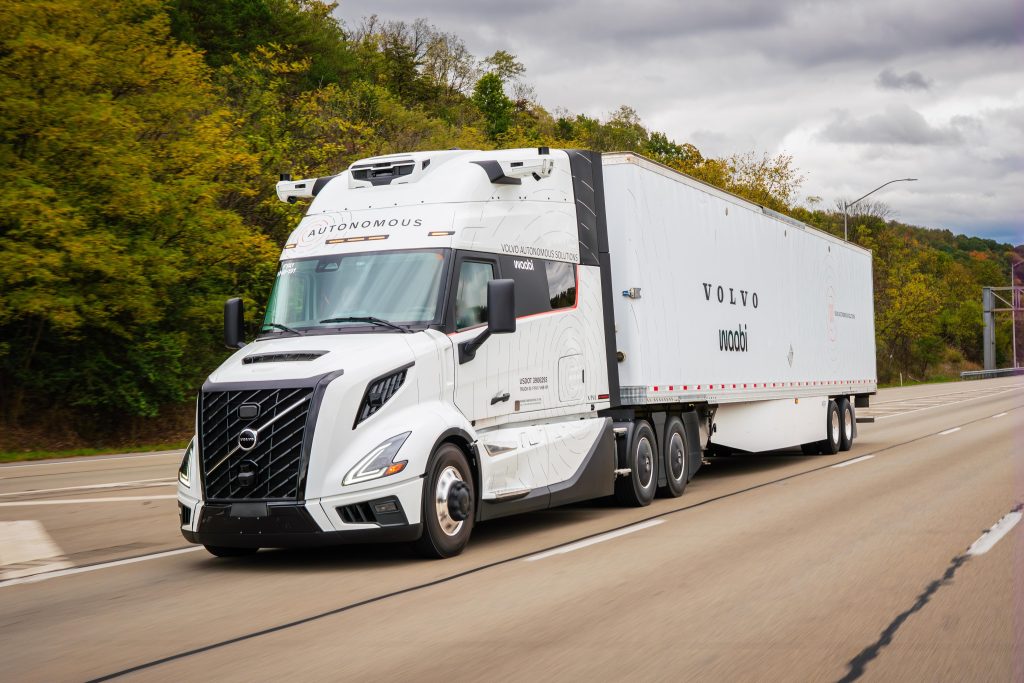
Waabi’s commercial progress in 2026 offers a more tangible measure of its development. In October, Volvo Autonomous Solutions and Waabi announced the beginning of customer freight operations for Warp along the Dallas–Houston corridor in Texas. The operations use Volvo VNL Autonomous trucks equipped with the Waabi Driver to transport commercial freight. Importantly, these vehicles were operating with an observer in the driver’s seat. The announcement should therefore not be confused with fully unsupervised driverless operations.
Waabi also announced a commercial partnership with Warrior Logistics in October 2026, supporting recurring customer shipments on the same corridor. According to Waabi and Warrior, their operations had achieved 100% on-time pickup and delivery with no reported safety incidents during the period disclosed. Those are promising company-reported results, but they do not establish a broader long-term safety record across all operating environments. Waabi must still demonstrate that its systems can operate safely and economically over extended periods, through changing conditions, and eventually without onboard human supervision where regulations permit. That will be the defining test of its business model.
Wellness Monster: The Canadian Startup Challenging the Children’s Snack Aisle
While Waabi tackles transportation, Wellness Monster operates much closer to everyday family life. Founded in 2023 and commercially launched in June 2025, Wellness Monster is a Canadian children’s snack company focused on creating convenient products using fruit, plant-based ingredients, and selected nutrient-rich foods. Its products include Fruit Bites and Power Bites, marketed as alternatives to conventional packaged snacks.
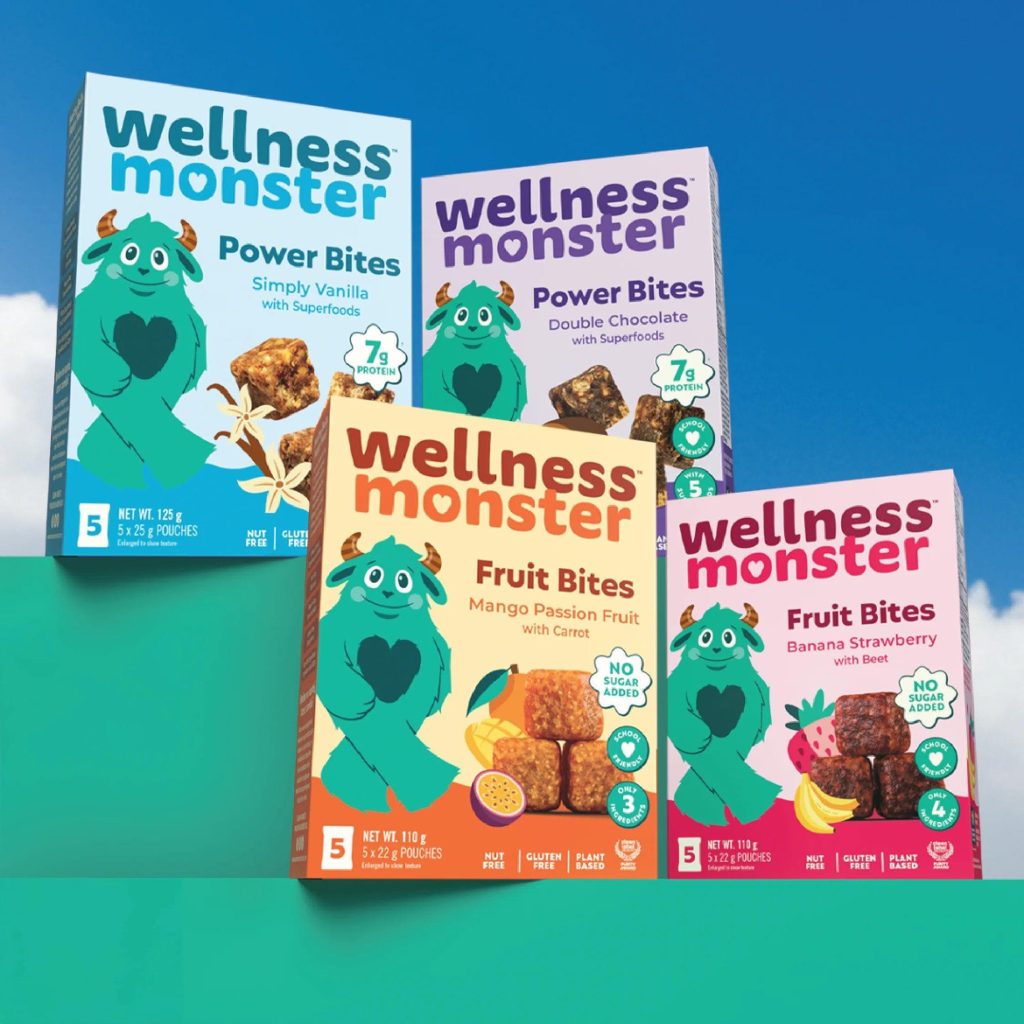
The company’s central argument is straightforward. Parents frequently want nutritious, convenient food for their children. Children, meanwhile, often make their choices based on flavour, texture, familiarity, and packaging. A snack can appeal to parents on its ingredient list and still fail commercially if children refuse to eat it. Wellness Monster is trying to satisfy both audiences. Its distinctive monster branding makes the products playful and recognizable, while its ingredient positioning targets families seeking alternatives to products containing refined sugar and artificial additives. That combination of nutrition, convenience, and branding is the foundation of its strategy.
Who Founded Wellness Monster?
Wellness Monster was founded by Brittany Compton, an experienced consumer packaged goods executive and mother of two. Compton spent approximately 13 years at Mars, working with established confectionery brands including M&M’s and Snickers. She subsequently served as president and general manager of Love Child Organics, a children’s food company acquired by Nature’s Path in 2023. Her background provides an unusual advantage in the emerging healthy-snack market. She understands both the commercial methods used by established confectionery companies and the operational challenges associated with building a children’s nutrition brand.
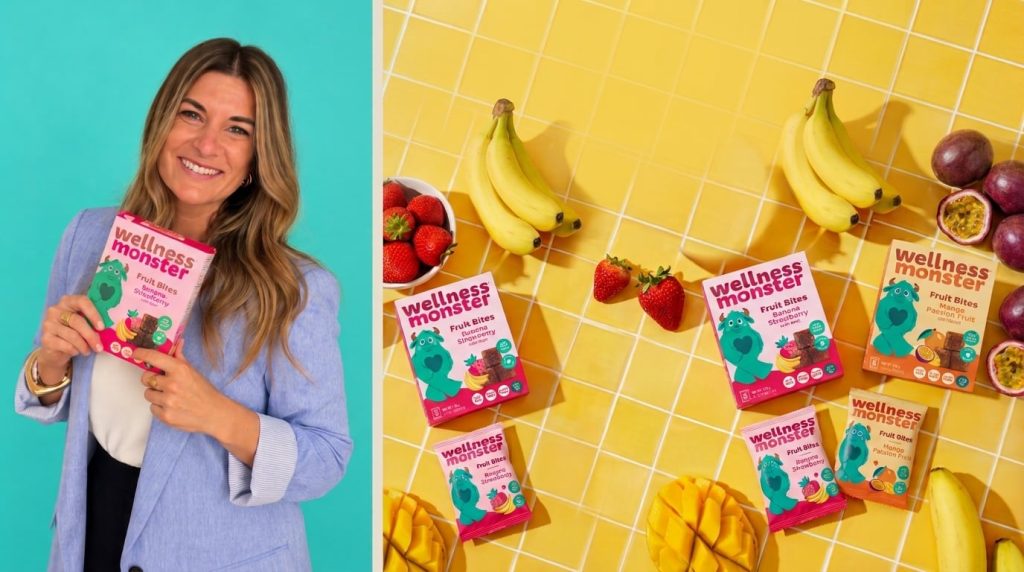
According to Compton’s account in Retail Insider, her decision to establish Wellness Monster was influenced by her experiences as a parent and her belief that the children’s snack category had not kept pace with changing consumer expectations. The business also benefits from experienced advisors. Retail Insider has identified SmartSweets founder Tara Bosch and former Avena Foods chief executive Gord Flaten among those advising the brand. These relationships potentially provide expertise in food formulation, retail distribution, manufacturing, and consumer brand development. Nevertheless, experience and industry connections can only open doors. Long-term commercial success depends on what happens after a product reaches store shelves.
How Wellness Monster Plans to Change Children’s Snacking
Wellness Monster’s strategy is built around turning recognizable food ingredients into convenient, appealing snack formats. Its Fruit Bites contain fruit-based ingredients and are positioned as alternatives to conventional fruit snacks made with juice concentrates or added sugars. Its Power Bites use plant-based protein sources, including pea and fava bean protein, alongside other ingredients selected for their nutritional properties. The brand’s current product listings advertise seven grams of protein per serving for Power Bites. The company also promotes attributes such as nut-free and gluten-free formulations, depending on the product.
Manufacturing is another important part of the business. According to Retail Insider, Wellness Monster uses Canadian manufacturing partners for its Power Bites, while fruit products are manufactured in Ghana, close to sources of fruit ingredients. This model combines domestic production with international agricultural sourcing. It also illustrates the complexity of the modern food industry: a company can be Canadian-owned and contribute to Canadian economic activity while relying on overseas manufacturing for some products.
Does Healthier Packaging Automatically Mean Healthier Food?
Not necessarily. Terms such as clean label, superfood, and natural can help consumers understand how a product is marketed, but they do not automatically establish that the product is nutritionally superior. A snack’s overall nutritional value depends on its ingredients, serving size, sugar content, fibre, protein, sodium, and contribution to a balanced diet.
Similarly, a product containing plant-based protein is not automatically necessary for every child. Protein requirements vary by age and individual circumstances, and most children can obtain adequate protein through ordinary meals. Wellness Monster’s products should therefore be evaluated using their actual nutrition facts and ingredient lists, rather than branding alone. Its strongest consumer proposition may be more practical than revolutionary: giving parents additional choices in a category historically dominated by large, established snack manufacturers. The ultimate measure of success is whether those choices deliver good nutrition, acceptable value, and a taste children genuinely enjoy.
Wellness Monster’s 2026 Seed Funding: What Happens Next?
In November 2026, Wellness Monster confirmed the completion of its first seed funding round. The investment was anchored by Grip Ventures, with participation from a small group of angel investors. The amount raised was not publicly disclosed. That distinction is important because an announced financing round does not, by itself, establish a company’s valuation, revenue, profitability, or financial health. However, the investment follows visible progress in retail distribution.
By November 2026, Wellness Monster reported reaching approximately 180 stores across Canada, including locations associated with Whole Foods Market Canada, Farm Boy, Metro, and Choices Market. For a young consumer brand, gaining access to established retail channels is a meaningful achievement. It suggests that buyers see potential in the category and are willing to give the products shelf space. But distribution does not automatically translate into a sustainable business. Food startups face significant costs associated with manufacturing, packaging, inventory, freight, marketing, retailer requirements, and promotions. They also compete with multinational companies that have substantially larger advertising budgets and stronger negotiating positions.
Compton has identified repeat purchases as a central priority. That is a commercially significant distinction. A family purchasing a snack once because of attractive packaging is not the same as a family making it part of their regular grocery basket. Wellness Monster plans to use its new funding to strengthen existing retail performance, improve supply-chain capacity, expand distribution, and introduce new products. Its announced Tropical Pineapple Fruit Bites flavour is scheduled for December 15, 2026. The company’s longer-term ambition includes broader Canadian distribution and eventual expansion into the United States. Whether it can achieve those goals will depend heavily on customer retention, pricing, production capacity, and retail economics.
How Waabi and Wellness Monster Are Helping Canada’s Economy
Waabi and Wellness Monster represent different forms of potential economic value. Waabi belongs to Canada’s research-intensive technology economy, where specialized intellectual property, engineering talent, and international investment can create opportunities extending far beyond the initial company. Wellness Monster belongs to the consumer products economy, where growth can generate demand for manufacturing, packaging, logistics, retail services, agriculture-related supply chains, and brand development.
Neither company’s total contribution to Canadian gross domestic product or employment has been publicly established in the sources reviewed. Nevertheless, several economic channels are clear.
1. Attracting International Capital
Waabi’s financing demonstrates the ability of a Canadian-headquartered company to attract substantial international investment. Its investors span technology, automotive manufacturing, financial services, and venture capital. This strengthens Toronto’s visibility as a centre for commercial artificial intelligence. It also creates opportunities to finance research and development, hire skilled workers, and build business relationships. However, foreign investment commitments should not be treated as equivalent to Canadian GDP growth. Their domestic economic impact depends on how much capital is ultimately spent in Canada and what value is created there. Wellness Monster’s funding is smaller and undisclosed, but represents another important part of Canada’s entrepreneurial ecosystem: early-stage financing for businesses outside the software industry.
2. Supporting Canadian Research and Skilled Employment
Waabi’s connection to the University of Toronto and the Vector Institute illustrates how publicly supported research ecosystems can contribute to commercial innovation. Companies emerging from these environments can create demand for AI researchers, software engineers, robotics specialists, safety experts, and other highly skilled professionals. Waabi maintains teams in Toronto and several American technology and logistics centres. Its global operations may increase the commercial reach of Canadian-developed technology. The central economic question is how much high-value research, management, intellectual property ownership, and employment remains in Canada as the company expands.
3. Creating Opportunities for Manufacturers and Suppliers
Wellness Monster’s domestic production partnerships provide a more direct connection to Canada’s manufacturing economy. Canada’s food manufacturing sector employed approximately 257,900 payroll workers in December 2025, according to Statistics Canada. Emerging food brands can create additional demand for specialized production, quality control, packaging, distribution, and product development. Wellness Monster’s growth could support some of these activities, especially as its Canadian-manufactured product lines expand. However, its specific employment impact and Canadian manufacturing expenditure have not been publicly quantified. Its Ghana-manufactured fruit products also mean that some production-related economic activity takes place outside Canada. This does not invalidate the company’s Canadian identity, but it is important when examining the geographic distribution of economic benefits.
4. Creating Export Potential
Both businesses are pursuing opportunities beyond Canada’s domestic market. Waabi is already operating commercially in the United States, where freight transportation provides a substantial potential market for autonomous systems. If its technology scales successfully, the company could build a valuable international business around AI developed within Canada’s research ecosystem. Wellness Monster sees the United States as a possible next stage of growth. Canadian food and beverage companies that establish successful distribution abroad can potentially generate additional revenue, strengthen brands, and create more demand across their supplier networks. But overseas expansion is not automatic evidence of increased Canadian exports. That depends on where goods are produced, where services are delivered, and how revenue flows through the business.
5. Strengthening Canada’s Entrepreneurial Reputation
There is also a less immediately measurable benefit. Successful Canadian companies can attract experienced employees, investors, suppliers, and future founders into the broader ecosystem. Waabi could strengthen Canada’s position in commercially deployed AI. Wellness Monster could demonstrate that Canadian consumer brands can develop differentiated products and compete with established international manufacturers. These outcomes are possible, but their long-term economic importance will only become clear as the companies grow.
The Challenges That Could Determine Their Futures
Both companies have achieved meaningful milestones. Neither has eliminated the fundamental risks associated with its business. For Waabi, the central challenge is safe, scalable autonomy. A vehicle operating with an onboard observer is an important commercial step, but the economic case changes considerably when removing that observer becomes feasible. The company must demonstrate that its technology can navigate difficult conditions, satisfy regulators, achieve acceptable safety performance, and deliver reliable economics for customers.
It must also compete with established autonomous trucking companies, including Aurora Innovation, which has already launched commercial driverless freight operations in the United States. Robotaxis introduce additional complexity. Dense urban streets present different hazards from controlled-access highways, making Waabi’s ambition to apply a common AI architecture across both markets especially demanding.
For Wellness Monster, the risks are primarily commercial. Securing distribution is difficult, but maintaining profitable distribution can be harder. The business must manage production costs, preserve product quality, respond to retailer pricing pressure, maintain attractive margins, and build lasting consumer loyalty. A larger competitor could also introduce products with similar nutritional positioning and significantly greater marketing resources. The company’s biggest advantage may be its founder’s understanding of how consumer brands scale. But its most important future metric is likely to be repeat purchase behaviour rather than the number of new stores announced.
What Waabi and Wellness Monster Reveal About Canada’s Startup Future
It would be misleading to present Waabi and Wellness Monster as equivalent success stories. Waabi is a heavily financed deep-technology company pursuing a potentially transformative but highly regulated transportation market. Wellness Monster is an emerging consumer brand using product differentiation, nutritional positioning, and retail execution to compete in a mature category. Their funding, technical complexity, commercial models, and market sizes differ substantially.
What connects them is the process of turning a recognizable problem into a business. Waabi is betting that AI can make transportation more efficient and that simulation-based development can help autonomous systems scale. Wellness Monster is betting that enough families want more nutritious snack options to sustain a competitive new brand. Both must demonstrate results beyond initial enthusiasm. For Waabi, success will be measured by safe driverless deployment, customer adoption, commercial performance, and scalable operations. For Wellness Monster, success will depend on consumer demand, repeat purchases, product economics, and the ability to expand distribution profitably.
For Canada, the broader opportunity lies in supporting both forms of entrepreneurship. Advanced research companies can generate globally relevant intellectual property. Consumer brands can strengthen manufacturing networks, distribution channels, and export opportunities. A healthy economy needs both.
The Bigger Picture: Canada’s Next Growth Story Is About Execution
Waabi and Wellness Monster demonstrate why Canada’s entrepreneurial potential cannot be measured through one industry alone. One company is developing sophisticated artificial intelligence that could eventually change how goods and people move. The other is trying to improve the everyday choices available to families. Both are Canadian-founded businesses pursuing markets substantially larger than their home country.
Their next stages will be more revealing than their founding stories. Waabi needs to turn technological progress into safe, economically viable autonomy at scale. Wellness Monster needs to turn growing retail availability into sustainable consumer demand. And Canada needs to ensure that the value created by successful domestic companies translates into meaningful benefits for its workers, suppliers, research institutions, and economy.
The real measure of Canadian startup success is not how much money a company raises or how quickly it makes headlines. It is how much lasting value it creates—and how much of that value Canada can retain.
That is the opportunity, and the challenge, represented by Waabi and Wellness Monster.
Verified external references
- Waabi — January 2026 financing announcement. Waabi+1
- Waabi and Volvo — October 2026 commercial operations. Waabi+1
- Waabi and Warrior Logistics — Commercial partnership. Waabi
- Retail Insider — Wellness Monster seed financing. Retail Insider
- Retail Insider — Founder, products and manufacturing. Retail Insider
- Wellness Monster — Official website. Wellness Monster Snacks
- Statistics Canada — Manufacturing employment data. Statistics Canada
Related Articles on IMFounder
- Anthropic Mythos Preview: Revolutionary New AI Model from Anthropic
- Nvidia Microduck: 7 Shocking Truths About the $399 Robot Duck Taking Over Tech
- Users but No Revenue: 7 Brutal Fixes Your Startup Must Make First
- Bootstrapping vs Raising: 7 Brutal Truths Nobody Tells You
- What Seed Investors Really Want From Technical Founders in 2026: 7 Brutal Truths Nobody Tells You
- 5 Powerful Startups You Can Launch With Only $1,000
- How to Validate a Startup Idea Without Writing a Single Line of Code