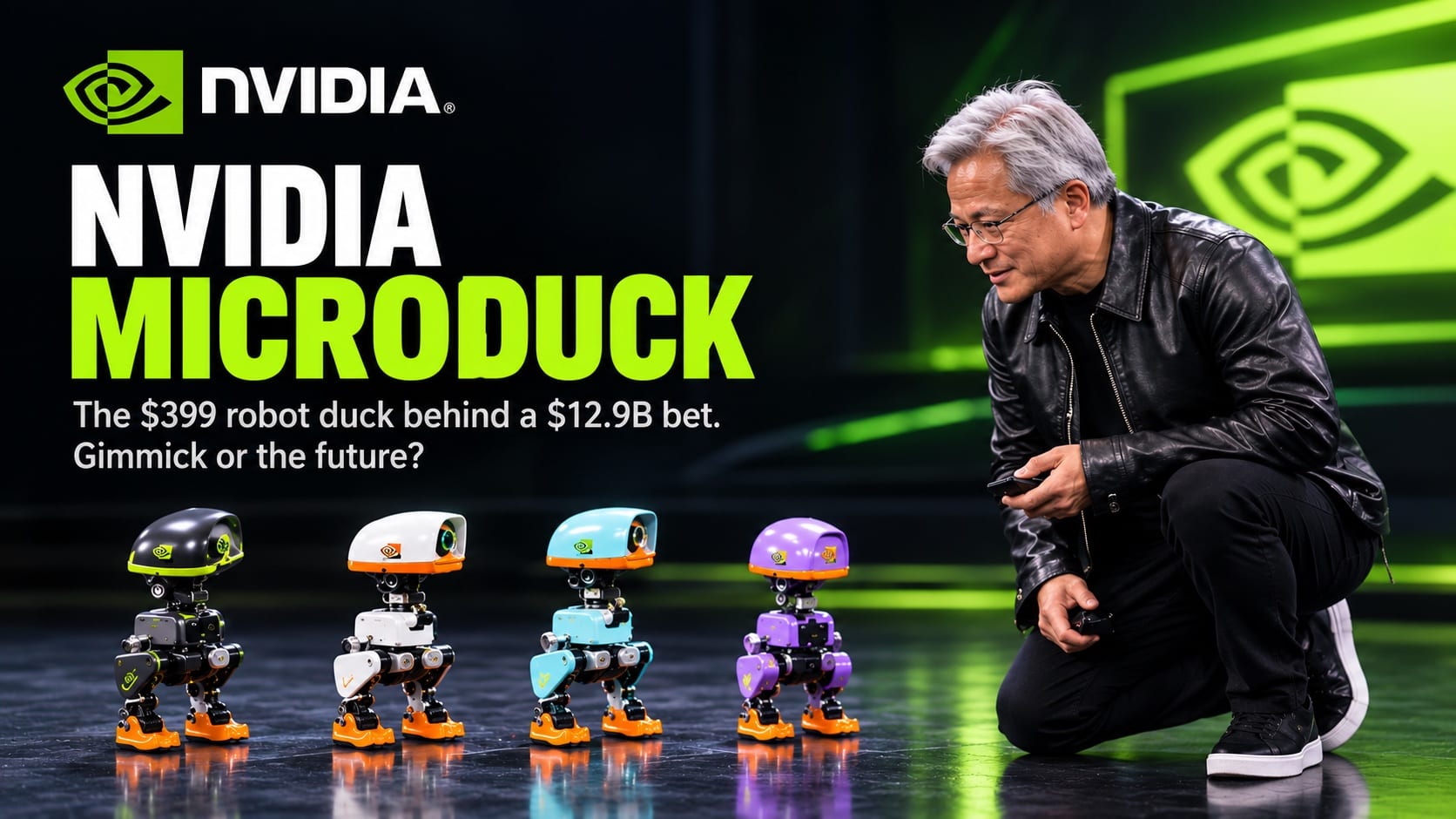

The Nvidia Microduck is the most unlikely tech hit of 2026: a 25-centimeter robot duck that waddles, somersaults, roller-skates and takes “naps” on command. After a flock of them stole the show at Jensen Huang’s GTC Berlin keynote on October 21, Hugging Face’s CEO claimed preorders were about to pass 20,000.
Here is the detail most headlines blur: Nvidia did not design this robot. It comes from Pollen Robotics, the Bordeaux team inside Hugging Face, which Nvidia agreed to acquire for $12.93 billion. “Nvidia Microduck” is shorthand for a robot that now sits in Nvidia’s orbit.
I judge hardware the way I judge any startup pitch: ignore the demo and follow the incentives. So is the Nvidia Microduck just another gimmick, or a clever wedge into physical AI? Seven truths decide it.
What Is the Nvidia Microduck, Exactly?
Microduck is a bipedal desktop robot, 25 cm tall and under 800 grams, with 15 motors, a front camera, a small depth sensor, motion sensors and an articulated beak for picking up light objects. It is the second consumer robot from Pollen Robotics, after Reachy Mini, and Pollen joined Hugging Face in April 2025.
The introductory price is $399 before taxes and shipping. The software is open source; the hardware is not. The beak cannot lift much more than 100 grams, so “picks up your socks” is charming, not a laundry plan. The Hugging Face Microduck is pitched as a playful, AI-native consumer robot that doubles as an education tool.
Five Fun Facts About the Hugging Face Microduck
- It has just one eye, which is part of its charm.
- It makes tiny R2-D2-style noises and can sing, sit, “nap” and somersault on command.
- It can roller-skate and get back up after being knocked over.
- Pollen Robotics was founded in Bordeaux in 2016 by former Inria researchers.
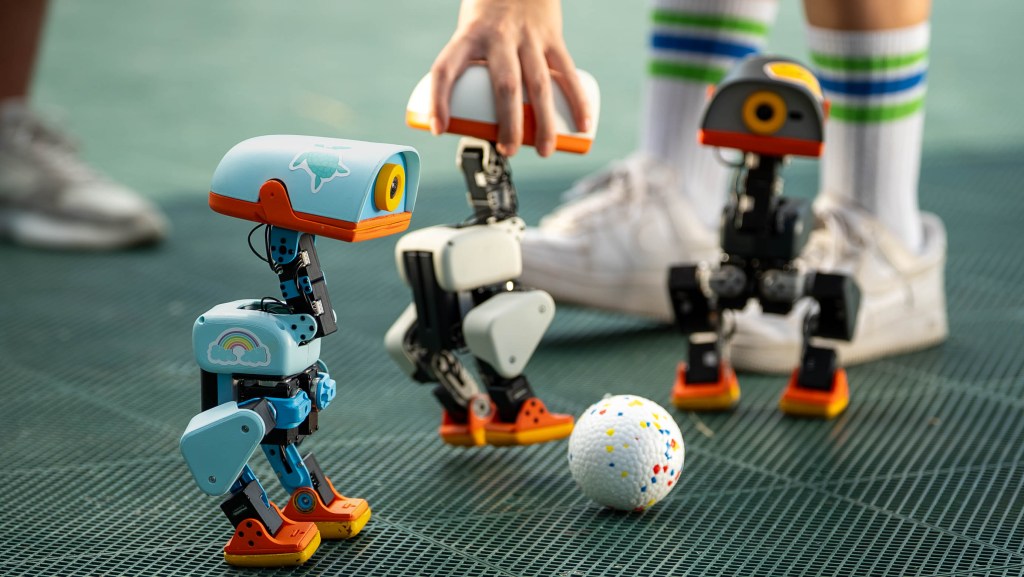
- It comes in four colorways: Cream, Graphite, Sky and Lavender.
Truth #1: The Nvidia Microduck Is Nvidia’s Strategy, Not Its Silicon
Nvidia announced the Hugging Face deal on September 3, 2026: roughly $11.9 billion in cash plus up to $1 billion in employee retention awards. Closing isn’t expected until 2027, and Nvidia says Hugging Face will stay open, with Nvidia hardware not required.
Inside the duck, Automate.org reports the processor is not an Nvidia chip. Nvidia’s fingerprints are on the training side instead. The simulator, MuJoCo Warp, is built on Nvidia’s Warp framework, and the training library mjlab reimplements the API of Nvidia’s Isaac Lab.
The lesson: Nvidia doesn’t need to sell the chip inside the duck. It needs you to learn on its stack.
Truth #2: A $399 Price Tag Changes Who Gets to Build Robots
Most humanoid robots cost tens of thousands of dollars, so their buyers need a warehouse ROI case. A Microduck needs only a curious teenager. The Microduck robot price puts physical AI in the same range as a games console, and that is a distribution advantage no enterprise robot can match.
As an investor, I read cheap hardware as a customer-acquisition channel. Every duck sold is a developer, student or parent with a reason to learn simulation, reinforcement learning and, eventually, Nvidia’s tools.
Truth #3: The Nvidia Microduck’s Real Product Is the Training Pipeline
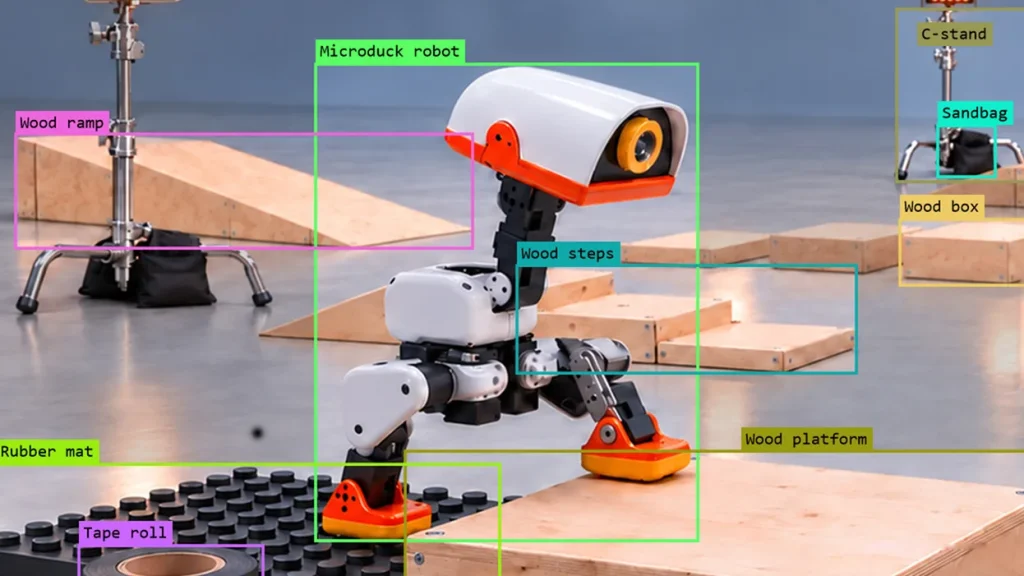
The Pollen Robotics Microduck GitHub page explains how to train a walking policy across 4,096 virtual ducks in parallel, which produces a usable gait in one to two hours. The result is then transferred to the physical robot, a method called sim-to-real. Nvidia and Hugging Face also published a technical walkthrough, and a Microduck Arena lets developers compare walking policies. The simulator even opens in a browser, so you can learn without owning a duck.
That is the Raspberry Pi playbook: the board is the doorway, the community is the product. This open-source robot duck is a reinforcement learning classroom disguised as a toy.
Truth #4: Flocks Make Nvidia Microduck Robots Feel Alive
Pollen says the experience comes alive with several robots together: races, football and robots reacting to one another. That is smart product design, because groups create shareable video, and shareable video is free marketing. The GTC Berlin stage proved it: four robots in front of a keynote audience did more for awareness than most paid campaigns could.
Truth #5: The Demand Is Real, but Read the Fine Print
Early signals are strong. One report counted more than 10,000 preorders in five days, and Hugging Face’s CEO later wrote that the total would “probably” pass 20,000, asking whether this might be the most-sold robot of 2026. Note the question mark: these are company figures, not audited ones.
Do the math. Twenty thousand units at $399 is roughly $8 million in revenue, a rounding error beside a $12.93 billion deal. Nvidia isn’t buying a toy company. Also remember that preorders aren’t deliveries: Hugging Face expects shipments before Christmas, yet at least one report suggests spring.
Truth #6: Where the Nvidia Microduck Falls Short
Stay skeptical. The payload is tiny, the hardware is closed, and the built-in behaviors are basic tricks such as walking, sitting and standing, not general intelligence.
A claim circulating on X says four people manually piloted the stage robots. It is unverified, and stage demos often blend scripted, autonomous and manual control, so treat it as an open question. With no shipments yet, there are also no independent reviews of battery life, durability or noise.
Truth #7: A Developer Funnel Beats a Product Launch
Nvidia’s CUDA story is the template: win the learners and the professionals follow. Teach a generation to train robots on a $399 duck, and when they graduate to professional work, Nvidia’s Isaac Lab, Jetson modules and data-center GPUs are the tools they already know. The Nvidia Microduck is the cheapest top-of-funnel in robotics.
Is the Nvidia Microduck a Gimmick? My Investor Verdict
Both. As a household helper, it is a gimmick: a 100-gram payload and tabletop scale won’t clean your home. As a distribution engine for physical AI, it is one of the smartest moves in consumer robotics this year.
My scorecard:
- Education and hobbyist fit: strong
- Home utility: weak
- Strategic value to Nvidia: high
- Hardware moat: low, because open-source software invites copycats
What would change my mind: delivery slips into 2027, early reviews expose fragile hardware, or Nvidia narrows its open-platform promise after the deal closes.
The Future of the Nvidia Microduck: What Happens Next
These are my predictions, not facts:
- The deal closes in 2027 and Pollen’s hardware roadmap becomes the story. Nothing is announced, but as onboard AI models grow, Nvidia silicon is a natural upgrade.
- Rivals copy the formula. Expect more low-cost, open robots at game-console prices. Pollen’s edge will be community and training tools, not parts.
- Regulators and parents ask hard questions. A camera and depth sensor in a child’s room invite privacy and safety scrutiny.
- The prize is the learner. Whoever owns the next generation of robot builders owns tomorrow’s robotics ecosystem, and a $399 duck is a very cheap way to start.
Nvidia Microduck FAQ
Is the Nvidia Microduck made by Nvidia?
No. Pollen Robotics, part of Hugging Face, designs and sells it. Nvidia agreed to buy Hugging Face, and its tools power the training, but the deal isn’t expected to close until 2027.
How much does the Nvidia Microduck cost?
The introductory price is $399 before taxes and shipping. Hugging Face expects deliveries before Christmas, but treat that date as an estimate.
Can I train a Microduck without buying one?
Yes. The simulator runs in a browser and the training code is on GitHub. For training, you will need an Nvidia GPU or Hugging Face’s own infrastructure.
Final Take: Should You Buy an Nvidia Microduck?
Buy one if you are a developer, teacher or parent of a curious kid and want a hands-on way to learn reinforcement learning. Skip it if you expect a home helper. The duck is small; the bet behind it is not. If Nvidia’s open-platform promise holds, this $399 robot could do for physical AI what cheap gaming GPUs did for deep learning: put the tools in millions of hands.
Sources and further reading: Pollen Robotics Microduck page · The Next Web · The New Stack · TechCrunch · TechRepublic · Automate.org
This article is analysis, not financial advice. Facts reflect public reporting as of October 24, 2026, and the Nvidia–Hugging Face deal has not yet closed.
Related Articles on IMFounder
- Anthropic Mythos Preview: Revolutionary New AI Model from Anthropic
- Claude Fable 5 Unleashed: The AI Anthropic Called Too Dangerous Is Now Open to Every Founder
- AMD CEO Lisa Su just killed Nvidia’s $4,000 AI box with a $1,499 lunchbox.
- AI Stock Market Crash Fears Surge as Nvidia Loses $300 Billion and Nasdaq Tumbles
- 15 Explosive AI Updates September 2026: OpenAI’s Shock IPO U-Turn, Nvidia’s $13B Power Grab and more..