
Is the AI Boom Starting to Crack?
AI Stock Market Crash fears exploded across Wall Street on June 5 after one of the most brutal selloffs in technology stocks since the AI revolution began.
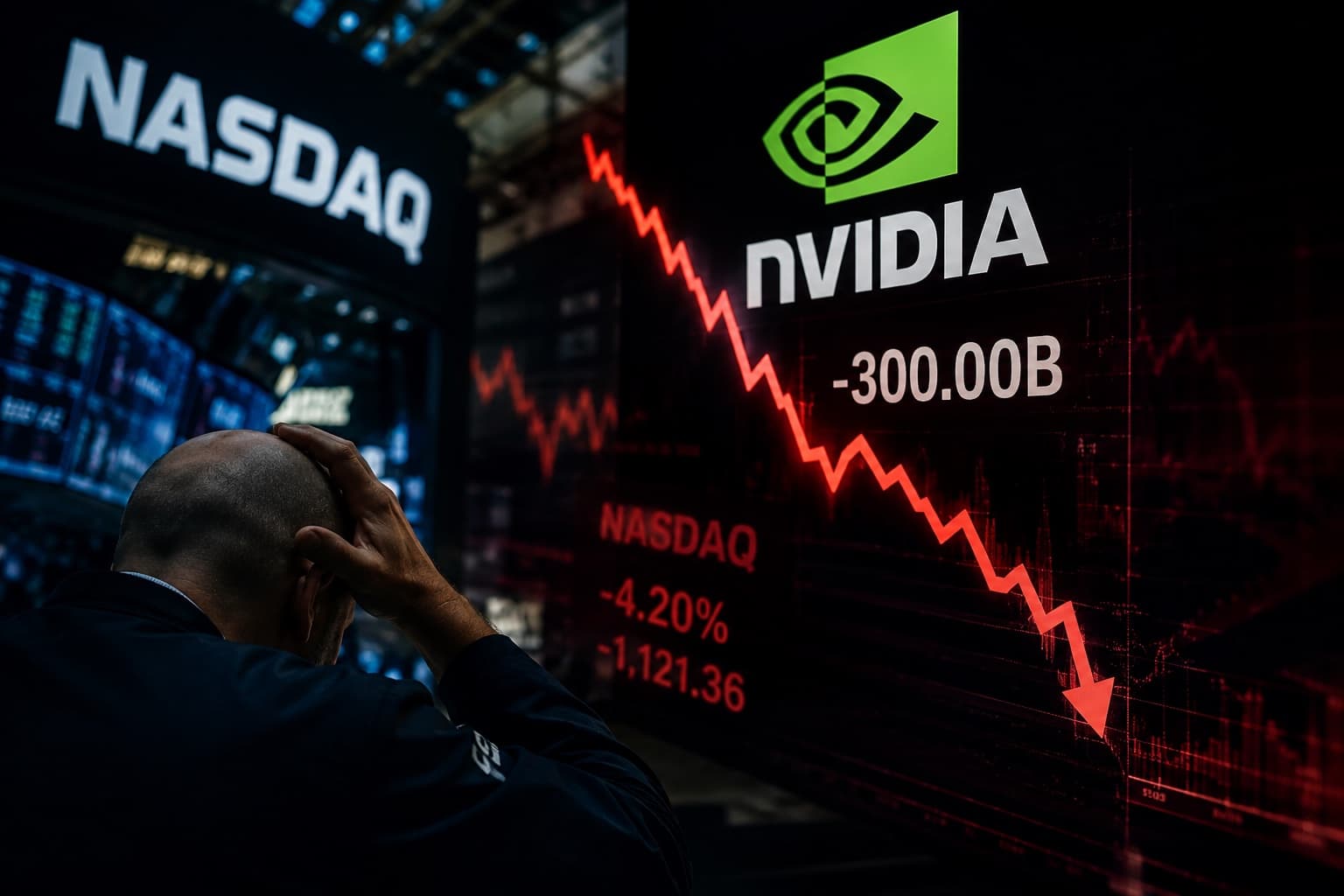
The Nasdaq plunged 4.2%, losing more than 1,100 points in a single session. Semiconductor companies collectively lost approximately $1.3 trillion in market value, while AI leader Nvidia alone saw more than $300 billion wiped from its market capitalization. The Philadelphia Semiconductor Index suffered its worst one-day decline since March 2020.
Headlines immediately began comparing the situation to the dot-com bubble. Investors, founders, and analysts started asking whether the AI boom had finally hit a wall.
But is this really the beginning of an AI market collapse?
The answer is more complicated.
What Actually Triggered the Selloff?
The market reaction was not caused by a single event.
First, Broadcom’s latest earnings report failed to meet the extremely high expectations investors had built around AI demand. While AI revenue remained strong, growth projections were not enough to satisfy a market that had become accustomed to seemingly endless upside surprises.
Second, a stronger-than-expected U.S. jobs report increased fears that interest rates could remain higher for longer. High-growth technology companies tend to suffer when borrowing costs rise because future profits become less valuable in today’s dollars.
Third, investors have started questioning whether the unprecedented level of AI spending can continue forever.
That question may be the most important one.
The AI Spending Race Nobody Wants to Lose
Over the past two years, the world’s largest technology companies have entered an arms race unlike anything seen before.
Companies including Microsoft, Meta, Alphabet, Amazon, and others have committed hundreds of billions of dollars toward AI infrastructure, data centers, GPUs, networking equipment, and custom AI chips.
The competition is simple:
Whoever builds the most powerful AI infrastructure today may dominate the next decade.
The problem is that building AI infrastructure is incredibly expensive.
Some analysts estimate that global AI-related capital expenditures could exceed one trillion dollars over the next several years. Companies are pouring cash into massive data centers filled with Nvidia GPUs and specialized AI hardware.
The market is now beginning to ask whether these investments will generate enough revenue to justify their enormous costs.
Why Some Companies Are Selling Stock to Fund AI Expansion
One development that has caught Wall Street’s attention is the possibility that some technology companies may issue new shares to help finance AI expansion projects.
Reports suggesting additional equity financing for AI-related capital expenditure raised concerns among investors because issuing new shares can dilute existing shareholders.
For founders, this should sound familiar.
Many startups raise money because they need capital to grow faster than cash flow allows.
Today, some of the world’s largest companies are facing a similar challenge. The scale is simply much larger.
Building AI infrastructure requires billions of dollars before meaningful returns are realized. Investors are becoming more cautious about how those projects will be funded.
Nvidia’s $300 Billion Loss Sounds Worse Than It Is
One number dominated headlines:
Nvidia lost more than $300 billion in market value in a single day.
That figure is staggering.
For perspective, the amount erased from Nvidia’s market capitalization exceeds the total value of many global corporations.
However, context matters.
Nvidia had previously become one of the most valuable companies in the world because investors viewed it as the primary supplier powering the AI revolution. The company’s valuation had expanded dramatically due to expectations of years of explosive growth.
When expectations become extremely high, even minor disappointments can trigger major corrections.
A falling stock price does not automatically mean the underlying business is failing.
In fact, Nvidia remains one of the most profitable and strategically important companies in artificial intelligence.
Is This the AI Bubble Bursting?
The comparison to the dot-com bubble is understandable.
Both periods share several similarities:
- Massive investor excitement
- Sky-high valuations
- Rapid capital spending
- Fear of missing out
- Technology narratives dominating markets
However, there is one major difference.
Many AI companies are already generating substantial revenue and profits.
During the dot-com era, countless companies had little or no revenue.
Today’s AI leaders operate some of the largest and most profitable businesses in the world. Microsoft, Alphabet, Amazon, Nvidia, and Meta are not speculative startups. They are cash-generating giants.
That distinction matters.
While valuations may be adjusting, the underlying demand for AI services remains significant.
What Founders Should Learn From This
The AI selloff offers an important lesson for founders.
Markets often confuse innovation with unlimited growth.
Artificial intelligence is almost certainly transforming industries. That does not mean every AI investment will succeed or every AI company deserves unlimited valuation expansion.
The companies winning today are not necessarily the ones spending the most money.
They are the ones creating sustainable economic value.
For startup founders, the lesson is clear:
Build products customers are willing to pay for.
A great story can attract investment. A great business creates long-term value.
The Bottom Line
The recent AI Stock Market Crash fears are understandable after Nvidia lost more than $300 billion in value and semiconductor stocks erased roughly $1.3 trillion in market capitalization.
But the evidence does not yet suggest that artificial intelligence itself is collapsing.
What appears to be happening is a reassessment of expectations.
Wall Street spent two years assuming AI growth would continue at an almost perfect pace. The June 5 selloff was a reminder that even transformational technologies experience corrections.
The AI revolution may still be in its early stages.
The question investors are now asking is not whether AI will change the world.
The question is whether today’s valuations accurately reflect that future.
Related Articles on IMFounder
- Google’s $15 Billion AI Data Centre Raises Water Concerns in a Country Where over 600 Millions Already Face Water Stress
- The Shocking Cost of ChatGPT and Claude Inside Modern Companies
- 7 Explosive AI Updates in May 2026 That Will Shock Every Founder
- The Hidden Carbon and Water Crisis Behind Artificial Intelligence