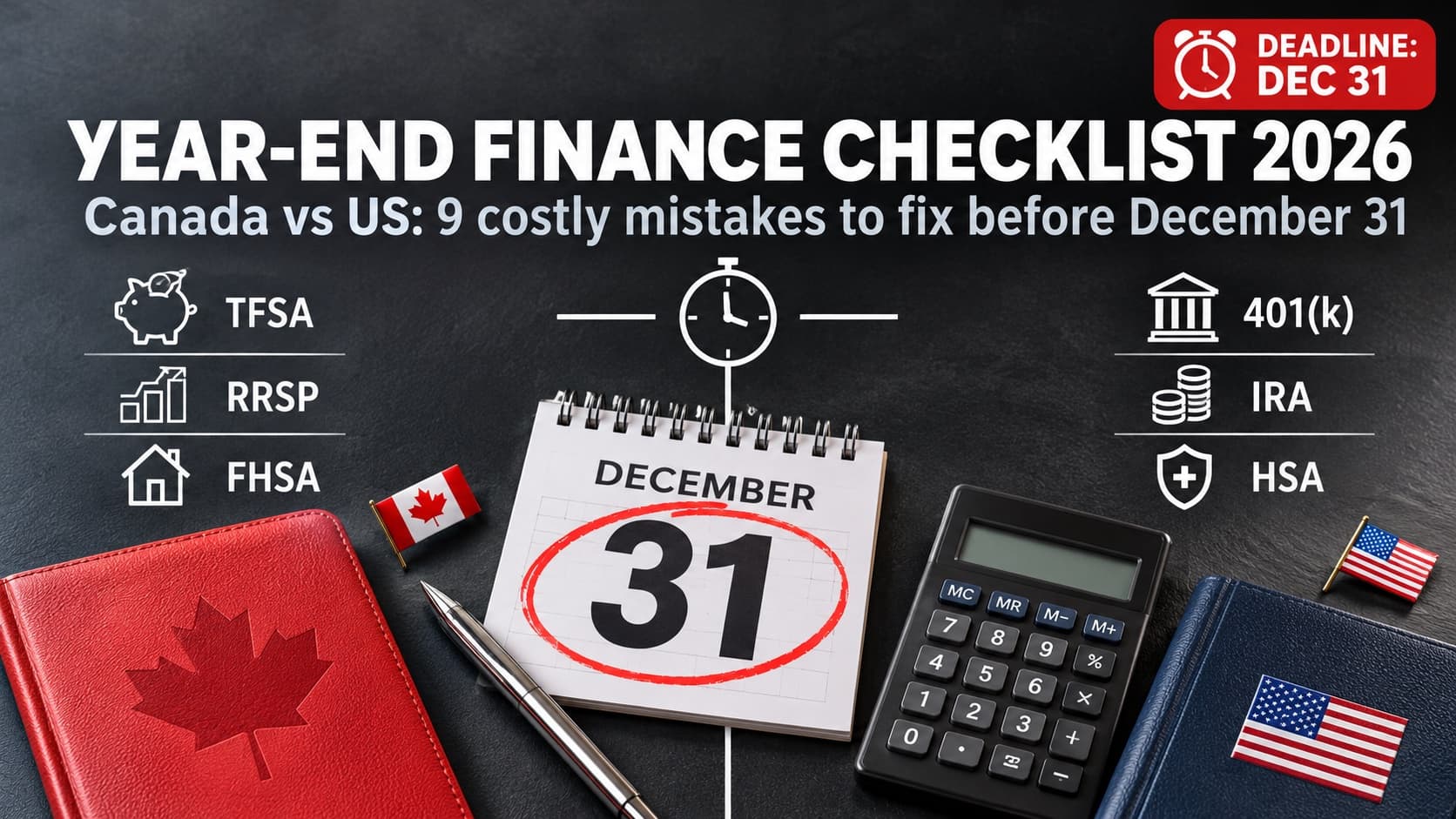

TFSA, RRSP and FHSA in Canada. 401(k), IRA, HSA and FSA in the US. One founder’s plan to keep more of what you earn.
A smart year-end finance checklist is the highest-return project you will run this quarter. It takes a few hours, needs no new software, and can recover thousands of dollars in tax savings, employer matches, and avoided penalties.
I treat my own money the way I treat a company. Every December, a good founder closes the books, finds the leaks, and uses every deadline before it expires. The catch is that Canada and the United States run on different calendars. A Canadian can make an RRSP contribution as late as March 1, 2027 and still count it toward 2026. An American 401(k) contribution is gone once the final paycheck of the year is processed.
This Canada vs US year-end finance checklist puts both systems side by side so you can see what to do now, what can wait, and which deadlines are hard. It works for employees, freelancers, and founders who pay themselves through their own company.
Read this first: every limit below is the 2026 figure, checked against government and advisor-published tables on November 4, 2026. This is education, not personalized tax advice. Confirm your own room and eligibility before you move money.
Why Every Founder Needs a Year-End Finance Checklist
Founders obsess over runway and margins, then leave their personal tax position to chance. That is expensive, because registered accounts follow a use-it-or-lose-it rhythm. Expired room never comes back, and a missed employer match is an instant pay cut.
A good year-end finance checklist works like a month-end close. You answer three questions: what must happen by December 31, what can wait until the filing deadline, and what to automate for next year.
The Year-End Finance Checklist at a Glance: Canada vs US
| Goal | Canada | United States |
|---|---|---|
| Tax-free growth | TFSA: $7,000 for 2026, no contribution deadline | Roth IRA: $7,500, income limits apply |
| Retirement deduction | RRSP: up to $33,810, deadline March 1, 2027 | 401(k): $24,500 by your last 2026 paycheck; Traditional IRA: $7,500 by April 15, 2027 |
| First home | FHSA: $8,000 a year, $40,000 lifetime, December 31 | No direct equivalent |
| Health spending | Mostly covered by public plans | HSA: $4,400 single, $8,750 family; health FSA: $3,400 |
| Education savings | RESP: 20% grant on the first $2,500, December 31 | 529 plan: rules vary by state |
| Charitable giving | Tax credit for gifts made by December 31 | Deduction for gifts made by December 31, with new 2026 rules |
Notice the pattern. Canada leans on a few flexible accounts. The US spreads its benefits across many employer-linked accounts with more hard deadlines. Neither is better. They simply demand different habits.
Year-End Finance Checklist for Canada: TFSA, RRSP and FHSA
Mistake 1: Treating the TFSA as a “Someday” Account
The 2026 TFSA dollar limit is $7,000, and a person who has been eligible since 2009 and never contributed has $109,000 in total room. There is no December 31 contribution deadline, so why does the TFSA belong on a year-end list?
First, withdrawals only restore room on January 1 of the following year. Put money back too soon and the CRA charges 1% per month on the excess. Second, room is personal. Check your actual number in CRA My Account instead of trusting memory or a banking app.
Founder tip: keep your personal emergency reserve here. It grows tax-free, and you can tap it during a slow quarter without creating a tax bill.
Mistake 2: Guessing Your RRSP Room
The CRA sets the 2026 RRSP dollar limit at $33,810. Your personal limit is 18% of your 2025 earned income up to that cap, minus any pension adjustment, plus unused room carried forward. The deadline to deduct a contribution on your 2026 return is March 1, 2027.
The mistake is not waiting for March. It is waiting without a number. Read your deduction limit now, then set a steady monthly amount, which beats a stressed lump sum in February.
Two guardrails apply. The CRA allows a $2,000 buffer over your limit, but anything beyond it costs 1% per month. And if you turn 71 this year, your RRSP must be closed or converted by December 31, so March is not your deadline at all.
Mistake 3: Missing the FHSA’s December 31 Cliff
The First Home Savings Account lets first-time buyers contribute $8,000 a year up to $40,000 lifetime. Contributions are deductible like an RRSP, and qualifying home withdrawals are tax-free like a TFSA. Unused annual room can carry forward, up to $8,000.
Unlike the RRSP, the FHSA has no 60-day grace window, so December 31 is your cutoff for a 2026 deduction. Room also starts accruing only once the account is open, so waiting costs you room. You can use an FHSA and the RRSP Home Buyers’ Plan on the same purchase.
Mistake 4: Leaving Free Money on the Table
If you have children, the RESP is the account where government adds to your deposit. The Canada Education Savings Grant matches 20% of the first $2,500 contributed per child each year, up to $500 of free money. Contribute before December 31 to claim this year’s grant.
Charitable giving also runs on the calendar year. Gifts made by December 31 can be claimed on your 2026 return, and unused receipts carry forward five years. The federal credit is 15% on the first $200 and 29% above that, rising to 33% on income taxed at the top federal rate, with a provincial credit on top. Spouses can pool receipts on one return. Donating publicly listed shares in kind can also eliminate the capital gain on them, which suits founders holding stock.
Year-End Finance Checklist for the US: 401(k), IRA, HSA and FSA
Mistake 5: Underfunding the 401(k) and Missing the Match
The 2026 limit for 401(k), 403(b), and most 457 plans is $24,500. Workers 50 and older can add an $8,000 catch-up, and those aged 60 to 63 get a higher $11,250. Starting in 2026, catch-up contributions for employees whose prior-year FICA wages exceeded $150,000 generally must be made as Roth.
The deadline is mechanical: the money must flow through payroll by your last paycheck of the year. Divide your remaining gap by your remaining pay periods and adjust now, because payroll changes can take a cycle or two. At minimum, capture the full employer match. It is part of your compensation.
I could not find an official IRS announcement of 2027 401(k) and IRA limits as of November 4. The IRS usually publishes them between late October and mid-November, so check before you set 2027 payroll elections.
Mistake 6: Ignoring the IRA Window and Roth Rules
The 2026 IRA limit is $7,500, plus a $1,100 catch-up at 50 and older. You have until April 15, 2027 to contribute for 2026. Roth IRA eligibility phases out between $153,000 and $168,000 for single filers and $242,000 to $252,000 for joint filers. Above that, ask a tax professional whether a backdoor Roth fits.
Two related moves have hard December 31 deadlines. A Roth conversion must be completed by year-end to count for 2026, so a lower-income year, such as an early-stage founder year with a modest salary, can be the cheapest time to convert. And if you are subject to required minimum distributions, generally starting at 73, the withdrawal is due by December 31 or you face a penalty tax. Your first RMD can wait until April 1 of the following year.
Mistake 7: Wasting Your HSA and FSA
These are the most underused benefits in the US system. An HSA requires a qualifying high-deductible health plan. The 2026 limits are $4,400 for self-only coverage and $8,750 for family coverage, plus $1,000 at 55 and older. You can contribute until April 15, 2027. The HSA is triple tax-advantaged: deductible going in, tax-free growth, tax-free withdrawals for qualified medical costs, and the balance never expires. The IRS has already set 2027 limits at $4,500 and $9,000. See IRS Publication 969 for the rules.
FSAs behave differently. The 2026 health FSA limit is $3,400, and the dependent care FSA now allows $7,500 for joint filers and single parents, up from $5,000. Many plans allow a carryover of up to $680, some offer a short grace period instead, and some offer neither. Read your plan document this month, because FSA balances are the closest thing in personal finance to a hard expiry date. Schedule the dental work, buy the eligible supplies, and reset your 2027 election during open enrollment.
Mistake 8: Giving to Charity Without a Strategy
The IRS charitable deduction rules changed in 2026. The standard deduction is $16,100 for single filers and $32,200 for joint filers, so most households never itemize. A new provision lets non-itemizers deduct up to $1,000 ($2,000 joint) in cash gifts to qualifying public charities, though donor-advised fund contributions do not qualify. Itemizers face a new floor: only giving above 0.5% of adjusted gross income is deductible, so at $200,000 of AGI the first $1,000 earns nothing.
Three moves follow. If you itemize and give regularly, consider bunching two years of gifts into one through a donor-advised fund, then take the standard deduction the next year. Give appreciated stock instead of cash to avoid the capital gain and deduct fair market value. And if you are 70½ or older, a qualified charitable distribution from your IRA can satisfy your RMD without being counted as income.
Founder Moves for Your Year-End Finance Checklist
Mistake 9: Paying Yourself in a Way That Starves Your Retirement Room
In Canada, RRSP room is 18% of earned income. Salary counts as earned income, while dividends do not, so a founder who pays only dividends can quietly stop creating new RRSP room. That is not automatically wrong, because dividends can be tax-efficient, but it should be a decision, not an accident. Run the numbers with your accountant before your corporation’s year-end.
In the US, self-employed founders have more room than employees. A Solo 401(k) lets you contribute as both employee ($24,500) and employer, up to the $72,000 overall limit for 2026, before catch-ups. A SEP IRA allows employer contributions of up to 25% of compensation, capped at $72,000, with a lower effective rate for sole proprietors. Plan-adoption deadlines differ by plan type, and recent law changes loosened some of them, so confirm with your provider before assuming you can wait.
Tax-Loss Harvesting: The Cross-Border Item on Your Year-End Finance Checklist
Both countries let investment losses offset gains. In the US, losses offset capital gains plus up to $3,000 of ordinary income a year, and the wash-sale rule blocks a repurchase within 30 days before or after the sale. Canada’s superficial loss rule works similarly and also catches repurchases by your spouse. Trades must settle by December 31, so the last practical trading day is often one or two business days earlier. Confirm your broker’s cutoff. Losses inside a TFSA, RRSP, 401(k), or IRA cannot be claimed, so harvest only in taxable accounts.
Cross-border warning: if you are a US citizen or green card holder living in Canada, or you move between the two countries, do not copy this year-end finance checklist blindly. The IRS generally does not treat a TFSA as tax-free, and the FHSA raises similar issues, while RRSP growth is generally tax-deferred under the Canada-US tax treaty. A cross-border tax professional costs far less than one avoidable mistake.
Your 30-Minute Year-End Finance Checklist Action Plan
If you are in Canada
- Confirm your TFSA room and RRSP limit in CRA My Account.
- Fund your FHSA and RESP by December 31.
- Make charitable gifts by December 31 and keep the receipts.
- Set an RRSP plan before March 1, 2027.
- Review your salary and dividend mix with your accountant.
If you are in the US
- Raise your 401(k) deferral so you reach your target by your last paycheck.
- Check your FSA balance, carryover, and grace-period rules.
- Decide on a Roth conversion and take any required minimum distribution.
- Plan charitable gifts around the new 2026 rules.
- Fund your IRA and HSA by April 15, 2027.
If you are in both worlds
- Harvest losses in taxable accounts only and avoid repurchases for 30 days.
- Book a cross-border tax consult before year-end.
- Set automatic 2027 contributions in January.
Print this year-end finance checklist, put the dates on your calendar, and finish it before December 15.
Year-End Finance Checklist FAQ
What Should Be on a Year-End Finance Checklist?
Contribution deadlines, tax-loss harvesting, charitable giving, benefit-plan balances, and next year’s automatic contributions. In Canada that means the TFSA, RRSP, FHSA, and RESP. In the US it means the 401(k), IRA, HSA, and FSA.
Is December 31 the Deadline for TFSA, RRSP, and FHSA Contributions?
Only for the FHSA. The TFSA has no contribution deadline, and RRSP contributions for 2026 can be made through March 1, 2027.
Can I Contribute to an IRA or HSA After December 31?
Yes. Contributions for 2026 are allowed until April 15, 2027. 401(k) deferrals must go through payroll by year-end.
Which Country Has Stricter Year-End Deadlines?
The US has more hard deadlines because of 401(k) payroll cutoffs, FSA expiries, and RMDs. Canada has fewer, but the FHSA, RESP, and donation deadlines are just as firm.
Final Thoughts
The best year-end finance checklist is the one you finish. Pick the three items with the biggest dollar impact for your situation, do them this week, and schedule the rest. Treat December like a company close: reconcile, fix the leaks, and set next year’s budget on autopilot. Then spend the holidays knowing your money is already working.
This article is educational and not tax, legal, or investment advice. Limits and rules change, so confirm with the CRA, the IRS, or a qualified professional.
Sources for this year-end finance checklist: CRA TFSA, RRSP and FHSA limits · CRA First Home Savings Account · IRS 401(k) contribution limits · IRS Publication 969 · IRS charitable contributions
Related Articles on IMFounder
- What Seed Investors Really Want From Technical Founders
- SR&ED Tax Credits: Free Money Canadian Founders Are Missing in 2026
- 5 Powerful Startups You Can Launch With Only $1,000
- The Complete Guide to Starting an AI Startup in Canada
- How to Get Funding & Grants for Your Startup in Canada
- Top 5 Grants for Women Entrepreneurs in Canada
- Top Incubators and Accelerators to Know in 2026 in Canada and the United States