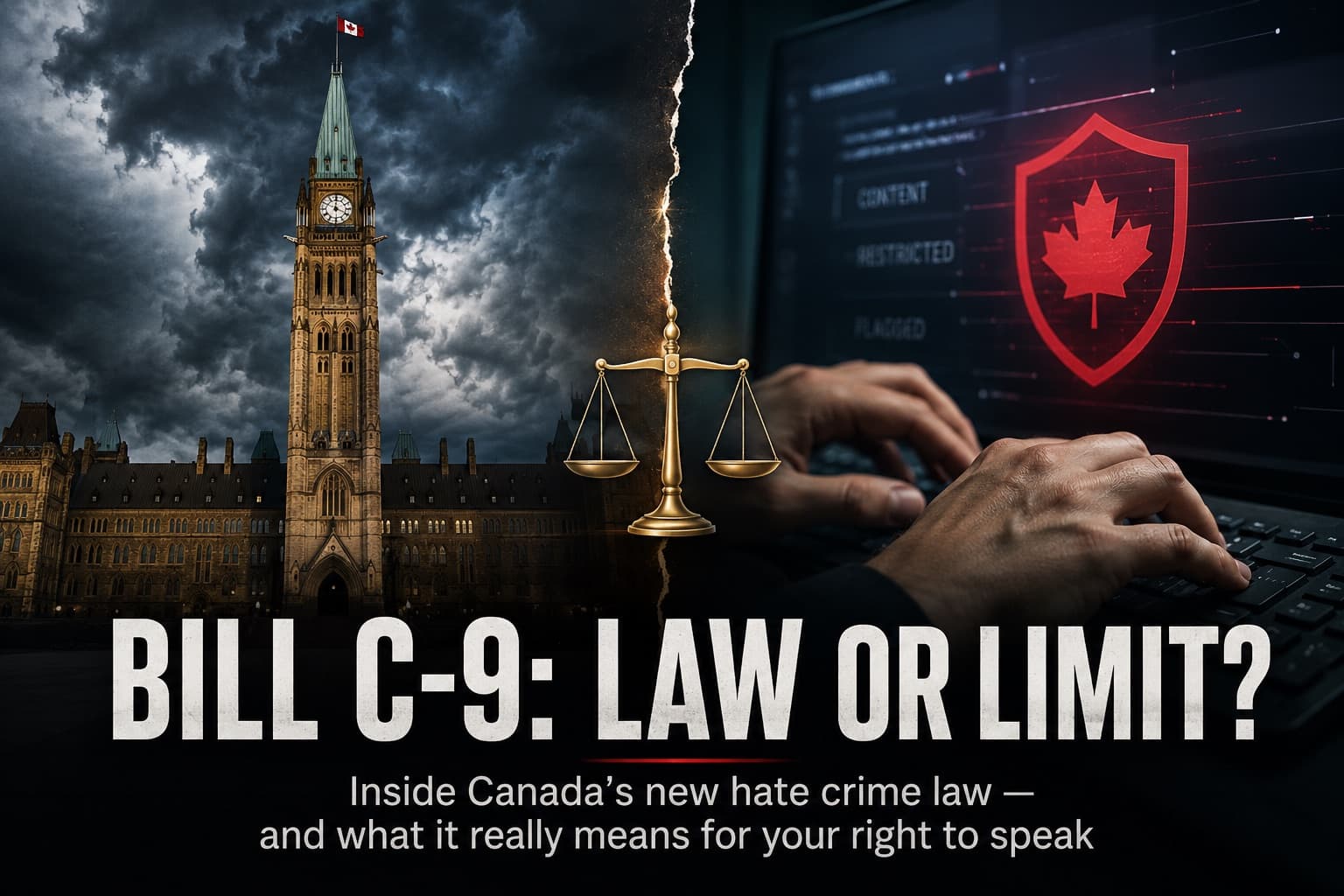

Bill C-9 Canada is now the law of the land — and it has triggered one of the loudest free-expression debates the country has seen in years. Officially called the Combatting Hate Act, the bill received Royal Assent on June 18, 2026, and its provisions came into force on July 18, 2026. But between the headlines, the petitions, and the viral social media claims, a lot of Canadians are asking the same blunt question: does Bill C-9 mean you can no longer speak freely online, the way many say has happened in the UK?
The short answer is no — but the longer answer is more nuanced, and worth understanding properly before you accept either the panic or the reassurance at face value.
What Bill C-9 Actually Does
Bill C-9 amends the Criminal Code, not any internet or platform regulation framework. The bill creates a new offence for crimes motivated by hatred, a new prohibition on promoting hatred through the display of certain terrorism and hate symbols, and new offences around intimidation or obstruction of access to places of worship and similar community spaces.
A few concrete changes stand out:
- A new hate-motivated crime offence, applied when an existing offence is proven to be motivated by hatred toward an identifiable group.
- A ban on displaying certain hate and terrorism symbols — such as swastikas, nooses, or flags tied to listed terrorist entities — when done with intent to promote hatred in public, with context playing a key role in enforcement.
- A new intimidation and obstruction offence, targeting people who block or threaten others trying to access a religious or cultural institution, punishable by up to 10 years in prison for the most serious cases.
- A statutory definition of “hatred,” which the Senate clarified as an intense and extreme emotion clearly tied to vilification and detestation — deliberately excluding speech that merely discredits, humiliates, hurts, or offends.
Importantly, the hate-propaganda sections Bill C-9 touches — sections 319(1) and 319(2) of the Criminal Code — already existed before this bill. They’ve made it illegal since long before C-9 to publicly incite hatred likely to cause a breach of the peace, or to wilfully promote hatred against an identifiable group outside of private conversation. Bill C-9 clarifies and tightens definitions within that existing framework; it does not create a brand-new internet censorship regime.
Is Bill C-9 Canada’s Version of the UK’s Online Safety Act? No.
This is the biggest misconception surrounding Bill C-9 Canada, and it deserves a direct answer: Bill C-9 is not an online speech law in the way the UK’s Online Safety Act is.
The UK law places legal duties directly on tech platforms — forcing them to actively moderate, filter, and remove content under threat of massive fines. Bill C-9 does none of that. It is a Criminal Code amendment aimed at individual conduct — hate-motivated crimes, symbol displays, and intimidation at religious or community sites — enforced the same way any criminal charge is: through police investigation, Crown prosecution, and the courts. There’s no new government body monitoring your posts, no platform-takedown mandate, and no algorithmic content-scanning requirement attached to this bill.
That said, it’s fair to note some existing hate-propaganda offences under section 319 can apply to statements made publicly online, since they’ve never been restricted to in-person speech. Legal commentators have pointed out this isn’t new ground created by C-9 — it flows from offences that already existed and applied wherever hatred was wilfully promoted outside private conversation, whether that happened on a street corner or a social media post. So while Bill C-9 doesn’t build a UK-style content-moderation machine, it does operate within a legal environment where online hate speech was already prosecutable — a distinction worth understanding rather than collapsing into “Canada banned free speech online.”
The Case For Bill C-9 (Pros)
Supporters, including the governing Liberal party, argue the bill closes real gaps. A Parliamentary Secretary described it in the House of Commons as measured, targeted legislation designed to protect Canadians from hate, intimidation and violence while fully respecting the Charter of Rights and Freedoms. Advocates point to:
- Clearer legal thresholds. A standardized definition of “hatred” is meant to give police and prosecutors more consistent guidance, reducing arbitrary application of the law.
- Direct protection for worshippers. The intimidation and obstruction offence responds to real incidents of protestors or harassers blocking access to synagogues, mosques, and churches.
- A response to rising hate crimes. The Justice Department framed the bill as addressing growing antisemitism, Islamophobia, homophobia and transphobia that have left communities feeling unsafe.
The Case Against Bill C-9 (Cons)
Critics span a surprisingly wide political and religious spectrum, and their concerns are substantive rather than fringe.
- Removal of the “good faith” religious defence. Bill C-9 repealed a decades-old Criminal Code defence that protected sincerely held religious opinion from hate-propaganda charges. The Bloc Québécois and Liberals worked together in the House to repeal this section, prompting warnings from pro-life and faith groups that peaceful religious expression could face new legal risk.
- Vague or “circular” definitions. Even the added clarifying language faced pushback. Critics argued the amended wording was circular — stating that religious communication isn’t hate propaganda unless it wilfully promotes hatred — without genuinely resolving the ambiguity.
- Redundancy concerns. Some legal observers noted the new intimidation offence largely duplicates existing Criminal Code protections, just carrying a longer maximum sentence — 10 years instead of five.
- The NDP’s opposite critique. Interestingly, criticism didn’t only come from the right. The NDP argued the bill neglects white nationalist violence entirely and questioned whether harsher sentences actually deter hate crimes, favouring prevention and social investment instead.
Common Misconceptions About Bill C-9
- “Bill C-9 bans criticizing religion or ideology.” False. The bill explicitly states that discrediting, humiliating, hurting, or offending someone does not meet the legal threshold for hatred — the bar remains “extreme” vilification or detestation.
- “Canadians can be arrested for private conversations.” False. The underlying hate propaganda offences have always excluded private conversation; that hasn’t changed.
- “This is Canada’s Online Safety Act.” False, as outlined above — there’s no platform-moderation mandate in Bill C-9.
- “Hate crime charges can be laid instantly by any officer.” False. Hate crime charges under the bill require the consent of a provincial attorney general before they can proceed, which is meant to prevent hasty or politically motivated charges by local police.
So, Can Canadians Still Speak Freely Online?
Yes — the vast majority of online expression, including sharp political criticism, religious commentary, and controversial opinions, remains fully legal under Bill C-9. What changed is narrower and more specific: symbol displays intended to promote hatred, hate-motivated criminal conduct, and intimidation at religious or cultural sites now carry clearer definitions and, in some cases, harsher penalties. The removal of the religious good-faith defence is the most legitimately contested change, and it’s worth watching how courts interpret it in practice over the coming months.
Bill C-9 is neither the speech apocalypse some warn of, nor the uncomplicated safety measure its supporters describe. It sits, as most contested legislation does, somewhere in between — and understanding that middle ground matters more than any viral headline.
Related Articles on IMFounder
- Canada’s Bill C-12 Becomes Law: A Turning Point for Immigration
- Canada Startup Visa 2026: Shocking Truth for 43,000 Trapped Founders
- The Dark Truth Behind Canada’s International Student Explosion
- Canada’s Start-up Visa Program Backlog: How IRCC Is Responding as Founders
- The New Immigration Backlash: What’s Driving the Anti-Immigration Wave
Sources:
- Department of Justice Canada — Combatting Hate Act announcement
- LEGISinfo — Bill C-9 official bill tracker, Parliament of Canada
- Canadian Constitution Foundation — Bill C-9 explainer
- openparliament.ca — Bill C-9 debate transcripts