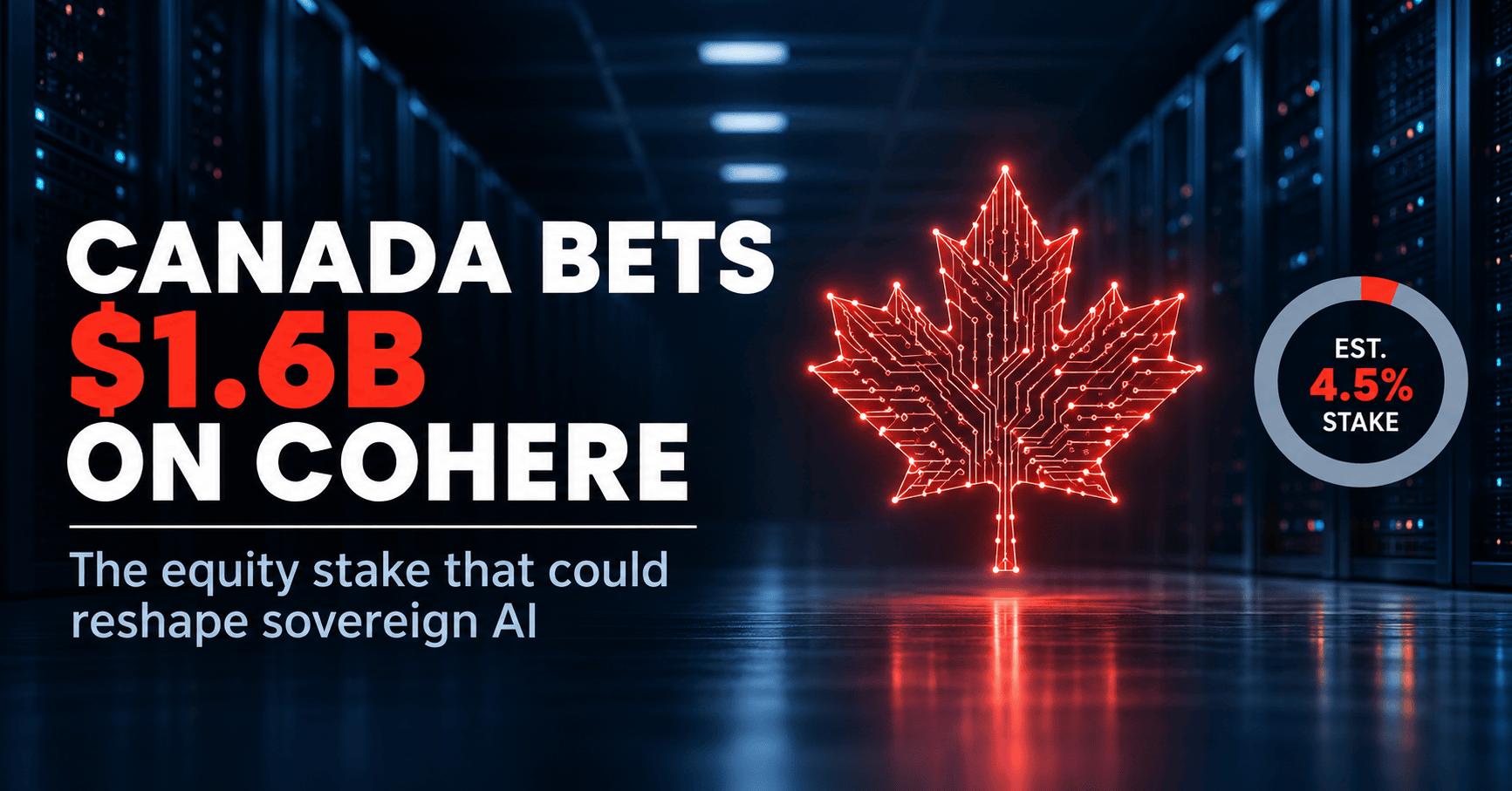

The Canada Cohere investment is the boldest technology bet Ottawa has ever placed: up to $1.6 billion, paid in stages, in exchange for a stake in the Toronto-founded AI company. Prime Minister Mark Carney announced it in Montréal on October 29, 2026, and it is a commercial equity deal, not a grant. BetaKit’s reporting indicates it is likely the largest single government equity commitment ever made to a Canadian tech company.
The deal raises three questions that every founder, investor, taxpayer and IT leader is asking: how much of Cohere does Canada actually own, why would a government buy into a private AI lab, and is it a smart use of public money? This guide answers all three with verified facts, simple math and the sharpest expert opinions from both sides.
Canada Cohere Investment at a Glance: The Key Facts
- Amount: Up to $1.6 billion (Canadian dollars), structured as equity on a commercial basis, according to the Prime Minister’s Office.
- Announced: October 29, 2026, in Montréal, by Prime Minister Mark Carney.
- Payment structure: Made in stages, with regular reporting on Cohere’s progress against its commitments. The money is negotiated through the Canada Development Investment Corporation, a Crown corporation that manages government assets, Reuters reported.
- The funding round: Part of a Series E raising up to $7 billion at a $35.7 billion valuation, led by Germany’s Schwarz Group. The Logic reports that Bell Ventures, Bullhound Capital and the Government of Canada are new investors, joining returning backers Inovia Capital, Nvidia and Prosperity7 Ventures.
- Cohere’s promises: At least 1,000 new Canadian technical jobs and at least $1.7 billion in additional Canadian computing infrastructure by 2030, while staying incorporated and headquartered in Canada.
- Stake size: Not disclosed. Our estimate is roughly 4.5%, explained below.
How Much Equity Does the Canada Cohere Investment Buy?
Neither Ottawa nor Cohere has disclosed what percentage of the company the government will own. Reuters reported that the size and terms of the stake were not revealed beyond the $1.6 billion ceiling, and CTV News confirms the government has not said what share it will gain.
Here is the simple math. Divide $1.6 billion by the round’s $35.7 billion valuation and you get roughly 4.5%. Sovereign Magazine and The Hub’s Charles Lammam land on the same figure. Treat it as an estimate rather than an official number, because three caveats apply:
- “Up to” matters. The $1.6 billion is a ceiling paid in stages. If every tranche is not released, the final stake will be smaller.
- The terms are private. Price per share, share class and shareholder rights have not been published, and all of them change what a dollar amount really buys.
- The round is still filling. Cohere has not yet raised the full $7 billion and has not said how much investors have committed so far, according to The Logic. The final percentage depends on how much of the round closes.
Two more numbers add context. Ottawa’s cheque equals about 23% of the $7 billion target. And Cohere’s pledge to spend at least $1.7 billion on Canadian computing is slightly larger than the federal investment, so one fair reading is that Ottawa is co-investing alongside a private build-out rather than bankrolling it.
What about control? AI Minister Evan Solomon says the stake gives Canadians a “seat at the table”. But the government’s announcement does not spell out board seats or special shareholder rights, which is why critics question how much influence about 4.5% really buys.
This is also not Ottawa’s first cheque. The government earlier committed up to $240 million toward a $725 million projectto secure computing capacity at a CoreWeave data centre in Cambridge, Ontario, and Crown corporations BDC Capital and Export Development Canada are already Cohere investors.
Why Is Ottawa Backing Cohere? The Strategy Behind the Canada Cohere Investment
Four ideas sit behind the Canada Cohere investment.
1. Sovereignty over a critical technology. Carney calls the deal “an investment in choice, in security” and argues that real sovereignty means being able to build, adopt and govern AI on Canada’s own terms. He warned that the most powerful systems sit with “a very small number of companies, in a very small number of countries,” a concentration he says carries risks to cost, resilience and sovereignty.
2. Control over sensitive data. Cohere sells to governments and heavily regulated industries such as banking, health care and defence, and its technology can run on customers’ own systems so they keep control of sensitive information. Solomon says that should keep Canadians’ data stored in Canada under Canadian law.
3. Insurance against geopolitical pressure. Both the United States and China have used tariffs to pressure Canada and Europe, and analysts quoted by CTV say a credible homegrown option reduces the risk of either country using AI as leverage. Cohere’s tie-up with Germany’s Aleph Alpha extends that logic across the Atlantic by offering an alternative to US tech giants and Chinese AI developers.
4. Keeping winners at home. Carney argued that Canada has too often funded research whose commercial rewards ended up elsewhere. Solomon put it plainly: founders should not have to leave Canada to build a company that succeeds globally. The headquarters and incorporation commitments are how the government plans to hold that line.
Why equity instead of a grant? Jaxson Khan, who worked on the federal Sovereign AI Compute Strategy, wrote that “Grants can buy time but not always effectively build long-term capacity”. With shares, the government says, Canadians share in the upside if Cohere succeeds.
Benefits of the Canada Cohere Investment for Canadians
Supporters say the Canada Cohere investment pays off in seven concrete ways:
- Jobs. Cohere must create at least 1,000 high-paying Canadian technical jobs by 2030. In an update a day later, the company said it expects more than 1,500 Canada-based roles and over $4 billion in R&D and AI infrastructure spending through 2031. Those figures are not directly comparable, so do not add them together.
- Computing power at home. At least $1.7 billion in new Canadian computing infrastructure by 2030 builds local capacity to train and run advanced models.
- A company that stays Canadian. Cohere agreed to keep its Canadian incorporation and headquarters.
- Taxpayer upside. As a shareholder, Canada benefits if Cohere’s value grows, which a grant could never deliver.
- Research and talent. The deal includes research partnerships in Canada, opportunities for students and recent graduates, and continued work with the Canadian AI Safety Institute.
- Built-in accountability. Payments come in stages with regular reporting. Cohere’s chief financial officer told The Globe and Mail that funding depends on hitting hiring and infrastructure commitments.
- Business momentum. Cohere says annual recurring revenue grew 165% year over year at the end of the third quarter and that its customer base reached 300 companies, up twentyfold in a year, including RBC, Bell, TD Bank and Fujitsu. These figures are company-reported.
What Experts Say About the Canada Cohere Investment
Reaction to the Canada Cohere investment has split into two camps: those who see a long-overdue move to back a Canadian champion, and those who ask why taxpayers are funding a company already attracting billions in private money.
Experts who back the deal
- Jaxson Khan, CEO of Aperture AI and University of Toronto senior fellow: He argues equity builds lasting commercial advantage in a way grants often cannot.
- Sean Mullin, senior fellow at the Munk School: He told CTV that frontier models could be used for both defensive and offensive cybersecurity, so it matters who controls them. Cohere will not replace US tech giants, he said, but Canada and Europe need options.
- Chris Arsenault, partner at Inovia: He says the stake helps position Cohere for sovereignty-focused partnerships with other countries. Inovia has invested more than US$100 million in Cohere, so he is not a neutral observer.
- Cohere’s leadership: CEO Aidan Gomez calls Cohere “the largest AI company outside the United States and China,” a self-assessment. The Logic places it in a small group of frontier-model developers alongside OpenAI, Anthropic and Mistral. CFO François Chadwick said Canada “needs to be there at the forefront.”
- Market analysts: Finimize reads the stake as an early signal of alignment that could ease approvals and pull forward multi-year contracts in regulated sectors.
Experts who question the deal
- Charles Lammam, economic policy professional, writing in The Hub: He discloses his bias up front, calling the move “a totally inappropriate role for government.” His case: a company backed by Schwarz Group, Nvidia and an arm of Saudi Aramco hardly needs a federal co-signer, roughly 4.5% hands Ottawa little control, taxpayers carry the risk because the funding is debt-financed, and the precedent encourages industry groups to ask government for handouts.
- Keith Jansa, CEO of the Digital Governance Council: He welcomes treating AI as critical infrastructure but warns that building models at home does not by itself give control over the infrastructure, data and conditions they run under. What matters, he says, is whether Canadian organizations can choose technologies and switch providers without being locked in.
- Industry benchmarks: The Globe and Mail reports that Cohere’s models significantly lag those of OpenAI and Anthropic on key capabilities such as coding and cybersecurity, according to industry technical rankings.
- The funding gap: OpenAI announced a US$122 billion raise at a US$852 billion valuation in March, and Anthropic raised US$65 billion at a US$965 billion valuation in May, The Logic reports. Cohere’s founders counter that business customers often pay for their own computing, so Cohere needs less capital than the US labs.
Risks and Open Questions Around the Canada Cohere Investment
Even supporters concede the deal carries real uncertainty:
- Undisclosed terms. Until the share class, board rights and exact stake are public, the true value and influence of the Canada Cohere investment remain unclear.
- A tough race. Cohere competes against rivals with far deeper pockets and, per current rankings, stronger models in some areas.
- Taxpayer exposure. If Cohere stumbles, the government owns that outcome. Analysts also ask whether Ottawa can be both an investor in the sector and its regulator.
- A precedent. Solomon told BetaKit this will not be the last equity stake, and a forthcoming Canadian Tech Growth Fund is designed to take equity positions.
- Ownership is not the same as sovereignty. As Jansa notes, control also depends on infrastructure, data and the freedom to switch vendors.
What the Canada Cohere Investment Means for Businesses and Developers
- Regulated industries: Banks, insurers, health systems and public bodies now have a better-funded domestic option. Ask any vendor about data residency, deployment choices and who can access your data.
- Test before you trust the flag: Benchmark models on your own use case. A national label does not guarantee the best performance for coding, search or agents.
- Protect your exit: Design systems so you can swap models, which echoes Jansa’s lock-in warning.
- Watch the milestones: Staged payments, progress reporting, the final close of the Series E and new model releases will show whether the strategy is working.
- Investors: Cohere is private, so there is no public stock to buy, and nothing here is financial advice.
Final Verdict: Is the Canada Cohere Investment a Smart Bet?
The Canada Cohere investment is best understood as a strategic option, not a guaranteed win. Supporters can point to staged payments, binding commitments on jobs and computing, a real equity upside and private co-investors who priced the company at $35.7 billion. Critics can point to a small estimated stake, a company that was already raising money privately, a capability gap with the biggest US labs and the risk that public money chases a moving target.
Both views can be true at once. The real test arrives by 2030, when Cohere’s jobs, infrastructure and headquarters commitments come due, and when the final shape of the Canada Cohere investment becomes clear. Until then, watch the disclosures, not the headlines. This story is still developing, so check back for updates.
Canada Cohere Investment FAQs
How much is the Canada Cohere investment worth?
Up to $1.6 billion in Canadian dollars, paid in stages as an equity investment on commercial terms.
What percentage of Cohere does Canada own?
The government has not disclosed the stake. At the round’s $35.7 billion valuation, the full $1.6 billion would equal roughly 4.5%, though the real figure may differ.
Is the Canada Cohere investment a grant?
No. Ottawa is buying shares and will share in Cohere’s growth. The earlier $240 million for computing capacity was a separate commitment.
Can I buy Cohere shares?
Not on a stock exchange. Cohere is a private company and has not announced a public listing.
Sources:
The Prime Minister’s Office announcement, Cohere’s Series E announcement, The Logic, BetaKit, CTV News via BNN Bloomberg and The Hub.