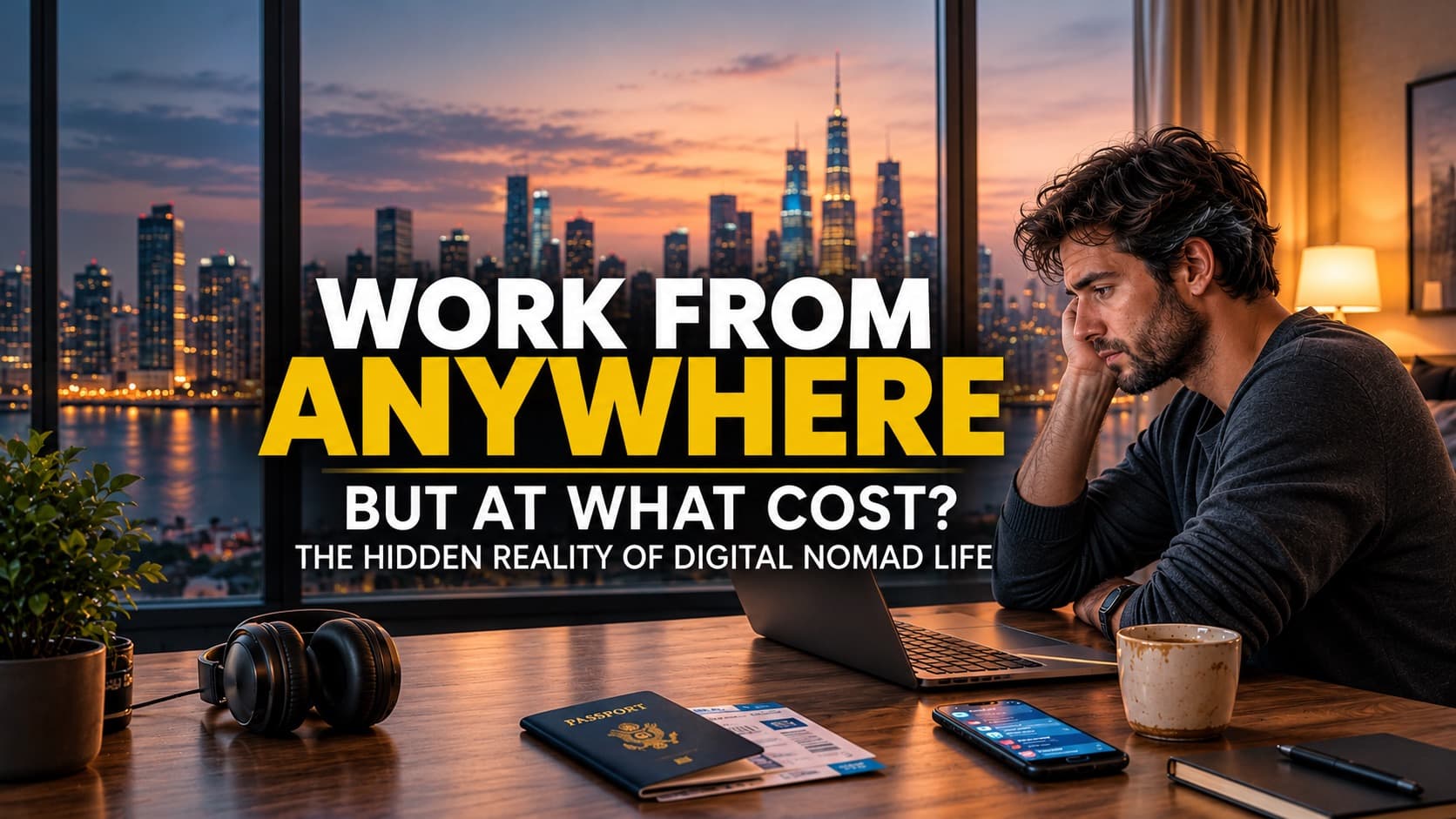

The freedom to work from anywhere comes with a price few Instagram posts reveal. Behind the beautiful destinations are financial pressures, isolation, legal complications and the constant challenge of finding somewhere productive to work.
Introduction: The dream of working from anywhere
Digital nomad life has become one of the most attractive ideas in the modern world of work. Imagine opening your laptop overlooking the Mediterranean, answering emails from a café in Bali or attending a video conference from a mountain town in Switzerland.
No daily commute. No traditional office. No geographical boundaries.
For millions of professionals, entrepreneurs, freelancers and remote employees, this is no longer just a fantasy. Technology has made it possible to earn a living while moving between countries, cities and cultures.
But there is another side to the story.
Behind the carefully curated photographs of beachside laptops and beautiful apartments lies a lifestyle that can involve unpredictable expenses, immigration complications, professional isolation, unstable routines and an exhausting search for reliable places to work.
The question is no longer whether you can work from anywhere. It is whether you can build a sustainable life while doing it.
The digital nomad movement deserves a closer look, not because the idea is flawed, but because understanding its realities is essential before making the leap.
1. The digital nomad life is not as financially free as it looks
One of the biggest misconceptions about location-independent work is that travelling to cheaper destinations automatically means spending less.
In reality, frequent movement can become surprisingly expensive.
Flights, accommodation deposits, travel insurance, international banking charges, transportation, visas, coworking memberships and unexpected medical expenses can quickly consume an otherwise comfortable income.
There is also a fundamental difference between living somewhere and travelling through it.
A person renting an apartment for six months may negotiate a significantly better arrangement than someone constantly booking short-term accommodation. Similarly, eating out every day in tourist destinations is rarely a sustainable financial strategy.
Income uncertainty makes matters worse.
Freelancers and independent consultants may experience inconsistent client payments, seasonal demand and gaps between contracts. Unlike traditional employees, they might not have paid leave, employer-sponsored health insurance or predictable monthly earnings.
The 2025 MBO Partners Digital Nomads report identified financial stress as one of the reported challenges, affecting 26% of surveyed digital nomads.
The lesson is straightforward: geographical freedom does not automatically create financial freedom.
A sustainable digital nomad lifestyle requires an emergency fund, reliable income, realistic budgeting and a clear understanding of the actual cost of living in each destination.
2. Loneliness can become the hidden cost of constant travel
Travelling introduces people to new cultures, communities and experiences. However, constantly leaving places can make it difficult to develop meaningful relationships.
You might meet interesting people at a café, make friends at a coworking space or connect with other travellers during a weekend excursion. But when everyone is moving, maintaining those relationships becomes difficult.
The problem extends beyond friendships.
Being away from family, partners and established support networks can create emotional pressure that is difficult to appreciate before experiencing it. According to the 2025 MBO Partners research, 26% of digital nomads identified being away from family and friends as a challenge, while 19% reported loneliness. This is particularly relevant for people who have children, ageing parents or responsibilities that cannot simply be packed into a suitcase.
A beautiful destination cannot replace emotional stability.
Digital nomadism works best when people deliberately build community into their routines rather than treating social connections as something that will happen automatically.
Staying longer in one location, joining professional communities and maintaining regular contact with family can make a significant difference.
3. Working from anywhere does not mean working from everywhere
Perhaps the biggest disconnect between the digital nomad fantasy and reality is the assumption that every location is suitable for productive work.
A beach may be wonderful for a holiday, but it is rarely an ideal place for a client presentation.
A hotel room may offer privacy, but it might have unreliable Wi-Fi, uncomfortable furniture or insufficient space for a full working day.
A café can provide an enjoyable atmosphere, but background noise, limited seating, power availability and pressure to keep purchasing refreshments can make extended working sessions impractical.
Professional work requires more than an internet connection.
It requires a comfortable chair, a suitable desk, dependable connectivity, privacy, electricity and an environment where concentration is possible.
This is where the distinction between travelling and working while travelling becomes important.
A growing number of remote professionals are discovering the value of flexible workspaces. Instead of depending entirely on accommodation or cafés, they can use coworking spaces, private offices, meeting rooms and other professional environments when the situation demands it.
For people travelling across Canada, Kangrooo offers a marketplace for discovering coworking and event spaces, meeting rooms and other flexible physical spaces.
Whether someone needs a desk for a focused workday, a private room for an important client call or a venue for a professional gathering, having access to suitable spaces can make location-independent work more practical.
The important point is that freedom should include the ability to choose the right working environment, not simply the freedom to change your background.
4. Visa, immigration and tax rules can complicate everything
This is one of the least discussed aspects of digital nomadism, particularly in social media conversations.
Being able to enter a country as a tourist does not necessarily mean you are legally permitted to work remotely from there. Countries have different immigration regulations, and the rules governing remote work, employment, business activities and permitted length of stay can vary considerably. Digital nomad visas have emerged as one response to this challenge. Several countries now offer specific immigration pathways for qualifying remote employees, freelancers and business owners.
However, obtaining a visa is only one part of the equation.
Tax residency, social security contributions, employment regulations and potential corporate tax obligations can create additional complications.
The OECD’s November 2025 Model Tax Convention update provides additional guidance on cross-border remote working and when an employee working from another country could create a taxable presence for an employer. Its May 2026 explanation highlights why the circumstances of remote work matter, rather than assuming every temporary overseas working arrangement creates the same tax consequences.
For employees, an employer’s approval is also essential. Some organisations restrict international remote working because of regulatory, security and data protection obligations.
Before relocating, digital nomads should investigate:
- Whether their immigration status permits their intended working activities.
- Whether they need a digital nomad visa or another appropriate permit.
- How long they can legally remain in the destination.
- Whether their income creates local or home-country tax obligations.
- Whether their employer permits international remote working.
- Whether their health and travel insurance covers their circumstances.
Professional tax and immigration advice is worth the expense. An attractive destination can become an expensive mistake if the legal arrangements are overlooked.
5. Time zones can turn flexibility into an exhausting routine
Working remotely across different time zones sounds manageable until professional responsibilities start dictating your daily schedule.
Consider someone employed by a company in Toronto but spending several months in Southeast Asia.
Their colleagues may start work while it is already evening at their destination. Important meetings might take place late at night, while client calls interrupt what would otherwise be personal time.
The result is a working day that can stretch far beyond conventional office hours.
The challenge is not limited to employees. Freelancers working with international clients face similar pressures when they attempt to remain available across multiple markets.
Over time, irregular sleep patterns, missed social activities and constant notifications can undermine the very lifestyle they wanted to create.
The 2025 MBO Partners research identified working across time zones as a challenge for 21% of surveyed digital nomads.
The solution is not necessarily to become available around the clock. Successful remote professionals establish communication windows, agree on response expectations and prioritise asynchronous collaboration wherever possible. Location independence should give people greater control over their time, not eliminate the boundaries that protect it.
6. Travel burnout is real, and constant movement has a price
There is a difference between enjoying travel and continuously organising your life around it.
Every move requires decisions: accommodation, transportation, connectivity, local transportation, groceries, banking, laundry and unfamiliar surroundings.
Even relatively simple tasks become more complicated when repeated in different countries. Then comes the pressure to make every destination worthwhile. Digital nomads can feel compelled to explore, take photographs, meet people and experience everything while simultaneously maintaining professional responsibilities. This creates an unusual contradiction: a lifestyle designed around freedom can become another demanding schedule.
The 2025 MBO Partners report found that 23% of surveyed digital nomads identified travel burnout as a challenge.
An increasingly sensible alternative is slow travel.
Instead of visiting six destinations in six weeks, professionals can spend two or three months in one location. This reduces transportation costs, allows routines to develop and creates more opportunities to build genuine relationships. The objective should not be to visit as many places as possible. It should be to experience a place without sacrificing the stability needed to work and live well.
7. The digital nomad lifestyle is not equally suitable for everyone
The lifestyle is often presented as a universal upgrade to conventional employment. That is misleading.
A single freelancer with established clients and flexible working hours has very different requirements from a parent travelling with children, a professional managing a large team or someone supporting family members back home.
Healthcare access, education, accessibility, accommodation security and proximity to family can all influence whether frequent international movement is practical.
There are also professionals who simply perform better with a stable home, familiar surroundings and consistent face-to-face interaction.
None of these preferences makes someone less ambitious or less adaptable. In fact, choosing stability over constant movement can be a rational decision.
The future of work should not be defined by whether people travel continuously. It should be defined by whether they have meaningful control over where, when and how they work.
For some, that means living internationally. For others, it means working remotely from their home city and occasionally renting a professional workspace in another neighbourhood.
Both are legitimate expressions of workplace flexibility.
The smarter alternative: Build a flexible working lifestyle, not a permanent holiday
The most sustainable approach to location-independent work may not involve travelling continuously.
It may involve building a stable professional foundation while retaining the flexibility to work from different environments. This means thinking beyond accommodation and destinations. A productive remote professional needs access to reliable infrastructure, including appropriate workspaces, meeting facilities, internet connectivity and professional communities.
Flexible workspaces are becoming an important part of this equation.

Coworking spaces offer opportunities to work alongside other professionals, while private offices and meeting rooms provide environments for confidential conversations, presentations and collaboration.
For remote workers, freelancers and entrepreneurs exploring Canada, Kangrooo.com is one platform worth exploring.
Kangrooo connects people looking for physical spaces with hosts offering coworking environments, meeting rooms and event venues. Its marketplace helps users discover different options for work and professional gatherings, while space owners can make their underutilised spaces available to potential customers.
This creates value on both sides.
A freelancer can find an alternative to working from an apartment every day. A startup founder can arrange a professional meeting without committing to a permanent office. A business can discover suitable venues for workshops, networking events and team gatherings.
The broader opportunity is significant: as work becomes more flexible, the demand for physical spaces does not necessarily disappear. Instead, people increasingly need access to the right space at the right time.
The future may not be about eliminating offices. It may be about making access to workspaces more flexible.
How to make digital nomad life sustainable: A practical checklist
Before committing to a location-independent lifestyle, consider these seven essentials:
1. Establish dependable income. Build a reliable client base or secure employer approval before making major travel commitments.
2. Create an emergency fund. Ideally, maintain enough savings to cover several months of essential expenses and unexpected travel costs.
3. Understand immigration and taxation. Research the legal requirements of both your destination and your home country.
4. Choose destinations based on practicality. Consider internet reliability, healthcare, accommodation, safety, transportation and the actual cost of living.
5. Prioritise professional infrastructure. Identify coworking spaces, meeting rooms and alternative work environments before arriving.
6. Protect your health and relationships. Maintain sleep routines, physical activity, regular contact with family and meaningful social connections.
7. Slow down. Spend enough time in each location to establish a routine instead of constantly chasing the next destination.
These decisions might not look particularly exciting on social media, but they are what make the lifestyle sustainable.
The future of work is flexibility, not permanent travel
Digital nomadism represents an important shift in how people think about employment, geography and personal freedom.
It demonstrates that professional opportunities are no longer necessarily tied to a single office or city. It also creates opportunities for businesses, local communities, hospitality providers and flexible workspace operators.
But the movement should not be confused with an endless holiday.
Financial stability, legal compliance, mental well-being, professional infrastructure and meaningful relationships remain essential, regardless of where someone chooses to work.
The most successful digital nomads are unlikely to be those who visit the greatest number of countries.
They will be those who understand how to balance mobility with stability.
And perhaps that is the real lesson behind the work-from-anywhere movement: freedom is not about being able to work from everywhere. It is about having the ability to choose where you work best, without compromising the life you are trying to build.
Related Articles on IMFounder
- Why Work from Home is Not Ideal for the Economy
- The Income Stack: How Smart Workers Are Building Six Figures Without a Single Job
- The Best Coworking Spaces for Founders in Canada in 2026
- LinkedIn Has a Fake Job Problem and People Are Finally Starting to Notice