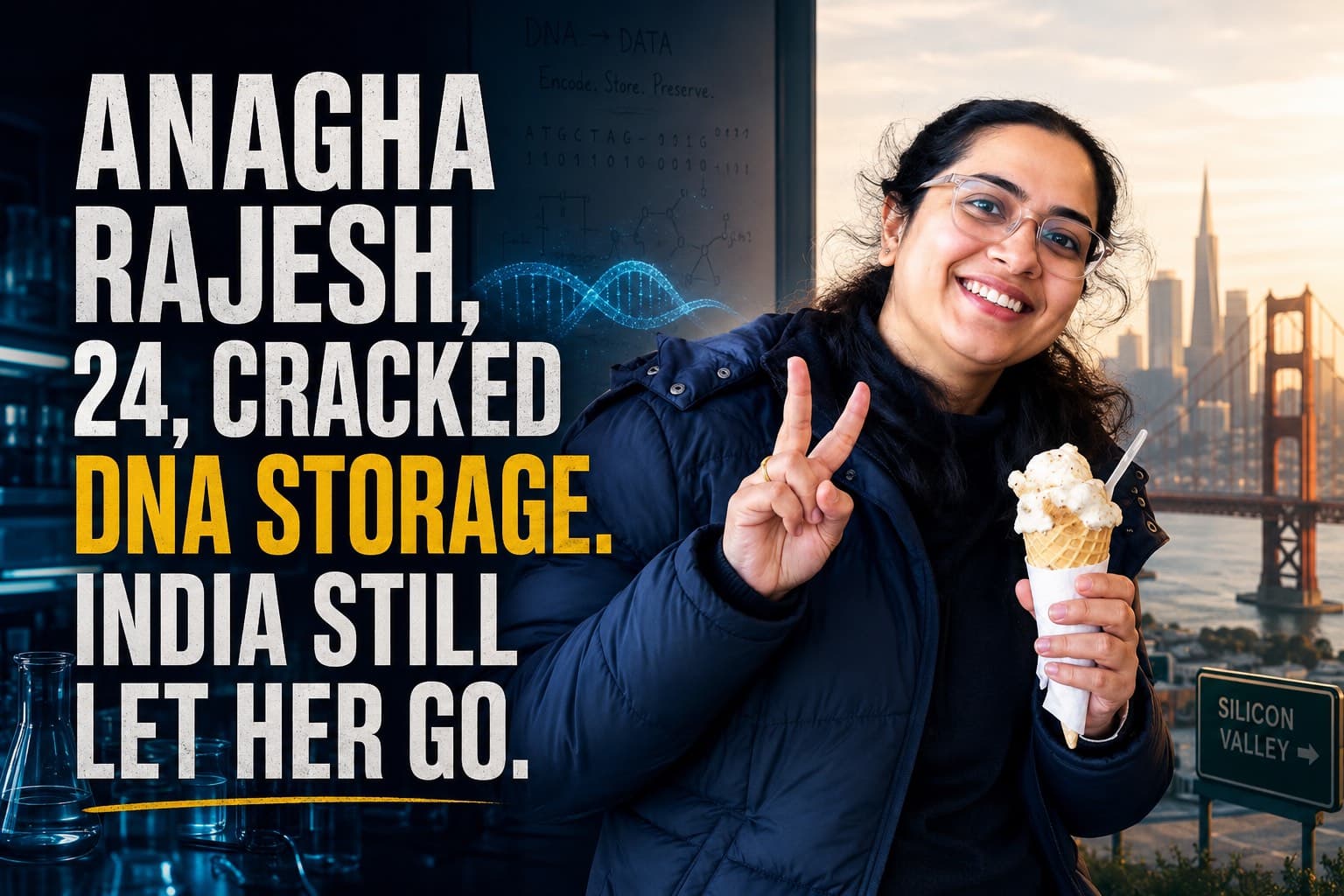

A BITS Pilani graduate built India’s first DNA data storage lab in two years. Then she shut it down and moved to San Francisco — and her exit says something uncomfortable about Indian deep tech.
BioCompute and its founder Anagha Rajesh have become the latest — and loudest — case study in a question Indian tech circles keep avoiding: can a country that talks endlessly about Atmanirbhar Bharat and “Startup India” actually hold onto its most ambitious scientific founders? Rajesh, a 24-year-old entrepreneur who built India’s first DNA-based data storage lab from scratch in Bengaluru, has just answered that question with her feet. In June 2026, she packed up two years of lab equipment, said goodbye to her team, and relocated BioCompute to San Francisco — publicly stating that India’s ecosystem simply wasn’t built to back a bet this audacious.
This is not a story about one founder’s personal ambition. It’s a story about what happens when a country builds glossy startup policy on paper while its actual capital, culture, and institutions quietly push its hardest, riskiest, most consequential science-driven founders out the door.
Who Is Anagha Rajesh, the Founder Behind BioCompute?
Anagha Rajesh was born on March 21, 2002, in Kerala, and grew up with an early pull toward science and invention. She went on to study at the Birla Institute of Technology and Science (BITS Pilani), one of India’s most competitive engineering and science schools, where she completed an integrated M.Sc. and developed a deep interest in synthetic biology and biotechnology — a combination that would eventually define her career.
In 2024, at just 22, Rajesh founded BioCompute, a deep-tech startup pursuing one of the hardest problems in modern computing: storing digital data inside strands of synthetic DNA. It’s a wildly ambitious pursuit for a first-time founder barely out of college, competing conceptually with computing giants like IBM and Microsoft, both of which have run their own DNA-storage research programs for years.
Over the next two years, Rajesh built an interdisciplinary team spanning biology, electronics, and hardware engineering, secured a working lab space in Bengaluru, and — according to people who worked alongside her — created an environment where junior engineers and researchers were trusted to lead their own work without micromanagement. Colleagues who built the company’s early prototypes have described her as a founder who protected her team from resource scarcity even when the company itself was operating on a shoestring budget, a rare trait in early-stage deep tech.
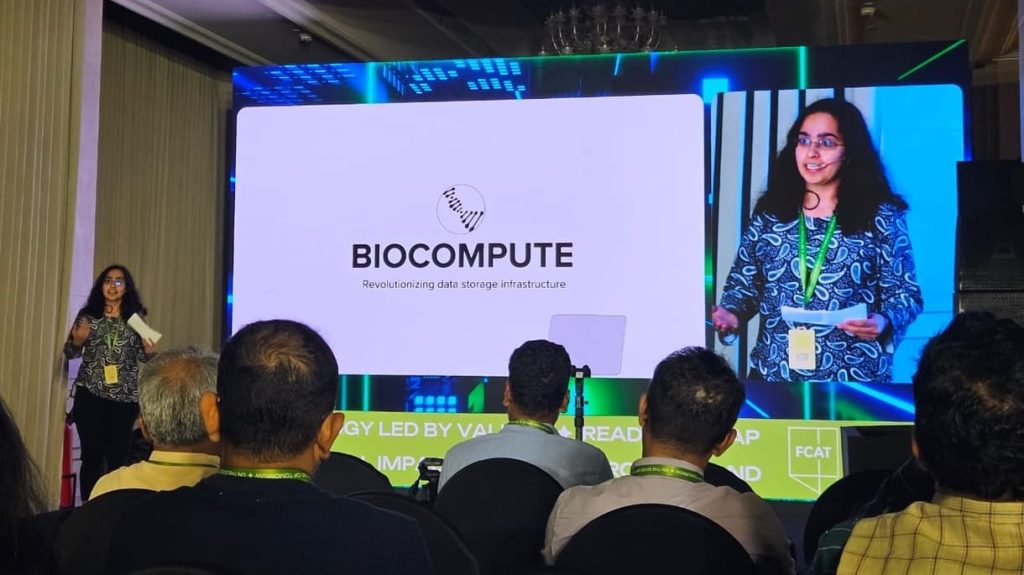
By 2026, BioCompute had raised more than ₹5 crore from investors including WTF Fund, Grad Capital, and 1517 Fund, run thousands of lab experiments, and produced what Rajesh describes as an end-to-end working prototype — making BioCompute the first Indian lab operating at this scale in DNA data storage.
Then she left.
What Is BioCompute Actually Building?
To understand why Anagha Rajesh’s exit matters, it helps to understand what BioCompute is trying to solve. Traditional data centers — the physical backbone of the internet, cloud computing, and AI — are enormous consumers of land, electricity, and water for cooling. As global data volumes explode, driven in large part by the AI boom, that infrastructure burden is only getting heavier.
DNA data storage proposes something radical: encode digital information — photos, documents, entire databases — into synthetic DNA strands instead of magnetic tape or silicon. DNA is astonishingly dense (a gram of it can theoretically hold enormous amounts of data) and stable over extremely long timescales without power. BioCompute’s next phase, now underway in San Francisco, involves building the company’s first DNA-storage chips — the hardware layer needed to move this idea from a lab curiosity toward a commercial product.
It’s the kind of project that requires years of runway before it generates a rupee of revenue, deep scientific patience from investors, and access to specialized hardware supply chains. That combination is exactly where, according to Rajesh, India’s startup ecosystem falls apart.
The technical challenge itself is not trivial. Writing data into DNA requires synthesizing custom nucleotide sequences that map to binary code, then reliably reading that sequence back out through sequencing hardware — a process that has historically been slow and expensive at lab scale. Making it commercially viable means shrinking that entire read-write pipeline into something closer to a chip: compact, fast, and cheap enough to compete with hard drives and magnetic tape archives on cost per gigabyte. IBM, Microsoft, and a handful of well-funded US and European labs have spent years and hundreds of millions of dollars chasing exactly this problem without a clear commercial winner yet. That BioCompute — a two-year-old startup out of Bengaluru with a fraction of that capital — built a working end-to-end prototype at all is, by most engineering standards, a genuinely rare achievement for a first-time founder’s team.
Why Anagha Rajesh and BioCompute Left India
In a blog post explaining the move, Rajesh was careful to say the decision wasn’t about a shortage of Indian talent. Her argument was more structural: building semiconductor-adjacent hardware and reaching global customers demands capital and risk appetite that India’s investor base still isn’t offering at the scale deep tech requires. She described India’s market as one that often prefers adapting proven Western ideas over funding unproven, frontier hardware from scratch — a far safer, faster path to returns than a DNA-storage chip that might not work for years.
She also pointed to something less quantifiable: mindset. In interviews after the move, Rajesh said the San Francisco investor community immediately understood her long-term technical vision and was focused on what she’d need to see it through, rather than pushing for near-term revenue milestones. That’s a strikingly different posture from what many Indian deep-tech founders report experiencing with domestic investors, who are frequently trained on software, fintech, and consumer-internet return timelines — three to five years, not the seven-to-ten-year horizons hardware and biotech actually require.
The human cost was real too. Rajesh has publicly said that the hardest part of the move wasn’t logistics — it was the conversations with her Bengaluru team, several of whom she couldn’t take with her. She’s since listed lab equipment, chemicals, and office furniture for sale on LinkedIn, closing the chapter on the company’s Indian origin story even as the mission continues abroad.
The Global Capital Reality: Where the Money Actually Goes
Rajesh’s decision doesn’t exist in a vacuum — it’s happening against the backdrop of one of the most lopsided capital concentrations in startup history. According to Crunchbase data, close to 88% of AI-related startup funding in 2026 — roughly $319 billion — has flowed to U.S.-headquartered companies, with the bulk of it landing in just two names. That level of concentration isn’t a mild imbalance; it’s a near-total pull of frontier-tech capital toward a single geography.
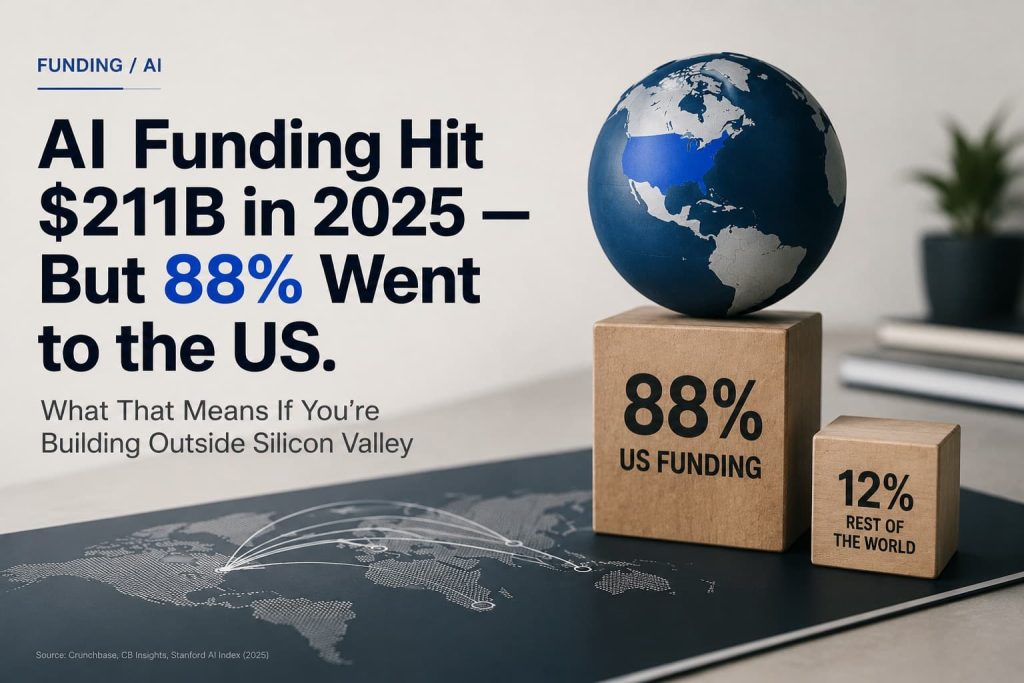
We covered this dynamic in detail in our earlier investigation, AI Funding: Where The Money Went, which broke down exactly how skewed global venture capital has become toward American AI and deep-tech companies. BioCompute’s relocation is, in many ways, a live case study of that same pattern playing out in biotech and hardware rather than large language models — ambitious, capital-hungry science startups gravitating toward wherever the risk-tolerant money actually sits, regardless of where the founder or the original idea came from.
More than 100 Indian AI and deep-tech founders have reportedly relocated or are actively planning to move to the US in search of that capital, customer access, and ecosystem depth. Anagha Rajesh and BioCompute are simply the most recent — and most visible — name on that growing list.
India’s Startup Policy: Impressive on Paper, Different in Practice
This is where the uncomfortable part of the story lives. On paper, India has spent a decade building an aggressive startup narrative. The government’s Startup India Fund of Funds has deployed over ₹21,000 crore into startups since 2016, the Union Budget 2025 added a fresh ₹10,000 crore Fund of Funds 2.0 with a specific carve-out for deep tech and advanced manufacturing, and in late 2025 the government approved a roughly $1.1 billion state-backed venture program aimed squarely at high-risk sectors like AI and deep tech.
Those numbers sound substantial. But founders on the ground tell a more complicated story. India’s deep-tech sector, home to more than 3,600–4,200 startups depending on the count, raised close to $10 billion over five years — yet deep-tech funding cratered from $3.7 billion in 2022 to just $850 million in 2023, a 77% collapse driven largely by investor unease about long, uncertain return timelines. Even with a partial recovery since — deep tech’s share of total Indian startup funding climbed from roughly 5% in 2023 to about 21% in 2025 — that’s still a small fraction of the domestic venture pool, and much of it remains concentrated in “safer” categories wearing a deep-tech label rather than genuinely frontier science.
The tension isn’t hidden. At a major founder gathering, Union minister Piyush Goyal drew sharp criticism when he pointedly contrasted India’s obsession with 10-minute delivery apps and quick-commerce ice-cream startups against the country’s shortage of hard-tech innovation — a comment many founders read as an admission from inside government that India’s own capital markets, not just its founders, have chosen speed and consumer monetization over patient, IP-generating research.
That’s the real gap behind BioCompute’s exit. Government schemes exist. Budget line items exist. What’s missing, according to founders across India’s deep-tech landscape, is patient private capital willing to underwrite five-to-ten-year hardware and biotech bets the way Silicon Valley routinely does — plus growth-stage funding once a startup graduates past its first government-backed grant. Founders like Suchin Jain of solar-tech startup iPanelKlean have described investing years of personal capital just to keep a patented, working technology alive, only to struggle for growth-stage rounds that, in the US, would already be routine.
Anagha Rajesh Isn’t Alone: A Pattern, Not an Exception
What makes the Anagha Rajesh BioCompute story significant isn’t that one founder moved abroad — founders relocate for all kinds of reasons. It’s that her stated reasoning matches a well-documented, systemic pattern rather than a personal grievance. A study commissioned by India’s Office of the Principal Scientific Advisor found that only 1 in 4 publicly funded R&D institutions in India offer meaningful incubation support for startups at all, and just 1 in 6 focus specifically on deep tech. Combine that with a domestic investor base still calibrated to software-style return timelines, and the incentives for a founder like Rajesh to stay become genuinely thin — no matter how proud she may be of what she built in Bengaluru.
None of this means Indian policymakers are indifferent. The direction of travel — bigger government funds, explicit deep-tech carve-outs, growing venture studio models — is real and, by most accounts, broadly positive. The honest criticism from founders isn’t that nothing is happening; it’s that the scale, patience, and follow-through capital still lag badly behind the rhetoric, and that gap is currently being paid for in relocated founders, sold-off lab equipment, and DNA-storage chips that will now say “Made in San Francisco” instead of “Made in Bengaluru.”
The Talent Exodus Behind the Anagha Rajesh Headline
Zoom out from BioCompute specifically, and the pattern gets harder to dismiss as a one-off. India built one of the largest startup ecosystems on the planet in under a decade — from fewer than 500 recognised startups in 2016 to more than 200,000 today, with over $160 billion in cumulative venture capital raised along the way. That is a genuine achievement, and it’s worth saying plainly: India did not fail to build a startup ecosystem. What it built, according to founders and analysts covering the sector, is overwhelmingly a distribution ecosystem — one exceptionally good at taking existing technology and delivering it to a billion people faster and cheaper, through quick commerce, fintech apps, and consumer platforms.
What it has struggled to build is an innovation ecosystem — one willing to fund original, IP-generating science from the ground up. India’s own startup funding data reflects that split starkly: even amid a broader funding recovery, the number of completed funding rounds nationally fell nearly 39% in a recent year as investors grew more selective, with deep-tech and hardware bets consistently the hardest hit. Recent research into India’s top-ranked startups found that a majority hold no granted patents at all — a signal, researchers argue, of an ecosystem that has systematically rewarded speed and early monetization over genuine research risk.
Against that backdrop, a founder like Anagha Rajesh isn’t an outlier making an emotional decision — she’s a rational actor responding to where the incentives actually point. And she’s far from alone: industry trackers now put the number of Indian AI and deep-tech founders who have relocated or are actively planning to relocate abroad at over 100, a figure that has been climbing steadily as global AI and biotech capital keeps concentrating in the US.
What BioCompute’s Move Means for India’s Deep-Tech Future
The uncomfortable truth is that Anagha Rajesh’s exit isn’t really a story about her. It’s a preview of what happens repeatedly if the underlying capital math doesn’t change: India will keep producing extraordinary young scientific talent, watch that talent build working prototypes on shoestring budgets and personal sacrifice, and then lose the commercialization phase — the chips, the patents, the manufacturing jobs, the eventual IPO — to wherever the patient capital actually lives.
BioCompute’s next chapter will now play out in the US, where Rajesh is building the company’s first DNA-storage chips with investors she says are focused on the long game rather than quarterly optics. Whether India’s expanding deep-tech funds can close that gap before the next Anagha Rajesh packs up her lab is the real question this story leaves behind.
Frequently Asked Questions About BioCompute and Anagha Rajesh
Who founded BioCompute?
BioCompute was founded in 2024 by Anagha Rajesh, an Indian entrepreneur and BITS Pilani graduate, as India’s first lab pursuing DNA-based data storage at scale.
Why did Anagha Rajesh move BioCompute to the US?
Rajesh has said the move wasn’t about a lack of Indian talent, but about needing deeper capital, bolder risk appetite, and an investor ecosystem willing to back long-horizon hardware bets — resources she felt were more available in San Francisco than in India.
How much funding has BioCompute raised?
BioCompute has raised more than ₹5 crore from investors including WTF Fund, Grad Capital, and 1517 Fund since its founding in 2024.
What is DNA data storage?
DNA data storage encodes digital information into synthetic DNA strands instead of traditional magnetic or silicon-based media, offering extremely high data density and long-term stability with far lower energy and land requirements than conventional data centers.
Is Anagha Rajesh’s move part of a larger trend?
Yes. Reports indicate more than 100 Indian AI and deep-tech founders have moved or are planning to move to the US, citing similar concerns about capital availability, risk appetite, and ecosystem depth compared to India.
Related Articles on IMFounder
- 5 Powerful Startups You Can Launch With Only $1,000
- The Complete Guide to Starting an AI Startup in Canada
- No-Code vs Low-Code vs Full-Code: What Founders and Small Business Owners Actually Need
- The Complete Guide to Starting an AI Startup in Canada
- The Explosive Startup Built With ChatGPT That Hit $401M
- 10 Bootstrapped Startups That Raised Zero — And Still Won in 2026
- Why 90% of Startups Fail (Data + Real Case Studies)