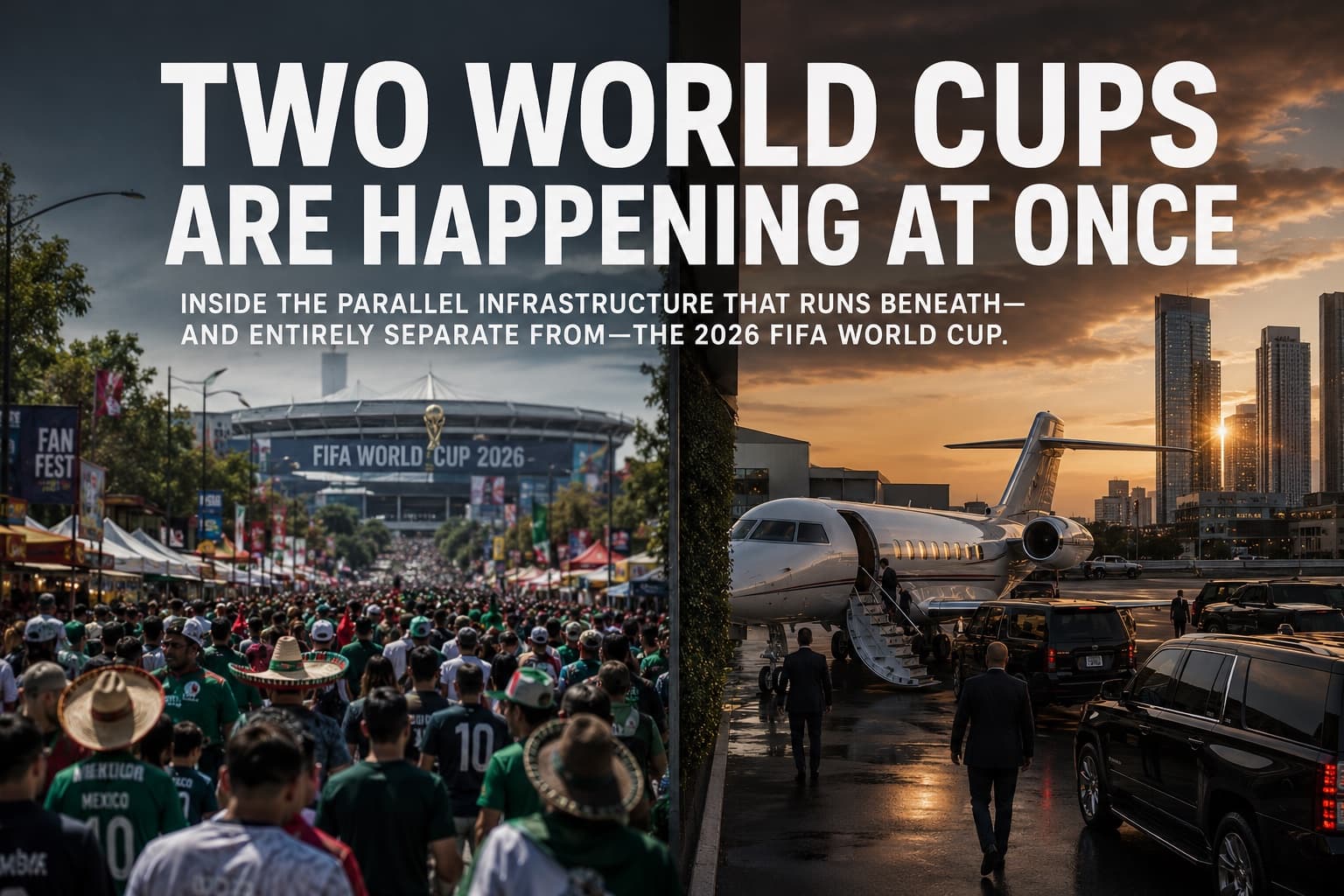

Inside the parallel infrastructure that runs beneath — and entirely separate from — the 2026 FIFA World Cup.
Somewhere inside a 2026 FIFA World Cup host city, ninety thousand fans are pressing toward stadium turnstiles. Street vendors are moving at full speed. Bars have been open since morning. The atmosphere is loud, chaotic, and everywhere at once.
Three miles away, another arrival is underway.
A private terminal at a regional airport has been quietly reserved. A motorcade is staged. A hotel floor — booked wholesale months before any public room inventory opened — is waiting. The kitchen has been staffed with a private culinary team. The concierge has a single client. The security detail outnumbers the guest list.
Both of these things are the World Cup. They are not the same event.
The Parallel Architecture
The 2026 World Cup — hosted across the United States, Canada, and Mexico — is the largest FIFA tournament in history: 16 host cities, 48 teams, 104 matches, and a projected 6.5 million total attendees.[1] FIFA projects a $30.5 billion economic windfall across the three host nations, describing the event as the equivalent of “104 Super Bowls.”[2] By every conventional metric, it is a sporting event. By every operational metric, it is something more complicated.
For a specific tier of attendee, the World Cup functions as a temporary geopolitical gathering point — sovereign wealth funds, private equity firms, defense contractors, luxury brands, and national delegations converging in the same cities at the same time. The matches provide the schedule. The hospitality infrastructure provides the real venue.
The Hotel Economy Nobody Talks About
Hotel inventory around World Cup host cities moves in two distinct phases. The first is public-facing: rooms become available, prices surge, fans book. Oxford Economics projected hotel room revenues increasing 7% to 25% around match days.[3] The second phase happens earlier and leaves no visible trace. Entire floors — sometimes entire properties — are placed under block agreements by corporate sponsors, FIFA partners, and private client services firms before the public booking window ever opens.
What fills those floors is not a traveling fan base. It is a temporary city within the city: principals, advisors, security personnel, and hospitality workers whose job is to ensure that a small number of people experience a version of the World Cup engineered specifically to avoid the conditions of the public one.
The scale of FIFA’s own block bookings became visible this spring when the organization released thousands of contracted rooms back to market — reportedly 2,000 in Philadelphia, 1,000 in Atlanta, and 800 in Mexico City — after international demand came in below projections.[4] Those are the rooms the public saw. The private agreements, held by corporate and sovereign clients, operate on an entirely different timeline.
Logistics as a Service
When an ultra-high-net-worth delegation arrives at a World Cup host city, the logistics required to move them do not interact with public infrastructure. Every host city is equipped with Fixed Base Operators — private terminals offering expedited customs, luxury lounges, and full concierge handling.[5] The movement from aircraft to suite to stadium to aircraft is executed without a single uncontrolled variable. FBO special event fees at host city airports run between $5,000 and $30,000 per aircraft on peak match days.[6]
Inside stadiums, FIFA’s hospitality program — operated exclusively through On Location — structures access in tiers that function less like ticket categories and more like entirely different venues.[7] Single-match private suites start at approximately $43,200, with full private boxes for a tournament series exceeding $100,000.[8] The sightlines may overlap. The event does not.
At the highest levels of global hospitality, luxury is often measured by how effectively reality can be edited out.
The Invisible Workforce
The labor required to sustain a World Cup’s luxury layer is enormous, temporary, and largely undiscussed. Hospitality workers — chefs, concierges, drivers, security personnel, event coordinators, housekeeping staff — are scaled up dramatically across the same six-week window, contracted through staffing agencies operating across hospitality, food and beverage, event operations, transportation, and security simultaneously.[9]
Behind stadium terraces and private hospitality suites, freight elevators run continuously through the night. Kitchens reset for breakfast service before midnight cleanup has fully ended. Laundry operations scale at industrial volume. The service corridor at 3 a.m. looks nothing like the product it is producing. Staff meals happen in back stairwells. Breaks are short. The physical distance between a guest’s experience and the labor required to produce it is engineered to be invisible — and in premium hospitality, the quality of that invisibility is itself the metric.
Luxury at scale is, in its operational reality, invisible labor at scale.
They Built the World Cup on the Promise of Jobs. Then They Just Walked Out.
Here is the part of the World Cup story that nobody on a sponsor call will say out loud.
The jobs promised as justification for public investment in this tournament are being automated out of the equation by the same catering operators holding the contracts.
FIFA and the WTO jointly projected 823,000 full-time equivalent positions created across North America.[10] Seattle alone promised 20,762 jobs and $929 million in regional economic impact.[11] That same event is simultaneously being used as a proving ground for the technology designed to eliminate those jobs permanently. The press releases just don’t mention that part in the same paragraph.
In October 2025, Atlanta-based catering company Proof of the Pudding became the first food and beverage operator to implement Amazon’s Just Walk Out technology using RFID at a live sports and events venue — Circuit of the Americas, Austin, Texas.[12] No cashiers. No checkout lines. Average transaction time: 15 seconds. CEO Adam Noyes described it as “key to the growth of our outdoor sports and events business.” What he did not describe was what it also is: an operational blueprint for replacing the concession workforce at every major stadium event this company manages. Proof of the Pudding operates food service at convention centers, collegiate stadiums, cultural landmarks, golf courses, and motorsports facilities nationwide.[13] Its footprint is expanding. Its headcount, by design, is not.
The technology is called “Just Walk Out.” For the workers it replaces, that’s exactly what happened — except they didn’t choose to leave.
Just Walk Out is now deployed across more than 300 third-party locations — stadiums, airports, hospitals, campus stores — with Amazon describing it as entering a “scaled growth phase.”[14]
An independent investigation found that Amazon’s Just Walk Out system — marketed as AI-powered autonomous checkout — relied, in earlier iterations, on remote workers based in India monitoring in-store camera feeds to review and confirm transactions.[15] The American concession workers it displaced at venues like Circuit of the Americas were gone. The jobs did not go to a machine. They went offshore — to a lower-wage remote workforce processing transactions for pennies on the dollar compared to what a U.S. stadium worker earns. The automation was not autonomous. The displacement was. And in stadiums built with American taxpayer dollars, operating under contracts that promised American jobs, that is not a technology story. That is a labor story with a geography problem.
The supply chain feeding these stadium operations runs through Amazon’s fulfillment infrastructure — a network the company confirmed it plans to operate with 600,000 fewer human hires by 2033, with $12.6 billion in projected automation savings between 2025 and 2027, per internal documents reviewed by The New York Times.[16] Those same documents directed employees to replace “automation” and “AI” with “advanced technology” and “cobot” in external communications.[17] When a corporation starts managing its vocabulary this carefully, it is worth asking what it is managing around.
The World Cup sold taxpayers on jobs. The catering companies sold investors on automation. Both transactions closed. Only one of them made the brochure.
Host cities signed agreements with FIFA that included confidentiality clauses restricting public disclosure of the full financial terms, per a review of host city contracts by the Houston Chronicle.[18] Taxpayers across all eleven U.S. host markets are funding stadium retrofits, security, and fan infrastructure — while receiving no share of ticket sales, concessions, merchandise, or parking revenues. FIFA is projected to net $11 billion in profit. Food preparation and serving roles face documented automation disruption rates as high as 80%.[19] The hospitality service robot market is projected to grow from $1.21 billion in 2026 to $3.45 billion by 2034.[20] The savings are real. The ROI is measurable. The labor footprint continues shrinking.
What is not captured on that spreadsheet is the worker who trained for this event, showed up for orientation, and discovered their position had been restructured into a sensor array and a ceiling-mounted camera. What is not captured is the tax base erosion in host cities that spent public money attracting an event that then systematically automated the employment it promised. What is not captured is the downstream economic contraction when the wages that were supposed to circulate through local restaurants, transit systems, and small businesses never materialized — because the jobs were never actually filled by humans.
What the World Cup Has Become
Football remains one of the few genuinely global cultural phenomena, capable of suspending economic and political divisions for ninety minutes in a way almost nothing else achieves. The stands are real. The matches are real. The fans who travel across hemispheres and sleep four to a room to be present for a single knockout match are experiencing something that cannot be manufactured.
The 2026 FIFA World Cup will be remembered for attendance records, expanded formats, and global scale. Less visible will be the parallel infrastructure constructed around it: private terminals, sealed hotel floors, invitation-only hospitality compounds, and the invisible workforce required to sustain a version of the tournament most fans will never encounter.
Football may still be the world’s most universal sport. But the infrastructure surrounding it increasingly reflects something else entirely: the growing ability of wealth to experience global events without participating in the public reality around them.
And on the loading dock, the workers who built that experience are being replaced by the same technology that just walked out on them.
Renée Tomato™ — Culinary Journalist | Hospitality Systems Analyst | Covering AI, labor, and infrastructure across the global food economy.
Related Articles on IMFounder
- Women’s Sports Are Breaking Records and Fans Are Taking Notice
- The Stadium Economy Was Rewritten Without Labor
- Olympic Lessons for Businesses: Risk, Ethics, Support, Leadership, and Purpose
- A Moment in Football That Ignited a Nation: The Bad Bunny Super Bowl Story
Sources
[1] FIFA / Oxford Economics via Spectrum News (2025)
[2] Fortune (2026)
[3] Oxford Economics via Spectrum News (2025)
[4] Travel Weekly / AHLA Hotel Outlook (2026)
[5] ACC Aviation / Universal Weather (2026)
[6] Paramount Business Jets (2026)
[7] FIFA / On Location (2026)
[8] Goal.com / FIFA Hospitality Platform (2026)
[9] Frontline Source Group (2026)
[10] FIFA / WTO via Focus on Travel News (2026)
[11] Visit Seattle / SeattleFWC26 (2024)
[12] Proof of the Pudding / EIN Presswire (2025)
[13] Proof of the Pudding / ZoomInfo (2026)
[14] CampusIDNews / Retail Wire / AWS (2025–2026)
[15] Forrester Research via HR Executive (2025)
[16] The New York Times / SupplyChainBrain (2025)
[17] Marketing AI Institute / Fast Company (2025)
[18] Houston Chronicle / Salon (2026)
[19] Fortunly Automation Statistics (2026)
[20] Intel Market Research (2026)Inside the parallel infrastructure that runs beneath — and entirely separate from — the 2026 FIFA World Cup.