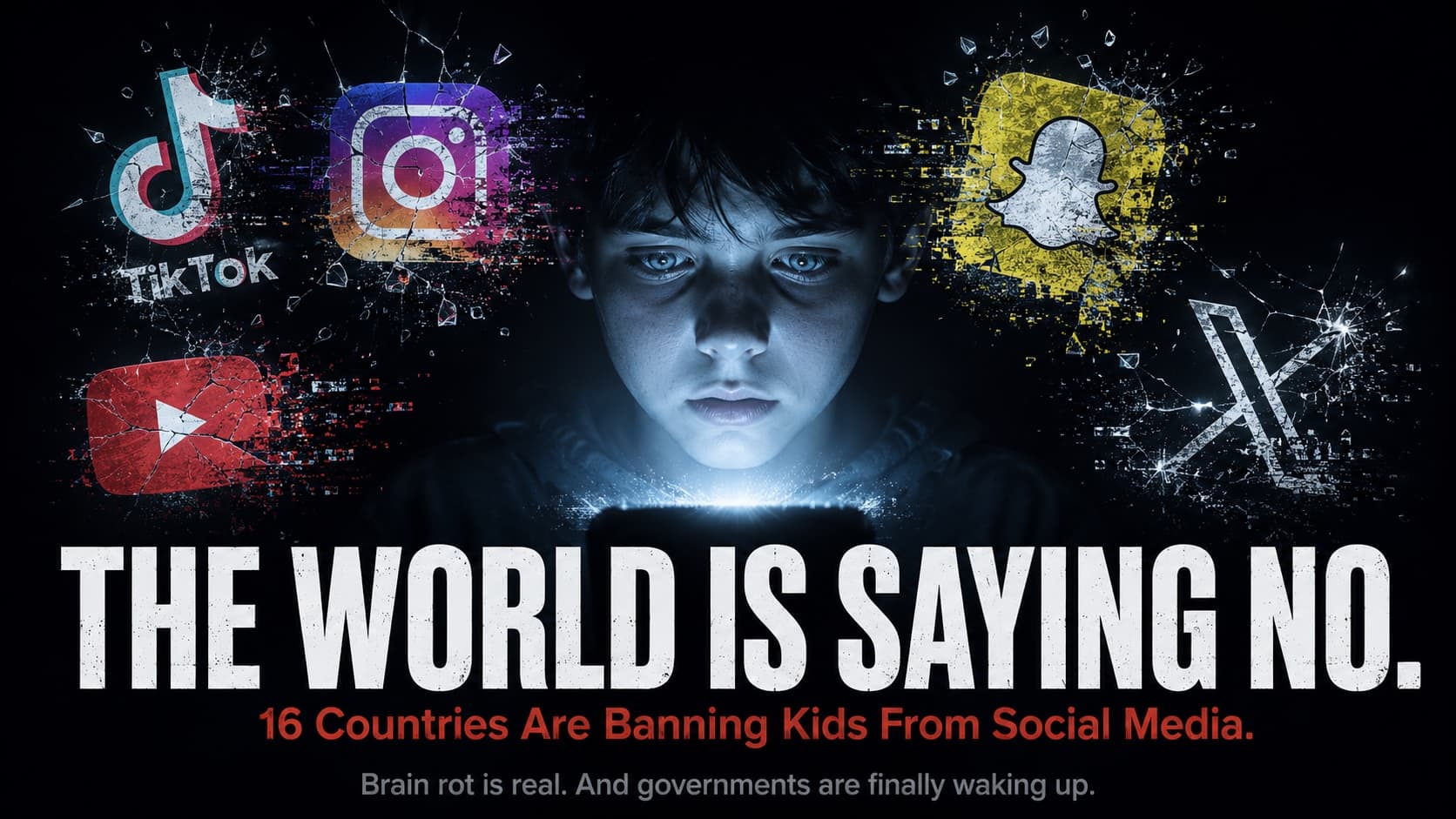

From Australia to the UK and Canada, governments are finally declaring war on the brain rot epidemic destroying a generation
The number of countries banning kids from social media reached at least 16 in June 2026 — and two of the world’s most influential democracies just joined the movement in the same week.
On June 10, Canada’s Prime Minister Mark Carney introduced federal legislation to bar children under 16 from social media platforms unless companies can prove their services are safe. Just five days later, on June 15, British Prime Minister Keir Starmer stood outside 10 Downing Street and announced the UK would do the same — and go even further. Curfews for older teenagers. Restrictions on AI chatbots. And a hard deadline: the spring of 2027.
This is no longer a fringe policy idea. Countries banning kids from social media has become one of the defining political movements of 2026. And it is accelerating fast.
What’s Happening: 16+ Countries Banning Kids From Social Media
The wave started with Australia in December 2025 — the first country in the world to fully implement a social media ban for children under 16. Within six months, a cascade of governments followed.
The full list of countries banning kids from social media or actively drafting legislation as of June 2026:
- 🇦🇺 Australia — Under 16. In force since December 2025.
- 🇬🇧 United Kingdom — Under 16. Announced June 15, 2026. Expected spring 2027.
- 🇨🇦 Canada — Under 16. Legislation tabled June 10, 2026.
- 🇫🇷 France — Under 15. Bill passed lower house.
- 🇩🇰 Denmark — Under 15. Expected mid-2026.
- 🇳🇴 Norway — Under 16. Bill to be introduced by end of 2026.
- 🇲🇾 Malaysia — Under 16. Implementation planned for 2026.
- 🇮🇩 Indonesia — Under 16. Legislation announced March 2026.
- 🇪🇸 Spain — Under 16. Parliamentary approval pending.
- 🇸🇮 Slovenia — Under 15. Draft legislation in progress.
- 🇵🇱 Poland — Under 15. Legislation drafting stage.
- 🇵🇹 Portugal — Under 16. Parental consent law approved in 2026.
- 🇩🇪 Germany — Under 16. Proposal under coalition discussion.
- 🇬🇷 Greece — Ban close to announcement.
- 🇦🇹 Austria — Under 14. Drafting stage.
- 🇮🇹 Italy — Under 15. Parliamentary bill introduced.
In less than 12 months, what Australia did alone has become a global standard.
Why Are Governments Banning Kids From Social Media?
The reasons are no longer theoretical. Three forces have converged in 2026 to make the movement politically unstoppable.
1. The Mental Health Data Became Undeniable
Governments aren’t acting on gut instinct. The research linking social media use to deteriorating mental health in children has become overwhelming. Anxiety, depression, disordered eating, sleep disruption, self-harm, and suicidal ideation — all are statistically elevated in heavy social media users under the age of 16.
The platforms know it. Internal research leaked from major companies over the past three years confirmed what public researchers had long warned: the algorithmic design of these apps — infinite scroll, dopamine-driven notification cycles, like counts, and recommendation engines — is optimized for addiction. Not engagement. Addiction.
2. A Landmark U.S. Court Verdict Changed Everything
In March 2026, a Los Angeles jury ruled that Meta and YouTube were legally liable for creating products that led to harmful and addictive behavior by young users. The verdict sent shockwaves through the tech industry and handed governments worldwide the political ammunition they had been waiting for.
If the courts agreed these platforms were dangerous by design, what was stopping lawmakers from treating them the way societies treat tobacco, alcohol, and gambling?
Nothing, it turned out.
3. Parents Are Demanding It
In the UK alone, the government’s public consultation on children and social media drew over 116,000 responses. More than 90 percent supported a ban for under-16s. These numbers don’t lie. Parents across the world are desperate, exhausted, and frightened. They have watched their children disappear into screens. They have fought nightly battles over phones at dinner tables. They have sat in doctors’ offices listening to diagnoses they cannot explain. They are done waiting for Silicon Valley to fix the problem it created.
The UK Goes Further Than Anyone
When PM Keir Starmer announced Britain’s ban, he did not frame it as a compromise. He called it a declaration.
The UK’s plan goes beyond Australia’s model. It will include age verification using facial recognition, voice recognition, and government ID. It will introduce curfews on social media use for older teenagers. It will restrict AI chatbots targeted at children. And it places the full legal burden on tech companies — not on parents, not on children — to enforce the rules, or face enormous fines.
Starmer’s message to Meta, TikTok, Snapchat, and YouTube was clear: “Social media is making our children unhappy and unsafe. As a parent, as much as a Prime Minister, I just can’t let that go on anymore.”
YouTube and Meta pushed back immediately, warning that blanket bans would push children toward “anonymous, less-safe services.” Starmer said he was not deterred.
Canada’s Historic Online Harms Bill
Canada’s legislation, tabled as Bill C-34, takes a slightly different approach. Rather than an outright hard ban, it restricts children under 16 from social media platforms unless companies can demonstrate — and prove through regulation — that they have meaningful safeguards in place.
The bill establishes a new Digital Safety Commission with real enforcement power: fines of up to $10 million CAD or three percent of a company’s gross global revenue, whichever is greater, for violations.
It is Canada’s most significant intervention in the digital rights of children in the country’s history — and it came directly from mounting pressure from parents, youth mental health advocates, and provincial governments.
The Brain Rot Is Real — What Science Keeps Warning Us About
Here at IMFOUNDER, we’ve been covering this story long before it became a political issue.
In our deep-dive investigation, Why Gen Z & Gen Alpha Can’t Focus: Inside the Global Attention Crisis, we documented how smartphones, short-form video, and 24/7 algorithmic content have structurally rewired young brains. We reported on a 2025 study finding a moderate negative correlation between frequent short-form video consumption and sustained attention span in young adults. We shared the findings from Nanyang Technological University showing heavy social media use is directly linked to emotional fatigue, compulsive behavior, and difficulty concentrating — even for content longer than one minute.
We reported on children like Aryan, 14, from Mumbai — a top student until Instagram Reels became his daily habit. By 2023, he couldn’t sit through a 40-minute tutoring session. His neurologist’s fMRI showed measurably reduced activation in the prefrontal cortex — the part of the brain responsible for focus, impulse control, and decision-making.
And in our follow-up piece, Gen Z’s Attention Span Crisis Is Reshaping How Startups Build Products, we showed how this cognitive collapse has rippled outward into the economy itself — forcing an entire generation of startups to redesign their products around a user base that decides whether to stay or leave within eight seconds.
This is what brain rot looks like in practice. Not a meme. A measurable, documented, economy-shifting cognitive crisis — and its most direct victims are the youngest users.
The Tech Giants Still Say No
Despite the court verdict, despite the legislation, despite 116,000 parents — the platforms are not going quietly.
Meta, Snapchat, TikTok, and YouTube have each issued statements warning that broad bans are ineffective, unenforceable, and potentially counterproductive. Their argument: push children off regulated platforms and they’ll move to darker, less monitored corners of the internet.
It is a reasonable point — but it is also the same argument the alcohol lobby used against minimum drinking ages. The same argument the tobacco industry made against advertising restrictions. And the same argument the gambling industry made against advertising bans near schools.
Governments are no longer buying it.
The difference in 2026 is that the liability has shifted. After the LA verdict, social media platforms can no longer claim neutrality. They are publishers of algorithmically targeted content, and courts are beginning to hold them responsible for the damage that content causes.
Will the Bans Actually Work?
Australia’s experience offers the first real-world data — and it is mixed. A survey by Australia’s internet regulator in March 2026 found that roughly 70 percent of parents said their children had found ways to bypass the age-verification systems.
Starmer acknowledged the problem directly. “We don’t say: ‘Oh, look, a teenager managed to get a drink somehow, so let’s not bother banning drinks from children.'”
The consensus among child welfare researchers is that perfect enforcement is not the point. Even imperfect bans reshape social norms, reduce casual or habitual use, give parents legal backing in household conflicts, and most importantly — place legal and financial pressure on the platforms themselves to build better systems.
The Australian eSafety Commission has confirmed that several platforms have significantly accelerated their age-assurance technology since the ban took effect. That alone is progress.
What This Means for Parents Right Now
If you are a parent reading this, the message from 16 governments in 2026 is simple: you are not overreacting.
The anxiety you feel about your child’s phone is not generational panic. It is an appropriate response to a real, scientifically documented, judicially confirmed crisis. The platforms that have your child’s attention were built by engineers and behavioral psychologists to maximize the time that child spends on the screen — regardless of what that time costs them.
Governments are now treating this the way they treat other public health crises involving children: with law.
While legislation works its way through parliaments, the most effective tools remain in your hands: delayed smartphone adoption, device-free bedrooms, consistent screen-time boundaries, and most powerfully of all — talking to your children about what these apps are actually designed to do to their brains.
The brain is plastic. Recovery is possible. But the window matters. And 16 governments just told the world: the window is closing.
The Bottom Line
Countries banning kids from social media is no longer a debate. It is a global movement. In 2025, one country acted. In 2026, at least 16 are acting — and within this single week alone, the UK and Canada added their weight to the growing list.
The science is clear. The courts have ruled. The parents have spoken.
The only question now is how fast the rest of the world follows — and whether the platforms will fight it, accept it, or finally do what they should have done a decade ago: build something that doesn’t break the people who use it.
Related Articles from IMFounder
- Gen Z’s Attention Span Crisis – From TikTok-trained attention habits to AI-driven product experiences.
- TikTok and the Death of the 3-Minute Song – short-form video, streaming algorithms, and attention span.
- From Side Hustle to Freedom – How Gen Z Is Building Multiple Income Streams.
- Influencer-Founded Brands – The New Million-Dollar Empires Built From Followers.
External Sources:
- UK Government Announcement — CBS News
- Canada’s Bill C-34 — CBC News
- Countries Banning Kids From Social Media — TechCrunch
- Australia eSafety Commission
- Meta & YouTube Liable Verdict — The Hill