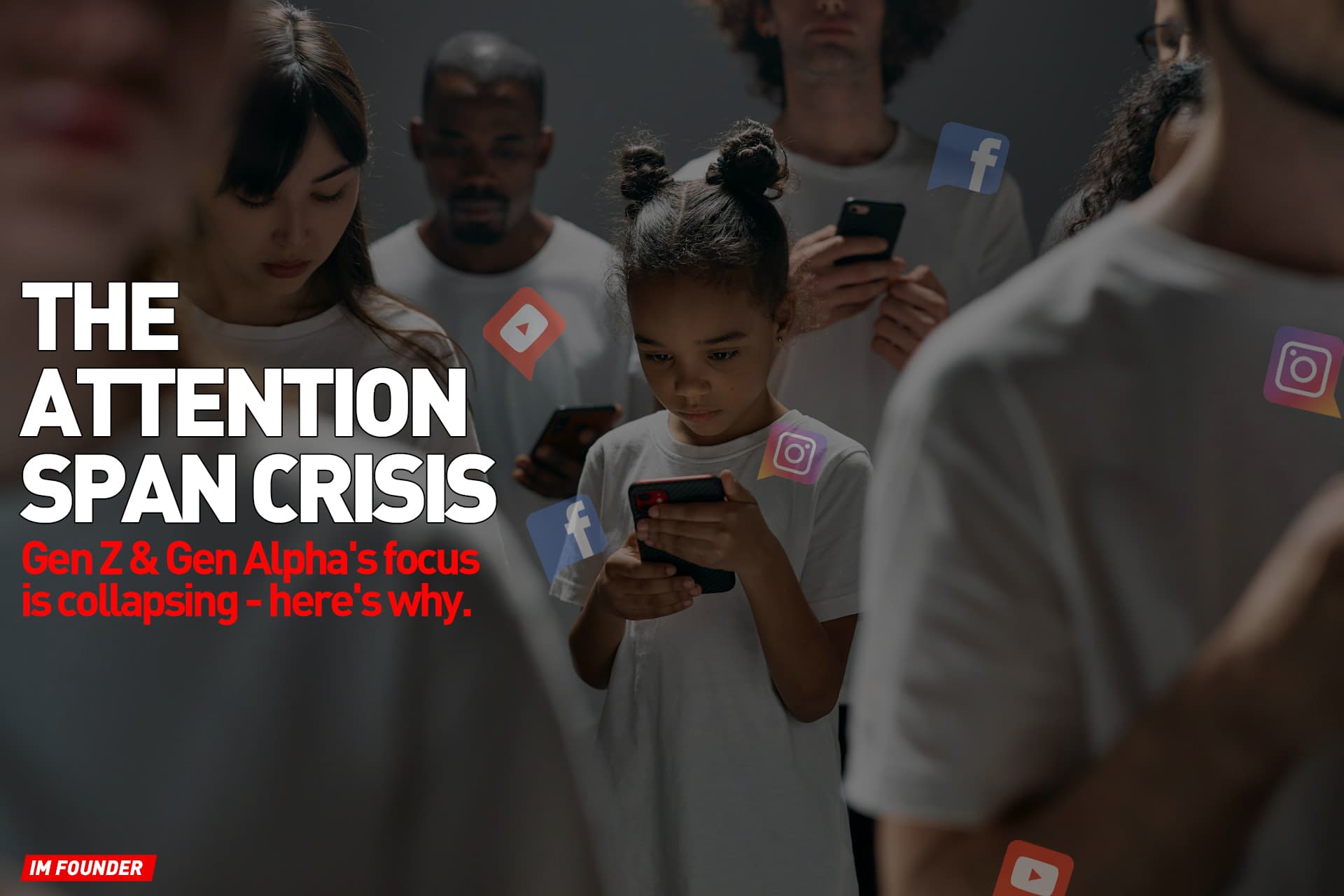

Back in the mid-1990s, a 12-year-old in Canada or the United States could count on Saturday mornings for one thing: cartoons. Shows like DuckTales or Animaniacs were scheduled, and missing an episode meant waiting a full week for the next one. That wait wasn’t frustrating it taught something rare today: patience, anticipation, and the ability to sit through a full 20-minute episode without distractions.
Now, in 2025, the attention span of teens looks very different. Many struggle to finish a 90-minute movie without checking their phone dozens of times. Reading a single page of a textbook can feel impossible without switching to TikTok or YouTube Shorts. Psychologists have a name for this modern condition: “popcorn brain” a restless, jumpy state shaped by constant, rapid-fire stimulation.
This article dives into why attention spans have shrunk, what recent research uncovers about our overstimulated brains, and why it’s becoming a serious challenge for learning, creativity, and mental well-being.
What Recent Research Says: Attention Span Is Dropping
What Recent Research Says: Attention Span Is Dropping
• Short‑form Video Addiction Linked to Lower Focus
A 2025 study — Impact Of Short Form Videos on Attention Span Mediated by Sleep Quality and Stress — found a moderate negative correlation between frequent short‑form‑video use (e.g. reels, shorts) and attention span among young adults (18–25). Psychopedia Journals According to the authors, high exposure to rapid media, constant novelty, and the cognitive overload they produce appear to impair working memory and reduce sustained attention. Psychopedia Journals
• Decline in Ability to Focus & Emotional Strain Among Youth
A report from 2025 by researchers at Nanyang Technological University (Singapore) shows that heavy social‑media use is linked to difficulties in sustaining focus, emotional fatigue, compulsive behaviour especially among adolescents and young adults (ages 13–25). A significant portion of participants said they struggled to maintain concentration, even for content longer than a minute. News-Medical
• Broader Review of Social Media’s Cognitive Impact
A 2025 review published in BMC Pediatrics summarised multiple studies on social media use among children and young adults. It concluded that while some cognitive benefits exist, excessive use often correlates with reduced attention, impaired memory, and weaker decision‑making faculties. SpringerLink
• Teachers & Educators Notice Reduced Patience and Focus
In a more anecdotal but telling finding, a survey of teachers revealed that many believe their students (Gen Z and younger) exhibit shorter attention spans and lower patience compared to earlier generations. Some specifically attribute this to heavy social media and smartphone use from a young age. Tjhss Journals+2India Today+2
Real Children, Real Damage
Case 1 – Aryan, 14, Mumbai
A topper until Class 7, Aryan discovered Instagram Reels in 2021. By 2023 his grades had collapsed. His mother noticed he could no longer sit through a 40-minute tuition class. During counselling, Aryan admitted: “If a video is longer than 30 seconds, I just swipe. Even when I try to study, my brain keeps waiting for the next thing to happen.” An fMRI scan ordered by his neurologist showed reduced activation in the dorsolateral prefrontal cortex – the exact region responsible for sustained attention and impulse control.
Case 2 – Sarah, 17, California (reported in The Atlantic, 2024)
Sarah was hospitalised for severe anxiety after failing her mock SATs. She had been watching 6–8 hours of TikTok daily. When doctors asked her to sit quietly without her phone for 15 minutes, she experienced physical withdrawal symptoms – racing heart, sweating, and tears. “My brain feels like it’s screaming if nothing is happening,” she said.
Why Infinite Content Is Different from 90s Television
| 1980s–1990s Experience | 2020s Experience |
|---|---|
| Fixed schedule → built anticipation | 24/7 availability → zero anticipation |
| 30-minute episodes with ad breaks | 15-second dopamine hits, no breaks |
| One TV in the house → family bonding | Personal device → isolated consumption |
| Limited choice → learned to stick with something | Infinite choice → learned to abandon quickly |
The brain’s reward system was never designed for this. Every swipe delivers a micro-dose of novelty, triggering dopamine bursts similar to slot machines. Over time, the brain down-regulates its own dopamine receptors and starts craving constant stimulation. Real life – a classroom lecture, a book, a conversation – suddenly feels unbearably slow.
The Patience Muscle Has Atrophied
Children today rarely experience the delicious ache of waiting. There is no thrill of standing outside an archies gallery for the new Tinkle digest, no countdown to Sunday morning cartoons, no saving pocket money for months to buy a video game. When everything is available instantly and endlessly, nothing feels special anymore.As one 13-year-old confessed to his therapist:
“I know I’m missing out on real life, but waiting for anything feels like torture.”
It’s Not Just Attention – It’s Identity
Short-form content also trains kids to view themselves as consumers, not creators. They spend hours watching “day in my life” vlogs instead of living their own. Deep reading, long conversations, hobbies that take weeks to show results – all of these are being crowded out by the endless scroll.
What Can Still Be Done?
The brain remains plastic, especially in childhood and adolescence. Recovery is possible, but it requires deliberate intervention:
- Delayed smartphone adoption (ideally not before 13)
- Complete ban on short-form video apps for children under 16 (several European countries are moving toward this)
- Reintroducing “boredom” as a regular part of life – no screens in bedrooms, enforced device-free evenings
- Bringing back slow hobbies: reading physical books, board games, outdoor sports, music practice, etc.
Final Thought
We wanted to give our children a world of infinite knowledge and entertainment. Instead, we have accidentally handed them a world that is training their brains to be impatient, distracted, and chronically unsatisfied. But if we treat this solely as a “kids don’t have patience” problem, we miss a bigger picture: we are witnessing a structural cognitive shift.
The tragedy is not that they have access to everything.
The tragedy is that, because of that access, they may never learn the profound joy of waiting for something truly worth having.
Our job now is simple, and urgent: we must teach them – by example and by boundary – how to be bored again. Because only in boredom does the mind learn to wander, to focus, and eventually, to create.
Related Articles from IMFounder
- Gen Z’s Attention Span Crisis – From TikTok-trained attention habits to AI-driven product experiences.
- TikTok and the Death of the 3-Minute Song – short-form video, streaming algorithms, and attention span.
- From Side Hustle to Freedom – How Gen Z Is Building Multiple Income Streams.
- Influencer-Founded Brands – The New Million-Dollar Empires Built From Followers.