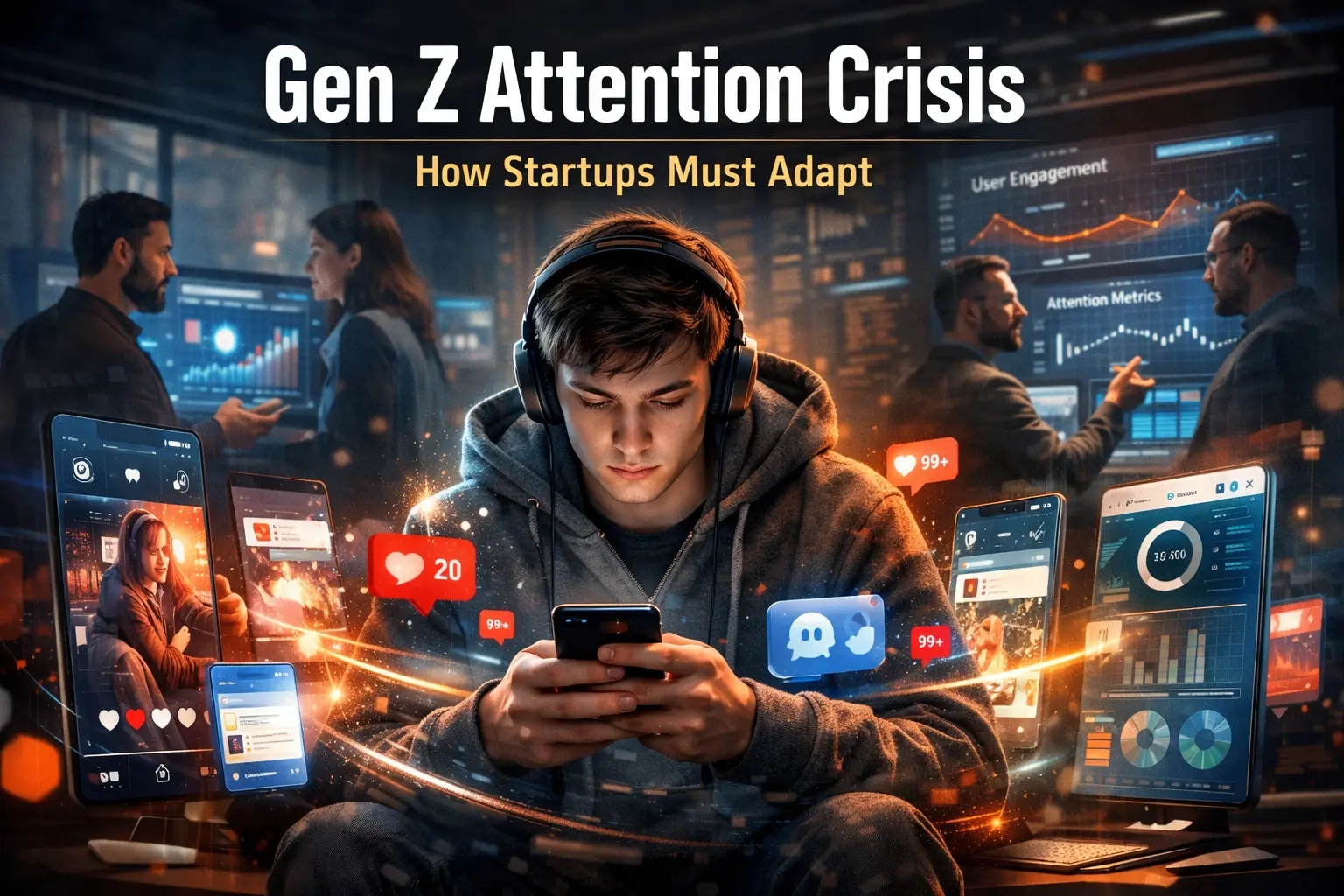

For decades, startups competed on technology, price, and scale. Today, the Gen Z attention span is forcing startups to compete on something far more fragile: human attention. In a digital ecosystem dominated by algorithmic feeds, short-form video, and infinite scrolling, the most scarce resource is no longer capital or distribution — it is the ability to hold someone’s focus for more than a few seconds.
At IMFOUNDER, we previously explored this transformation in our analysis of the internet economy’s shift toward attention as the most valuable digital asset. In “The Internet Economy 2026: Why Attention Is Becoming More Valuable Than Money,” we examined how digital platforms—from social networks to AI tools—are competing in an emerging marketplace where time, not capital, determines power.
https://imfounder.com/science-tech/internet-economy-2026-attention-more-valuable-than-money/
We also examined the behavioral side of this shift in “The Gen Z Attention Span Crisis,” where we analyzed how algorithm-driven platforms and constant digital stimulation are reshaping how younger users consume information and interact with technology.
https://imfounder.com/science-tech/gen-z-attention-span-crisis/
Taken together, these shifts are forcing startups to rethink everything—from onboarding flows to product design. The generation now entering the workforce and consumer market does not simply behave differently online. They process the internet differently.
And for founders, that difference is becoming existential.
How Gen Z Attention Span Is Reshaping Startups in 2026
The concept of the attention economy is not new. But the scale at which it now shapes the digital marketplace is unprecedented.
Generation Z—those born roughly between the late 1990s and early 2010s—grew up inside algorithmically optimized platforms like TikTok, Instagram Reels, and YouTube Shorts. These systems are engineered to maximize engagement through endless content streams tailored to individual behavior.
The result is a media environment that rewards speed, novelty, and constant stimulation.
Gen Z now spends more than three hours per day on social media on average, significantly more than previous generations. (ZipDo)
At the same time, content engagement patterns reveal a dramatic shift in how quickly users decide whether something is worth their attention. Research across short-form platforms shows that viewers often abandon content within seconds if it fails to deliver immediate value or stimulation. (Gitnux)
In practical terms, this means a startup’s product or marketing message now has only a tiny window to capture interestbefore a user moves on.
For founders, that window may be the difference between traction and obscurity.
The Rise of the 8-Second Product Test
Data from short-form video platforms shows how rapidly attention declines in modern digital environments.
Many short videos lose the majority of viewers within 8–10 seconds if pacing or visuals fail to engage. (Gitnux)
This behavioral pattern has quietly reshaped how digital products are designed.
Historically, software assumed users would spend time learning interfaces or navigating onboarding flows. That assumption is increasingly obsolete.
Gen Z expects instant proof of value.
If an app cannot demonstrate usefulness, entertainment, or novelty within seconds, users simply abandon it. Scroll culture has conditioned them to treat every digital experience as disposable.
In other words, the product must justify its existence immediately.
Scroll Culture and the Dopamine Loop
Part of this shift is neurological.
Short-form content platforms rely on rapid reward cycles—likes, new videos, surprising visuals—that trigger dopamine responses in the brain. Over time, users become accustomed to constant novelty and rapid context switching.
Researchers studying short-form video consumption have found that frequent exposure to these rapid content cycles can impair sustained attention and memory tasks, particularly when users are repeatedly interrupted by algorithmic feeds. (arXiv)
Even educational researchers have begun observing similar effects in classrooms. Studies indicate that heavy screen use and constant multitasking can reduce attention accuracy and slow cognitive processing among young adults.
The implications extend beyond psychology.
They shape how entire digital products must function.
Why Do Startups Fail to Engage Gen Z?
A surprising number of early-stage products still follow design assumptions that emerged during the desktop internet era.
These products often fail with Gen Z users for several predictable reasons:
- Slow onboarding: Lengthy sign-up flows and multi-step tutorials create friction.
- Delayed value: If users must invest effort before seeing benefits, most leave.
- Text-heavy UI: Visual-first communication now dominates digital culture.
- No social layer: Gen Z interacts with information collectively rather than individually.
Research on Gen Z’s information behavior shows that younger users often encounter information socially rather than actively searching for it, interpreting content through peer networks and communities. (arXiv)
This means products that ignore social interaction risk irrelevance.
The Hook-First Product Design Era
Successful startups increasingly follow what product designers call “hook-first design.”
Instead of asking users to invest effort upfront, these products deliver value instantly.
Examples include:
- AI tools that generate results within seconds
- Apps that work without full registration
- swipe-based interfaces requiring minimal effort
- micro-interactions that provide constant feedback
The objective is simple: create a compelling moment before attention disappears.
In the attention economy, that moment is the product.
Marketing in the Age of Micro-Attention
Marketing strategies are undergoing a similar transformation.
Traditional digital marketing relied heavily on blog posts, landing pages, and long-form messaging. While those formats still exist, they increasingly serve a secondary role.
For Gen Z audiences, discovery now happens through:
- short-form video platforms
- creators and influencers
- meme culture and viral moments
- algorithmic recommendation systems
Influencer ecosystems have become particularly powerful because Gen Z often trusts creators more than corporate messaging.
For startups, the lesson is clear: distribution now flows through culture, not just advertising.
The AI Opportunity in the Attention Economy
Ironically, the same technological forces that shortened attention spans may also help startups adapt.
Artificial intelligence is emerging as a tool for attention compression.
AI systems can summarize complex information, personalize content feeds, and automate tasks that previously required extended focus.
In many ways, AI products are designed for the attention-constrained internet.
Instead of reading a long report, users ask an AI to summarize it.
Instead of navigating complex menus, they issue natural-language commands.
Instead of searching multiple sources, they receive a synthesized answer.
AI does not simply accelerate productivity. It reduces the cognitive cost of information consumption.
The Paradox: Gen Z Still Consumes Long-Form Content
Despite widespread concern about shrinking attention spans, the reality is more nuanced.
Gen Z still spends hours watching podcasts, documentaries, and YouTube videos.
The difference lies in context and storytelling quality.
Long-form content succeeds when it delivers:
- strong personalities
- narrative structure
- emotional authenticity
- clear informational value
In other words, attention has not disappeared.
It has become selective.
Users are willing to invest time—but only when the experience justifies it.
What Founders Must Understand
For startups, the implications of the Gen Z attention shift are profound.
Products are no longer competing solely against other startups. They are competing against every piece of content on the internet.
That includes:
- TikTok videos
- Instagram memes
- gaming platforms
- streaming services
- AI chat tools
The modern digital user lives inside an endless entertainment ecosystem.
If a product feels slow, complicated, or boring, it loses instantly.
The Future: Startups Built for the Attention Economy
As we argued in our earlier IMFOUNDER analysis of the internet economy’s attention shift, the next generation of successful startups will likely be those that treat attention as their core design constraint.
The shift is not happening in isolation. As we discussed in IMFOUNDER’s earlier analysis of why attention is becoming the core currency of the internet economy, digital platforms are increasingly designed around capturing and optimizing user focus.
This means building products that are:
- fast to understand
- instant to experience
- socially shareable
- visually engaging
- frictionless to use
The companies that succeed will not simply capture attention.
They will respect it.
Because in the digital economy of 2026, attention is no longer just a metric.
It is the foundation of everything.
Related Reading on IMFounder
- The Internet Economy 2026: Why Attention Is More Valuable Than Money
- The Gen Z Attention Span Crisis
- From Side Hustle to Freedom: How Gen Z Is Building Multiple Income Streams
- Oracle Didn’t Just Lay Off Thousands — It Sent a Message About the Future of Work