
For years, economists, investors, and entrepreneurs debated a question that once sounded impossible:
Who will become the world’s first trillionaire?
At IMFounder, we explored that question earlier this year in our article, “The Race to Become the World’s First Trillionaire,” where we examined how Elon Musk, Jeff Bezos, Mark Zuckerberg, Jensen Huang, and other tech leaders were competing in an unprecedented wealth race.
Now, history appears to have delivered an answer.
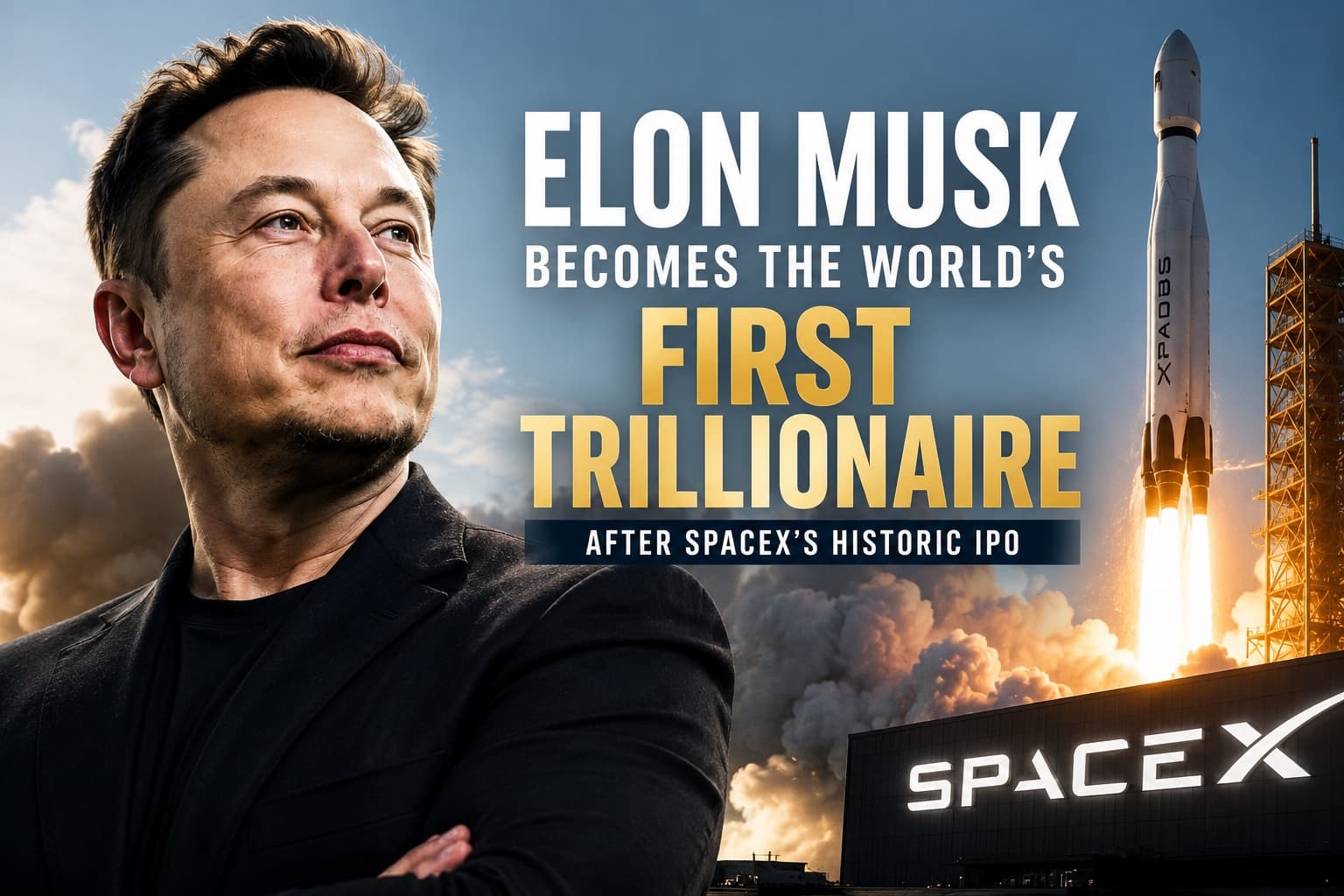
Following the record-breaking public debut of SpaceX, Elon Musk’s net worth has reportedly surpassed the $1 trillion mark, making him the first individual in modern history to achieve trillionaire status on paper. Multiple financial outlets reported that SpaceX’s historic IPO pushed the company’s valuation above $2 trillion, dramatically increasing the value of Musk’s ownership stake.
But this story is about far more than one billionaire becoming richer.
It marks the beginning of a new era in technology, capital markets, artificial intelligence, and space commercialization.
From Millionaires to Billionaires to Trillionaires
In the late 20th century, becoming a billionaire was considered nearly impossible.
Today, there are thousands of billionaires worldwide.
The trillionaire milestone represents another shift in how wealth is created. Modern fortunes are increasingly tied not to physical assets alone but to ownership of platforms, infrastructure, software ecosystems, artificial intelligence, and global technology networks.
The path to a trillion-dollar fortune is fundamentally different from traditional wealth accumulation.
A trillionaire is not created through salary, real estate holdings, or even successful public companies alone.
Instead, trillionaire-level wealth emerges when founders maintain significant ownership stakes in companies that become foundational infrastructure for entire industries.
That is exactly what happened with Elon Musk.
The SpaceX Effect
SpaceX was once viewed as an ambitious private rocket startup.
Today, it operates launch systems, satellite communications networks, national security contracts, commercial space transportation services, and increasingly significant AI-related technologies.
The company’s IPO became the largest in history, raising approximately $75 billion and triggering a surge in valuation that transformed Musk’s personal fortune. Reports estimate that Musk’s SpaceX holdings alone are worth hundreds of billions of dollars.
Unlike many previous wealth milestones, this jump was driven primarily by ownership of a company operating at the intersection of:
- Space exploration
- Satellite internet
- Artificial intelligence
- Defense technology
- Advanced manufacturing
- Global communications infrastructure
For investors, SpaceX is no longer viewed simply as a rocket company.
It is increasingly being valued as a platform company capable of influencing multiple trillion-dollar industries simultaneously.
Why Elon Musk Won the Trillionaire Race
When IMFounder analyzed the trillionaire race earlier this year, Elon Musk stood out because he possessed something no other contender had:
Multiple High-Growth Assets
Unlike most billionaires, Musk controls significant ownership across several transformative companies:
- SpaceX
- Tesla
- xAI
- Neuralink
- The Boring Company
- X
Each company targets a massive market opportunity.
Collectively, they create a unique wealth ecosystem where advances in AI, transportation, robotics, energy, and communications reinforce one another.
Founder Ownership
Many technology founders dilute ownership over time.
Musk retained unusually large stakes in several of his companies.
As valuations increased, his personal net worth accelerated far faster than traditional corporate executives.
Investor Confidence
Whether supporters love him or critics oppose him, markets have consistently attached a premium to Musk-led ventures.
Analysts often describe this phenomenon as the “Elon Premium”—the belief that Musk can execute ambitious projects that competitors consider impossible.
What This Means for Entrepreneurs
The trillionaire milestone carries important lessons for founders.
1. Ownership Matters More Than Salary
Most wealth creation comes from equity ownership rather than compensation.
Founders who maintain meaningful ownership in high-growth businesses can create exponentially larger outcomes than those focused solely on income.
2. Infrastructure Creates Massive Value
The largest fortunes increasingly emerge from building infrastructure rather than consumer products alone.
Cloud computing, AI systems, semiconductor platforms, space networks, and communication ecosystems are becoming the foundations of the modern economy.
3. Long-Term Thinking Wins
SpaceX spent years facing skepticism, failed launches, funding challenges, and regulatory hurdles.
The trillionaire milestone demonstrates how long-term execution can eventually create extraordinary value.
The Growing Wealth Gap Debate
Not everyone is celebrating.
Musk’s trillionaire status is reigniting debates about economic inequality, taxation, corporate power, and wealth concentration.
Critics argue that no individual should control wealth equivalent to the GDP of many nations.
Supporters counter that entrepreneurs who build transformative technologies deserve rewards proportional to the value they create.
The discussion is likely to intensify as AI, automation, and advanced technologies generate even larger fortunes in the coming decades.
Who Could Become the Next Trillionaire?
Although Musk may have crossed the finish line first, the race is far from over.
Several contenders remain positioned for trillion-dollar fortunes:
Jeff Bezos
Amazon and Blue Origin continue expanding into cloud infrastructure, logistics, AI, and space technologies.
Mark Zuckerberg
Meta’s aggressive investments in artificial intelligence and next-generation computing platforms could significantly increase future valuations.
Jensen Huang
NVIDIA remains one of the biggest beneficiaries of the global AI boom, powering data centers and AI infrastructure worldwide.
Future AI Founders
The next trillionaire may emerge not from social media or e-commerce, but from artificial intelligence, robotics, biotechnology, or quantum computing.
A Historic Turning Point
The world’s first trillionaire is more than a financial headline.
It symbolizes a broader transformation in the global economy.
For decades, industrial giants dominated wealth creation.
Today, software, artificial intelligence, space technology, and digital infrastructure are creating value at unprecedented speed.
Whether viewed as an extraordinary entrepreneurial achievement or a sign of growing wealth concentration, Elon Musk’s trillionaire milestone marks one of the defining economic moments of the 21st century.
At IMFounder, we predicted earlier this year that the trillionaire era was approaching.
The question is no longer whether trillionaires will exist.
The question now is:
How many more will follow?
Related Articles on IMFounder
- The Race to Become the World’s First Trillionaire
- Elon Musk’s xAI Commits Over $20 Billion to Mississippi
- The AI Anthropic Called Too Dangerous Is Now Open to Every Founder
- The AI Bubble: Are Startups Repeating the Dot-Com Crash?
- AI Stock Market Crash Fears Surge as Nvidia Loses $300 Billion and Nasdaq Tumbles