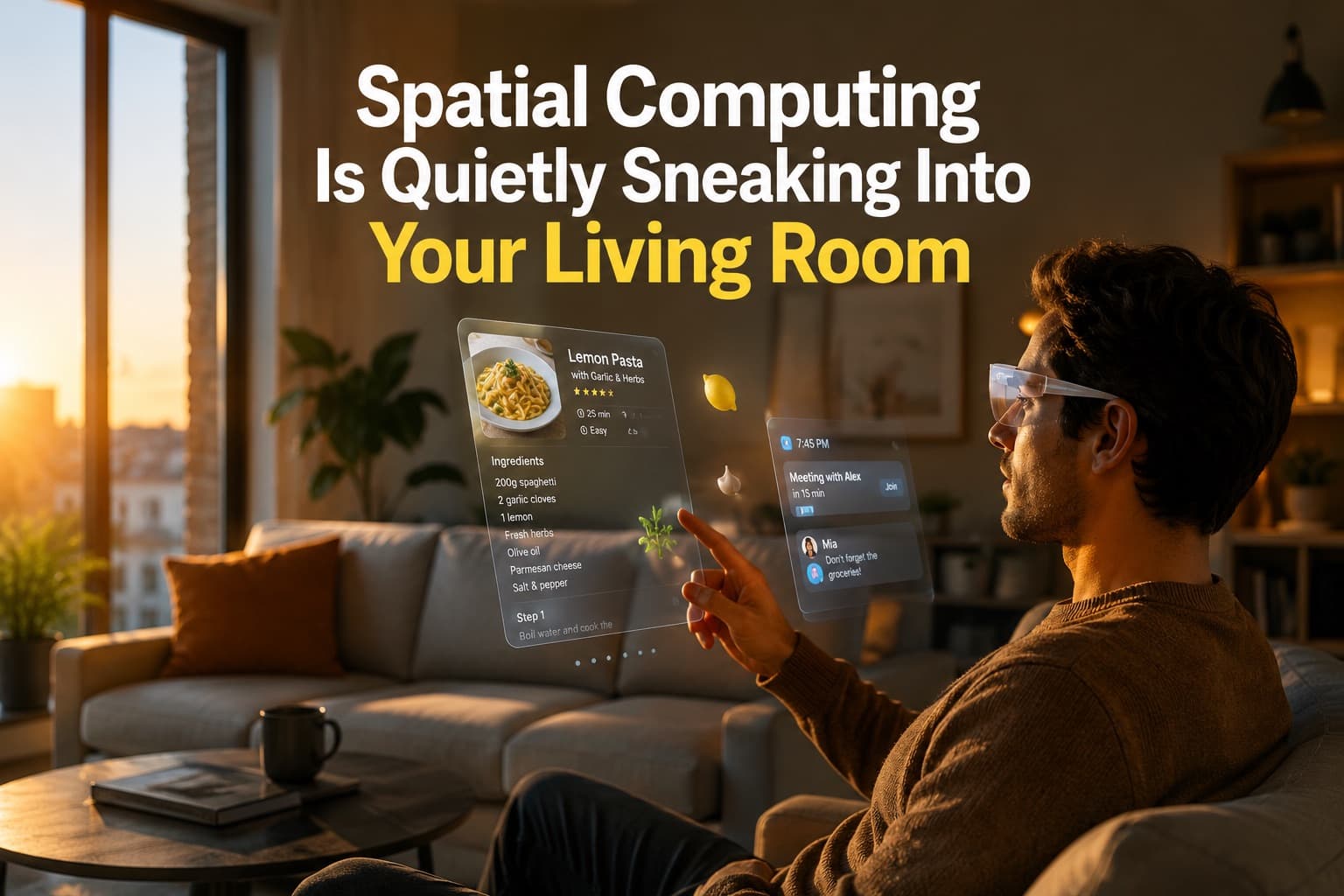

A few years ago, “spatial computing” sounded like something out of a lab in Cupertino — expensive headsets, awkward straps, a device you’d wear for ten minutes and then quietly put back in the box. In 2026, that story is changing fast, and it’s happening in a much less dramatic way than anyone predicted: not through a single blockbuster headset, but through ordinary-looking glasses and glowing little displays that are starting to show up in actual homes.
If you haven’t been paying close attention to this corner of tech, here’s the honest, non-technical version of what’s going on — and why it’s worth a second look.
Wait, What Is Spatial Computing Again?
Strip away the buzzword and it’s a simple idea: instead of looking at a screen, digital information gets layered into the space around you. That could mean a text message floating in your field of view, a recipe hovering next to your stovetop, or a 3D product you can walk around and inspect from every angle — no flat rectangle required.
Two categories are driving this shift right now, and they’re arriving from very different directions.
AR Glasses Have Quietly Gotten Normal-Looking
The biggest change in the last year isn’t a new feature — it’s that AR glasses finally stopped looking like AR glasses. Meta’s Ray-Ban collaboration, Snap’s newly launched consumer Specs, and a wave of competitors from Samsung, Google, Xreal, and Rokid are all chasing the same goal: something you’d actually wear in public without feeling like a tech demo.
A few developments worth knowing about:
- Meta has continued expanding its Ray-Ban partnership, including prescription-friendly models, pushing smart glasses further into “just another accessory” territory rather than a gadget category.
- Snap began shipping its long-awaited consumer Specs in mid-2026, a notable jump from years of developer-only access — though the price tag still sits well above impulse-buy territory.
- Samsung showed off a frame-first design emphasizing battery life and everyday wearability over flashy specs, a signal that comfort — not raw power — may decide who wins this race.
- Apple is widely reported to be shifting focus away from bulky headsets and toward lighter, glasses-style hardware, expected sometime around the end of 2026.
- Google has re-entered the space with dual approaches: screen-free assistant glasses for simple notifications, and display-equipped versions for a fuller AR experience.
None of this means AR glasses are about to replace your phone. But the direction is unmistakable: from a handful of enthusiast gadgets a couple of years ago to a genuine multi-brand product category today, with analysts projecting the broader AR and VR glasses market to roughly double in size by the end of the decade.
Volumetric Displays: The Screen That Isn’t Flat
The second, quieter trend is volumetric displays — screens that project real three-dimensional images into open space, viewable from multiple angles without any glasses or headset at all. Think less “sci-fi hologram from a movie” and more a genuinely new way to look at 3D content: product designs, game characters, medical models, or just a cool desk ornament that reacts to what’s happening on your computer.
These have existed in research labs and niche enterprise settings for years, mostly in industries like healthcare, defense, and industrial design, where being able to see something from every side actually matters. What’s changing now is the trajectory: this category is one of the fastest-growing corners of display technology, driven largely by rising interest from gaming and entertainment, where fully three-dimensional, walk-around visuals promise something flat screens and even VR headsets can’t quite deliver.
Consumer-grade volumetric displays are still niche and mostly novelty-priced today. But the same pattern that played out with flat-panel TVs and, more recently, smart glasses — expensive and clunky, then smaller, cheaper, and normal — appears to be starting here too.
Why This Is a Lifestyle Story, Not Just a Tech One
It’s tempting to file all of this under “gadget news” and move on. But the more interesting story is what it does to daily life once it actually lands in living rooms:
- Cooking with a recipe floating beside your ingredients instead of propping up a phone.
- Workouts with form corrections overlaid in your field of view instead of squinting at a mirror.
- Video calls where a colleague’s 3D presentation actually looks three-dimensional, instead of a flat slide.
- Gaming and hobbies where a display shows a model, board, or character you can walk around, rather than a screen you stare into.
This is the same pattern smart speakers and smartwatches followed: a slightly odd first wave, followed by a “wait, that’s actually useful” phase, followed by ordinariness. Spatial computing looks to be somewhere between the first and second stages right now.
What’s Coming Next
A few things to watch over the rest of 2026 and into 2027:
- Price drops. Consumer AR glasses currently range from a few hundred dollars to well over two thousand. Expect that range to compress as more manufacturers compete.
- Design over specs. Several major players are now prioritizing weight, comfort, and how “normal” the hardware looks over raw performance — a sign the industry is targeting everyday wearers, not just early adopters.
- AI integration. Nearly every new glasses launch is pairing the hardware with an AI assistant, turning the glasses into an ambient way to ask questions, translate speech, or get real-time information — not just a display.
- More entertainment-focused volumetric products. As costs fall, expect smaller, gaming- and media-oriented volumetric displays to show up outside of enterprise and research settings.
The Bottom Line
Spatial computing isn’t arriving as one dramatic launch event — it’s sneaking in through smart glasses that look like regular glasses and 3D displays that are starting to shrink from lab equipment into living-room curiosities. Nobody needs to rush out and buy an AR headset this weekend. But if the current pace holds, “spatial computing” may stop being a tech-conference buzzword and start being something that’s just… in the room with you.
FAQ
Is spatial computing the same as AR or VR? Not exactly. VR replaces your entire view with a digital environment; AR overlays digital elements onto the real world you’re already looking at. Spatial computing is the broader umbrella term covering both, plus other tech (like volumetric displays) that blend digital content into physical space.
Are AR glasses worth buying right now? For most people, not yet — prices are still high and the software ecosystem is young. Enthusiasts and early adopters are the main audience today, though prices and polish are both improving quickly.
What’s a volumetric display, in plain terms? A screen that shows a real 3D image floating in space, viewable from different angles, without needing glasses or a headset.
Related Articles on IMFounder
- 7 Brutal Truths About Meta Ray-Ban Smart Glasses Gen 2 vs Gen 1
- Apple AirPods Max 2 Review: New Features, Same Price
- Apple MacBook Neo: Gimmick or Game Changer?
- While Apple Repeats, Samsung Reinvents
- Pet Owners’ Guide to the Best Vacuums & Robot Cleaners
- Why Breville launched the Oracle® Dual Boiler