

How Matt Brown’s 2009 startup became a $2 billion infrastructure layer connecting more than 65,000 financial advisors to private markets once reserved for institutions.
The CAIS alternative investment platform just became one of the best-funded fintech stories of 2026 — and most people outside the wealth management industry have never heard of it. In late July 2026, the New York-based company closed a $170 million Series D round led by Vista Equity Partners at a valuation north of $2 billion, capping a 17-year climb from a scrappy idea about advisor access to a piece of financial infrastructure that now touches roughly $8.5 trillion in client assets.
If you’ve never heard of CAIS, that’s kind of the point. It doesn’t sell to consumers. It sells to the financial advisors who manage consumers’ money — and it has quietly become one of the most important pipes connecting independent wealth management to the private markets. This is the story of how it got there, who built it, and why the money keeps pouring in.
What Is the CAIS Alternative Investment Platform?
CAIS — short for Capital Integration Systems — is a financial technology company that operates a digital marketplace for alternative investments. In plain English: it’s the platform that lets independent financial advisors, the ones not employed by giant banks like Goldman Sachs or Morgan Stanley, buy into hedge funds, private equity, private credit, real estate funds, structured notes, and other “alternative” assets that were historically reserved for pension funds, endowments, and the ultra-wealthy.
The CAIS alternative investment platform handles the entire lifecycle of that process — pre-trade research and due diligence, the actual transaction, and post-trade reporting — through a single digital operating system. Instead of an advisor faxing paperwork to a hedge fund’s back office and waiting weeks for confirmation, CAIS turns fund subscriptions into a digital workflow integrated with major custodians like Fidelity, Charles Schwab, and Pershing.
According to the company’s own figures released around its Series D announcement, CAIS now serves more than 2,500 wealth management firms and over 65,000 financial advisors who collectively oversee close to $8.5 trillion in end-client assets. That scale is why Wall Street’s biggest asset managers — from Apollo to Blue Owl to Carlyle — have all, at various points, wanted a piece of the company.
The Problem CAIS Set Out to Solve
To understand why the CAIS alternative investment platform matters, you have to understand the access gap it was built to close.
For decades, alternative investments — hedge funds, private equity, venture capital, private credit — were effectively off-limits to everyday financial advisors and their clients. Large institutions like pension funds and university endowments had the relationships, the minimum-check sizes, and the operational infrastructure to invest directly with elite fund managers. A solo advisor managing money for dentists and small-business owners in a mid-sized American city simply couldn’t get a meeting, let alone meet a $5 million minimum investment.
That imbalance created a two-tier system: institutions got access to asset classes that, over long periods, have offered diversification and return potential unavailable in public stocks and bonds, while independent advisors and their clients were largely locked out. Matt Brown, who spent years inside that world as a financial advisor himself, saw the gap up close and built CAIS specifically to close it — aggregating advisor demand so that fund managers would open their doors, and building the technology to make the transaction and reporting process manageable at scale.
That mission — leveling the playing field between institutional and independent wealth channels — remains the throughline of everything CAIS has built since, from its original hedge fund marketplace with minimum commitments as low as $100,000 to today’s sprawling platform covering private equity, private credit, real estate, digital assets, structured notes, and even access to select initial public offerings.
Meet the Founder: Who Is Matt Brown?
Every great infrastructure company has a founder who lived the problem before they solved it, and Matt Brown fits that mold closely.
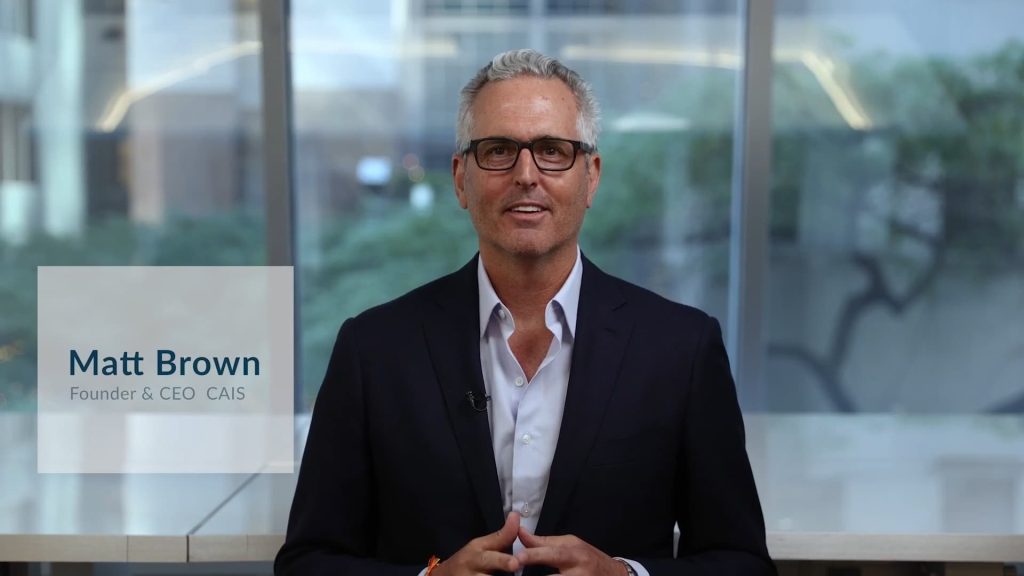
Brown spent more than three decades at the intersection of wealth management, alternative investments, and financial technology. He started his career as a financial advisor at Shearson Lehman Brothers and later Smith Barney — two of the storied names of old Wall Street before founding Brownstone Advisors, his own wealth advisory practice. That hands-on experience, watching how much friction and access inequality existed between independent advisors and institutional-grade investment products, became the direct inspiration for CAIS.
In 2009 — in the smoldering aftermath of the global financial crisis, when trust in Wall Street was at a generational low and independent advisory models were gaining ground — Brown founded CAIS as what the company describes as the first truly open marketplace for alternative investments. (Some public company databases, including Crunchbase, also list Jeremy Norton as a co-founder alongside Brown; CAIS’s own corporate materials credit Brown as founder, CEO, and chairman.)
Brown has remained CAIS’s CEO and chairman ever since — a rarity in the fintech world, where founders often exit or get replaced well before a company reaches unicorn status. Following the Series D announcement, Brown framed the raise as validation of both the market opportunity and CAIS’s category leadership, adding that the company’s “biggest chapter is still ahead” — a comment that reads less like typical fundraising boilerplate and more like a founder who still sees a long runway after seventeen years.
How the CAIS Alternative Investment Platform Works
At its core, the CAIS alternative investment platform is built around three connected pillars:
Funds Marketplace. This is the original product: a searchable, digitized catalog of alternative investment funds — hedge funds, private equity, private credit, real estate — that advisors can research, run due diligence on, and subscribe into electronically. Every fund listed goes through independent due diligence and ongoing monitoring conducted by Mercer, giving advisors a layer of institutional-grade vetting they couldn’t easily access on their own.
Custom Funds. For advisors or asset managers who want to build a bespoke investment vehicle around a specific idea or strategy, CAIS provides the infrastructure to stand one up — turning what used to be a months-long legal and operational project into something far more streamlined.
Capital Markets. This arm covers structured notes and, more recently, access to select initial public offerings and secondary-market transactions, the latter enabled through CAIS’s integration with LODAS Markets. It’s the part of the platform expanding fastest as CAIS pushes beyond traditional fund subscriptions into a broader universe of private capital markets activity.
Layered on top of all three pillars is a growing set of decision-support and education tools. CAIS Compass is a portfolio construction tool that lets advisors model how adding alternative investments would change a client portfolio’s risk and return characteristics, now with an AI-generated summary option. CAIS IQ is an on-demand learning platform built to help advisors build genuine expertise in alternatives rather than just executing trades blind. CAIS Live extends that education into the physical world, running in-person events in cities across the U.S. so advisors can meet asset managers directly. And the Models Marketplace, launched in 2025, packages alternative investments into ready-made multi-asset, multi-manager model portfolios — responding to survey data showing a large majority of advisors would consider using model portfolios to simplify how they allocate to alternatives.
CAISey: How CAIS Is Using AI Inside the Platform
The newest and arguably most consequential layer is artificial intelligence. CAIS has built a research assistant called CAISey, powered by Anthropic’s Claude models, that gives advisors conversational, natural-language access to platform information, fund data, and investment insights — instead of digging through PDFs and spreadsheets.
The company says its broader push into AI and automation increased internal software development throughput by roughly 80% year over year, which helps explain how CAIS managed to ship more than 150 new technology features in just the first half of 2026, a 50% jump over the prior year’s pace. Those releases spanned interval fund trading, bulk order signing, structured note analysis tools, expanded secondary-market access, and AI-powered portfolio monitoring — evidence that the CAIS alternative investment platform is trying to compound its technology lead rather than rest on its existing market position.
CAIS’s Funding History: From Seed Idea to $2 Billion
CAIS didn’t reach a $2 billion valuation overnight. Its capital-raising path traces a fairly classic, patient fintech trajectory:
- 2009: Matt Brown founds CAIS in New York, initially built around aggregating advisor demand for hedge fund access.
- 2020: CAIS raises a $50 million Series B, backed by Eldridge, as the platform’s advisor and asset base scale up.
- 2022: CAIS closes a $340 million Series C, led by Apollo and Motive Partners, with additional participation from firms including Franklin Templeton — a round that signaled some of the largest names in alternative asset management wanted a strategic stake in the distribution layer reaching independent advisors.
- July 2026: CAIS announces its $170 million Series D, led by Vista Equity Partners, valuing the company above $2 billion and pushing total capital raised to nearly $600 million.
The Series D round is notable not just for its size but for its participant list, which reads like a who’s-who of institutional alternative asset management: AllianceBernstein, funds managed by Blue Owl Capital, Carlyle, Fortress Investment Group, Golub Capital, Lord Abbett, and Royal Bank of Canada all joined alongside lead investor Vista Equity Partners. Vista president David Breach is taking a board seat as part of the deal, while representatives from Blue Owl, Lord Abbett, Fortress, and Carlyle will serve as board observers.
That roster matters strategically. These aren’t just financial backers — several of them are also asset managers whose funds are distributed through the CAIS marketplace, meaning the CAIS $170 million funding round effectively deepens the company’s relationships with the very fund managers advisors want access to.
CAIS’s Growth by the Numbers
The metrics CAIS disclosed alongside its Series D tell a growth story that goes well beyond the headline valuation:
- Transaction volume grew 53% year-over-year in the first half of 2026.
- Total platform assets climbed 55% over the same period.
- The company’s three-year organic revenue compound annual growth rate sits at 37% — an unusually strong figure for a fintech infrastructure company at this scale.
- Since 2025, more than 425 new registered investment advisor (RIA) firms and independent broker-dealers, representing over $1.8 trillion in combined assets, have joined the platform.
- Advisor Net Promoter Score reportedly hit a record 74, more than double the typical B2B SaaS benchmark of 36.
Taken together, those figures explain why dealmakers described the $170 million round as sitting in the 92nd percentile of comparable U.S. Series D deals — this wasn’t a defensive raise to extend runway, but growth capital for a company already generating real momentum.
Why Investors Are Betting Big on Alternative Investments for Financial Advisors
The enthusiasm around CAIS isn’t happening in a vacuum. It reflects a broader structural shift in how private markets are being distributed. For years, alternative investments for financial advisors have been one of the most talked-about, least-solved problems in wealth management: everyone agrees advisors and their clients are underexposed to private equity, private credit, and hedge funds relative to institutions, but the operational plumbing to fix that — due diligence, subscription documents, reporting, custodial integration — has historically been too clunky to scale.
CAIS built exactly that plumbing, at a moment when regulators have also been gradually widening the pool of investors eligible to access certain alternative products. As private markets continue absorbing capital that once flowed almost automatically into public stocks and bonds, the company controlling the distribution rails into the $8.5-trillion independent advisor channel becomes strategically important — not just profitable, but genuinely hard to displace once thousands of firms have built their workflows around it.
That’s the underlying logic behind a $170 million check from a group of investors that includes both a private equity giant in Vista Equity Partners and several of the very asset managers — Carlyle, Blue Owl, Fortress — whose funds already live on the CAIS marketplace.

What’s Next for CAIS
CAIS says the fresh capital will go toward three things: expanding the platform’s product footprint, scaling its technology and AI capabilities, and pursuing further strategic opportunities, which in plain terms usually signals openness to acquisitions or deeper partnerships. Given the pace of feature releases in just the first half of 2026 — spanning trading functionality, AI-powered monitoring tools, and secondary-market access — it’s a safe bet CAIS will keep pushing further into full-lifecycle capital markets services rather than staying a pure fund marketplace.
The bigger, more interesting question is whether CAIS starts to feel less like a niche wealth-management vendor and more like foundational financial infrastructure — the kind of company that becomes so embedded in how an entire industry operates that its name eventually becomes shorthand for the category itself, the way “Bloomberg terminal” became shorthand for market data.
Key Takeaways
- The CAIS alternative investment platform connects independent financial advisors to hedge funds, private equity, private credit, real estate, and structured notes through a single digital marketplace.
- Founder and CEO Matt Brown started CAIS in 2009 after seeing firsthand, as a financial advisor himself, how little access independent advisors had to institutional-grade alternative investments.
- CAIS closed a $170 million Series D in July 2026, led by Vista Equity Partners, at a valuation above $2 billion — bringing total funding to nearly $600 million.
- The platform now serves over 2,500 wealth management firms and 65,000+ advisors overseeing roughly $8.5 trillion in client assets.
- CAIS has embedded AI throughout its platform, including a Claude-powered research assistant called CAISey, and says AI-driven automation has boosted its software development throughput by about 80% year-over-year.
FAQ About the CAIS Alternative Investment Platform
What is the CAIS alternative investment platform? CAIS is a fintech company that operates a digital marketplace giving independent financial advisors access to alternative investments — including hedge funds, private equity, private credit, real estate, and structured notes — along with the due diligence, transaction, and reporting tools to manage them.
Who founded CAIS? Matt Brown founded CAIS in 2009, drawing on his earlier career as a financial advisor at Shearson Lehman Brothers and Smith Barney. He remains the company’s CEO and chairman.
How much funding has CAIS raised? CAIS has raised close to $600 million in total, including a $50 million Series B in 2020, a $340 million Series C in 2022, and a $170 million Series D in 2026.
What is CAIS’s valuation in 2026? Following its July 2026 Series D round led by Vista Equity Partners, CAIS was valued at more than $2 billion.
How does CAIS use artificial intelligence? CAIS has integrated a Claude-powered research assistant called CAISey into its platform, along with AI-powered portfolio monitoring and analysis tools, and says AI-driven automation has increased its software development throughput by roughly 80% year-over-year.
Is CAIS available to retail investors? No. CAIS is built for financial advisors and the wealth management firms they work for, not for individual retail investors to access directly.
Related Reading on IMFounder
- Google’s Vizag AI Data Centre and India’s Water Debate
- How GLP-1 Drugs Are Reshaping Entire Industries
- Over 600 Million Indian Face High to Extreme Stress Over Water while Google Investing $15 Billion on AI Data Centre.
- 7 Explosive Tech News Stories That Could Change the Future of Technology
- How Forbes Lost Up To 90% Of Its Traffic