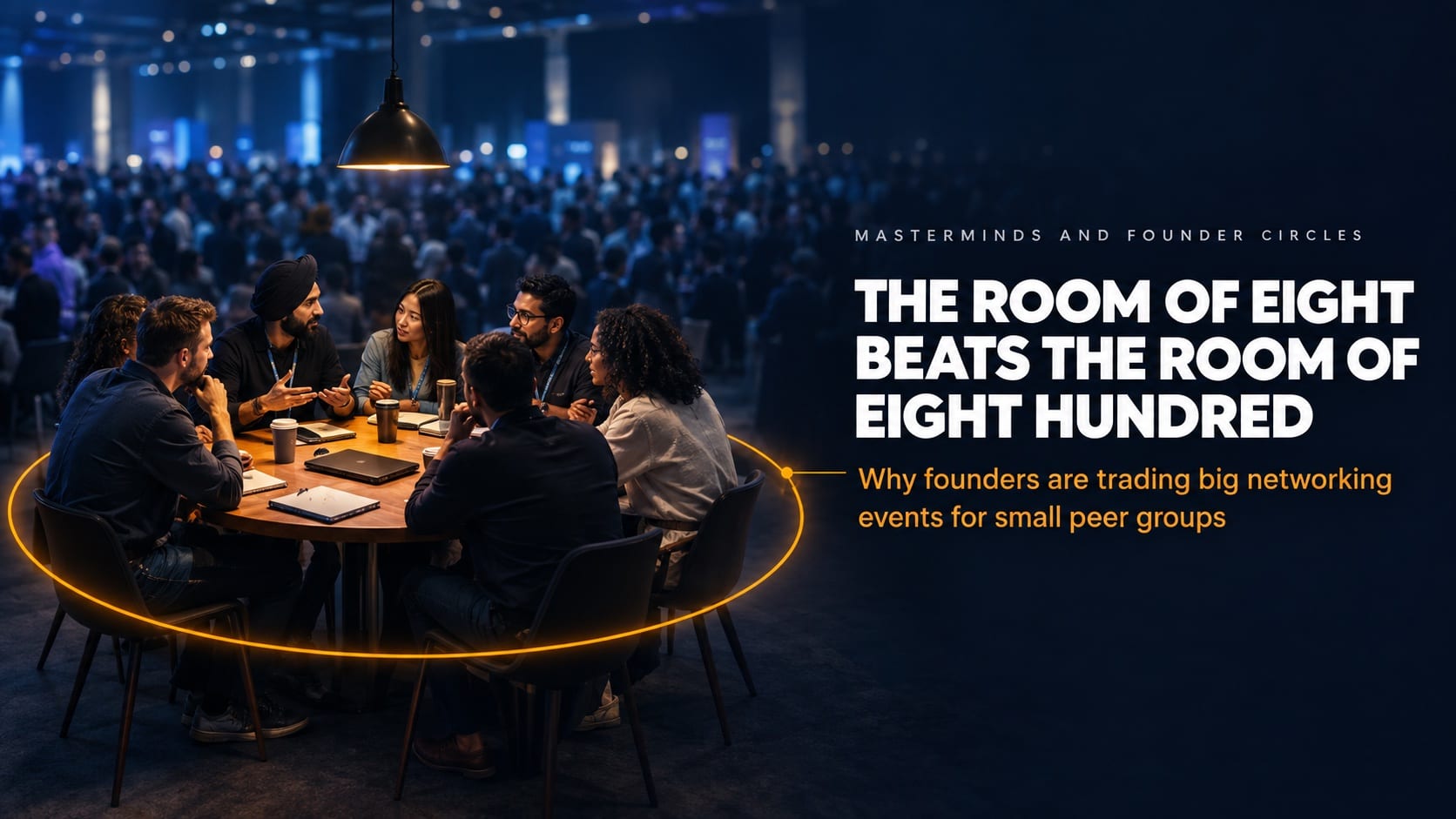

Masterminds and founder circles are no longer a niche habit of self-help devotees and Silicon Valley insiders. They have become the default way many founders look for advice, accountability and honest feedback. Ask a group of company builders where they get their best ideas and hardest truths, and a growing share will not mention a conference keynote or a panel. They will mention a recurring meeting with six to ten peers who know their numbers, their doubts and their blind spots.
The shift is easy to miss because it happens in private. Nobody posts a photo of a monthly founder dinner the way they post a conference badge. But the pattern is visible in the growth of paid peer networks, the rise of invite-only cohorts, and the number of founders who say their calendar now has more standing peer sessions than networking events.
This article explains what is driving that change, what these groups actually do, what they cost, where they fail, and how to join or start one without wasting a year finding out the hard way.
What Are Masterminds and Founder Circles?
Masterminds and founder circles are small, structured peer groups, usually five to twelve people, who meet on a regular schedule to help each other solve real business problems. The format varies, but the core is consistent: confidentiality, honest feedback, and a commitment to show up.
The word “mastermind” was popularized by Napoleon Hill in his 1937 book Think and Grow Rich, where he described a “master mind” as the coordination of knowledge and effort between two or more people working toward a common purpose. You can read about his legacy through the Napoleon Hill Foundation. The modern version is less mystical and more practical. It is a standing meeting where each member brings a challenge, the group asks hard questions, and everyone leaves with something to do before the next session.
A “founder circle” is typically a related but slightly different idea. It tends to be tied to a stage, a role or an identity: first-time CEOs, bootstrapped software founders, female founders, founders in a specific city. In practice the terms overlap so heavily that most people use them interchangeably, and so will this article.
What separates masterminds and founder circles from a casual group chat or a coffee habit is structure. Good groups have a facilitator or a rotating leader, a set agenda, agreed rules about confidentiality, and an expectation that members report back on what they did with the last round of advice.
A Short History: From Franklin’s Junto to Modern Founder Peer Groups
The idea is old. In 1727, a young Benjamin Franklin gathered a small circle of tradesmen and thinkers in Philadelphia into a club called the Junto. Members met weekly to discuss business, morals and ideas, and to help each other get ahead. Britannica’s profile of Franklin covers his work in building civic and intellectual institutions, and the Junto sits at the root of that story.
Fast forward to the twentieth century and the formal peer group became an institution. The Young Presidents’ Organization, now YPO, was founded in 1950. Vistage, which runs peer advisory groups for CEOs and business owners, traces its origins to 1957. The Entrepreneurs’ Organization, EO, launched in 1987. TIGER 21, a peer network for investors, started in 1999.
All of these institutions reached the same conclusion Franklin did: people who carry big responsibility learn faster from a small, trusted group of equals than from a crowd of strangers.
What is new today is the scale and the variety. The old model was expensive, formal and aimed at established executives. The new wave of founder peer groups starts at the earliest stage of company building, runs online as often as in person, and costs anywhere from nothing to tens of thousands of dollars a year.
Why Big Networking Events Stopped Working for Founders
To understand why masterminds and founder circles are rising, look at what is failing around them.
Large networking events were designed for a world in which access was scarce. If you wanted to meet an investor, a customer or an expert, you had to be in the same room. Today a founder can message almost anyone in minutes. The scarce resource is no longer access. It is trust, context and attention.
A big event delivers the opposite. You meet forty people for ninety seconds each. You exchange cards or LinkedIn requests. You follow up with a polite note that rarely leads anywhere. The conversation stays at the level of “What do you do?” because there is no time or safety to go deeper.
Anthropologist and psychologist Robin Dunbar proposed that humans can maintain roughly 150 stable relationships, with much smaller layers of close ones. You can see the idea summarized in Britannica’s entry on Dunbar’s number. You do not need to accept the exact figure to see the point: meaningful relationships form in small groups with repeated contact. A ballroom of hundreds gives you neither.
Founders also have a specific problem that large events cannot solve. The hardest questions they face are not “who should I meet?” but “should I fire my co-founder?”, “should I raise at this valuation?”, or “is this business actually working?” Nobody answers those honestly in a cocktail line. They need a room where the people around the table know the context and have nothing to sell.
7 Reasons Masterminds and Founder Circles Beat Big Networking Events
1. Trust Builds Because the Same People Show Up
The first advantage of masterminds and founder circles is repetition. When the same eight people meet every month, they learn your history. They remember that you were worried about churn in March and that you hired a head of sales in June. Advice improves because it is informed by your story, not a thirty-second summary.
Trust also changes what people say. In a stable group, members share real revenue, real conflicts and real fears. That level of candor almost never appears in a one-off event.
2. Advice Comes From Operators, Not Spectators
Conference stages are full of people who have succeeded and are describing it in hindsight. Founder peer groups are full of people who are in the middle of the same fight. A founder two months into a pricing change can tell you what actually happened to their conversion rate, not what a book says should happen.
That is the quality of advice that peer advisory groups for founders are built to deliver: current, specific and tested in conditions similar to yours.
3. Accountability Turns Ideas Into Action
Most founders do not lack ideas. They lack someone who will ask, next month, “Did you do it?” Masterminds and founder circles build that question into the format. Members commit to specific actions and report back at the next meeting.
The effect is simple but strong. People are far more likely to finish what they have told a respected group they will finish. A good circle turns vague intentions into dated commitments.
4. They Reduce Founder Loneliness
Leadership is isolating. A founder cannot fully share doubts with employees, investors or sometimes even family. In 2023 the U.S. Surgeon General issued an advisory on loneliness and social connection, treating it as a public health concern. You can find his office’s work at the Office of the Surgeon General. While the advisory covers the general population, the dynamic it describes is familiar to anyone who has run a company alone.
A founder mastermind group offers something rare: a place where you do not have to perform confidence. Many members describe that relief as the single biggest benefit, bigger than any tactical tip.
5. The Introductions Are Warmer and More Useful
Networking events promise connections, but the value of a connection depends on who vouches for it. When someone in your circle introduces you to an investor, a supplier or a potential hire, they put their own reputation behind it. That introduction converts far more often than a cold message sent after a conference.
Because members know exactly what you need, they also introduce you to the right people. A group of eight can quietly unlock a network of several hundred second-degree contacts, all pre-qualified by someone who knows you.
6. The Format Respects Your Time
A conference costs you two or three days, plus travel, plus the recovery time of being “on” the whole time. A mastermind typically asks for a few hours a month. For a founder whose calendar is the scarcest asset in the company, that difference matters.
The agenda is also focused. Instead of choosing between forty sessions and hoping one is relevant, you spend your time on the challenges you actually have.
7. The Value Compounds Over Time
A networking event gives you a spike of energy and a stack of contacts that decays within a month. Masterminds and founder circles compound. In year one, you get advice. In year two, you get people who have watched you grow and can challenge you more sharply. By year three, members often become informal advisors, co-investors, customers or co-founders of the next venture.
That compounding effect is the real reason many founders keep the same circle for years while their conference attendance quietly drops to once or twice a year.
The Main Types of Founder Peer Groups
Not all small peer groups work the same way. Knowing the main formats makes it easier to choose.
Paid Peer Advisory Groups
These are professionally run groups, often led by a trained chair or facilitator. Vistage, YPO and EO fit this model, as do many regional and industry-specific equivalents. They offer structure, vetting and a track record, but they cost money and may require a minimum revenue or company size.
Invite-Only Founder Circles
These are curated by a community builder, investor or accelerator. Entry depends on stage, sector or reputation. They tend to be smaller, more intimate and heavily focused on trust. The tradeoff is that access can depend on who you know.
Self-Organized Founder Mastermind Groups
A handful of founders decide to meet monthly and set their own rules. They cost nothing except time. They can be excellent, but they also have the highest failure rate, because nobody is responsible for keeping the group on track.
Online Masterminds
Video-based groups have removed geography as a barrier. A solo founder in a small city can now join a circle of peers across several time zones. The loss of in-person chemistry is real, but for many founders the access outweighs it.
What Do Masterminds and Founder Circles Cost?
Costs vary enormously. Self-run circles are free. Community-based groups may charge a modest monthly fee. Established peer advisory organizations often charge annual membership fees that run from several thousand to tens of thousands of dollars, depending on the organization, region and level.
The right question is not “is it cheap?” but “what is one good decision worth?” A single avoided hiring mistake, a better pricing structure or a well-timed introduction can easily exceed the membership cost. Still, treat price as a signal to check, not proof of quality. Ask for references, talk to current members, and attend a trial session if the group allows one.
How to Join or Start Masterminds and Founder Circles
If you want to benefit from masterminds and founder circles, you have two routes: join an existing group, or build your own.
How to Choose a Group to Join
Before you commit, look for four things:
- Stage match. Members should be within a similar range of revenue, team size and challenges. A pre-revenue founder in a group of established CEOs will struggle to contribute, and the reverse is also true.
- Clear rules. Confidentiality, attendance and how time is divided should be written down, not assumed.
- A strong facilitator. Groups drift without someone keeping the discussion honest and on schedule.
- No selling. If members are there mainly to pitch each other, leave.
How to Build Your Own Founder Mastermind Group
Starting your own is realistic and often the best way to get a perfect fit. A workable plan looks like this:
- Pick six to eight people whose judgment you respect and who face similar challenges. Aim for a mix of strengths rather than clones of yourself.
- Set a regular rhythm. Monthly works for most groups, with sessions lasting two to three hours. Put dates in the calendar for the full year.
- Agree on ground rules in the first meeting: confidentiality, no phones, no pitching, and a commitment to attend.
- Use a simple format. Each member gets a block of time. They share a challenge, the group asks questions before offering advice, and the member closes by stating what they will do next.
- Review the previous commitments at the start of every session. This is the habit that makes the whole system work.
- Rotate the facilitator so that no one person carries the burden.
- Review the group after six months. Remove members who do not show up or contribute, and add new ones if needed.
Common Mistakes That Kill Peer Groups
Many masterminds and founder circles die within a year. The causes are predictable.
Mismatched members. When some people are far ahead or far behind, the conversation never finds a level.
Weak commitment. If attendance slips, trust slips with it. Two or three missed sessions can end a group.
Advice without questions. Groups that jump straight to opinions give shallow advice. The best sessions begin with clarifying questions.
No accountability. Without a review of previous commitments, the group becomes a pleasant conversation instead of a driver of progress.
Hidden agendas. If members are using the group to recruit clients or find investors, the trust that makes it valuable collapses.
The Honest Limits of Small Peer Groups
A trustworthy picture of masterminds and founder circles has to include their downsides.
Peer groups can become echo chambers. If everyone shares the same assumptions, they can reinforce bad ideas. Strong groups include at least one person who regularly disagrees.
They can also create false confidence. Peers are not lawyers, accountants or investors. Advice on legal, tax or financial questions from a friendly group should be checked with qualified professionals.
Finally, there is a risk of exclusivity. Invite-only circles can concentrate opportunity among people who already have networks, which makes it harder for outsiders to enter. If you are building one, consider how to keep the door at least partly open.
None of this cancels the benefits. It simply means a circle works best when it is treated as one input among several, alongside customers, mentors, advisors and data.
Do Networking Events Still Have a Place?
Yes, but a different one. Large events are still useful for market research, spotting trends, finding a specific person, or discovering new circles to join. Many founders now treat conferences as a place to recruit trusted peers rather than a place to build relationships from scratch.
The healthiest approach is a mix: a small, steady circle for depth, and a limited number of events for breadth. The mistake is relying on events alone and expecting them to provide trust, accountability and honest feedback. They were never built for that.
Frequently Asked Questions About Masterminds and Founder Circles
How many people should be in a founder mastermind group?
Most effective groups have between six and ten members. Fewer than five can feel thin if people miss a session. More than ten makes it hard for everyone to get enough time.
How often should a founder peer group meet?
Monthly is the most common rhythm, with sessions of two to three hours. Some groups also add a short weekly check-in for accountability.
Are masterminds and founder circles only for startups?
No. Small business owners, freelancers, creators and executives all use them. What matters is that members face comparable challenges and are willing to be open.
Can online masterminds work as well as in-person groups?
They can, especially when the group meets consistently and uses video. In-person meetings build trust faster, so many groups combine regular online sessions with one or two annual in-person gatherings.
What is the difference between a mentor and a mastermind?
A mentor offers guidance from experience and usually works one-to-one. A mastermind is a group of peers who learn together and hold each other accountable. Most founders benefit from having both.
The Bottom Line
The rise of masterminds and founder circles tells us something simple about how people build companies. Information is abundant. Trust is not. A founder can read every book and watch every talk and still make a costly mistake because nobody who knew the full picture was there to question the plan.
Small peer groups fix that. They give founders a steady room of people who know their story, ask better questions and notice when a promise goes unkept. They cost little time, they compound over the years, and they ease a kind of loneliness that few other tools address.
If you have been collecting business cards without collecting real allies, the next step is not another conference. It is a short list of six or eight people you respect, an invitation to a first meeting, and a calendar that holds the date. Start there. The best networking you do this year may happen around a single table.
Related Articles on IMFounder
- 5 Powerful Startups You Can Launch With Only $1,000
- How to Validate a Startup Idea Without Writing a Single Line of Code
- Startup Failure Rate 2026: Why 90% of Startups Fail (Data + Real Case Studies)
- 7 Shocking Lessons From the OpenAI–Australia AI Agent Breach
- SR&ED vs R&D Tax Credit: 7 Brutal Truths for Founders