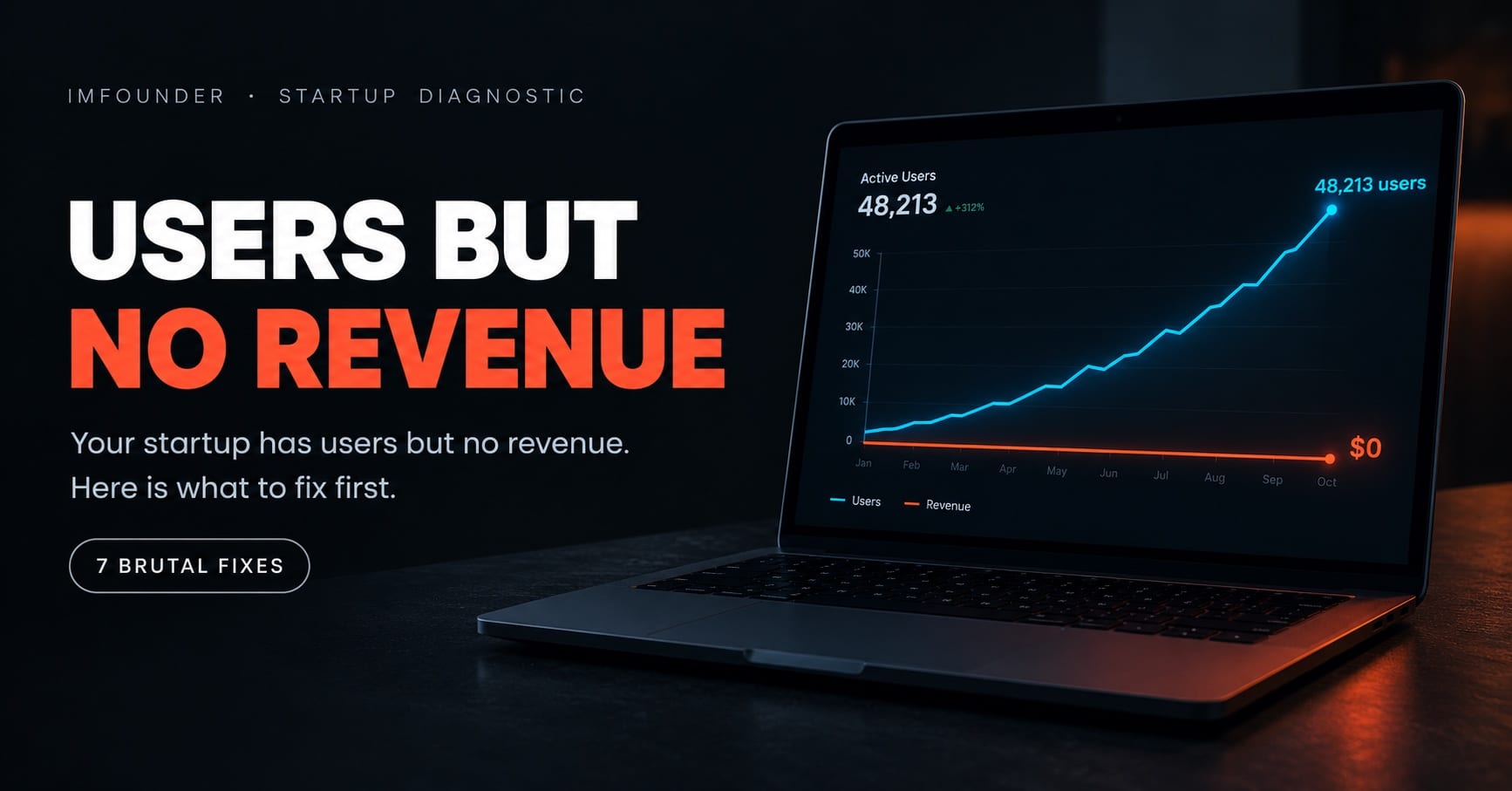

Your startup has users but no revenue. Here is the diagnostic order for conversion problems, weak positioning, pricing mistakes, and customers who love the product but won’t pay.
Users but no revenue is the most misleading milestone in startup life. The dashboard looks healthy. Sign-ups climb, customers send warm messages, and your updates read like good news. Then you open the bank account, and the one number that keeps the company alive has not moved.
If your startup has users but no revenue, you are in good company, and you are not automatically doomed. But you are in a risky place, because attention feels like progress and is not. The common response is panic: slash the price, bolt on features, and hope. The better response is a diagnosis.
This guide gives you that diagnosis in a specific order. It covers conversion problems, weak positioning, pricing mistakes and the maddening case where customers love the product but won’t pay. For each, you get a test you can run this week and a rule for what to do with the result.
The short answer: check these in order. (1) Are your users real? (2) Is the problem painful enough to pay for? (3) Is your positioning clear? (4) Is the path to payment broken? (5) Is the price wrong? (6) Are you talking to the actual buyer? (7) Does the business model fit the customer? Most founders jump straight to step five because price is the fastest thing to change. It is usually the wrong place to start.
Why Users but No Revenue Is a Diagnosis Problem, Not a Pricing Problem
A flat revenue line is a symptom, and a symptom has many possible causes. Founders grab the nearest lever, which is price, because it takes five minutes to change. That is how a positioning problem becomes a cheaper positioning problem.
The research on failure points upstream. In CB Insights’ widely cited analysis of startup post-mortems, “no market need” was the most common reason, named by 42 percent of failed companies, ahead of running out of cash at 29 percent. Pricing and cost issues appear on that list too, but they trail the demand problem by a wide margin. Two caveats: founders could cite several reasons, so the figures overlap, and the sample was small and tilted toward venture-backed tech.
The top two items are linked. Running out of cash is often what “nobody pays quickly enough” looks like from the inside. Here is a map of the most common patterns:
| What you see | Likely cause | First test |
|---|---|---|
| Users sign up but never come back | No real problem, or weak activation | Day-7 retention and exit interviews |
| Users return but can’t explain what you do | Weak positioning | Ask five users to describe it unprompted |
| Users love it, hit the paywall, leave | Conversion or pricing friction | Funnel drop-off and session recordings |
| Users say they’d pay, then don’t | Polite interest, no budget | Ask for a pre-order or paid pilot |
| The team uses it, the boss won’t buy | Wrong buyer | Map who signs the invoice |
Use the table as a map. The rest of this article follows the order I recommend: the cheapest and most fundamental checks first.
Step Zero: Make Sure Your Users Are Real Users
Before you diagnose users but no revenue, define what a “user” means. A sign-up is not a user. A visit is not a user. A real user is someone who completed the core action that delivers your product’s value at least once.
Pull your last 100 sign-ups and count how many reached that moment. If most never did, you have an activation problem before you have a revenue problem, and no pricing change will fix it. Also check where those sign-ups came from. A launch-day spike, a giveaway or a viral post can fill your database with people who were never your customer. Count only the ones who match the person you built this for.
Write down two numbers and keep them visible: activated users and retained users at day 7 and day 30. Everything below depends on them.
Fix 1: Prove the Problem Is Painful Enough to Pay For
Here is the uncomfortable truth behind most cases of users but no revenue: the product is pleasant, not necessary. Pleasant products collect free users. Necessary products collect payment.
The cleanest test is the product-market fit survey popularized by Sean Ellis. Ask people who have experienced your core value one question: “How would you feel if you could no longer use this product?” The common benchmark is that 40 percent or more answering “very disappointed” signals real pull. Superhuman’s team used it systematically, and First Round Review’s account of how Superhuman found product-market fit describes starting at 22 percent, focusing on the users who loved the product most, and reportedly reaching 58 percent. Treat 40 percent as a heuristic, not a law, and make sure you have enough responses to mean something.
The rule: if fewer than 40 percent say “very disappointed,” do not touch pricing. Go back to the problem.
Then talk to people the right way. The Mom Test, a short book on customer interviews, makes a point every founder should absorb: opinions about the future are worthless, and facts about the past are gold. “Would you pay for this?” invites a polite lie. Better questions are:
- What did you do the last time this problem came up?
- What did it cost you in time or money?
- What have you already paid for to solve it?
If the answers to the last question are “nothing, I just live with it,” you have found your answer.
Fix 2: Sharpen Your Startup Positioning Before You Touch the Price
Weak startup positioning is the quiet cause of many cases of users but no revenue. When people cannot say what your product is, who it is for and why it beats the alternative, they will not pay, however much they like you.
Run a simple test. Ask five active users to explain your product in one sentence to a colleague, without looking at your website. If you get five different answers, your positioning is the problem.
Fix it with a plain structure:
For [specific customer] who [painful situation], [product] is a [category] that [concrete outcome], unlike [what they do today].
Two details matter most. First, the real competitor is what the customer does today, often a spreadsheet, a contractor or doing nothing. Second, narrow beats broad. Consider a hypothetical scheduling tool described as “smart scheduling for teams.” Compare it with “reminders that cut no-shows at dental clinics.” The second is easier to find, easier to believe and easier to price, because the buyer can calculate what a missed appointment costs. This is an illustration, not a case study, but the pattern holds across categories.
Fix 3: Repair the Path From Free to Paid
If your users are real and your positioning is clear, look at the funnel. Free users not converting is usually a leak in one specific step, and finding it takes an afternoon. Map the path: sign-up, activation, first value, pricing page, checkout, payment. Measure the drop at each step and fix the biggest one.
The usual leaks:
- The paywall appears before value. People pay after they see results, not before.
- The free plan solves the whole problem. If free users get everything they need, they have no reason to upgrade.
- There is no natural upgrade trigger. Gate on a value metric such as usage, seats or outputs, not on arbitrary features.
- Checkout friction. Forced credit cards, no invoice option for business buyers, or no clear next step.
- Nobody ever asked. Many founders never make a direct request for payment.
That last one is more common than it sounds. Paul Graham’s essay Do Things That Don’t Scale argues that early-stage founders should recruit and talk to users by hand. Apply it here: email your 20 most active free users personally and offer a paid plan. The goal is not to close all 20. The goal is to hear the reason when they say no. That one email can teach you more than a month of analytics.
Fix 4: Correct the Startup Pricing Mistakes That Kill Revenue
Now, and only now, look at price. These startup pricing mistakes show up again and again when a company has users but no revenue.
Underpricing out of fear. A very low price attracts the least committed customers and cannot fund support or acquisition. Here is illustrative math. At $9 a month with 5 percent monthly churn, a customer stays about 20 months (1 divided by 0.05) and generates roughly $180. At $49 with the same churn, the same customer generates about $980. If your acquisition and support costs sit between those two numbers, the low price does not just reduce revenue. It makes the business impossible.
Pricing by cost instead of value. Your cost to serve is irrelevant to the customer. What matters is what the outcome is worth to them.
Charging for the wrong thing. Price on the metric that tracks the value customers receive, such as seats, projects or results, not on something they do not care about.
Too many tiers. Three clear options beat six confusing ones.
Reflexive discounting. Discounts feel like a shortcut to conversion, but they train customers to wait and give margin to people who would have bought anyway. IMFounder’s explainer on how AI decides who gets the discount shows how sophisticated retailers try to separate customers who need an incentive from those who do not. A startup can borrow the principle without any machine learning: do not discount for people who already want it.
Never testing price. Run a pricing conversation, not a guess. Ask prospects at what price the product feels so cheap they would doubt its quality, at what price it gets expensive, and at what price it is too expensive. Then offer real prices to new cohorts and watch what they do, not what they say.
When Customers Love the Product but Won’t Pay
This is the most painful version of users but no revenue. People tell you they love it. They recommend it. They still do not pay. The reasons are usually structural, not emotional:
- The user is not the buyer. The person who loves the tool has no budget, and the person with the budget has never heard of you.
- There is no budget line. Nobody pays for the current solution because the problem is tolerated, not solved.
- It is a vitamin, not a painkiller. Nice to have, never urgent.
- A free alternative is good enough. Including a spreadsheet and a shrug.
- Switching costs outweigh the benefit. Migration, training and risk all count.
The test is direct: ask for money in a form that costs something to refuse. A pre-order, a deposit, a paid pilot with clear success criteria, or a signed letter of intent. Love is free. A signed invoice is information.
If users won’t pay even a small amount for something they say they love, take that seriously. Either the buyer is somewhere else, or the value is smaller than the compliments suggest. Both are fixable, but only if you stop reading praise as demand.
Fix 6: Remove Risk and Trust Barriers
Sometimes the product is valuable, the price is fair and buyers still hesitate. Risk is the hidden brake, especially in business software, finance, health and AI products. Buyers worry about data security, integration effort, switching pain and being the person who chose the tool that failed.
Reduce that risk deliberately. Offer a pilot with defined success criteria. Add a money-back guarantee. Publish security and privacy details in plain language. Show two or three specific customer outcomes with numbers. Offer onboarding help. Each of these tells a buyer that you will carry part of the risk.
Fix 7: Check Whether Your Business Model Fits Your Customer
If the earlier fixes are clean and you still have users but no revenue, question the model itself. Some products attract consumers who will never pay, because the category runs on advertising or data and needs enormous scale. A freemium product converting a tiny share of a small base cannot fund a company. A product loved by individuals may need to be sold to their employer instead.
This is where cash decides how fast you move. Runway is your cash divided by your monthly net burn. With $90,000 saved and $6,000 a month in burn, you have 15 months, and a pivot, a pricing test and a sales cycle all consume them. IMFounder’s guide to bootstrapping vs raising walks through the runway math and the real cost of outside capital. If you are thinking about raising, read what seed investors really want from technical founders in 2026 first. They fund evidence of demand, and a company with users but no revenue has not yet produced it.
The 30-Day Plan for Users but No Revenue
Do not fix everything at once. Run this sequence and make a decision at the end.
Week 1: Measure.
- Define activation and count activated users.
- Build the funnel from sign-up to payment and find the biggest drop.
- Segment users by source and by behavior.
Week 2: Listen.
- Interview 15 to 20 users, focusing on past behavior and current spending.
- Send the “very disappointed” survey to activated users.
- Ask the five most engaged users what they would pay and who else must approve the purchase.
Week 3: Sharpen and ask.
- Rewrite your positioning for one narrow segment.
- Offer paid pilots or pre-orders to your 10 best-fit accounts.
- Email active free users with a direct upgrade offer.
Week 4: Test and decide.
- Test two price points on new conversations.
- Review the results against a decision rule:
- Payments arrived: double down on that segment and price.
- Interest but no payments: the buyer or budget is wrong. Find who owns the money.
- Neither: the problem is not painful enough. Narrow, change segment or pivot.
For deeper reading on what separates survivors from casualties, browse IMFounder’s startup failures coverage, and consider a small peer group. IMFounder has also reported on why masterminds and founder circles are replacing big networking events, and a trusted circle is often where a blind spot gets named.
Stuck With Users but No Revenue? Get an Outside Diagnosis
The hardest part of this diagnosis is that you are inside the idea. You cannot easily see which of the seven problems is yours, and friends will tell you it is great.
That is the gap IMFounder’s Founder Review is built to close. It is a startup advisory service for early-stage founders, with knowledge of the Canadian and US startup ecosystems, and sessions run remotely. A review covers idea validation and viability, market research and competitive landscape, solution design and refinement, go-to-market strategy, marketing ideas and pitch or business plan review, with ongoing monthly advisory available. You apply with the details of your idea, IMFounder replies within 48 hours with a proposed scope, engagements typically take three to ten business days, your idea stays confidential, and the first conversation is free with no obligation. It is an honest outside read before you spend more runway.
FAQ: Users but No Revenue
Why does my startup have users but no revenue?
Usually because one of seven things is true: users are not activated, the problem is not painful enough, the positioning is unclear, the path to payment is broken, the price is wrong, you are talking to the wrong buyer, or the business model does not fit the customer. The diagnostic order above helps you find which one.
Should I lower my price if users won’t pay?
Not first. Price is the fastest lever and the least likely root cause. Check demand, positioning and the buyer before cutting. Often the answer is a higher price paired with a clearer promise.
How early should a startup start charging?
As early as you can ask honestly. An early paid commitment is the strongest signal you will get, far stronger than sign-ups or compliments. A pilot or pre-order counts.
Do free users count as traction?
Only as a leading indicator, and only if they are activated and match your target customer. Free users who never reach the core value are a vanity metric.
When should I pivot?
When you have run the diagnosis, asked real buyers for real money, and the answer from your target segment is still no. A pivot should follow evidence, not discouragement.
Final Word: Revenue Is the Only Honest Feedback
Users are a promise. Revenue is proof. A startup with users but no revenue is standing between the two, and the way across is not a bigger discount or another feature. It is a disciplined sequence: confirm the users are real, confirm the problem hurts, make the offer clear, remove friction, set a price that matches the value, find the person with the budget, and match the model to the customer.
Pick the first check you have not done, run it this week, and let the evidence, not the compliments, tell you what to fix next.