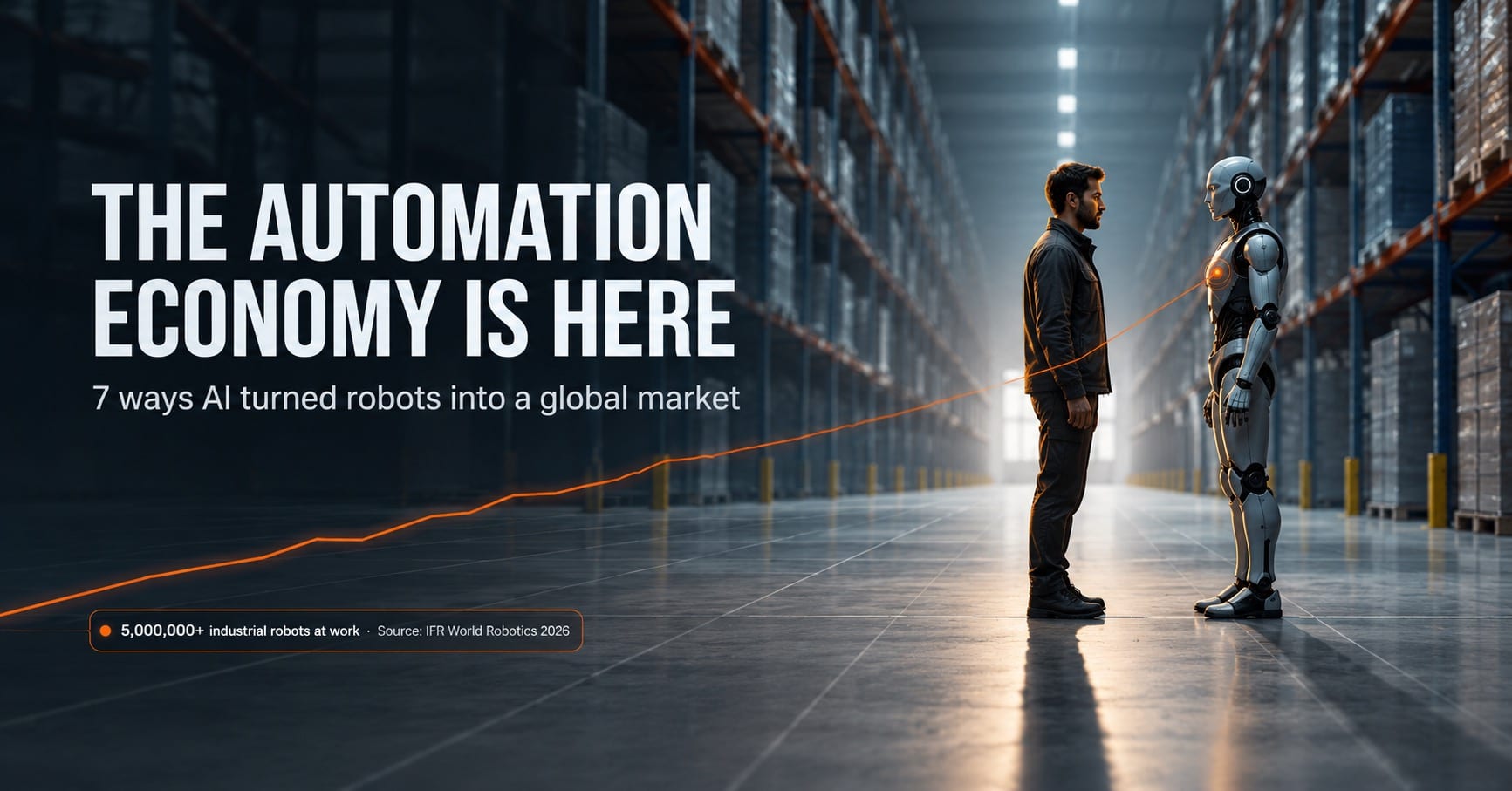

Humanoid robots, million-robot warehouses and AI-run factories are rewriting how the world makes and moves things. Here is what is real, what is hype, and which industries are most exposed.
The automation economy is no longer a forecast tucked inside a consulting deck. It is a budget line on factory floors, a hiring plan inside the world’s largest online retailer, and a funding thesis behind some of the most ambitious startups alive.
The evidence is hard to ignore. Factories installed more than 600,000 new industrial robots in 2025, and the global fleet passed five million machines for the first time, according to the International Federation of Robotics (IFR). Behind that number sits a quieter shift: artificial intelligence now lets machines see, plan and adapt, which means robots can finally leave the caged assembly line and enter messier, more valuable work.
This guide separates verified data from headline hype. You will see how big the automation economy really is, where humanoid robots stand today, why warehouses became the testing ground, what AI-powered manufacturing looks like in practice, and which industries face the most exposure. If you are a founder, investor, operator or worker, you will leave with a clearer map and a short action plan.
1. AI Gave Machines Judgment: The Spark Behind the Automation Economy
For decades, industrial robots were powerful but not very smart. They repeated a programmed motion with extraordinary precision, as long as the part arrived in exactly the right place. Change the part, the lighting or the layout, and the robot stalled. Engineers often spent more on fixtures and programming than on the robot itself.
AI changed that equation. Modern machine vision, learned control and large neural models allow robots to recognize objects, adjust their grip and recover from surprises. The IFR points to advances in AI, machine vision and sensor technology, together with skilled-labor shortages and demographic change, as the forces pushing robot demand higher.
Three forces powering the automation economy
- Smarter software. Perception and planning models turn a generic arm or walking machine into a flexible worker.
- Cheaper, better hardware. Sensors, actuators and onboard computing keep improving, which lowers the cost of each new deployment.
- Labor pressure. Aging workforces and hard-to-fill physical jobs push employers to automate tasks that fewer people want to do.
Together, these forces explain why the automation economy is expanding across so many industries at once.
Why this wave is different
Earlier automation replaced one task at a time, and each replacement required fresh engineering. This wave aims at general capability: a machine that can be retrained for a new job through software rather than rebuilt through hardware. That flexibility is why many investors now treat robotics as a new market rather than a niche of industrial equipment.
2. Five Million Robots: The Hard Numbers Behind the Automation Economy
Numbers keep the automation economy honest, so start with the most credible source in the industry. The IFR’s World Robotics 2026 report, released on 24 September 2026, found the following.
| Metric | Latest figure |
|---|---|
| New industrial robots installed worldwide (2025) | 603,307 units, up about 11% |
| Global operating stock of industrial robots | 5,079,078 units, up 9% |
| IFR forecast for 2026 installations | 655,000 units (+9%) |
| IFR forecast for 2029 installations | 806,000 units |
| China installations (2025) | 354,000 units, about 59% of the world total |
| United States installations (2025) | Almost 38,500 units, up 12% |
| India installations (2025) | Almost 10,500 units, up 15% |
Sources: IFR World Robotics 2026 executive summary and Australian Manufacturing’s report on the findings.
Three takeaways stand out.
China sets the pace. China installed 354,000 robots in 2025, and Chinese manufacturers supplied 55% of the units installed in their home market. The supply side of robotics is shifting, not only the demand side.
The United States is climbing. U.S. installations overtook Japan’s, making America the second-largest market. Japan, by contrast, fell 19% to about 36,200 units, according to coverage of the IFR release.
Growth is not fragile. The IFR notes that regional patterns may shift, yet it sees no sign that the long-term growth trend is ending.
These figures describe industrial robots, the mature core of the automation economy. The newer, more speculative layer is humanoid robots.
3. Humanoid Robots Left the Lab, but Hype Still Outruns the Hardware

No corner of the automation economy attracts more attention, or more exaggeration, than humanoid robots. The pitch is simple: a machine shaped like a person can step into spaces built for people, from factory aisles to hospital corridors, without anyone redesigning the building.
What the humanoid robots shipment data really says
Estimates for 2025 vary, which is itself a sign of an immature market. Analyst counts, including a report from Omdia, put worldwide humanoid shipments at roughly 13,000 units, as summarized in this deployment-gap analysis. Unitree’s stock-market prospectus says the Chinese company alone shipped more than 5,500 humanoids in 2025, while U.S. startups Figure AI and Agility Robotics each shipped about 150, according to Interesting Engineering’s reality check.
Momentum is real. One market research firm estimates that about 19,100 humanoid units shipped in the first half of 2026, with Chinese manufacturers accounting for more than 97%. Treat that as an estimate, not an audited fact.
Where Tesla, Figure and Agility actually stand
On its July 22, 2026 earnings call, Tesla said it was installing first-generation Optimus production lines in Fremont. Elon Musk described Optimus as the hardest product the company has ever tried to scale, because the supply chain for a humanoid does not yet exist. As of that call, Tesla had not publicly verified a production unit from the new line, as the same reality check reports.
Figure’s humanoid completed an eleven-month posting at BMW’s Spartanburg plant that ended in November 2025, and Agility Robotics is described by Humanoid Guide as having one of the clearest operating records among Western humanoid makers. Claims of tens of thousands of deployed humanoids, that review cautions, often do not come from the companies themselves.
A founder’s reading of humanoid robots in the automation economy
My read is that humanoid robots will follow the path of industrial robots more than the path of smartphones: slow, task-by-task adoption in structured environments, with costs falling as volumes rise. The winners are unlikely to be the companies with the best demo videos. They will be the ones that deliver reliable uptime, safety certification and a clear return on investment per shift.
4. Warehouse Automation Became the Proving Ground for the Automation Economy
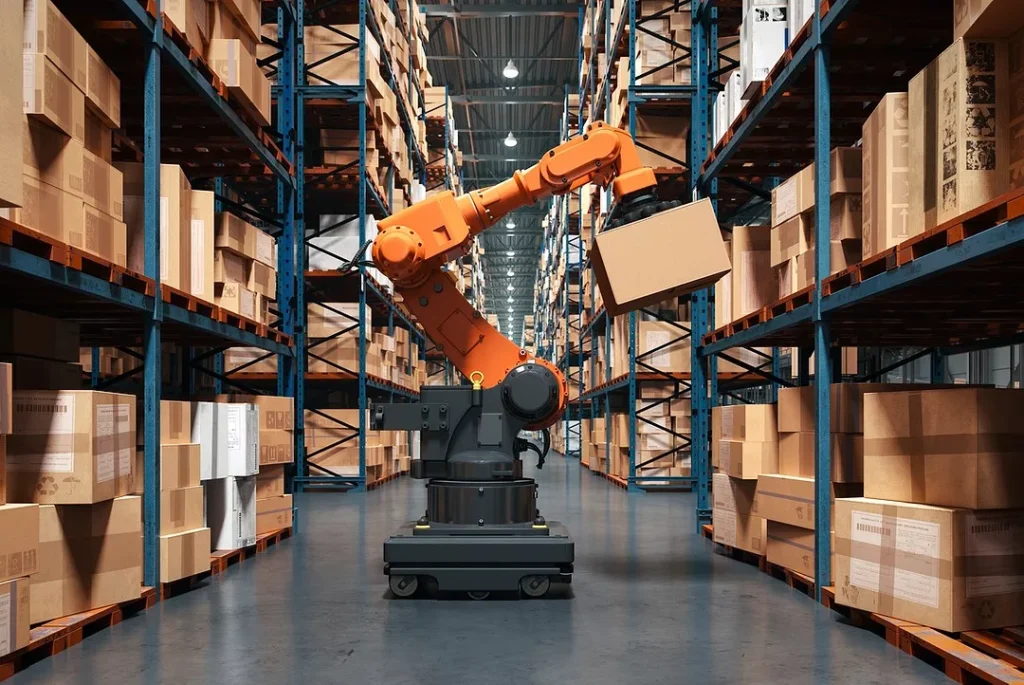
If humanoids are the promise, warehouse automation is the proof of the automation economy. Warehouses offer repeatable tasks, measurable productivity and operators who track cost per package to the cent. That makes them the ideal laboratory for robotics at scale.
Amazon’s million-robot milestone
In July 2025, Amazon announced that its one millionth robot had arrived at a fulfillment facility in Japan. The company also introduced an AI model that coordinates robot traffic and was expected to make the fleet about 10% faster, TechCrunch. One of its newer machines, called Vulcan, has a sense of touch that helps it pick items from crowded shelves. Amazon has also said that roughly 75% of its global deliveries are assisted by some form of robotics, according to a summary of the Wall Street Journal’s reporting.
What automation-first buildings mean for workers
Internal documents seen by The New York Times, as summarized by Interesting Engineering, suggest Amazon has modeled a future in which it sells about twice as many products by 2033 without a matching rise in headcount, and in which it automates as much as 75% of its operations. Those are reported internal plans, not announced targets. Amazon has also pointed to new technical roles, such as robot maintenance, as part of the picture.
The runway ahead for warehouse automation
One industry analysis estimates that the global warehouse automation market could grow from about $30 billion in 2026 to roughly $60 billion to $66 billion by 2030 or 2031, and that around 80% of warehouses still run without automation. See the full analysis and treat the figures as estimates. Even so, the direction is clear: warehouse automation is moving from competitive edge to operating expectation.
5. AI-Powered Manufacturing Is Rewiring the Factory Floor
AI-powered manufacturing is the least glamorous and most valuable corner of the automation economy. It rarely makes headlines, yet it is where the largest number of robots actually work.
From programmed motion to adaptive work
Traditional factory robots followed fixed scripts. AI-powered manufacturing adds cameras, sensors and learning software, so a robot can inspect a weld, pick a randomly placed part, or adjust when a component varies slightly. Predictive maintenance models flag a failing motor before it halts the line, and scheduling software keeps expensive equipment busy.
Which sectors lead
The IFR reports that the automotive industry remained the second-largest customer of industrial robots in 2025. In Germany, which accounts for 41% of all robot installations in the European Union, automotive is still the biggest user, although its share is falling, according to German industry coverage of the report. A falling share is good news for the robotics industry: it signals that customers are diversifying beyond cars.
Cobots bring the automation economy to mid-sized factories
Collaborative robots, or cobots, work near people without heavy safety cages and are easier to reprogram. That lowers the entry cost for small and mid-sized manufacturers, which is where much of the next growth in AI-powered manufacturing is likely to come from.
6. New Markets Born From the Automation Economy
The automation economy does not only sell robots. It creates entire supply chains and service categories around them. For founders, this is where the opportunity may be largest.
- Components. Actuators, sensors, batteries and precision gears. Musk’s own comment that no ready-made supply chain exists for humanoids shows how much room there is for specialist suppliers.
- Robotics software and simulation. Tools that train, test and monitor robot behavior before it reaches the factory floor.
- Integration services. Most buyers do not want a robot; they want a working line. Integrators who make the machines fit existing operations are in demand.
- Robots as a service. Leasing models let customers pay per task or per shift, which reduces upfront risk and speeds adoption.
- Safety, compliance and insurance. Machines that share space with people need standards, audits and coverage.
- Maintenance and fleet operations. A million robots need technicians, spare parts and software updates.
The entrepreneur’s lens on the automation economy is simple: when a gold rush begins, sell the tools and solve a specific vertical problem better than anyone else. Narrow, measurable outcomes such as cost per pick or defects per thousand beat grand visions.
7. The Industries Most Exposed to the Automation Economy
Exposure is not the same as elimination. Automation targets tasks, and most jobs bundle many tasks together. Still, the industries exposed to automation first share three traits: repetitive work, standardized environments and persistent labor shortages or turnover. The table below summarizes where current evidence points.
| Industry | Why it is exposed | What still protects human work |
|---|---|---|
| Warehousing and logistics | Repetitive picking, moving and sorting, with large operators already running huge robot fleets | Handling unusual items, fixing exceptions, maintaining machines |
| Electronics and automotive manufacturing | Among the largest customers of industrial robots, per the IFR | Complex assembly, line changeovers, quality judgment |
| Retail checkout and cashier roles | The World Economic Forum lists cashiers among the roles expected to decline | Customer service, trust, handling disputes |
| Clerical and data-entry work | The World Economic Forum expects data entry clerks and administrative assistants to decline | Oversight, exceptions, relationship-based work |
| Hospitality, entertainment and education pilots | Chinese humanoid makers are shipping into these settings, according to industry analysis | Empathy, improvisation, human connection |
What the automation economy means for jobs
The World Economic Forum’s Future of Jobs Report 2025, based on a survey of more than 1,000 employers, expects 170 million new roles and 92 million displaced roles by 2030, a net gain of 78 million jobs. That headline is encouraging, yet the details matter. Robotics and autonomous systems are expected to be among the biggest net displacers, with a net loss of about 5 million jobs, according to a summary from the University of Amsterdam. The same research finds that 41% of employers plan workforce reductions as automation spreads, and that 59% of workers will need training by 2030.
The lesson is balanced. The automation economy can create more jobs than it removes, but the people losing roles are not automatically the people gaining them. Geography, age and skills gaps decide who benefits.
How to Prepare for the Automation Economy: 5 Moves for Workers, Founders and Investors
- Audit tasks, not job titles. List the repetitive, rule-based tasks in your role. Those are the ones software and robots will reach first. Move your time toward judgment, relationships and problem solving.
- Learn the human-machine interface. Robot supervision, maintenance, data labeling and process design are growing skill sets, and they pay for themselves quickly.
- Founders: sell outcomes in one vertical. Pick an industry, measure a hard metric and use leasing or pay-per-use pricing to lower the buyer’s risk. This is the most reliable way to build inside the automation economy.
- Investors: trust deployments, not demos. Ask for paying customers, uptime, safety records and independent verification. The humanoid sector shows how quickly unaudited claims spread.
- Employers: pair automation with reskilling. Companies that retrain workers for supervision and maintenance roles keep institutional knowledge and reduce backlash.
Frequently Asked Questions
What is the automation economy?
The automation economy is the part of the global economy in which machines, guided by artificial intelligence, perform physical and cognitive tasks once done by people. It includes industrial robots, humanoid robots, warehouse systems, AI-powered manufacturing and the services built around them.
Which industries are most exposed to automation?
Warehousing and logistics, manufacturing, retail checkout and clerical or data-entry work show the strongest signals today. Exposure varies by task, so many roles will change rather than disappear.
Are humanoid robots commercially available?
Yes, but in small numbers. Analysts estimate around 13,000 humanoids shipped worldwide in 2025, mostly from Chinese manufacturers, and Western pilots remain limited. Mass deployment depends on reliability, safety and cost.
Is the automation economy creating or destroying jobs?
Both. The World Economic Forum projects a net gain of 78 million jobs by 2030, but robotics and autonomous systems are expected to displace more roles than they create.
Conclusion: The Automation Economy Rewards the Prepared
The automation economy is real, measurable and accelerating. Five million industrial robots are already at work, Amazon runs a fleet of more than a million warehouse machines, and humanoid robots are moving from stage demos to early production, even if the hype still runs ahead of the hardware. The IFR expects installations to keep climbing through 2029.
The smart response is neither panic nor blind optimism. Workers should move toward judgment and machine-supervision skills. Founders should build narrow, measurable solutions. Investors should reward evidence over spectacle. Whoever acts early on the automation economy will shape it, and whoever waits will adapt to it.
This article is for informational purposes only and is not investment or career advice. Figures come from the sources linked above; estimates are labeled as estimates.
Related Articles on IMFounder
- AI Is Entering the IVF Lab—and Quietly Getting a Vote on Who Gets Born
- Get Paid to Train AI: Your Daily Chores Are Becoming Robot Data
- AI Just Fired the Kitchen: Meet CA-1, This Robot Can Cook 800 Meals a Day
- Travis Kalanick Used CloudKitchens to Build a $1.7 Billion Robot Empire
- China Just Built a $650,000 Robot That Can Punch Through a Wall
- Humanized Robots Companies Leading The Humanoid AI Race
Sources and further reading
- IFR World Robotics 2026, Industrial Robots executive summary
- World Economic Forum, Future of Jobs Report 2025
- TechCrunch: Amazon deploys its one millionth robot
- Interesting Engineering: The humanoid robot reality check
- Humanoid Guide: Humanoid deployments in 2026