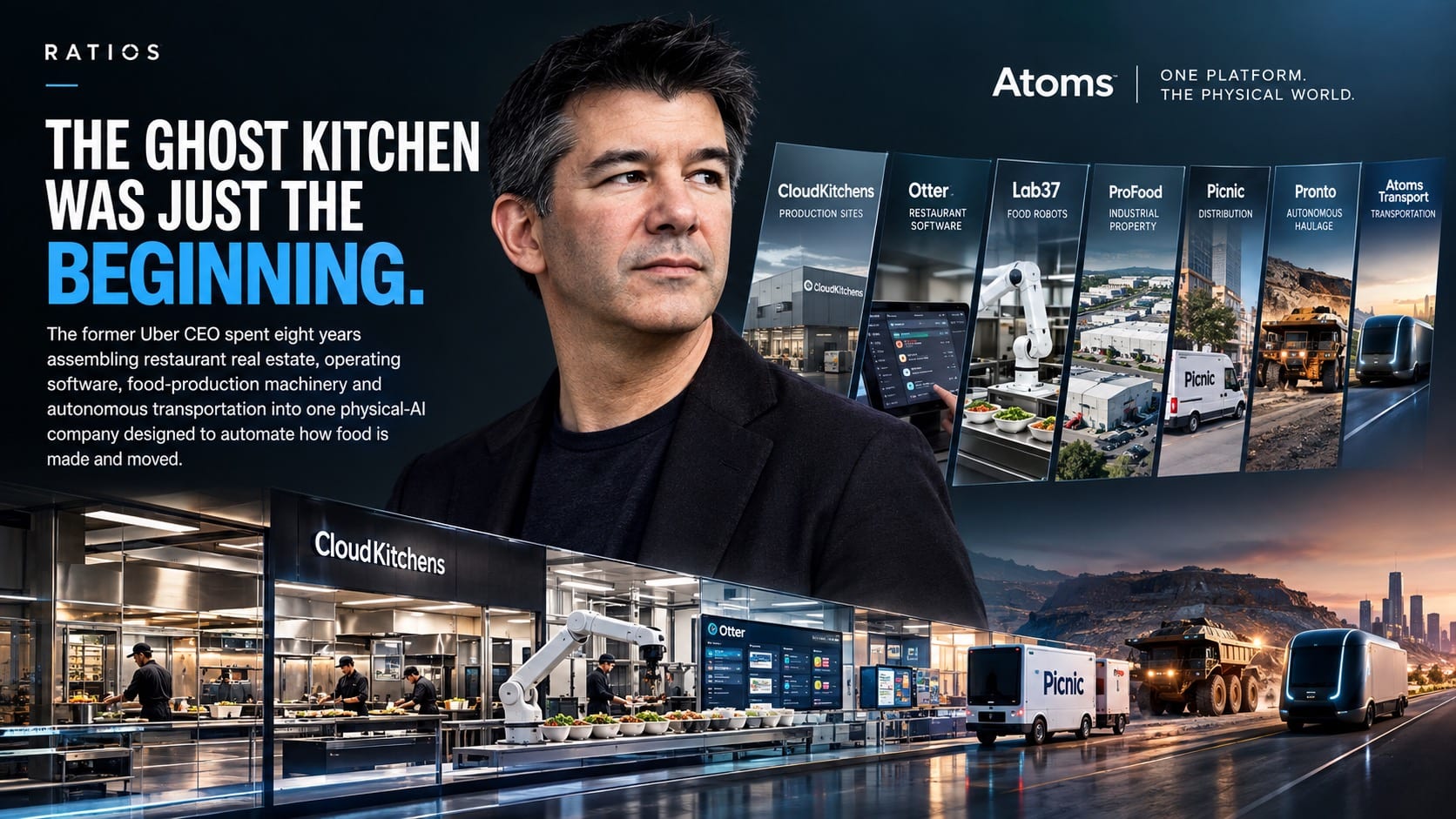

The former Uber CEO spent eight years assembling restaurant real estate, operating software, food-production machinery and autonomous transportation into one physical-AI company designed to automate how food is made and moved.
For eight years, Travis Kalanick appeared to be building a secretive ghost-kitchen company.
He was actually studying how the physical economy works.
That conclusion no longer depends on speculation. Andreessen Horowitz disclosed it while announcing its investment in Kalanick’s new physical-automation company, Atoms. The venture firm said City Storage Systems—better known as CloudKitchens—was created to discover the basic patterns governing how people “make, store, and move things” and learn how to build a computer for the physical world.
The kitchen business was the entry point. The larger target is physical labor.
Atoms now places CloudKitchens beside Otter, Lab37, ProFood, Picnic, autonomous-mining company Pronto and an unrevealed transportation division. The company raised $1.7 billion in a round led by Andreessen Horowitz and joined by Uber.
This is not another delivery application. It is an attempt to control the property, software, machinery and transportation required to manufacture and move food with fewer workers.
The Ghost Kitchen Was the Beginning
After leaving Uber, Kalanick took control of City Storage Systems and expanded CloudKitchens into multi-tenant, delivery-only kitchen facilities. Restaurants could enter new markets without building dining rooms while CloudKitchens supplied the operating infrastructure.
Kalanick later described the facilities as “multi-tenant food manufacturing” sites. The kitchen becomes a production floor, the meal a standardized output and the cook one component inside a measurable system.
Andreessen Horowitz has now provided the clearest explanation of what that system was designed to accomplish. Its investment announcement says Kalanick used CloudKitchens to learn the patterns behind making, storing and moving physical goods. It describes Atoms as a manufacturer of specialized computers for food, mining and transportation.
The official Atoms portfolio reveals the assembled stack: production sites, factories, restaurant software, food robots and meal distribution.
Each company solves a separate bottleneck. Together, they form an automated food system.
Otter Can See the Restaurant Operating System
Robots cannot run a commercial kitchen with mechanical arms alone. They require structured instructions about orders, modifiers, preparation time, inventory and production volume.
Otter supplies that coordination layer. Its restaurant operating system combines orders, menus, delivery applications, kitchen displays and analytics. It integrates with more than 100 partners and places orders from DoorDash, Uber Eats and Grubhub onto one screen. Otter calls it “Mission Control.”
A machine cannot become productive until software converts consumer demand into timed physical instructions.
IMFounder previously documented how workers are being paid to turn ordinary physical activity into training data for artificial intelligence. Atoms approaches the problem from the infrastructure side: own or coordinate the environment where repetitive work, software commands and physical production already meet.
There is no public evidence that CloudKitchens secretly recorded tenant chefs or transferred their movements into a robotics dataset. What is documented is direct: Atoms’ investor says CloudKitchens was used to learn how physical production works.
Lab37 Is Already Removing Kitchen Labor
Kalanick publicly connected ghost kitchens to robotics before announcing Atoms.
During a 2024 RestaurantSpaces presentation, he called robotics the “linchpin” of the ghost-kitchen model. He said Lab37’s automated Bowl Builder could prepare and bag more than 100 bowls per hour while a human replenished the ingredients.
According to Kalanick, the machine removed approximately 50% of the labor required by a bowl-based restaurant and was operating inside a delivery-only Pittsburgh business producing $2 million in annual unit volume. RestaurantSpaces reported his remarks and demonstration.
The objective extends beyond bowls. Kalanick described modular machines capable of producing different foods once the company can manufacture the robots at scale.
This exposes why controlled production spaces matter. Restaurant kitchens are difficult to automate because layouts, menus, equipment and worker habits vary. CloudKitchens and ProFood can reduce those variables by designing standardized facilities around machines.
The robot does not have to master every independent restaurant. The restaurant can be rebuilt around the robot.
Atoms Connects Food, Property and Autonomous Movement
ProFood gives Atoms another layer of control. It develops factories, central kitchens, cold storage and research facilities while coordinating utilities and building-management systems. ProFood can acquire properties around a food tenant’s operational requirements.
Atoms also acquired Pronto, which operates driverless haulage systems in mines and quarries. Mining trucks and kitchen robots perform different tasks, but the architecture is similar: sensors observe, software assigns and specialized machinery moves physical material.
Atoms Transport remains largely undisclosed. Its placement beside food production and autonomous haulage points toward the final expensive component: movement.
At Uber, Kalanick built a marketplace coordinating human drivers. At CloudKitchens, he built facilities coordinating food production. At Atoms, the workers operating both systems can increasingly become machines.
That transition extends across the food supply chain. IMFounder’s investigation into AI-powered beef grading documented the same structural divide: workers perform the judgment until infrastructure converts it into a standardized, technology-mediated system.
Watch: Inside Kalanick’s $1.7 Billion Physical-AI Bet
The Workers Created the Knowledge
Kitchen automation is routinely marketed as a response to labor shortages, inconsistency and high operating costs. That framing conceals where the operating knowledge originated.
Cooks learned how ingredients behave. Expediters learned production sequencing. Dishwashers maintained throughput. Managers coordinated demand, inventory and labor under pressure.
Technology companies can convert that knowledge into software rules, standardized environments and specialized machines. Once encoded, it becomes a capital asset owned by the infrastructure company—not the workers who developed it.
Andreessen Horowitz argues that robots will perform most menial physical work within a generation. Its announcement presents automation as a productivity engine. The labor consequences remain unresolved.
A bowl machine that removes half the labor does not merely help an employee become more productive. It changes how many employees the business requires.
The Real Atoms Business
The $1.7 billion financing is not funding a single robot. It is financing a vertically integrated physical-AI company.
CloudKitchens supplies the production environments. Otter supplies the digital instructions. Lab37 supplies the food machinery. ProFood supplies the industrial property. Picnic supplies distribution. Pronto supplies autonomous movement. Atoms Transport could eventually connect the remaining distance between production and the customer.
Kalanick’s strategy follows the same principle that made Uber powerful: do not simply participate in an industry. Build the system through which the industry must operate.
Restaurants may see cheaper kitchens, consolidated orders and automated equipment. Investors see something larger—a repeatable infrastructure capable of manufacturing meals at scale while continuously reducing its dependence on human labor.
That changes the economic position of every participant.
The independent restaurant rents the kitchen.
The restaurant operator purchases the software.
The customer places the order through a digital platform.
The machine prepares an increasing portion of the meal.
The autonomous system moves the product.
The infrastructure owner collects revenue at multiple points across the transaction.
The ghost-kitchen era made restaurant production invisible to customers. The physical-AI era could make increasing portions of the restaurant worker invisible to the production process.
CloudKitchens was not a detour between Uber and Atoms. It was the bridge.
Kalanick did not spend eight years learning how to rent kitchens.
He spent eight years learning how to convert physical work into a computer.
Sources:
Primary Company Sources
- Atoms — Official portfolio containing CloudKitchens, Pronto, Lab37, Otter, Picnic, ProFood and Atoms Transport.
- CloudKitchens — Delivery-first commercial kitchens, restaurant infrastructure and proprietary operating technology.
- Otter — Restaurant operating system connecting orders, menus, delivery applications, kitchen displays and analytics.
- Lab37 — Automated restaurant machinery and food-production robotics.
- ProFood Properties — Food-production real estate, factories, cold storage, central kitchens and infrastructure development.
- Pronto — Autonomous haulage systems for mines, quarries and industrial environments.
- Picnic — Workplace meal ordering and distribution.
Funding and Corporate Strategy
- Andreessen Horowitz: “Travis Is Back” — The Atoms investment thesis explaining that CloudKitchens was used to study how people make, store and move physical goods.
- TechCrunch: Travis Kalanick’s Robotics Company Raises $1.7 Billion — Reporting on the funding round, participating investors and Atoms’ corporate structure.
- Nation’s Restaurant News: Kalanick Launches Atoms — Restaurant-industry reporting on the companies consolidated under Atoms.
Kitchen Automation
- RestaurantSpaces: Travis Kalanick’s Vision for the Future of Restaurants — Coverage of Kalanick’s automated kitchen presentation, Lab37 Bowl Builder and stated labor reductions.
- Restaurant Business: Kalanick Moves Into Robotic Kitchens — Background reporting on Lab37 and automated restaurant production.
Related IMFounder Investigations
- Get Paid to Train AI: Your Daily Chores Are Becoming Robot Data — How human movements, professional techniques and ordinary physical work are being converted into robotics-training data.
- Trump Is Changing How American Beef Is Sold—and AI Is Moving Into the Slaughterhouse — How automated grading and digital infrastructure are restructuring labor and control inside the food supply chain.