
A $650,000 stunt, a $16,000 real product, and an IPO built to profit from both
⸻
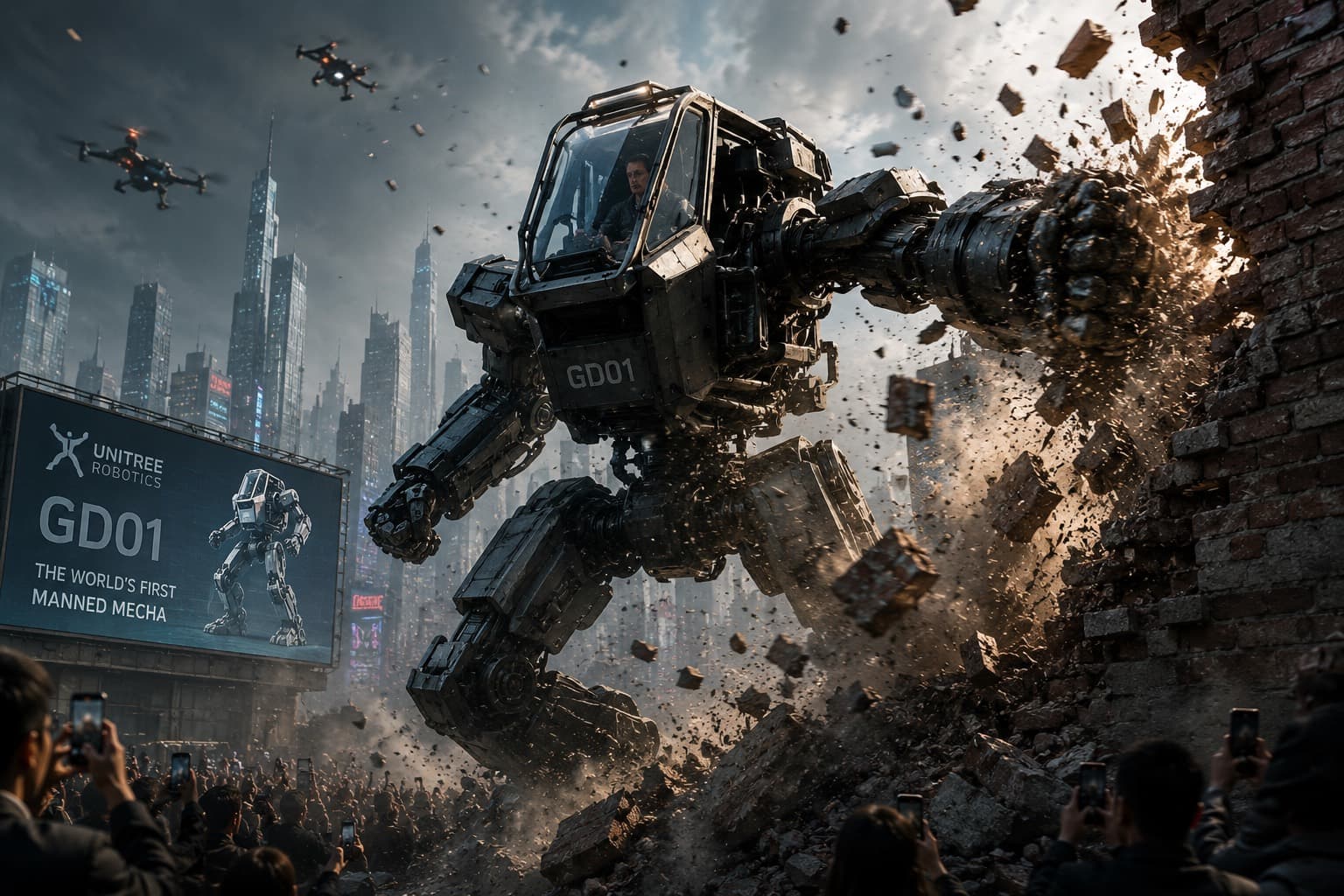
Unitree Robotics unveiled a piloted transformable mecha robot called the GD01, with footage showing CEO Wang Xingxing entering the machine as it demonstrated movement and pushed through brick barriers. The demonstration shows the mecha carrying a pilot in a torso-mounted cockpit as it walks in a humanoid stance, strikes a stack of bricks, and then reconfigures its chassis into a four-legged configuration. The wall-punching is the part everyone is sharing. The part that should actually keep you up at night is what the company did with the attention it bought.
⸻
What It Actually Costs, and What That Number Is Doing
What a viral robot reveals about the real cost of replacing a human shift
The GD01 starts at $650,000 USD, converted from the reported 3.9 million yuan. The company states the vehicle weighs about 1,102 pounds with a passenger on board, and in upright mode reaches roughly 1.6 times the height of an average adult. Nobody is buying this to solve a labor problem. That price tag isn’t a retail price. It’s a headline number, engineered to travel.
The machine was showcased in a video uploaded to Unitree’s official YouTube channel, with the company describing the GD01 as “the world’s first production-ready manned mecha,” adding that it is transformable and intended as a civilian-use vehicle. I have priced enough field kitchens and mobile disaster-relief units to recognize the pattern. When a company puts out a number that large for something that impractical, they are not selling the object. They are selling the capability behind it.
⸻
“How did they even come up with this track? It feels like watching Transformers in real life.” — Weibo user, quoted by Global Times
⸻
The Reaction Tells You More Than the Robot Does
The demonstration quickly went viral across Chinese and international social media, with many users comparing the machine to scenes from science fiction. Many viewers compared the scenes to films such as Pacific Rim. That reaction is the actual product. A viral clip does something a spec sheet cannot: it reaches procurement officers, private equity analysts, and retail investors who have never once thought about servo torque or actuator cost curves, and it gets them to stop scrolling on a robotics company they’d never heard of a week earlier.
Not everyone bought the spectacle at face value. Mixed online reactions ranged from awe to skepticism about the machine’s practicality and price point. That split is healthy, and it’s familiar. I’ve watched the same argument happen in hospitality boardrooms every time a chain rolls out an automated fry station or a scheduling AI. Half the room sees the future. The other half sees a company trying to justify a number on a pitch deck.
⸻
“Milliseconds before the fist hits, the ankle, knee, and hip motors adjust angles and shift weight forward to brace for impact, like a boxer tensing muscles in anticipation.” — on how the GD01 avoids being knocked backward by its own punching force
⸻
The Business the Mecha Is Actually Protecting
A $650,000 rideable robot will never be a volume product, and Unitree isn’t pretending otherwise. What it has is attention. Every technology publication in the world covered the announcement, the videos went viral, and the brand registered. That attention arrived on schedule. The reveal coincides with Unitree’s preparations to list on Shanghai’s STAR Market, with plans to raise up to 4.2 billion yuan, roughly $608 million USD.
Nobody builds a wall-smashing showpiece the same week they’re courting institutional investors by accident. The mecha is theater. The company underneath it is not. Unitree shipped more humanoid robots than Tesla in 2025, holds 70% of the global quadruped market, and grew revenue 335% to $235 million while remaining profitable since 2020. Its cheapest humanoid, the G1, starts around $16,000, and that number is the one every labor-dependent operator, from stadium concessions to hotel housekeeping, will eventually have to run against their own payroll.
⸻
Why This Belongs in a Labor Conversation, Not Just a Tech One
Strip away the cockpit and the wall-punching, and what Unitree actually announced this month is a cost curve. A $16,000 humanoid platform, built at scale, backed by a profitable company preparing to go public, is a labor substitution argument with a price tag attached. That is the number operators in food service, warehousing, and hospitality should be watching, not the mecha built to get their attention.
A machine that never sleeps, never unionizes, and never asks for a raise just got a price tag under $16,000. Somewhere, a hiring manager is already doing the math.
Related Articles on IMFounder
- Humanized Robots Companies Leading The Humanoid AI Race
- The Truth About AI Girlfriends & Digital Companionship
- SpudCell: Synthetic Cell Breakthrough
- Sex Bot Wars: The AI Intimacy Race
- 7 Brutal Truths About Meta Ray-Ban Smart Glasses Gen 2 vs Gen 1
- $11,000 World Cup Tickets. $30 Wages. Why SoFi Stadium Workers Are Ready to Strike