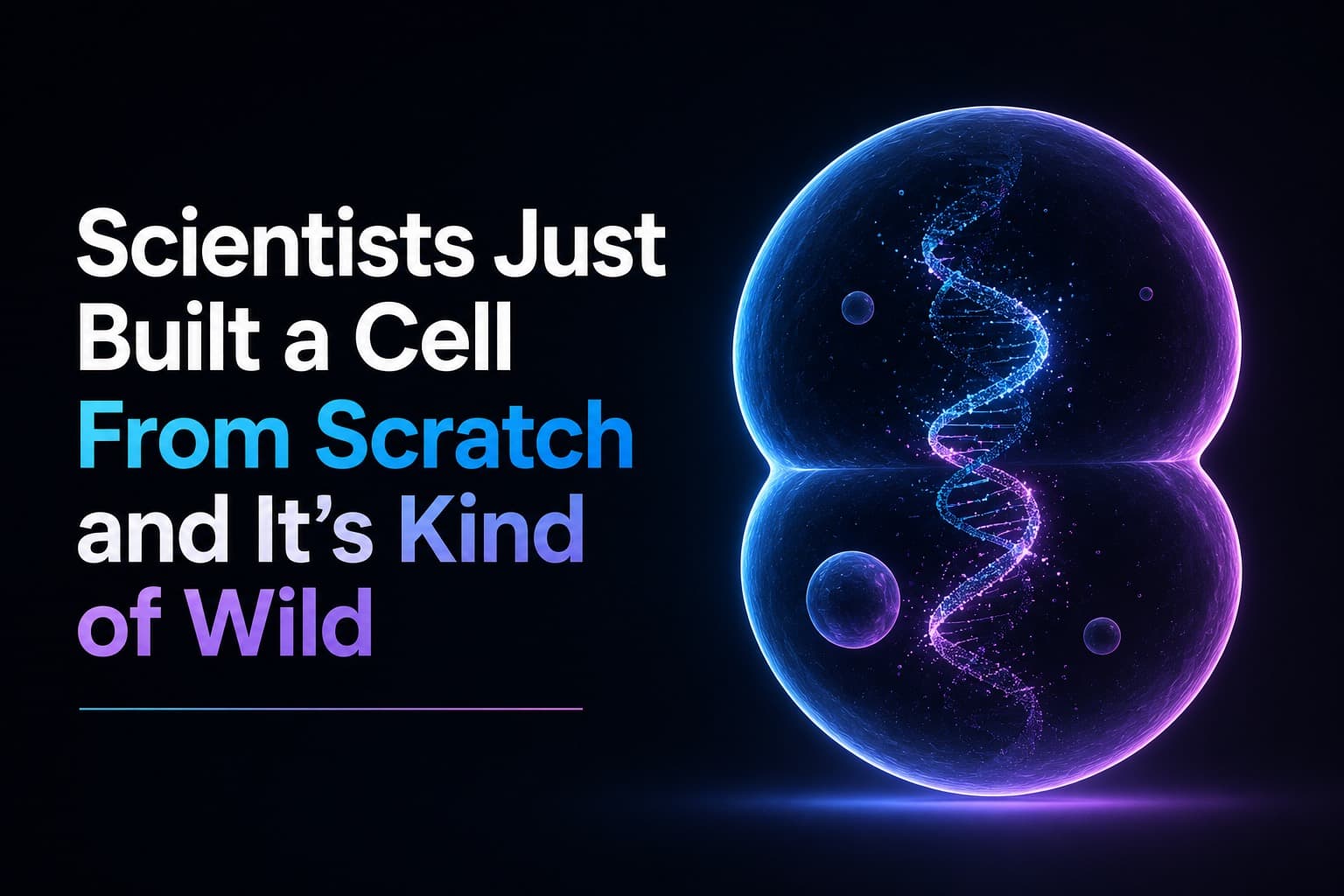

A synthetic cell-like system just crossed a major scientific line. The bigger question now is who gets to control the infrastructure built around it.
A team at the University of Minnesota just did something that sounds like science fiction: they built a synthetic cell-like system that isn’t alive in the traditional sense, but acts like it is. They’re calling it SpudCell. It’s being described as the first synthetic cell-like system that can complete a full cell cycle — meaning it grows, acquires resources, copies its own DNA, and splits into new cells — and it was built entirely from non-living chemical parts.
No living cell was used as a starting point. Researchers put it together from known molecules, piece by piece, instead of borrowing from something that was already alive.
“We’ve replicated in chemistry what only used to be possible in biology. It proves that the most fundamental functions of life do not need a mysterious magical spark.” — Kate Adamala, lead researcher, University of Minnesota
Here’s the part people skip over: SpudCell isn’t fully independent yet. It still relies on outside help — including ribosomes borrowed from E. coli bacteria — and when it divides, not every new cell ends up with a complete copy of its DNA. Only about 30% of daughter cells get the full set after five generations. So this isn’t “life created from nothing.” It’s a machine built to act like life, and it’s not perfect at it yet.
But it’s close enough that scientists are calling it a turning point.
Why This Isn’t Just a Lab Story
Most breakthroughs like this stay inside academic papers. This one didn’t. Right after the announcement, Adamala co-founded Biotic, a public-benefit organization built specifically to make sure this technology doesn’t get locked up by one company.
Biotic is releasing SpudCell’s data, methods, and specs publicly. Anyone can look at exactly how it was built. The core tech can still be licensed for commercial use, but the research stays open. One of Biotic’s co-founders, Stanford’s Drew Endy, said the goal is to stop this from becoming what he calls a “toll booth” — a single company charging every researcher who wants to use it.
“You are no longer tied to the constraints and evolutionary baggage of natural biology.” — Yuval Elani, Imperial College London
That decision matters more than the science itself, long-term. A lot of major technologies start open and end up controlled by whoever gets there first with money. Biotic is trying to skip that step entirely.
The Money Is Already Moving
This isn’t some niche research corner anymore — it’s an actual market. Venture investment in synthetic biology dropped off in 2022 and 2023, then bounced back hard. It went from $10.7 billion in 2023 to $12.2 billion in 2024, according to SynBioBeta. Some industry trackers put 2025 even higher, around $17.3 billion.
The overall global synthetic biology market was valued around $18.9 billion in 2025 and is projected to hit $69.2 billion by 2033. That is not just hype-cycle noise. That is infrastructure money moving into position.
Even the raw materials behind this stuff are growing fast. The global DNA synthesis market — basically the supply chain feeding this whole industry — is expected to jump from $5.95 billion in 2026 to $24.06 billion by 2034.
And it’s not just a U.S. thing. China’s biotech patent filings went from 119 in 2010 to 1,918 in 2023. This is becoming a global race, not an American solo project.
Where the “Open vs. Locked Down” Fight Shows Up Everywhere
This tension — open infrastructure versus one company owning the whole system — isn’t new, and it isn’t just happening in biotech labs.
Look at farm equipment. The fight between Mahindra and John Deere over right-to-repair is the exact same argument, just wearing a different uniform. Farmers don’t fully own the equipment they paid for because the software inside it is locked down by the manufacturer. One company controls the repair process, the parts, and the cost. That’s the “toll booth” model Biotic is explicitly trying to avoid with SpudCell.
“Any engineering discipline needs modularity. In our case, those modules must be built in the open.” — Kate Adamala
Same pattern shows up in labor, too. Companies quietly turning frontline workers into unpaid content machines is another version of the same story — someone builds the system, and then someone else controls who gets to benefit from it. Infrastructure decisions made early always end up mattering more than people expect.
What This Could Actually Be Used For
If this technology scales the way researchers hope, the payoff isn’t small. Synthetic cells could eventually manufacture medicine and fuel without needing petrochemicals or animal products. That means production methods that don’t rely on natural organisms or heavy industrial processes.
The global bioeconomy — everything built on biology-based production — is already worth an estimated $4 to $5 trillion. The OECD projects it could hit $30 trillion by 2050. Open-source synthetic cells are one of the more realistic paths to get there without a handful of companies owning the entire pipeline.
The Bottom Line
SpudCell isn’t fully alive, fully independent, or a finished product. It still needs outside help to function, and it doesn’t copy itself perfectly. But it’s the first system that pulls off a complete cell life cycle using only non-living components, and that alone puts it in a different category than anything before it.
The bigger story isn’t really about biology. It’s about who controls what gets built next. Right now, the people behind this breakthrough are trying to make sure the answer isn’t “just one company.” Whether that holds up once the money really starts flowing is the part worth watching.They built the cell in public because they already knew what private money does to anything that starts breathing.
Related Articles on IMFounder
- Anthropic Mythos Preview: Revolutionary New AI Model from Anthropic
- Claude Fable 5 Unleashed: The AI Anthropic Called Too Dangerous Is Now Open to Every Founder
- 12 Explosive Moves That Just Rewrote the ChatGPT vs Claude War
- TATA Electronics Data Breach Leaks 630GB of Apple & Tesla Trade Secrets Directly on the Dark Web