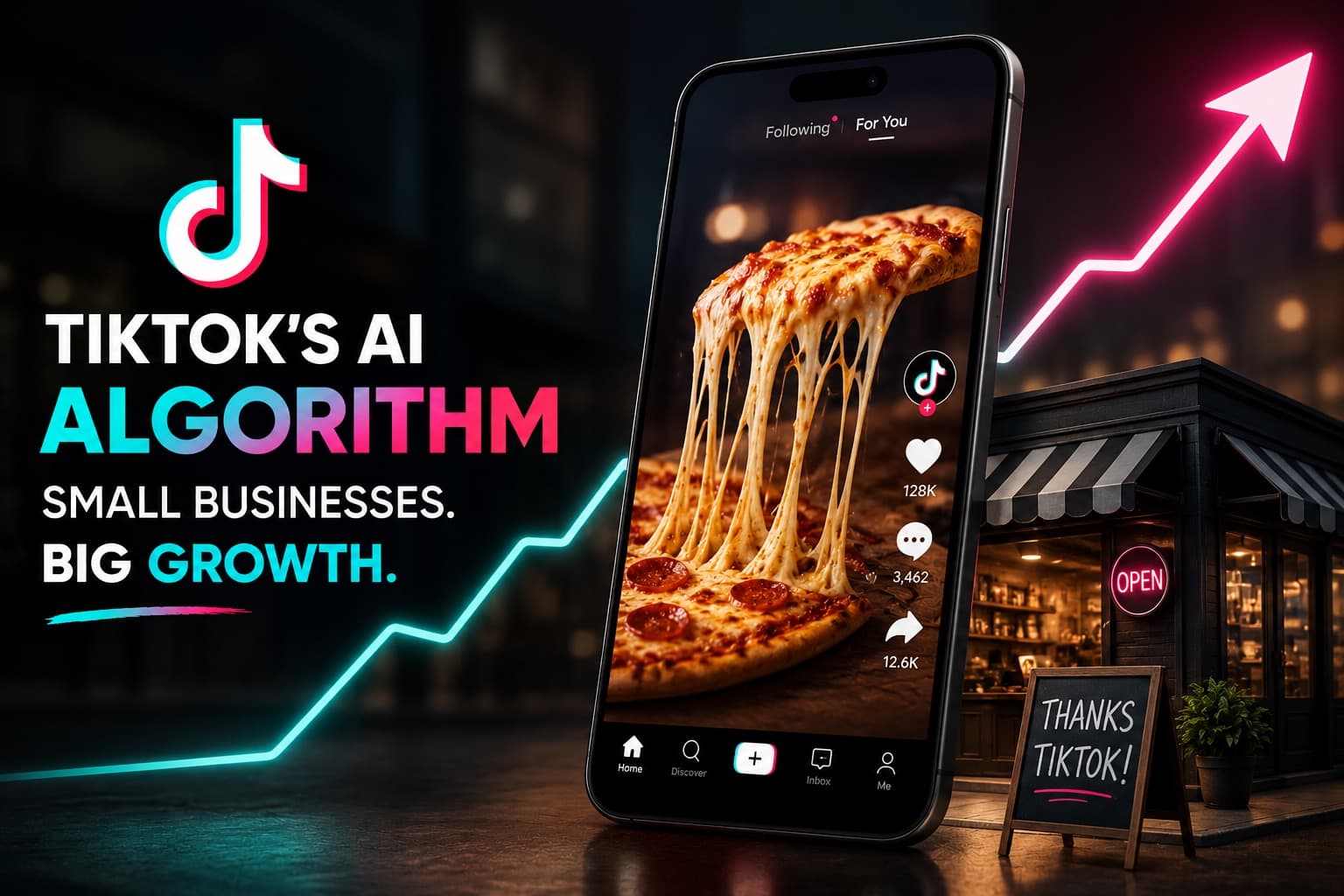

A restaurant with 200 followers posts a video of cheese pulling off a pizza slice. Forty-eight hours later, there’s a line down the block. No ad spend. No agency. No influencer contract. Just a phone, a kitchen, and an algorithm that doesn’t care who you are — only whether people keep watching.
This is not an anomaly. It is the operating model of small business growth in 2026, and it is rewriting the rules of who gets to scale and how fast.
The Old Rules Are Dead
For most of digital marketing history, reach was a function of budget. Bigger companies bought bigger placements and owned the algorithm by default. The bigger the war chest, the bigger the audience — that was the entire game, and it locked most small operators out before they even started. A local shop competing against a national chain wasn’t really competing at all. It was operating in a different universe, one where visibility was purchased, not earned.
TikTok broke that math. The platform does not distribute content based on follower count or ad spend — it distributes based on whether the content itself earns attention. A single-location coffee shop and a national chain are tested on the same terms: does the video hold, does it get rewatched, does it get shared. Neither the size of the business nor the size of its marketing team factors into that equation. The algorithm has no memory of who a business is until the content proves it’s worth remembering.
That shift is why a business with zero built-in audience can outperform a competitor with a full marketing department. It’s also why “going viral” has stopped being a lucky accident and became a repeatable skill — one that rewards small, scrappy operators who can move fast, far more than it rewards big brands that need six rounds of approval to post a single video. Speed and honesty became competitive advantages in a way they never were before.
Overnight Is Not a Myth, It’s a Mechanism
The phrase “blew up overnight” gets thrown around loosely, but the mechanism behind it is specific and understood. Every new video is first shown to a small test audience. If that audience watches, rewatches, and engages quickly, the platform expands distribution to a wider pool. If it doesn’t, the video dies quietly. There is no in-between, no partial credit, no slow leak of visibility over time.
This test-and-expand loop is why the same business can post two nearly identical videos a day apart and get wildly different results. One gets buried at a few hundred views. The other gets picked up and pushed to hundreds of thousands of people who never knew the business existed before that morning. The difference usually isn’t the product — it’s whether the first three seconds gave the algorithm a reason to keep testing it.
For a small business, this means the traditional slow-build model of brand awareness — months of consistent but modest growth, incremental word of mouth, a print ad here and there — can be compressed into a single afternoon, if the content earns it. That compression is the entire story. What used to take a year of foot traffic and referrals can now happen in the time it takes a video to finish rendering. It is not that the business changed overnight. It’s that the audience’s awareness of it did.
What Actually Gets Rewarded
The businesses scaling fastest right now aren’t the most polished. They’re the most real. Over-produced, agency-shot content consistently underperforms compared to raw, phone-shot footage of an actual process — a chef plating in real time, a mechanic explaining a repair, a tailor pinning a hem, a barista pulling a shot with a shaky hand and bad lighting. The audience isn’t looking for an advertisement. They’re looking for proof that the business is exactly what it says it is, and that proof reads as more trustworthy the less produced it looks.
The formula that keeps showing up across industries, regardless of what’s actually being sold:
- Open on the moment, not the intro. The first three seconds carry the entire video. A logo, a “hey guys,” or a slow build kills momentum before it starts, and the algorithm has already made its decision by the time a polished intro finishes.
- Show the process, not just the product. People don’t just want to see the finished item — they want to watch it get made. The reveal is satisfying, but the making is what actually holds attention.
- Post like it’s a job, not a hobby. Three to seven times a week is the baseline for staying in the algorithm’s rotation. Businesses that post sporadically get treated as inactive, regardless of how good any individual video is.
- Let staff be people, not brand mascots. Personality — humor, quirks, an actual point of view — consistently outperforms corporate polish. Audiences follow people they feel like they know, not logos.
- Design for the rewatch, not just the watch. Content that rewards a second look — a joke that lands differently, a detail easy to miss the first time — gets pushed further than content that’s fully understood on a single pass.
None of these are secrets. They’re publicly documented, widely discussed, and still ignored by most businesses that treat their TikTok account like a digital flyer instead of a living, daily operation.
Scale Without the Overhead
What makes this moment different from every previous wave of “social media marketing” advice is that the growth is no longer just about awareness — it’s directly tied to revenue in a way that didn’t exist before. In-app shopping means a viewer can go from watching a product get used to buying it without ever leaving the platform. That collapses the distance between discovery and transaction to almost nothing, which is exactly why small operators — the ones who can’t afford a long, patient funnel — are the ones benefiting most.
This is also reshaping who has leverage in small business growth conversations. A single-location operator with a strong niche and consistent posting can now generate more attention, and often more revenue, than a much larger competitor with a bigger budget and a slower, more cautious content strategy. Audience size stopped being the moat. Specificity and consistency became the moat instead. The business that knows exactly what it is, and says so on camera every day, beats the business that’s still workshopping its brand deck in a conference room.
The Catch
None of this is passive. The businesses that are actually scaling are treating content like a core operational function, not an afterthought squeezed in between real work. That means someone is filming consistently, someone is watching what performs and adjusting, and someone is engaging back with the audience the videos bring in. The algorithm rewards activity and responsiveness — not a single viral post, but the discipline of showing up in a way that compounds week over week.
The businesses that try to shortcut this — one viral video, then silence for a month — see exactly what you’d expect: a spike, then nothing. The platform doesn’t reward moments. It rewards momentum. And momentum has to be rebuilt every time it’s dropped, which means the businesses treating this as a one-time stunt are consistently outpaced by the ones treating it as a daily habit, even if that habit is unglamorous and repetitive behind the scenes.
There’s also a ceiling risk worth naming honestly: virality without operational readiness can break a business just as fast as it can grow one. A kitchen that goes viral without the staffing or supply chain to handle a sudden spike in orders can end up damaging its reputation instead of building it. Scale that arrives overnight still has to be absorbed by a business built to handle it.
The Bigger Picture
What’s happening here is bigger than any one platform trend. It’s a structural change in who gets to build a business fast. A shop, a kitchen, a studio, a workshop — the size of the operation no longer dictates the size of the audience it can reach. What dictates it now is whether the people running that business are willing to show their real process, on camera, consistently, without waiting for permission from a marketing budget that may never come.
That’s the real story behind every “overnight success.” It wasn’t overnight. It was consistent, unglamorous, unfiltered work — until the algorithm finally agreed it was worth showing to everyone else.
Related Articles on IMFounder
- 5 Powerful Startups You Can Launch With Only $1,000
- How to Validate a Startup Idea Without Writing a Single Line of Code
- The Complete Guide to Starting an AI Startup
- How a BBC undercover probe uncovered paid Instagram advertisements linked to child sexual abuse material
- Why Starbucks’ TikTok Creator Program Changes the Future of Work
- Top Incubators and Accelerators to Know in 2026
- The Rise of Solopreneurs: How Tech Tools Are Replacing Entire Teams