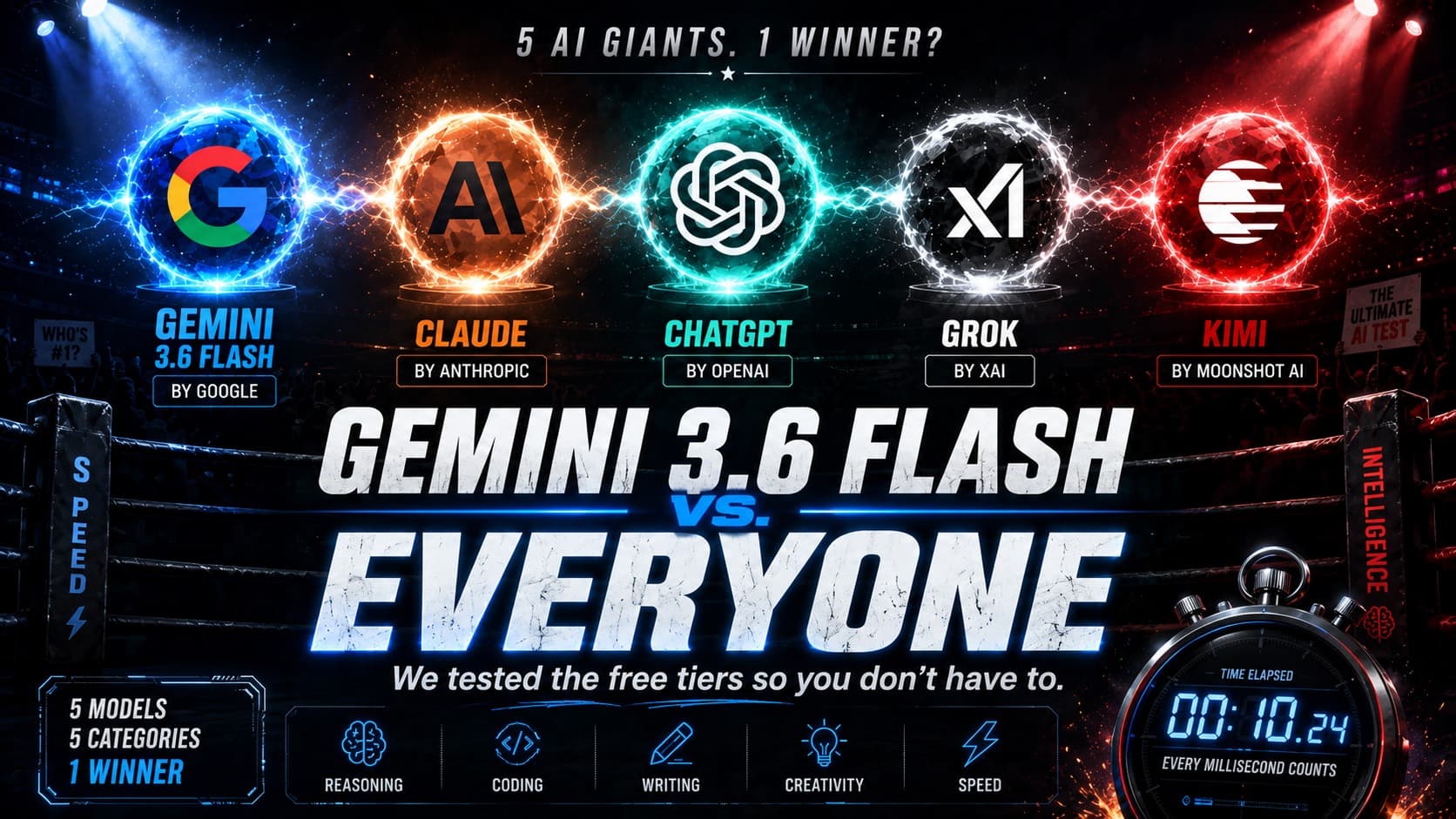

If you’ve typed “Gemini 3.6 Flash comparison” into Google in the last 24 hours, you’re not alone — Google just quietly dropped this model, and it’s already reshaping what “free AI” means in 2026. This isn’t a minor version bump. Gemini 3.6 Flash is Google’s new default workhorse, built specifically for coding, multi-step reasoning, and agentic workflows, and it’s rolling out at no cost inside the Gemini app right now.
But is it actually better than the free tools you’re already using? I ran this Gemini 3.6 Flash comparison against the current free versions of Claude, ChatGPT, Grok, and the newly released open-weight Kimi K3 — for both solo daily use and small-business workflows. Here’s what actually holds up.
What Makes This Gemini 3.6 Flash Comparison Different
Most “AI comparison” articles just paste in marketing benchmarks. This one focuses on what you can actually access for free today, because that’s the gap that matters for individuals and small teams watching every dollar.
Gemini 3.6 Flash is priced at $1.50 per million input tokens and $7.50 per million output tokens on the paid API, but consumers get it free inside the Gemini app and Google Search’s AI Mode. Google says it cuts output-token usage by 17% compared to its predecessor while improving coding precision — meaning fewer wasted, half-finished responses, which is the single biggest complaint people have about free-tier AI tools.
The Free-Tier Lineup, Head to Head
| Tool | Free model | Best at | Weak spot |
|---|---|---|---|
| Gemini 3.6 Flash | Gemini 3.6 Flash | Coding, agentic tasks, huge 1M-token context, chart/document reading | Rollout is uneven by region right now |
| Claude (free) | Claude Sonnet 5 | Long-form writing, careful reasoning, document analysis, Artifacts | Tighter message caps (roughly 15–40 per 5 hours) |
| ChatGPT (free) | GPT-5.5 Instant | Fast everyday Q&A, broad plugin ecosystem, familiarity | Free tier now shows ads in the US; deep reasoning is paywalled |
| Grok (free) | Grok 3/4-Mini class | Real-time X/Twitter trends, casual conversation | Text-only — no image generation on free tier anymore |
| Kimi K3 (free) | Kimi K3 (2.8T MoE) | Open-weight coding, huge context, dirt-cheap scaling | Newer ecosystem, less polished consumer app |
Gemini 3.6 Flash: The Agentic Workhorse
In this Gemini 3.6 Flash comparison, the standout trait is token discipline. Where older Flash models would over-edit code or wander through unnecessary steps, 3.6 Flash resolves read-only tasks without making unsolicited changes — a small detail that saves real time when you’re debugging a script or reviewing a spreadsheet formula. It also handles chart interpretation, screenshot-to-code conversion, and long documents well, thanks to its 1-million-token context window, according to Google’s official announcement.
Best individual use cases: summarizing long PDFs, converting a whiteboard photo into working code, quick spreadsheet formula debugging. Best business use cases: internal tooling, lightweight coding agents, document-heavy workflows like contract review drafts.
Claude Sonnet 5 (Free): The Careful Writer
Claude’s free tier now defaults to Sonnet 5, which Anthropic built specifically for agentic follow-through — planning, using tools, and self-correcting without constant nudging. It’s noticeably more careful and less prone to confidently making things up in long documents, which matters if you’re using AI for client-facing writing.
Best individual use cases: essays, emails, nuanced editing, brainstorming with genuine pushback instead of just agreement. Best business use cases: proposal drafting, internal documentation, policy or legal-adjacent writing where tone and precision matter.
ChatGPT Free (GPT-5.5 Instant): The Familiar Default
ChatGPT’s free tier stays fast and reliable for everyday questions, but OpenAI has clearly built a funnel: GPT-5.6 Sol, the actual flagship, is Plus-only. Free users in the US also now see labeled ads at the bottom of some answers, which paid users don’t.
Best individual use cases: quick facts, casual brainstorming, everyday scheduling help. Best business use cases:customer-facing chatbots where broad plugin/API support matters more than raw reasoning depth.
Grok Free: The Real-Time Wildcard
Grok’s edge has always been live access to X’s data stream, and that’s still true — it’s genuinely useful for tracking breaking news or sentiment in real time. But the free tier has been stripped down: it’s text-only now, image generation moved to paid plans, and you’re capped at roughly 10 prompts every two hours.
Best individual use cases: checking what’s trending, fast takes on breaking news. Best business use cases: social listening and sentiment snapshots, not heavy document or coding work.
Kimi K3: The Open-Weight Disruptor
Kimi K3 is the wildcard in any 2026 AI comparison. Moonshot AI’s 2.8-trillion-parameter model is open-weight, meaning developers can eventually self-host it, and it’s already benchmarking competitively with Western frontier models on coding tasks — at a fraction of the API cost of comparable US systems.
Best individual use cases: power users who want a free, capable model without a subscription treadmill. Best business use cases: startups building cost-sensitive coding agents or wanting to avoid vendor lock-in to a single US provider.
So Which One Wins This Gemini 3.6 Flash Comparison?
There isn’t one winner — there’s a right tool per job:
- Daily personal use: Gemini 3.6 Flash or Claude Sonnet 5, depending on whether you need coding help or careful writing.
- Business document work: Claude, for tone control and long-context reliability.
- Coding and agentic automation: Gemini 3.6 Flash for polish, Kimi K3 if budget is the deciding factor.
- Real-time trend tracking: Grok, with the caveat that free access is genuinely limited now.
- Everyday quick answers: ChatGPT free, mainly for familiarity and ecosystem reach.
The bigger story behind this Gemini 3.6 Flash comparison is that the gap between free and paid AI tiers is narrowing for reasoning and coding, even as companies quietly tighten caps and add ads elsewhere. If you’re building a business workflow around free-tier AI in 2026, don’t lock into one tool — the leaderboard has already shifted twice this month alone.
Related Articles on IMFounder
- Claude’s Explosive Browser Move Just Changed Everything
- Inside Apple’s explosive legal war against OpenAI, a missing laptop, and the 400 ex-employees accused of building a rival’s secret hardware empire
- 5 Powerful Startups You Can Launch With Only $1,000
- How to Validate a Startup Idea Without Writing a Single Line of Code
- China Just Built a $650,000 Robot That Can Punch Through a Wall
- 12 Explosive Moves That Just Rewrote the ChatGPT vs Claude War
- 15 Explosive AI Updates July 2026: GPT-5.6 Blocked, Claude in Your Slack, Nvidia, IBM Chip, AI Inflation & More