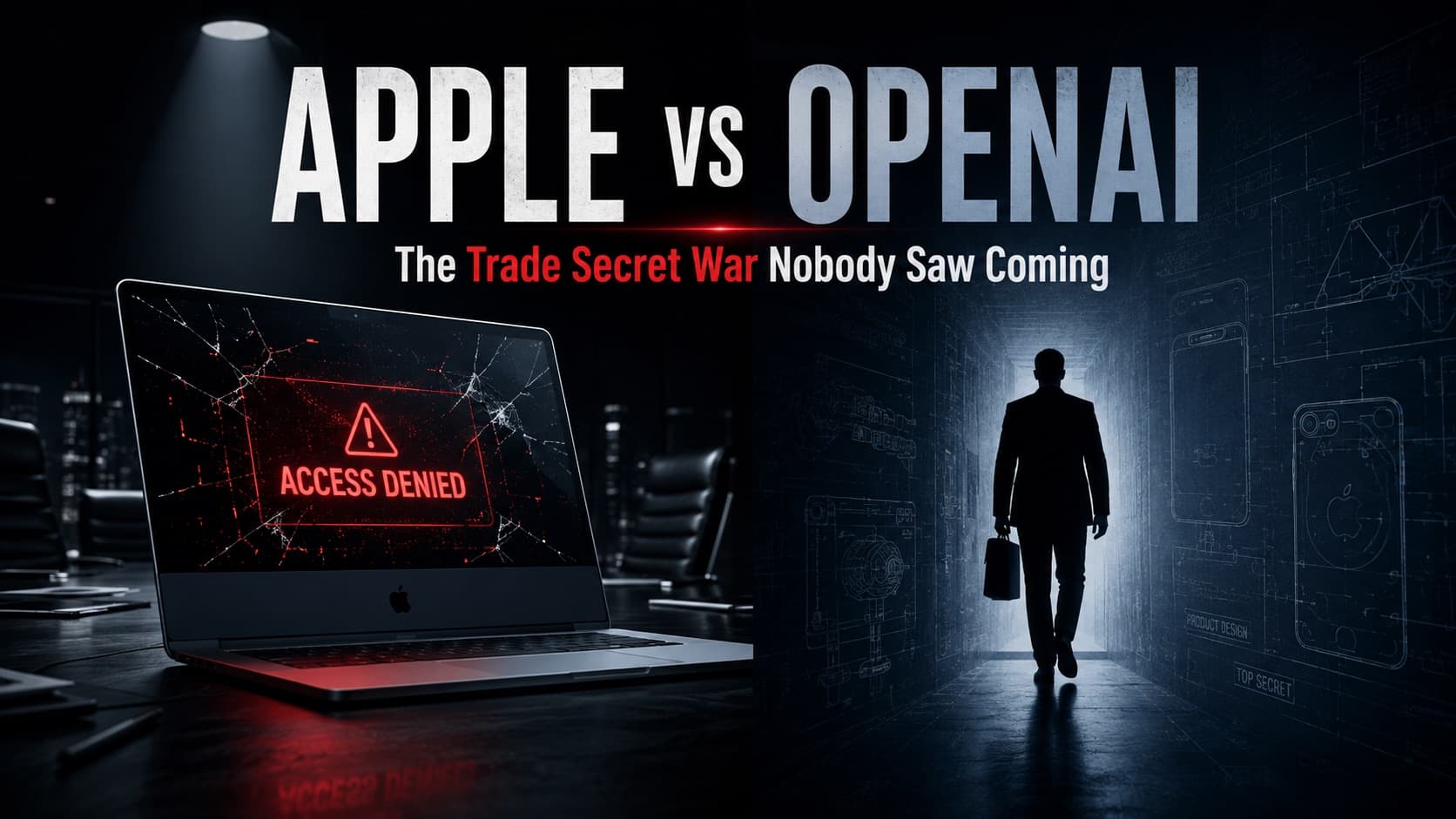

The Apple OpenAI lawsuit has exploded into one of the biggest corporate legal battles Silicon Valley has seen in years. Apple has formally sued OpenAI, along with two of its own former employees, accusing them of orchestrating a systematic scheme to steal confidential trade secrets and use them to build OpenAI’s secret push into consumer hardware. The filing, submitted in the U.S. District Court for the Northern District of California, reads less like a legal document and more like a corporate espionage thriller — complete with a missing laptop, a security bug exploited for laughs, and hundreds of departed employees.
For two companies that once stood shoulder to shoulder — Sam Altman appeared on stage at Apple’s own developer conference in 2024 when ChatGPT was integrated into Siri — this lawsuit marks a stunning collapse of what was once a landmark AI partnership.
What Is the Apple OpenAI Lawsuit About?
At its core, the Apple OpenAI lawsuit alleges that OpenAI didn’t just hire talent away from Apple — it allegedly built a pipeline designed to extract Apple’s most sensitive intellectual property along the way. Apple’s complaint claims OpenAI acted “at every level,” from junior technical staff all the way up to its Chief Hardware Officer, to obtain confidential information about unreleased Apple technologies, manufacturing processes, and product designs.
Apple is suing for breach of intellectual property agreements and misappropriation of trade secrets under the Defend Trade Secrets Act. The company is asking the court to block OpenAI from using any of the disputed material, force the return of confidential files, and require all parties to preserve evidence ahead of what could become a lengthy discovery process.
Named as defendants alongside OpenAI are io Products — the AI hardware startup co-founded by former Apple design chief Jony Ive and acquired by OpenAI in a multibillion-dollar deal — plus two individuals at the center of the storm: Chang Liu and Tang Yew Tan.
Chang Liu: The Ex-Apple Engineer at the Center of the Storm
Chang Liu spent eight years at Apple as a senior systems electrical engineer before leaving to join OpenAI’s San Francisco office in January 2026. According to Apple’s filing, Liu is one of the most damaging examples cited in the entire case.
The Laptop That Never Came Back
Apple alleges that after Liu departed, he never returned his Apple-issued laptop and skipped the standard exit interview meant to confirm all company devices were handed in. Months later, Apple claims, Liu discovered a previously unknown authentication flaw that let him slip back into Apple’s internal network using that very device — reportedly downloading dozens of confidential hardware files, some described in the complaint as running over a thousand pages of technical detail.
Rather than report the vulnerability, Apple alleges Liu treated it as a joke, messaging a still-employed Apple colleague that he’d found a way back into internal storage and calling it funny. That colleague, identified in the suit as Yu-Ting “Alyssa” Peng, was reportedly still working at Apple at the time and was allegedly coached by Liu on which proprietary materials to study before her own OpenAI interview — and later how to copy files off her Apple laptop without tripping internal security alerts.
Liu is not the only name attached to the alleged laptop scheme. The complaint says that within hours of leaving Apple, he referenced still having access to “another computer” — a detail Apple says it uncovered while reviewing Peng’s device.
Tang Tan and OpenAI’s Hardware Ambitions
The second individual defendant, Tang Yew Tan, spent roughly 24 years at Apple, most recently as vice president of product design overseeing the iPhone and Apple Watch. He left in 2024 to work alongside Jony Ive, eventually becoming OpenAI’s Chief Hardware Officer once io Products was folded into OpenAI.
Apple’s complaint accuses Tan of emailing himself supplier information and internal industry summaries before his departure, then using confidential Apple project codenames during OpenAI job interviews to pull additional details out of unsuspecting candidates who were still employed at Apple. In some cases, the suit alleges, candidates were even asked to bring actual Apple hardware components, prototypes, and CAD files to their interviews for “show and tell” sessions — a request so unusual that one candidate reportedly said he didn’t realize Apple parts could leave the building at all.
Apple also claims a manufacturing partner was misled into performing a proprietary metal-finishing technique for OpenAI, believing it had Apple’s blessing to do so.
400 Former Apple Employees Now Work at OpenAI
Perhaps the most eye-popping figure in the entire Apple trade secrets lawsuit is the scale of the talent migration. Apple’s filing states that more than 400 former Apple employees are now working at OpenAI — a number the company argues is not a coincidence but the byproduct of a deliberate recruiting strategy aimed at Apple’s hardware division specifically as OpenAI works to launch its own consumer devices.
Apple further alleges that OpenAI circulated an internal Apple document, marked “Need to Know,” among new hires — a guide detailing Apple’s own departure security protocols, allegedly used to help recruits dodge detection during their exit. The complaint claims departing staff were advised to alert OpenAI immediately if Apple asked them to sign any exit paperwork, and were told not to sign anything without direction.
Apple describes the pattern as something “normalized and exemplified by leadership,” arguing the conduct wasn’t the work of a few rogue hires but a culture problem reaching the top of OpenAI’s hardware division.
OpenAI’s Response to the Apple OpenAI Lawsuit
OpenAI has pushed back publicly, stating it has no interest in other companies’ trade secrets and remains focused on building its own technology. The company said it was still reviewing the full complaint. Neither OpenAI nor Jony Ive — who was not personally named as a defendant despite co-founding io — has filed a detailed rebuttal in court as of this writing.
It’s worth noting the backdrop: OpenAI has reportedly been weighing its own legal action against Apple over how ChatGPT was integrated into Apple Intelligence, and relations further cooled after Apple chose Google’s Gemini to power its next-generation Siri instead of OpenAI’s models.
What Happens Next?
The Apple OpenAI lawsuit now heads into the discovery phase, where both sides will be compelled to hand over internal communications, emails, and device logs. Apple has explicitly signaled it expects the evidence to reveal a far larger pattern of misconduct than what’s outlined in the initial complaint. With OpenAI reportedly preparing for a high-profile IPO, a drawn-out trade secrets battle — and the reputational risk that comes with it — could not have come at a more sensitive moment.
For now, the case stands as a rare public window into how fiercely Big Tech and AI labs are fighting over talent, design secrets, and the next generation of consumer hardware.
Related Articles on IMFounder
- TATA Electronics Data Breach Leaks 630GB of Apple & Tesla Trade Secrets
- 12 Explosive Moves That Just Rewrote the ChatGPT vs Claude War
- The Deal between OpenAI & Jony Ive : A $6.5 Billion Bet on the Future
- 15 Explosive AI Updates July 2026: GPT-5.6 Blocked, Claude in Your Slack, Nvidia
- How Companies Are Quietly Burning $50,000 a Month on AI
- Apple Forgot Steve Jobs’ Most Important Lesson: Design Is How It Works
- Tim Cook Stepping Out of Apple: The Operator Who Built a $4 Trillion Giant
Sources
- TechCrunch: Apple sues OpenAI over alleged trade secret theft
- Reuters via NBC News: Apple sues OpenAI and two former employees
- Axios: Apple sues OpenAI for trade secret theft
- Fortune: The wildest allegations in Apple’s lawsuit against OpenAI