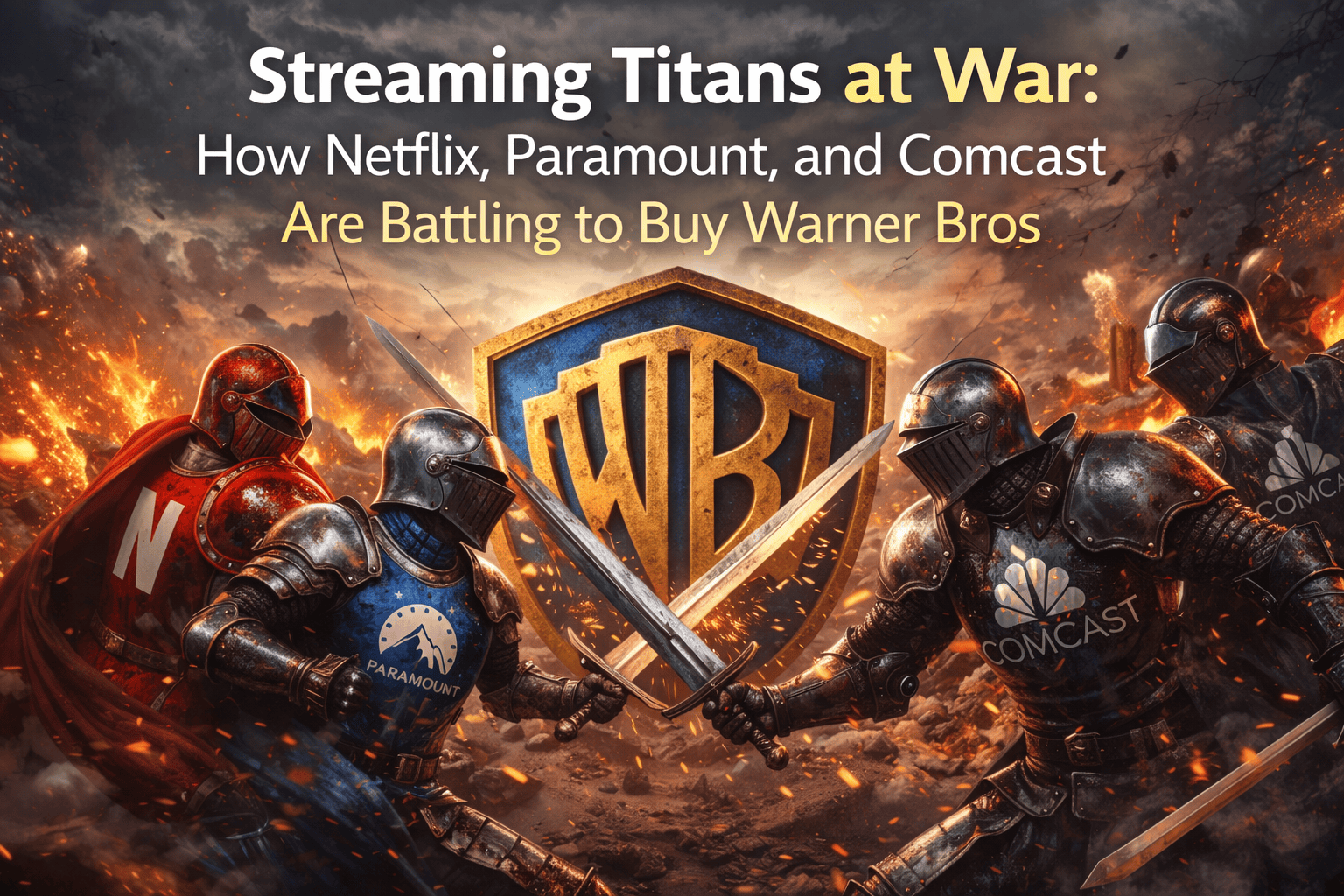

The entertainment world is in the midst of one of the most consequential bidding wars of the streaming era. At the center: Warner Bros. Discovery (WBD) — the media conglomerate whose vast library of films, TV shows, and streaming platforms has ignited competing offers from Netflix, Paramount Skydance, and even Comcast. The result is a battle not just for a company, but for the future of entertainment itself. Wikipedia
This article unpacks what’s at stake, why companies are willing to spend tens of billions to acquire Warner Bros assets, and how the outcome could affect consumers’ viewing experiences, subscription costs, content diversity, and competition across the media landscape.
The Bidding War in Numbers: How Big Are the Offers?
The acquisition saga began in late 2025 when Warner Bros. Discovery signaled openness to strategic alternatives, triggering formal interest from multiple giants in the industry. Wikipedia
Here’s how the major bids compare:
| Bidder | Offer Value (Enterprise) | Structure | Assets Targeted |
|---|---|---|---|
| Netflix | ~$82.7 billion | Cash + stock | Warner studios, HBO/HBO Max, DC Comics, film & TV libraries |
| Paramount Skydance | ~$108.4 billion | All-cash hostile bid | Entire WBD (including cable networks) |
| Comcast | ~$81 billion | Proposed competing bid | Includes streaming and linear networks |
Netflix’s deal focuses on the core studio and streaming business, while Paramount’s offer includes the entire company, drawing a much higher headline value but also significantly greater debt and financing complexity. Wikipedia
In response to Paramount’s hostile bid, Oracle co-founder Larry Ellison personally guaranteed $40.4 billion of financing, and Paramount increased its breakup fee to $5.8 billion — underscoring the intensity of the battle. Reuters
Why the Stakes Are So High
1. Control of Premium Content and Libraries
Warner Bros.’ intellectual property (IP) is one of the most valuable in the world:
- Harry Potter
- DC Universe
- Game of Thrones
- Friends
- HBO’s catalog
Owning these brands gives a company a massive competitive advantage in the streaming wars — especially as content subscriptions fragment and viewers pick platforms based on exclusive titles.
Netflix has historically operated as a builder, not a buyer, but the Warner deal represents a strategic pivot to acquisition-led expansion. Wikipedia
What Consumers Might Gain
1. More Content Variety on a Single Platform
If Netflix wins:
- Subscribers could access both Netflix originals and Warner Bros. classics under one roof — potentially reducing the need for multiple subscriptions.
- HBO and Warner Bros. content would merge into Netflix’s ecosystem, possibly at unchanged or slightly adjusted pricing.
This could benefit consumers who prefer a single destination for broad content coverage without switching between services.
2. Enhanced Global Rollout and Localization
Netflix’s vast global footprint might accelerate:
- Local language dubbing and subtitling
- Region-specific content curation
- Wider availability of HBO titles in markets that previously lacked full access
These changes could lead to broader international content equity.
Consumer Risks and Drawbacks
1. Reduced Competition and Higher Prices
A consolidation of major studios under Netflix (or another single entity) could reduce competition in streaming and media:
- Less incentive to lower prices
- Higher barriers for new entrants
- Potential for tiered or premium pricing models
Media consolidation often leads to fewer choices and higher costs for consumers. Wikipedia
2. Regulatory Scrutiny and Possible Restrictions
Both deals will face antitrust reviews in the U.S. and Europe. Some lawmakers have already voiced concerns that a Netflix–Warner combination could dominate content distribution and suppress competitive innovation. The Times of India
If regulators demand concessions (like divestitures or content licensing conditions), the outcome could significantly alter what consumers ultimately experience.
3. Content Focus Shifts
If a party like Paramount wins, strategic priorities might emphasize traditional broadcast, cinema, and cable alongside streaming — potentially slowing Netflix-style innovation in algorithmic recommendations and global distribution.
Impact on Stock Prices and Market Sentiment
The bidding war has already influenced market movement:
- Netflix stock dropped over 3% after Paramount launched its hostile bid, marking the lowest price since April 2025 amid investor caution. The Economic Times
- Paramount’s share price rose over 5% following Ellison’s guarantee, and Warner Bros. Discovery shares climbed nearly 3%. Reuters
This reflects investor sensitivity to bidding outcomes and perceived financing certainty — especially in deals of this size.
Why Netflix and Paramount Are Ready to Spend Billions
1. Content Is the New Currency
Streaming platforms are increasingly defined by ownership of exclusive content. Warner Bros.’ portfolio offers decades of proven IP with enduring audience demand — a rare acquisition target. Wikipedia
2. Subscriber Retention and Growth
Netflix aims to:
- Reduce subscriber churn by adding blockbuster franchises
- Expand international markets with localized content
- Cross-sell content via bundled offerings
Paramount sees value in owning linear networks, global distribution, and traditional broadcasting assets — offering a diversified revenue model across platforms. Wikipedia
3. Strategic Defense Against Rivals
Both companies fear being left behind as big tech and media giants — like Disney, Apple, Amazon, and Comcast — consolidate and scale. Winning the Warner bid could redefine competitive positioning for the decade ahead.
What Comes Next
The Warner Bros. Discovery board has recommended shareholders reject Paramount’s $108.4 billion hostile cash offer, citing significant financing risks and preferring Netflix’s binding agreement. Reuters
Still, Paramount continues to court shareholders directly, while Netflix works to finalize financing (including refinancing parts of its $59 billion bridge loan). Reuters
The outcome — likely not decided until early 2026 — will hinge on:
- Shareholder voting
- Regulatory review
- Financing certainty
- Potential counter-offers
What This Means for the Industry
No matter who wins, the bidding war signals a turning point in entertainment economics:
- Streaming consolidation is accelerating
- Content monopolies are being re-shaped
- Consumers may face broader platforms but fewer competitive choices
- Regulatory bodies will play an increasingly central role in media M&A
For consumers, this could mean richer content ecosystems but also higher prices and lower platform choice depending on the final structure.
Conclusion
The Warner Bros acquisition battle between Netflix and Paramount is more than a corporate transaction — it’s a defining moment for global media. With offers ranging from $82.7 billion to $108.4 billion, the stakes couldn’t be higher. As the process unfolds into 2026, consumers, creators, investors, and regulators alike are watching closely — because the outcome will shape the future of entertainment for years to come. Wikipedia