
If you’re a founder outside North America — or an immigrant entrepreneur already building in Canada or the US — the immigration and funding landscape in 2026 has changed significantly. Canada’s Start-Up Visa Program officially closed to new applicants on December 31, 2025. The US still has no dedicated founder visa. But legitimate, proven pathways exist in both countries — if you know how to use them.
This guide covers every viable visa route, the grants actually worth applying for, and how to sequence your strategy so your immigration status and your company’s growth move together.
Why This Guide Exists
Most immigration content is written for lawyers, not founders. Most funding content is written for people who already have permanent residency. This guide is for the founder in the middle — building something real, racing against visa timelines, trying to figure out what money is actually available without giving up equity.
1. Canada: Immigration Options After the SUV Closure
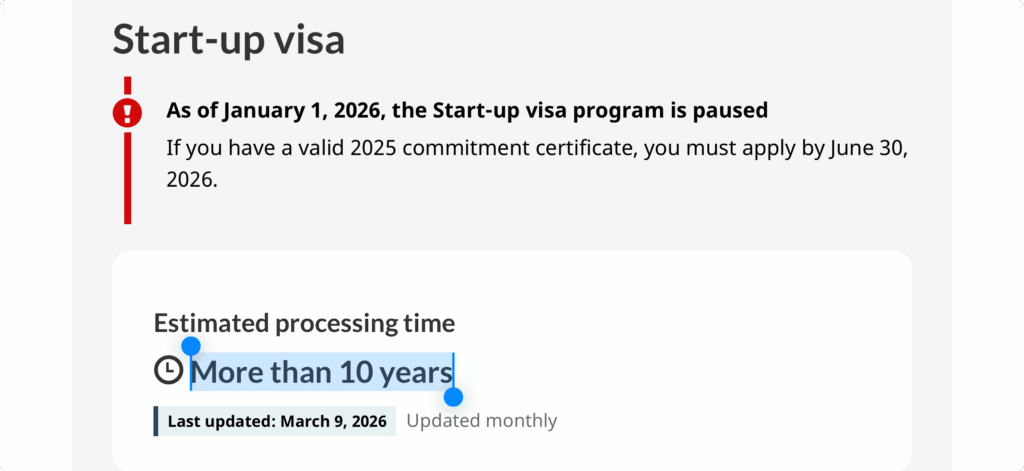
⚠️ Policy Update: Canada’s Start-Up Visa (SUV) Program stopped accepting new applications on January 1, 2026. If you received a valid commitment certificate in 2025, you have until June 30, 2026 to submit your PR application. A new federal entrepreneur pilot is expected later in 2026, with roughly 500 annual spots — down from 1,000.
With the federal SUV paused, founders now have three realistic paths in Canada.
1.1 Provincial Nominee Programs (PNPs)
Nine provinces run active entrepreneur or investor streams in 2026. These are now the most accessible federal alternative.
British Columbia (BCPNP)
- Base Stream: CAD $600K net worth, CAD $200K investment
- Regional Stream: CAD $300K net worth, CAD $100K investment — significantly lower bar
Alberta (AAIP)
- Rural Entrepreneur Stream: CAD $300K net worth, CAD $100K investment
- Active draws happening regularly in 2026
Manitoba & Nova Scotia
- Both offer International Graduate streams for founders who studied locally
- General entrepreneur pathways require CAD $500K–$600K net worth
The typical PNP process: enter on a work permit → operate your business for 12–18 months → meet business commitments → receive provincial nomination → apply for PR.
1.2 The Upcoming 2026 Federal Entrepreneur Pilot
IRCC has signalled a new pilot launching later in 2026. What we know so far:
- Priority for founders already in Canada on valid work permits
- Focus on high-growth sectors with demonstrated economic benefit
- Stricter eligibility than the old SUV
- Approximately 500 annual spots nationally
Our take: If you’re already in Canada building a real company, position yourself now. Strengthen your business metrics, secure Canadian investment if possible, and document every milestone before the pilot opens.
1.3 International Mobility Program (IMP) Work Permit
If you received a commitment certificate under the old SUV, you can apply for a short-term work permit through the IMP while your PR application is in process — which, given current backlogs, can take 18–36 months.
2. USA: Visa Pathways That Work for Founders
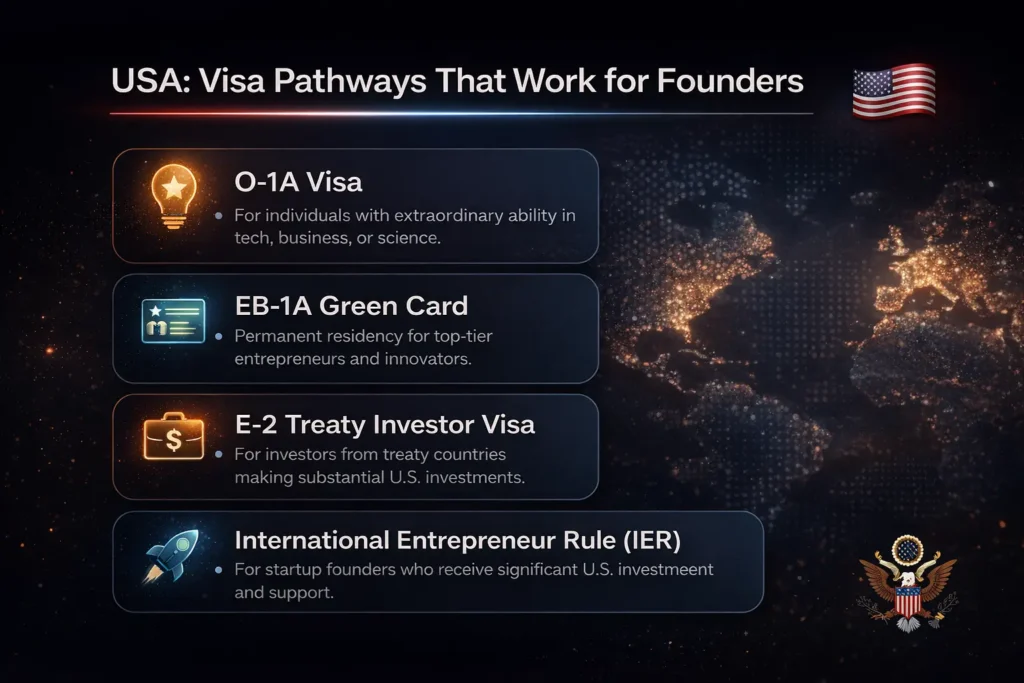
The US has never had a dedicated startup visa. What it has is a set of categories that strategic founders learn to use in sequence.
2.1 The O-1A Visa — The Most Practical Near-Term Option
The O-1A is for individuals with extraordinary ability in business. You need to satisfy at least 3 of 8 USCIS criteria. For founders, the most achievable are:
- Awards & recognition — VC funding, YC/Techstars acceptance, pitch competition wins, Forbes 30 Under 30
- Media coverage — features about you (not just your company) in Forbes, TechCrunch, Bloomberg
- Critical role — evidence you lead a distinguished organization (your own funded startup qualifies)
- Original contributions — patents, technology adopted by others, measurable market impact
Key advantages: No annual cap, no lottery, no employer required. File any time. Initially granted for up to 3 years with indefinite one-year extensions. Premium processing (15 calendar days) costs approximately $2,965 as of 2026.
2.2 EB-1A Green Card — The O-1A’s Natural Next Step
Many founders deliberately use the O-1A as a 2–3 year runway to accumulate evidence, then self-petition for the EB-1A green card. The EB-1A uses largely the same evidence framework, requires no employer sponsor, and leads directly to permanent residency. Timeline: 7–16 months with premium processing.
2.3 E-2 Treaty Investor Visa
Available to nationals of countries with a US investment treaty (Canada, UK, Germany, Japan — India does not qualify). Requires a “substantial” investment — typically $100K–$200K — in a US business you actively manage. Indefinitely renewable as long as the business operates.
2.4 International Entrepreneur Rule (IER)
An underused parole-based pathway. Requirements: either $311,071 in qualified US investor funding or $124,429 in government grants. If your startup has raised a proper seed round from US-based institutional investors, you may already qualify without knowing it.
3. Grants & Non-Dilutive Funding in Canada
Canada has one of the most generous non-dilutive funding ecosystems in the world. You keep your equity. You don’t repay. Here are the programs that matter most.
3.1 SR&ED (Scientific Research & Experimental Development)
Canada’s largest R&D incentive and the most underused by immigrant founders. If your startup conducts technical experimentation or product development, you almost certainly qualify. read more here.
- Up to 35% cash refund on eligible R&D expenditures for Canadian-Controlled Private Corporations (CCPCs)
- Even failed experiments qualify
- File annually with your T2 corporate return
- Stacks with every other grant on this list
3.2 NRC IRAP (Industrial Research Assistance Program)
IRAP assigns a dedicated Industrial Technology Advisor to your company and provides non-repayable contributions for R&D hiring and projects.
- $50,000 – $500,000+ per project
- Start the relationship before you need the funding — get an ITA assigned early and keep them updated
3.3 Futurpreneur Canada
Specifically for founders aged 18–39. Provides up to $60,000 in startup financing (combination of Futurpreneur loan + BDC loan), plus two years of mentorship. No equity taken.
3.4 Provincial Grants
Every province has its own programs. Stack these on top of federal funding — it’s legal and common.
- Ontario — Regional Innovation Centres, OCI Market Readiness ($25K–$250K)
- BC — Innovate BC programs
- Quebec — Investissement Québec contributions
- Alberta — Alberta Innovates
4. Grants & Non-Dilutive Funding in the USA
The US grant landscape is larger but more competitive, and skewed toward deep tech, health, and defense. Here’s where early-stage founders can realistically access capital.
4.1 SBIR / STTR — The Largest Non-Dilutive Source in the US
- Phase I: ~$150K–$275K for feasibility work
- Phase II: Up to $2M+ for development
- Administered across 11 federal agencies (NIH, DOD, NSF, and others)
- Any startup with a technology angle — biotech, hardware, AI, climate tech — should be applying
- SBIR awards also directly strengthen O-1A visa applications under the “awards” and “original contributions” criteria
4.2 NSF I-Corps
A $50,000 non-dilutive grant plus a structured customer discovery program. Particularly valuable for deeptech and university-affiliated founders. Cohort participation also builds NSF relationships useful for future SBIR applications.
4.3 State Innovation & Economic Development Grants
Ohio, Texas, Colorado, Michigan, and Massachusetts all run competitive state-level grants ($25K–$500K) with far less competition than federal programs. If you’re on an O-1A or IER parole and choosing where to incorporate or operate, factor grant access into that decision.
5. How to Sequence Your Visa + Funding Strategy
Most founders treat immigration and fundraising as separate problems. They’re not. Your grants, press coverage, and award history all become evidence in your visa petition. Plan them together.
- Start building your evidence base 12–18 months before you file. Apply to accelerators, pursue press coverage, file patents. These take time.
- Use SBIR or IRAP early — not just for money, but for visa evidence. Government grants signal that a federal body has validated your innovation. USCIS and IRCC both treat this as meaningful.
- Incorporate in the right country first. Delaware C-Corp for US targeting. Provincial incorporation for Canada. This determines which grant programs you can access.
- Use the O-1A as a 3-year runway to build toward EB-1A. Raise a Series A, get tier-1 media coverage, grow revenue. Then self-petition for the green card using the same upgraded evidence package.
- Document everything in real time. Keep a running log of every grant, press mention, award, speaking slot, and advisory role. Your future immigration attorney will need all of it.
6. 5 Mistakes Founders Make
1. Treating immigration as a last step. The evidence you build in year one — grants, press, awards — is the foundation of your visa case. Engage an attorney early enough to shape strategy, not just file paperwork.
2. Assuming the Canada SUV is coming back the same way. The 2026 pilot will be far more selective. Plan for stricter requirements and roughly 500 annual spots nationally.
3. Using VC funding alone as O-1A evidence. Under current USCIS standards, funding alone is unlikely to satisfy the “awards” criterion. Pair it with judging roles, publications, or patents.
4. Leaving SR&ED unclaimed. If you’ve been iterating on your product’s technical architecture or developing proprietary algorithms, you almost certainly qualify. Stack SR&ED + IRAP + a provincial grant before your first equity round.
5. Choosing your province or state based on lifestyle, not grants. Alberta, Manitoba, Ohio, and Michigan offer serious grant programs with significantly less competition. Do the math before you sign a lease.
Must Read: How to Decide What NOT to Build in Your Startup: A Founder’s Guide
Summary: Visa & Funding Options at a Glance
| Option | Country | Type | Key Requirement | Leads to PR? |
|---|---|---|---|---|
| PNP Entrepreneur Streams | 🇨🇦 Canada | Visa/PR | CAD $100K–$200K investment | Yes |
| 2026 Federal Pilot (upcoming) | 🇨🇦 Canada | Visa/PR | Active business in Canada | Yes |
| O-1A Visa | 🇺🇸 USA | Nonimmigrant | 3 of 8 extraordinary ability criteria | Via EB-1A |
| EB-1A Green Card | 🇺🇸 USA | Immigrant | Self-petition, same criteria as O-1A | Yes — direct |
| E-2 Treaty Investor | 🇺🇸 USA | Nonimmigrant | $100K–$200K investment, treaty country | No |
| SR&ED Tax Credit | 🇨🇦 Canada | Grant/refund | Technical R&D work | N/A |
| NRC IRAP | 🇨🇦 Canada | Non-dilutive grant | Innovative SME, active R&D | N/A |
| SBIR / STTR | 🇺🇸 USA | Non-dilutive grant | Technology-based project | N/A |
| NSF I-Corps | 🇺🇸 USA | Non-dilutive grant | Deeptech / research focus | N/A |
Bottom line: 2026 is a reset year for North American founder immigration. Canada closed its most accessible pathway and is rebuilding a more selective one. The US has never had a single founder visa and likely never will. What this means in practice: the path forward rewards founders who build genuine traction, document everything systematically, and treat immigration strategy as a core business function — not a last-minute admin task. For serious founders, it’s still very much navigable.
Frequently Asked Questions
Is Canada’s Start-Up Visa still open in 2026?
No. Canada’s Start-Up Visa Program closed to new applications on January 1, 2026. Founders who received a valid commitment certificate in 2025 have until June 30, 2026 to submit their permanent residence application. A new federal entrepreneur pilot with approximately 500 annual spots is expected later in 2026.
What is the best visa for a startup founder in the USA?
The O-1A visa is the most practical option for most founders. It has no annual cap, no lottery, and can be filed through your own US-incorporated startup. You need to satisfy at least 3 of 8 USCIS criteria — including awards, press coverage, and original contributions. Premium processing is available, with a decision in 15 calendar days.
Can immigrant founders apply for Canadian government grants?
Yes. Programs like SR&ED, NRC IRAP, and Futurpreneur are open to founders operating Canadian-incorporated businesses, regardless of immigration status. SR&ED requires your company to qualify as a Canadian-Controlled Private Corporation (CCPC). Always verify current eligibility directly with the program before applying.
What is the SBIR grant and can startup founders apply?
SBIR (Small Business Innovation Research) is the largest source of non-dilutive funding in the US. Phase I awards range from $150K to $275K, and Phase II can reach $2M or more. It is administered across 11 federal agencies including NIH, NSF, and the DOD. Any for-profit US small business with a technology-based project can apply.
Updated March 2026. Policy changes frequently — bookmark this page.